.png)
Give Me a Break! The Truth About Michigan's 15-Minute Break Laws

What Michigan Workers Need to Know About Break Laws Right Now
Are 15 minute breaks required by law in Michigan? The short answer is no — not for adults.
Here is the quick breakdown:
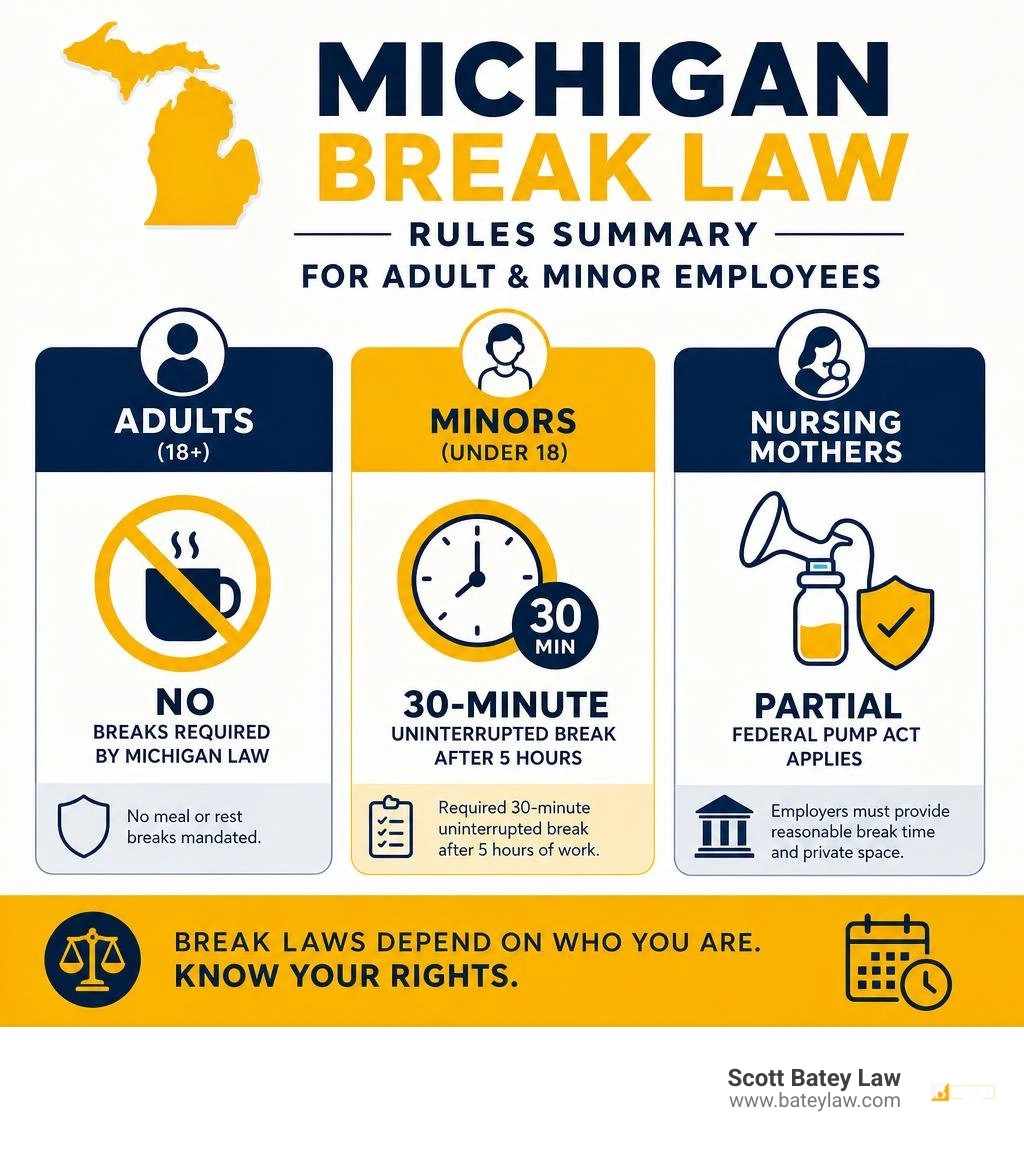
| Employee Type | Break Required by Michigan Law? | Details |
|---|---|---|
| Adults (18+) | No | No meal or rest breaks mandated |
| Minors (under 18) | Yes | 30-minute uninterrupted break after 5 hours |
| Nursing mothers | Partial | Federal PUMP Act applies |
Michigan does not require employers to give adult workers any breaks at all — not a 15-minute rest, not a lunch break, nothing. Most people assume there is some rule protecting their right to step away from work. There isn't, at least not at the state level.
That gap between what workers expect and what the law actually guarantees is where real problems can start.
When employers do provide breaks, different rules kick in. When minors are involved, strict requirements apply. And when an employer mishandles any of it, the consequences can include back wages and civil penalties.
I'm Scott Batey, a Michigan employment lawyer with nearly three decades of experience representing workers in wage disputes, wrongful termination, and other cases where employers cross the line — including situations where questions about are 15 minute breaks required by law in Michigan lead to broader violations. If you believe your employer has shortchanged you on pay or mishandled your breaks, understanding the law is the first step.
Are 15 Minute Breaks Required by Law in Michigan for Adults?
When you are deep in a long, exhausting shift, a brief rest can feel like a basic human right. However, under Michigan state law, adult employees (ages 18 and older) are not legally entitled to any rest breaks or meal periods whatsoever. Whether you work a 4-hour shift or a grueling 12-hour day, your employer is under no state obligation to let you step away.
This surprise often stems from Michigan's status as an at-will employment state, where employers hold broad discretion over workplace conditions, schedules, and policies. Unless you are covered by a specific union collective bargaining agreement or an individual employment contract that guarantees break times, your employer decides if, when, and for how long you can rest.
To find any historical context for Michigan's workday limits, we have to look back more than a century. Under the Legal Day's Work Act 137 of 1885, the state established that 10 hours constitutes a legal workday in specific industries like factories, workshops, and mines. While this ancient statute sets a framework for maximum standard working hours, it completely omits any mention of mandatory rest periods or meal breaks.
If you are an adult working in Michigan, state law leaves the concept of the "coffee break" entirely up to your employer's goodwill.
Federal FLSA vs. Michigan State Law on Rest and Meal Breaks
Because Michigan state law is completely silent on adult breaks, we have to look to federal standards to understand how workplace rest is regulated. The Federal Fair Labor Standards Act (FLSA) is the primary law governing wages and hours across the United States.
Like Michigan, the FLSA does not force employers to offer rest or meal breaks. However, the FLSA does dictate how those breaks must be treated financially if an employer chooses to provide them.

Here is how federal rules and Michigan rules compare:
| Feature | Federal FLSA Rules | Michigan State Law (Adults) |
|---|---|---|
| Mandatory Rest Breaks (5-20 mins) | No | No |
| Mandatory Meal Breaks (30+ mins) | No | No |
| Must Short Breaks Be Paid? | Yes, if offered | N/A (follows federal rule) |
| Must Meal Breaks Be Paid? | No, if fully relieved of duty | N/A (follows federal rule) |
| Mandatory Breaks for Minors | No | Yes (30 mins after 5 hours) |
How Federal Rules Apply When Are 15 Minute Breaks Required by Law in Michigan
So, how do federal rules apply when we look at the core question: are 15 minute breaks required by law in Michigan?
While the law does not force an employer to give you a 15-minute break, federal law states that if your employer does offer short rest periods (typically lasting anywhere from 5 to 20 minutes), these breaks must be paid.
Federal regulators view these short rests as beneficial to the employer because they re-energize workers, helping them maintain productivity. Therefore, your employer cannot require you to clock out for a quick 10- or 15-minute breather. If they dock your pay for a short break, they are violating the FLSA.
Unpaid Meal Breaks and the 30-Minute Rule
Meal breaks are treated differently. Under federal rules, a meal period typically lasts 30 minutes or longer and does not need to be paid, provided the employee is completely relieved of all duties.
To be considered "off duty" and unpaid during a meal break:
- You must not be required to perform any active work.
- You should not be forced to monitor machines, answer phones, or remain at your desk to greet customers.
- You must be free to leave your workstation or even the premises if you choose.
If your employer requires you to eat your lunch at your desk while keeping an eye on your email, you are not legally on a break. You are working, and every minute of that time must be paid.
Michigan Break Requirements for Minor Employees Under 18
While adults are left without state-mandated breaks, Michigan takes a completely different approach when it comes to youth employment. Under the Michigan Youth Employment Standards Act (YESA), minor workers receive strict legal protections to ensure their health and safety on the job.

If you employ or are a worker under the age of 18 in Michigan, these are the mandatory rules:
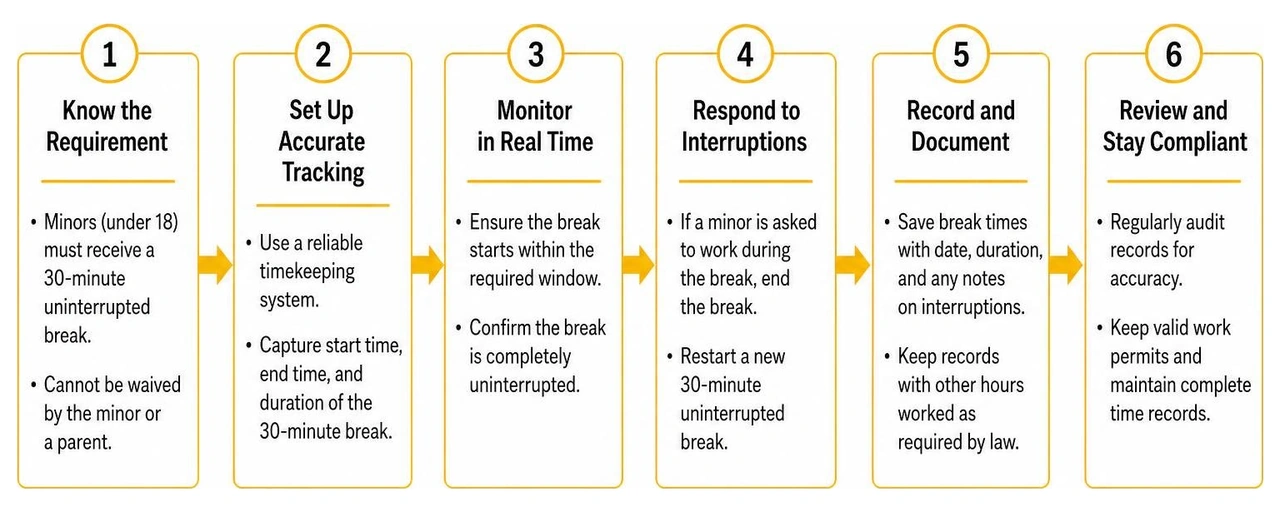
- The 5-Hour Rule: Minors cannot work more than 5 continuous hours without a documented break.
- The 30-Minute Mandate: The break must be at least 30 uninterrupted minutes.
- Timing: The break must be provided before the minor crosses the 5-hour work threshold.
- Documentation: Employers must carefully record the start and end times of these breaks on the minor's time card.
Strict Compliance and Why Are 15 Minute Breaks Required by Law in Michigan for Minors
For minor employees, a simple 15-minute rest break is not legally sufficient to satisfy the state's requirements. If a minor is scheduled for a 6-hour shift, giving them two 15-minute breaks does not count. They must receive a single, continuous, 30-minute block of rest.
Furthermore, this break must be entirely uninterrupted. If a manager asks a 16-year-old cashier to step back to the register to help clear a long line 20 minutes into their lunch break, the legal clock resets. The employer must restart the 30-minute break from scratch or pay the minor for the interrupted time, ensuring they receive their full, continuous rest before working another stretch.
Employers must also ensure minors have valid work permits and maintain impeccable time records to prove these 30-minute breaks are happening.
Special Protections: Lactation Breaks and ADA Accommodations
Beyond standard rest and meal breaks, both federal and state laws provide specific, mandatory protections for employees who require specialized accommodations.
The federal Providing Urgent Maternal Protections for Nursing Mothers (PUMP) Act requires employers to provide reasonable break times for nursing mothers to express breast milk. These protections apply for up to one year after the child's birth.
Key details of these protections include:
- Private Space: Employers must provide a private space that is shielded from view and free from intrusion.
- No Bathrooms: A restroom — even a private one — does not satisfy this legal requirement. The space must be a functional room with a chair, a flat surface, and an electrical outlet.
- Compensation: While these breaks do not have to be paid if the employee is completely relieved of duty, if a nursing mother continues to work or answer emails while expressing milk, she must be paid for that time.
Additionally, the Americans with Disabilities Act (ADA) may require employers to provide modified or extended break schedules as a "reasonable accommodation" for employees with qualifying medical conditions (such as diabetes, pregnancy-related complications, or mobility challenges).
If an employee requests additional short breaks to monitor blood sugar or take medication, the employer must engage in an interactive dialogue to find a workable solution rather than issuing a flat denial based on standard company policy.
Employer Compliance: Tracking, Waiving, and Penalties
Because Michigan's break laws are highly specific to the age of the employee, maintaining accurate records is vital.
Under the Payment of Wages and Fringe Benefits Act 390 of 1978, Michigan employers must keep accurate records of hours worked by all employees. For minors, these records must explicitly show that they received their mandatory 30-minute uninterrupted breaks.
Many employers ask: Can an employee waive their break?
- Adults: Yes. Because adults have no legally mandated breaks, they can work through their shifts without breaks, and employers do not violate state law.
- Minors: No. Minors cannot voluntarily waive their 30-minute breaks, and parents cannot sign waivers allowing them to skip them. The state of Michigan mandates these breaks, and employers face strict penalties if they fail to enforce them.
Violating minor labor laws can lead to severe consequences. Employers who fail to provide required breaks to minors or who falsify time cards can face misdemeanor charges, civil fines, and investigations by the Michigan Department of Labor and Economic Opportunity.
Furthermore, the legal landscape in Michigan is constantly shifting. With major legislative updates like the Earned Sick Time Act MCL 408.963 and 2025 PA 0001 reshaping how paid leave and wages are structured as we navigate 2026, keeping clean, compliant timecards is more critical for employers than ever before.
Frequently Asked Questions About Michigan Break Laws
Can an employer force me to work through my lunch break in Michigan?
If you are an adult (18 or older), yes. Because Michigan does not mandate meal breaks for adults, your employer can legally require you to work through lunch. However, if they force you to work, they must pay you for that time. If your employer automatically deducts 30 minutes from your daily pay for a "lunch break" that you were actually forced to work through, they are committing wage theft.
What happens if a minor's 30-minute break is interrupted?
If a minor's mandatory 30-minute break is interrupted by work duties, the break is invalidated. The employer must either restart the uninterrupted 30-minute clock or ensure the minor is paid for the time worked. Allowing minors to work five or more continuous hours without a full, uninterrupted 30-minute break is a direct violation of Michigan's Youth Employment Standards Act.
Are employers required to provide a break room in Michigan?
No. There is no Michigan or federal law requiring employers to provide a dedicated break room, cafeteria, or lounge area for adult employees. While many businesses choose to provide these amenities to boost employee morale and comfort, they are not legally required to do so.
Conclusion
Understanding your rights regarding workplace breaks can be confusing, especially when public perception does not match the actual laws on the books. While Michigan does not require 15-minute breaks or meal periods for adult workers, federal rules protect your right to be paid for any short breaks or working lunches your employer does provide.
If your employer has been docking your pay for breaks you weren't allowed to take, forcing you to work off the clock during your lunch, or violating minor labor laws, we are here to help.
At Scott Batey Law, based in Bingham Farms, Michigan, we have spent more than 25 years fighting for the rights of workers across Metro Detroit, including Oakland County, Southfield, Troy, and Detroit. We provide personalized, award-winning representation to help you recover unpaid wages, handle overtime violations, and stand up against unfair workplace practices.
Do not let an employer take advantage of your hard work. Contact us today to discuss your situation with a skilled Wage and Overtime Lawyer Metro Detroit.