.png)
Workplace Discrimination Lawyer in Bingham Farms, Michigan
When bias shows up at work, it can cost you promotions, pay, and peace of mind. If you’re being treated differently because of who you are or what you believe, you don’t have to put up with it. I’m Scott Batey, and I represent employees—not employers. My job is to level the playing field and hold companies accountable under Michigan and federal law.
Do I Have a Workplace Discrimination Case?
Not every rude comment or tough review is illegal. Discrimination happens when your employer takes action against you because of a protected characteristic, including:
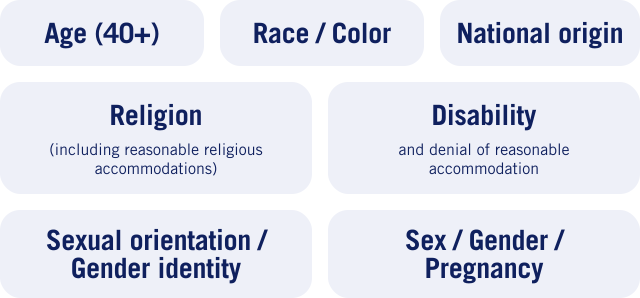
Unlawful actions include refusing to hire, disciplining without cause, terminating, denying training or promotion, pay cuts/demotions, and harassment that creates a hostile work environment. If you complained about discrimination or asked for an accommodation and were punished, that’s retaliation—which is also illegal.
Quick tip: Write down dates, names, and what was said. Save emails, texts, team chat messages, schedules, policy documents, performance reviews, and pay stubs. Evidence is how we prove what really happened.

How We Prove Retaliation
Timing & pattern
What changed after your report
Comparators
How similarly‑situated coworkers were treated
Policy deviations
Skipping steps, sudden rule changes
Pretext evidence
Shifting reasons, inconsistent documents
Paper trail
Emails, texts, HR tickets, performance history
How We Help
Evidence plan
Doctor certifications (WH‑380), emails, HR ticketing, time records, performance history, and attendance data
Agency filings
EEOC/MDCR/WHD strategy and deadlines
Negotiation & litigation
Demand letters, mediation, or filing suit
Damages focus
Back pay, front pay, compensatory damages, and attorney’s fees where statutes allow
What I Do for Wrongful Termination Clients
Fast case assessment
Timeline + documents review to identify the strongest legal theory
Evidence strategy
Preserve, collect, and organize proof (emails, chats, performance records)
Agency filings
EEOC/MDCR/WHD, where strategic
Negotiation & litigation
Demand letters, mediation, or filing suit when needed
Damages focus
Back pay, front pay, compensatory damages, possible punitive where available, and attorney’s fees where statutes allow
How I Help Employees
Fast case assessment
What happened, which laws apply, and your best next step
Evidence strategy
Preserve emails, texts, HR tickets, reviews, schedules, pay data
Agency filings
EEOC/MDCR, MIOSHA/OSHA, WHD (wage/hour), where strategic
Negotiation & litigation
Demands, mediation, or filing suit when needed
Damages focus
Back pay, front pay, compensatory damages, and fees where statutes allow
Employment Law Cases We Handle
Workplace disputes can threaten your career, your finances, and your peace of mind. Since 1996, attorney Scott Batey has represented employees across Michigan in a wide range of employment law matters — from wrongful termination to workplace discrimination and harassment. If your rights have been violated, we are here to help.


Employment Law
Full legal support for employees facing workplace disputes, from contract issues to policy violations.
Wrongful Termination
Defending workers who were unfairly fired in violation of their rights or contracts.
Workplace Discrimination
Protecting employees from bias based on race, gender, age, disability, religion, or other protected traits.
Sexual Harassment
Taking action against unwanted conduct or a hostile work environment.
FMLA & ADA
Enforcing your right to medical leave and workplace accommodations for disabilities.
Retaliation & Whistleblower
Representing those punished for reporting misconduct or asserting their legal rights.
Employment/Severance Agreements
Enforcing your right to medical leave and workplace accommodations for disabilities.

Michigan’s ELCRA (and How It Protects You)
Workplace Discrimination (ELCRA): Michigan’s Elliott–Larsen Civil Rights Act (ELCRA) prohibits discrimination in hiring, firing, pay, promotions, and the terms and conditions of employment. ELCRA works alongside federal laws (Title VII, ADA, ADEA, PDA) to give Michigan employees strong protections. Many cases are won under ELCRA because it’s tailored to Michigan and has robust remedies.
Religious Accommodation (Michigan)
Employers must provide a reasonable religious accommodation unless it causes undue hardship. Examples include schedule changes for religious observance, dress/grooming accommodations, and assignment changes that don’t burden operations.
LGBTQ+ Discrimination (Michigan)
In Michigan, discrimination based on sexual orientation or gender identity is illegal. If you’ve been misgendered, denied facilities, disciplined for transitioning, or edged out of opportunities because of who you are, you may have a claim.
Disability & Accommodation (ADA / PWDCRA)
If you have a disability, your employer must engage in the interactive process and provide reasonable accommodations that allow you to do the essential functions of your job. Denials, delays, or retaliation after you ask for help may violate the law.
Age Discrimination
Age bias shows up in “restructurings,” sudden performance nitpicking, or passing over workers 40+ for younger (and often less qualified) employees. The law forbids stereotyping older workers as “not tech savvy,” “too expensive,” or “near retirement.”
Local Focus, Real Access
Batey Law serves Bingham Farms and surrounding communities—Birmingham, Beverly Hills, Southfield, Royal Oak, Farmington Hills, Oak Park, Troy, Ferndale, Berkley, Madison Heights—and employees across Michigan. If you’re searching for: workplace discrimination lawyer, Bingham Farms MI, workplace discrimination attorney Birmingham MI, age discrimination attorney Birmingham MI, religious accommodation Michigan lawyer, LGBTQ+ discrimination Michigan…you’re in the right place. We’re local, responsive, and focused on employee rights.
How we build a winning case
Case Assessment
Timeline + document review to identify the strongest legal theories (ELCRA/Title VII/ADA/ADEA/PWDCRA).
Evidence Strategy
Preserve and organize emails, chats, write‑ups, metrics, schedules, comparators, and witness accounts.
Agency Filings
Personalized attention, clear communication, and strategies tailored to your goals.
Negotiation & Litigation
Demand letters, mediation, or filing suit—moving with purpose toward results.
Damages Focus
Back pay, front pay, compensatory damages, and attorney’s fees where statutes allow.
How We Help
Fast assessment
We identify the strongest legal theories and risks.
Evidence strategy
Preserve and organize messages, recordings where lawful, performance records, comparators, and witness accounts.
Agency Filings
We handle EEOC/MDCR strategy and deadlines.
Demand, negotiate, or sue
We push for corrective action and compensation; we litigate when necessary.
Damages Focus
Back pay, front pay, emotional distress, and attorney’s fees where statutes allow.
Free Consultation—Confidential & Straightforward
Call (248) 540‑6800 or email sbatey@bateylaw.com. Tell us what happened. We’ll explain your options, next steps, and how to stay safe at work.
Office: Batey Law Firm, PLLC 30200 Telegraph Rd., Suite 400, Bingham Farms, MI 48025
your legal questions
The Americans with Disabilities Act (ADA) is a federal law that protects qualified employees with disabilities from discrimination in the workplace. Michigan has its own state law, the Persons with Disabilities Civil Rights Act (PWDCRA), which provides similar protections. While the two laws overlap in many ways, they are not identical. Some of the key differences include: The ADA is a federal law, while the PWDCRA is specific to Michigan. The definition of a disability and how courts interpret it can differ between the two laws. Filing requirements, legal procedures, and available remedies may vary depending on which law applies. In many cases, employees may have claims under both statutes at the same time. Both laws generally prohibit disability discrimination, require employers to consider reasonable accommodations, and forbid retaliation against employees who assert their rights.
Yes. Many employees are surprised to learn that severance agreements are often negotiable. Employers may present a severance agreement as a "take it or leave it" offer, but that does not necessarily mean the terms are fixed. Depending on the circumstances, employees may be able to negotiate: Additional severance pay Continued benefits Positive references Neutral employment verification Extended deadlines Changes to restrictive covenants Confidentiality provisions Before signing away potential legal claims, it is usually wise to have an employment attorney review the agreement. Once signed, your ability to challenge the terms may be limited.
If you believe your termination was unlawful, preserving evidence should be one of your first priorities. Save: Termination letters Emails and text messages Performance reviews Pay records Employee handbooks Severance documents HR complaints Calendars and meeting notes Names of potential witnesses If possible, create a timeline while events are still fresh in your mind.
The more information you bring, the more productive your consultation will be. Helpful documents include: Termination or disciplinary notices Employment contracts Severance agreements Employee handbooks Performance evaluations Emails and text messages Pay stubs or compensation records Written complaints to HR or management Notes or timelines you created about workplace events Don't worry if you don't have everything. Bring what you have and be prepared to explain what happened, when it happened, and who was involved.
Hostile work environment cases are often won through documentation rather than dramatic "smoking gun" evidence. Start by keeping a timeline of what happened, including dates, locations, witnesses, and exactly what was said or done. Save emails, text messages, performance reviews, chat messages, and any written complaints you made to management or Human Resources. Witnesses can also be important. Coworkers who observed the conduct may help corroborate your account.
In Michigan, a hostile work environment becomes illegal when the harassment is based on a protected characteristic such as race, sex, age, religion, disability, national origin, marital status, or another protected category, and the conduct is severe or pervasive enough to interfere with your ability to do your job. Examples may include repeated racial slurs, sexual comments, unwanted touching, offensive jokes, or other discriminatory conduct that creates an intimidating or abusive workplace. The key question is whether the behavior goes beyond ordinary workplace conflict and crosses the line into unlawful discrimination. If you're unsure, speaking with an experienced employment attorney can help you understand whether your situation may qualify for legal protection.
Michigan law—again through ELCRA—makes it illegal for employers to treat you differently because of your religion. That includes: Refusing to hire or promote you Disciplining or firing you Harassing you because of your beliefs But it goes a step further. Employers also have a duty to reasonably accommodate religious practices, unless doing so would create an undue hardship. Examples of accommodations: Flexible scheduling for religious observances Dress code exceptions (like head coverings) Time for prayer The standard here is similar to disability accommodations: the employer must make a good-faith effort to work with you.
In most cases, no—“100% healed” policies are not legal. A “100% healed” policy means an employer won’t let you return to work unless you’re fully recovered, with no restrictions. The problem is, that directly conflicts with disability laws like the ADA. Why? Because the law requires employers to consider whether you can return to work with reasonable accommodations. A blanket rule that says “don’t come back until you’re perfect” skips that analysis entirely—and that’s where it becomes unlawful.
Not every difficult job qualifies—but there are red flags that should make you pause. Watch for patterns like: Sudden, unfair discipline after you complain about something illegal Demotions, pay cuts, or schedule changes that don’t make sense Being excluded, isolated, or set up to fail Ongoing harassment that management ignores Pressure to resign, especially after raising concerns Timing matters. If things go downhill right after you report discrimination, request medical leave, or assert your rights, that’s often a sign something isn’t right.
You don’t need a “smoking gun,” but you do need credible, consistent evidence. Strong evidence often includes: Your own detailed timeline of events Emails, texts, or messages Witnesses who saw or heard the behavior Prior complaints (yours or others’) Any documentation showing the employer knew about the issue One thing I tell clients all the time: cases are often won or lost on documentation and consistency. The more clearly you can show what happened, when it happened, and how your employer responded, the stronger your case becomes.
No—retaliation is illegal. That said, it still happens. Employers sometimes try to disguise retaliation as “performance issues” or other reasons. But if you report harassment and then suddenly: You’re written up for the first time Your hours change You’re demoted or fired —that timing matters. The law protects you for speaking up in good faith, even if the underlying claim is ultimately disputed. If your employer punishes you for reporting harassment, that can be a separate legal claim on its own.
If your employer knows about the harassment and does nothing—or does something half-hearted that doesn’t stop it—that’s a serious problem. At that point, you should: Document everything (dates, what happened, who you reported to, and their response) Follow up in writing if possible Consider speaking with an employment attorney sooner rather than later The law doesn’t expect you to tolerate ongoing harassment while your employer drags its feet. If they fail to act, they can be held legally responsible for allowing that behavior to continue.
In many cases, yes—or at least it’s strongly recommended. Employers are generally given a chance to fix the problem internally before they’re held legally responsible. That usually means reporting the harassment to HR, a supervisor, or following whatever complaint procedure your company has in place. Now, there are exceptions. If the person harassing you is the owner, or reporting would clearly be pointless or unsafe, the situation may be different. But as a general rule, reporting creates a paper trail. It shows you gave the employer an opportunity to do the right thing—and that matters later if legal action becomes necessary.
The short answer: sooner than you think. You don’t have to wait until you’ve been fired or things have completely fallen apart. In fact, getting advice early can often prevent a bad situation from getting worse. You should consider reaching out if: Something at work feels legally “off” and you’re not sure why You’ve been disciplined, demoted, or treated differently after speaking up You’re being asked to sign a severance or separation agreement You’re dealing with ongoing harassment or discrimination You’ve been terminated and suspect it wasn’t for a legitimate reason There are also strict deadlines for many employment claims, so waiting too long can limit your options. Even a quick consultation can give you clarity—and help you make informed decisions about what to do next.
No—and this is a big misconception that stops people from getting help early. You don’t need a perfectly organized file of evidence before reaching out to an employment lawyer. In fact, part of an attorney’s job is to help you figure out what evidence matters and how to get it. You may already have more than you think—emails, texts, performance reviews, or even just a clear timeline of what happened. What’s most helpful is your story: what changed, when it changed, and why you believe it happened. From there, a good employment lawyer can spot legal issues, identify missing pieces, and guide you on what to document moving forward.
If you’re dealing with harassment, the most important thing is to take it seriously early on. Many people try to ignore it or hope it will stop—but that often makes things harder down the line. Here are practical steps you can take: Document everything – dates, times, what was said or done, and any witnesses Review your company’s policies – follow any reporting procedures outlined Report the behavior to HR or management (in writing if possible) Save evidence – emails, texts, or anything else that supports your claim The law doesn’t require a perfect response—but it does help if you’ve given your employer a chance to address the issue. And if the harassment continues or you’re punished for reporting it, that may strengthen your legal claim.
Discrimination isn’t always obvious—and it rarely comes with a clear admission. More often, it shows up in patterns and subtle differences in how people are treated. Some warning signs include: You’re treated differently than coworkers in similar roles You’re passed over for promotions despite being qualified You receive harsher discipline than others for the same conduct Comments or behavior tied to your race, gender, age, religion, or disability Sudden negative treatment after disclosing a medical condition or pregnancy One of the most important concepts is comparison—how you’re treated versus how others are treated. If something feels off, it’s worth taking a closer look. Trust your instincts, but back them up with facts and documentation whenever possible.
In most cases, you have three years from the discriminatory act to file an ELCRA lawsuit in court. This is longer than many federal deadlines, but waiting is risky. Evidence disappears, witnesses move on, and employers often build their defense early. If you think discrimination may be happening, timing matters.
Usually, yes—but how and when matters. If your employer has a complaint process, you are generally expected to: Report the discrimination or harassment Give the employer a reasonable chance to fix it That said, how you complain is critical. Poorly documented or emotional complaints can later be used against you. In many cases, it’s smart to get legal guidance before making a formal complaint—especially if you fear retaliation.
Yes—harassment is part of discrimination under ELCRA. Workplace harassment becomes illegal when: It’s based on a protected characteristic and It is severe or pervasive enough to affect your ability to do your job This includes sexual harassment, racial slurs, repeated offensive jokes, or ongoing hostility. One isolated comment usually isn’t enough—but a pattern of behavior often is.
Discrimination is illegal under ELCRA when an employer treats you worse because of a protected characteristic—not just because they don’t like you or think you’re a bad fit. Examples include: Being fired shortly after disclosing a pregnancy Being passed over for promotion because of age Being disciplined more harshly than coworkers outside your protected group Hostile or degrading comments tied to race, sex, religion, or sexual orientation A bad boss isn’t illegal by itself. A bad boss who targets you because of who you are may be.
ELCRA stands for the Elliott-Larsen Civil Rights Act, Michigan’s main workplace discrimination law. It protects employees (and job applicants) from discrimination based on: Race or color Religion Sex (including pregnancy, sexual orientation, and gender identity) Age Height or weight National origin Marital status If you work in Michigan, ELCRA likely applies to you—whether you’re hourly, salaried, union, or management. It applies to most employers with one or more employees, which is broader than many federal laws.
It depends on the legal theory, but many Michigan wrongful termination claims must be filed within three years of the termination. However: Some claims have shorter deadlines Waiting too long can seriously weaken your case Employers often begin building their defense immediately Because deadlines and strategy vary by claim type, it’s best to evaluate potential claims as soon as possible, even if you’re unsure whether what happened was illegal.
Wrongful termination cases are built on patterns, documentation, and comparisons, not just what was said at termination. Key evidence often includes: Emails, texts, and written complaints Performance reviews (especially positive ones before termination) Timing of complaints, leave, or accommodation requests Treatment of similarly situated coworkers Sudden policy changes or shifting explanations Even small details—like calendar entries or internal messages—can make or break a case.
Absolutely. Timing is often one of the most important pieces of evidence in a wrongful termination case. Courts closely examine: Firings shortly after discrimination complaints Terminations following FMLA or medical leave Discipline that appears only after protected activity Sudden policy enforcement that wasn’t applied before The closer the termination is to the protected activity, the stronger the inference that retaliation may have played a role—especially if the employer’s explanation feels rushed or inconsistent.
Yes—constructive discharge can count as wrongful termination, even if you technically resigned. Constructive discharge occurs when: Working conditions become so intolerable that a reasonable person would feel forced to quit The employer intentionally creates or allows those conditions The conditions are tied to discrimination, retaliation, or protected activity Examples include extreme harassment, deliberate isolation, demotions with no legitimate reason, or forcing impossible job requirements. Courts treat these cases as terminations—not voluntary quits—when the facts support it.
No. An employer cannot legally fire you for requesting a reasonable accommodation for a disability. You are protected when you: Ask for modified duties, scheduling changes, or medical equipment Provide medical documentation when requested Participate in the interactive accommodation process An employer may deny an accommodation if it causes undue hardship—but terminating you for asking is unlawful. If discipline or termination follows soon after an accommodation request, that timing often raises a retaliation or discrimination issue.
No. That is classic retaliation, and it is illegal. You are protected when you: Report discrimination or harassment internally Participate in an investigation Oppose unlawful conduct in good faith Importantly, your complaint does not have to be correct—it just has to be made honestly. If termination follows shortly after a complaint, courts often infer retaliation unless the employer can prove a legitimate, well-documented reason.
Keep it simple. Michigan and federal law (ELCRA + Title VII) require employers to reasonably accommodate sincere religious beliefs unless doing so causes “undue hardship.” You can support your request with: A short written explanation of the religious practice/holiday, The dates you need off or the accommodation requested, A note from a clergy member only if you choose—it’s not required. The key is clarity, not proving the legitimacy of your faith.
Yes. Michigan is an at-will employment state, so you can be fired at any time, with or without cause or warning, unless: You have an employment contract or union agreement. You're protected by civil rights laws, FMLA, ADA, or other legal protections. The termination violates public policy, like firing a whistleblower or someone who filed a safety complaint. However, many companies follow their own progressive discipline policies—if your employer promised written warnings or has a handbook that requires it, that may be enforceable. If you were fired without a warning and suspect discrimination or retaliation, you may still have a wrongful termination case.
We look at evidence. If “personality” only becomes a problem after you disclose a disability, return from leave, or report bias, that’s a red flag we investigate.
No. Requesting a lawful accommodation is protected. Retaliation for asking can be its own claim.
Usually it helps to report issues using the policy or to HR. If you fear retaliation or already tried and nothing changed, we’ll discuss strategic options, including external filings.
Decisions or harassment driven by a protected characteristic (age, race, religion, sex/pregnancy, sexual orientation/gender identity, disability, national origin). Look for patterns: who gets opportunities, who gets disciplined, and what changed after you complained or requested an accommodation.
Need Legal Help With a Workplace Issue?
Get clear answers and a plan to protect your rights — starting with a free, confidential consultation.
Suite 400
Bingham Farms, MI 48025
United States