.png)
At-Will Employment 101: Your Guide to the Ultimate Legal 'It's Not You, It's Me'

What the At-Will Doctrine Actually Means for Your Job
The at will doctrine is the legal rule that governs most employment relationships in the United States — and it's more powerful than most workers realize.
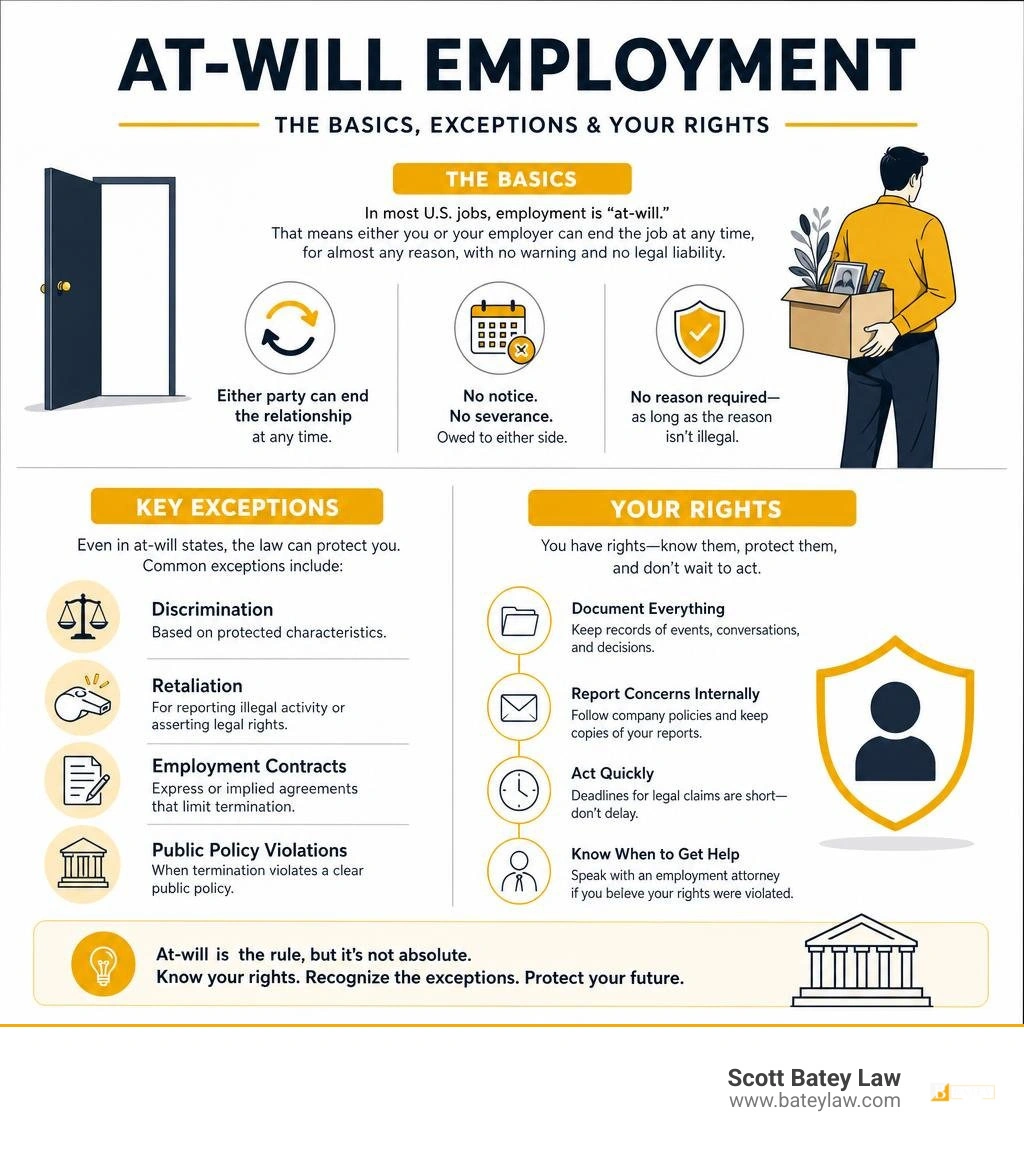
Quick answer: At-will employment means either you or your employer can end the job at any time, for almost any reason, with no warning and no legal liability. That's the default rule in 49 out of 50 states.
Here's what that looks like in practice:
- Your employer can fire you tomorrow with no explanation and no severance — and owe you nothing
- You can quit tomorrow with no notice — and owe your employer nothing
- No reason is required — as long as the reason isn't illegal
That last part matters a lot. The at-will rule has real limits. Federal and state laws, employment contracts, and court-created exceptions can all protect you — even in an at-will state like Michigan.
But here's the catch: most employees don't know where those limits are. And when a termination crosses the line, the window to act is short.
I'm Scott Batey, a Michigan employment lawyer with nearly three decades of experience representing workers in wrongful termination, discrimination, retaliation, and whistleblower cases — including many that turn on exactly where the at will doctrine ends and an employee's legal rights begin. Understanding that line is often the difference between walking away and having a real case.
What is the At Will Doctrine and How Does It Define US Employment?
When you take a job in Oakland County, Detroit, or anywhere else in Michigan, you rarely sign a document that says, "I agree to be an at-will employee." Yet, the law automatically assumes you are one.
According to the employment-at-will doctrine overview, this principle serves as the default standard for employment relationships across the United States. Under this bilateral framework, either party can sever the relationship at any time. If your boss wakes up and decides they no longer like the color of your shoes, they can legally fire you on the spot. Conversely, if you decide you would rather spend your afternoons fishing in the Detroit River than sitting in a cubicle, you can walk out the door without giving a single day's notice.
The United States is unique in this regard. We are one of only a handful of countries where employment is predominantly at-will. In most industrialized nations throughout the world, employers must establish "just cause" or provide a legally mandated notice period before dismissing an employee. In those countries, a sudden, explanation-free termination is highly illegal. In the U.S., however, the at will doctrine reigns supreme as the baseline of the modern labor market.
The Historical Origins of the At Will Doctrine
How did we end up with a system that favors such sudden employment breakups? The story is rooted in the rapid industrialization of the late 19th century.
For centuries, English common law followed "Blackstone's rule," which assumed that if an employment relationship didn't specify a duration, it was meant to last for one full year. This rule made sense in agrarian societies where crops took a year to grow and harvest.
However, as factories sprouted and railroad tracks spanned the continent, American industrialists wanted more flexibility. In 1877, a legal scholar named Horace G. Wood published a treatise that completely flipped the script. Wood declared that an indefinite hiring was presumed to be an "at-will" partnership that could be dissolved by either party at any moment.
As detailed in the academic paper Anti-Republican Origins of the At-Will Doctrine, this sudden shift occurred right on the heels of the Reconstruction era. While Radical Republicans had fought to elevate worker autonomy and place newly freed workers on an equal footing with employers, the rise of the at will doctrine acted as a counter-movement. Promoted heavily by powerful railroad interests, the doctrine was adopted rapidly by conservative courts during the Gilded Age, effectively cementing employer dominance over the working class.
At-Will vs. Just-Cause Employment
To truly understand how the at will doctrine shapes your daily working life, it helps to contrast it directly with its counterpart: just-cause employment.
| Feature | At-Will Employment | Just-Cause Employment |
|---|---|---|
| Default Legal Presumption | Yes (in 49 states, including Michigan) | No (except in Montana or via specific contracts) |
| Reason for Termination | Any legal reason, bad reason, or no reason at all | Must be a fair, objective, and legally defensible reason |
| Notice Requirement | None required by law | Often requires progressive discipline or formal notice |
| Bargaining Power | Heavily favors the employer | More balanced; protects employee job security |
While at-will is the default, a significant portion of the American workforce does not actually operate under pure at-will conditions. In fact, as of July 2026, roughly 34% of all U.S. employees enjoy some form of "just cause" or objectively reasonable requirement for termination. This protected group includes:
- 16% of the workforce who enjoy civil service protections as public-sector employees (such as municipal workers in Southfield, Royal Oak, or Farmington Hills)
- 7.5% of unionized private-sector workers and 0.8% of nonunion private-sector workers protected by collective bargaining agreements
- 15% of nonunion private-sector workers who have negotiated individual express contracts that explicitly override the at-will presumption
For the remaining 66% of workers, however, the at-will rule remains the law of the land.
The Three Major Common-Law Exceptions to At-Will Employment
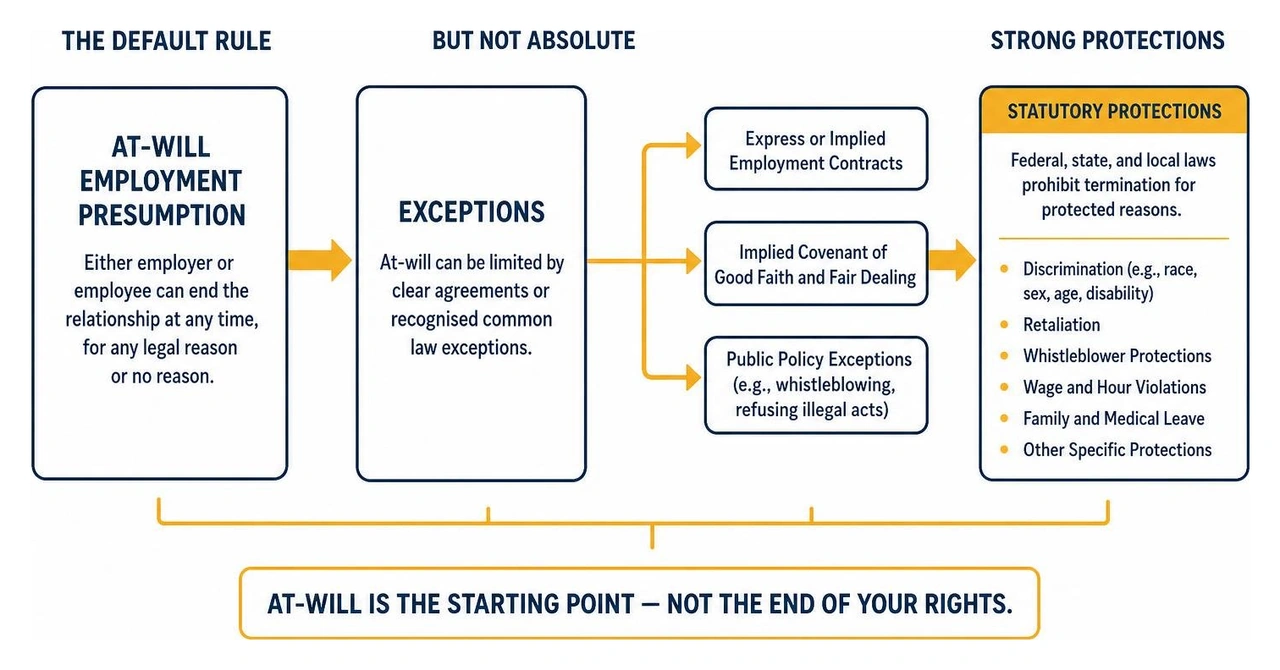
Because a pure, unchecked at-will rule can lead to incredibly harsh and unfair results, state courts over the last several decades have carved out legal exceptions. These exceptions act as safety valves, preventing employers from using the at-will shield to cover up egregious misconduct.
According to the At-Will Employment Overview compiled by the National Conference of State Legislatures, these common-law exceptions fall into three major categories. However, these exceptions are not applied equally nationwide; state courts have adopted them in widely varying degrees.
The Public Policy Exception
The public policy exception is the most widely recognized limitation on the at will doctrine. Under this rule, an employer cannot fire you for reasons that violate a well-established public policy of the state.
Generally, courts group public policy claims into four main categories. You cannot be terminated for:
- Refusing to perform an illegal act (such as refusing to commit perjury or falsify environmental records)
- Reporting illegal activity or whistleblowing (such as reporting safety hazards to OSHA or financial fraud to state authorities)
- Exercising a statutory right (such as filing a workers' compensation claim after an on-the-job injury)
- Performing a public duty (such as missing work to serve on a jury or responding to a court subpoena)
In Michigan, our courts strongly support this exception. If you are fired for refusing to break the law or for filing a workers' comp claim, you can bring a wrongful discharge lawsuit. You can learn more about how our state handles these situations in our detailed guide on At-Will Exceptions in Michigan: When a Firing Crosses the Line.
The Implied Contract Exception to the At Will Doctrine
Can an employer accidentally give up their at-will rights? Yes. The implied contract exception applies when an employer’s actions, oral promises, or written policies create a reasonable expectation of job security.
For example, if a hiring manager in Troy or Birmingham tells you during your interview, "As long as you hit your sales quotas, you'll have a job here for life," or if the company handbook outlines a mandatory progressive discipline policy (e.g., verbal warning, then written warning, then suspension, then termination), a court may find that an implied contract was formed. In such cases, the employer can no longer fire you at-will; they must follow the procedures they established.
Nationwide, implied contracts of employment are recognized in 41 states and the District of Columbia. Michigan is one of those states, meaning that careless language in employee manuals or verbal promises made by supervisors can legally bind an employer. To understand how these claims are evaluated locally, read our breakdown of At-Will Employment Exceptions in Michigan.
The Implied Covenant of Good Faith and Fair Dealing
This is the rarest and most employee-friendly exception. It reads an implied promise of honest, fair dealing into every employment relationship. Under this exception, an employer cannot terminate an employee in "bad faith" to deprive them of the benefits of their labor.
A classic example involves commission-based sales. If a salesperson in Detroit lands a massive, multi-million-dollar contract that is set to pay out a life-changing commission next month, and the employer fires them the very next day simply to avoid paying that commission, it violates the implied covenant of good faith and fair dealing.
While this exception is incredibly powerful, it is only recognized by a small minority of states (approximately 11, mostly in the West). Michigan does not recognize the implied covenant of good faith and fair dealing in employment relationships. Our courts maintain that if you are an at-will employee, your employer does not need to act in good faith when ending your employment. However, as we explain in Fired Without Warning in Michigan: What At-Will Really Means and Doesn't, you may still have other legal avenues if the termination was motivated by discrimination or retaliation.
State-by-State Variations and the Montana Exception
Because employment law is heavily governed by state courts and legislatures, the strength of your job security depends almost entirely on your zip code.
As documented on the At-will employment on Wikipedia page, the legal landscape is a patchwork:
- 6 states (Alaska, California, Idaho, Nevada, Utah, and Wyoming) recognize all three common-law exceptions.
- 41 states and D.C. recognize the implied contract exception.
- 43 states recognize the public policy exception.
- 4 states recognize none of the three common-law exceptions: Florida, Georgia, Louisiana, and Rhode Island. In these states, if you do not have an explicit written contract or a union backing you, your employer’s at-will power is virtually absolute under state common law.
Montana’s Wrongful Discharge from Employment Act (WDEA)
There is one massive, historic exception to the entire American system: Montana.
Montana is the only state in the country to have completely eliminated the pure at-will rule by statute. In 1987, the state passed the Wrongful Discharge from Employment Act (WDEA). Under this law:
- Employment is only at-will during an initial, designated probationary period (which defaults to 180 days if not specified).
- Once the probationary period is over, an employer must have "good cause" to terminate an employee.
- "Good cause" is defined as a reasonable, job-related ground for dismissal, such as failure to satisfactorily perform job duties, disruption of operations, or legitimate economic business reasons.
If a Montana employer wrongfully discharges a worker, the law limits the employee's damages to up to four years of lost wages and fringe benefits, keeping the system predictable for businesses while offering unmatched job security to workers.
Statutory Protections and Employer Best Practices
While common-law exceptions are created by judges, statutory exceptions are written directly into law by federal and state legislatures. These statutes act as absolute boundaries that no employer — no matter how powerful — can cross.
Even if you are a "pure" at-will employee, federal and state laws make it strictly illegal to fire you based on:
- Protected Characteristics: Title VII of the Civil Rights Act, the Americans with Disabilities Act (ADA), and Michigan's Elliott-Larsen Civil Rights Act prohibit termination based on race, color, religion, sex, national origin, age, disability, height, weight, or marital status.
- Protected Leave: The Family and Medical Leave Act (FMLA) protects your job if you need to take time off for a serious medical condition or to care for a family member.
- Retaliation & Whistleblowing: Approximately 17 states (including Michigan) have enacted specific whistleblower statutes protecting private-sector employees who report employer wrongdoing. Federal laws also protect workers who report wage theft, safety violations, or discrimination.
For a deeper look at how these state and federal protections shield local workers, check out our article: At-Will But Not Lawless: Michigan Exceptions Every Employee Should Know.
How Employers Protect Themselves with Disclaimers
Because a single misplaced sentence in an employee handbook or a casual promise by a supervisor can spark an expensive "implied contract" lawsuit, modern businesses go to great lengths to protect their at-will status.
To shield themselves, employers use several best practices:
- Conspicuous Disclaimers: They place bold, clear disclaimers on job applications and on the very first page of employee handbooks. These disclaimers explicitly state: "Nothing in this handbook creates a contract of employment, and your employment remains strictly at-will."
- Acknowledgment Forms: They require employees to sign a separate form acknowledging that they have read the handbook and understand that their employment is at-will.
- Restricting Authority: They include clauses stating that the at-will nature of the employment can only be modified through a formal, written contract signed directly by the company’s President or CEO.
If you signed one of these disclaimers, it becomes much more difficult to argue that you had an implied contract. However, as we discuss in Can I Sue for Being Fired Without Warning?, an employer's handbook disclaimer cannot save them if they fired you for an illegal, discriminatory, or retaliatory reason.
Frequently Asked Questions about At-Will Employment
Can I be fired without warning under the at-will doctrine?
Yes. Under the baseline at will doctrine, your employer has no legal obligation to give you a two-week notice, a warning, or a performance improvement plan (PIP). They can simply walk you to the door at 4:55 PM on a Friday. However, if the sudden termination was actually a cover-up for discrimination, or if it violated an established company policy that promised progressive discipline, you may have grounds for a legal claim.
What is the difference between wrongful termination and at-will firing?
An at-will firing is legal; a wrongful termination is illegal.
- At-Will Firing: You are let go because business is slow, your boss wants to hire their nephew, or they simply don't think you are a good "cultural fit." These reasons may feel unfair, but they are entirely legal.
- Wrongful Termination: You are fired because you rejected a supervisor's sexual advances, filed a workers' compensation claim, reported financial fraud to the police, or because of your race, age, or religion. These reasons violate state or federal statutes, or established public policy.
How do union contracts affect at-will status?
Union contracts (known as Collective Bargaining Agreements, or CBAs) completely displace the at will doctrine. If you are a union member, your employment relationship is governed by the contract your union negotiated. These contracts almost always contain a "just cause" provision, meaning your employer must prove they have a fair, documented reason to discipline or fire you, and you have access to a formal grievance process to fight the decision.
Conclusion
The at will doctrine is the foundation of the American workplace, but it is far from an absolute license for employers to abuse their staff. While employers hold a massive amount of bargaining power under this system, federal statutes, Michigan state laws, and common-law exceptions provide vital shields to protect you from bad-faith, discriminatory, and retaliatory actions.
If you work in Bingham Farms, Troy, Southfield, Royal Oak, or anywhere across Oakland County and Metro Detroit, and you believe your termination crossed the line from "unfair" to "illegal," you don't have to navigate these complex laws alone. At Scott Batey Law, we bring nearly 30 years of award-winning, personalized representation to workers fighting wrongful termination, discrimination, and retaliation.
Contact us today to discuss your situation, or read our comprehensive guide on At-Will Employment Exceptions in Michigan to learn more about your rights under the law.