.png)
Attorney for Wrongfully Fired Workers: Your Guide to Legal Help

When You've Been Wrongfully Fired: What You Need to Know First
If you're looking for an attorney for wrongfully fired workers in Michigan, here's the short answer: you may have a legal claim even if your employer says you were an "at-will" employee — and you should speak with an employment lawyer as soon as possible.
Quick answers to common questions:
| Question | Short Answer |
|---|---|
| Is at-will firing always legal? | No. Employers cannot fire you for illegal reasons, even in at-will states. |
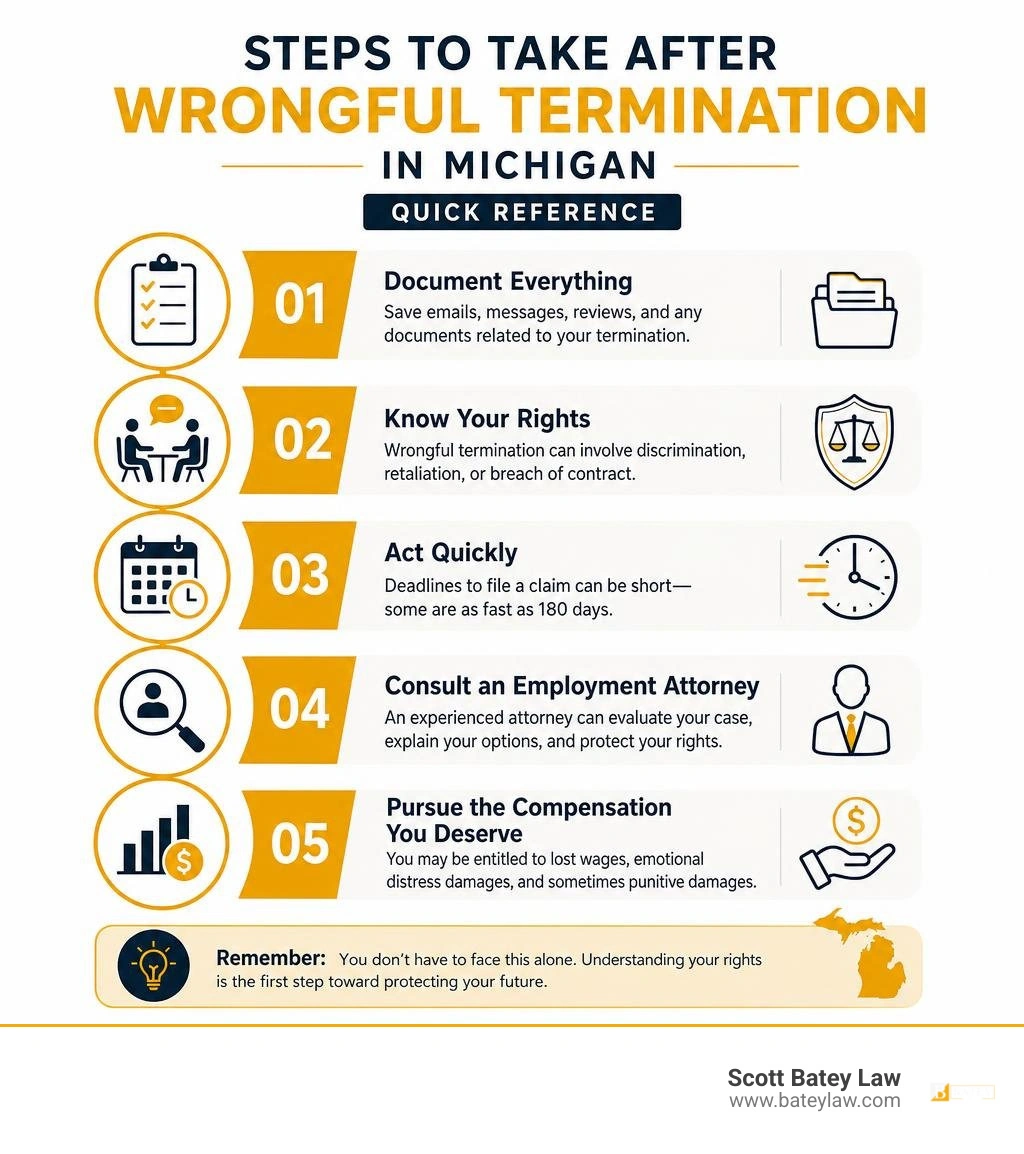
| What counts as wrongful termination? | Firing based on discrimination, retaliation, or breach of contract. |
| Can I sue if I quit? | Yes, if conditions were made so intolerable you had no real choice. |
| How fast do I need to act? | Some deadlines are as short as 180 days. Act quickly. |
| What can I recover? | Lost wages, emotional distress damages, and sometimes punitive damages. |
Losing your job is stressful. Losing it illegally — and not knowing your rights — makes it worse.
Many Michigan workers don't realize that their termination may have broken state or federal law. Employers often use vague language or policy reasons to cover up firings that are actually driven by discrimination, retaliation, or other illegal motives. Without legal guidance, those workers move on without ever knowing they had a case.
I'm Scott Batey, a Michigan employment lawyer and founder of Batey Law Firm, PLLC in Bingham Farms — and for nearly 30 years, I've worked exclusively as an attorney for wrongfully fired employees across Michigan, helping workers understand their rights and take action when employers cross the line. If you've recently been terminated and something doesn't feel right, this guide will help you figure out your next steps.
Understanding Wrongful Termination and At-Will Employment
To understand whether you have a case, we first have to tackle the elephant in the room: "at-will" employment.
Michigan is an at-will employment state. This means that, in general, an employer can fire you for any reason, or no reason at all, at any time. They can fire you because they don't like the color of your shirt, because they had a bad dream, or because they want to hire their cousin instead.
However, "at-will" is not a blank check for bad behavior. Employers often abuse this clause as a vague shield to disguise illegal, discriminatory, or retaliatory actions. There is a massive difference between firing someone for a silly reason and firing someone for an illegal reason.
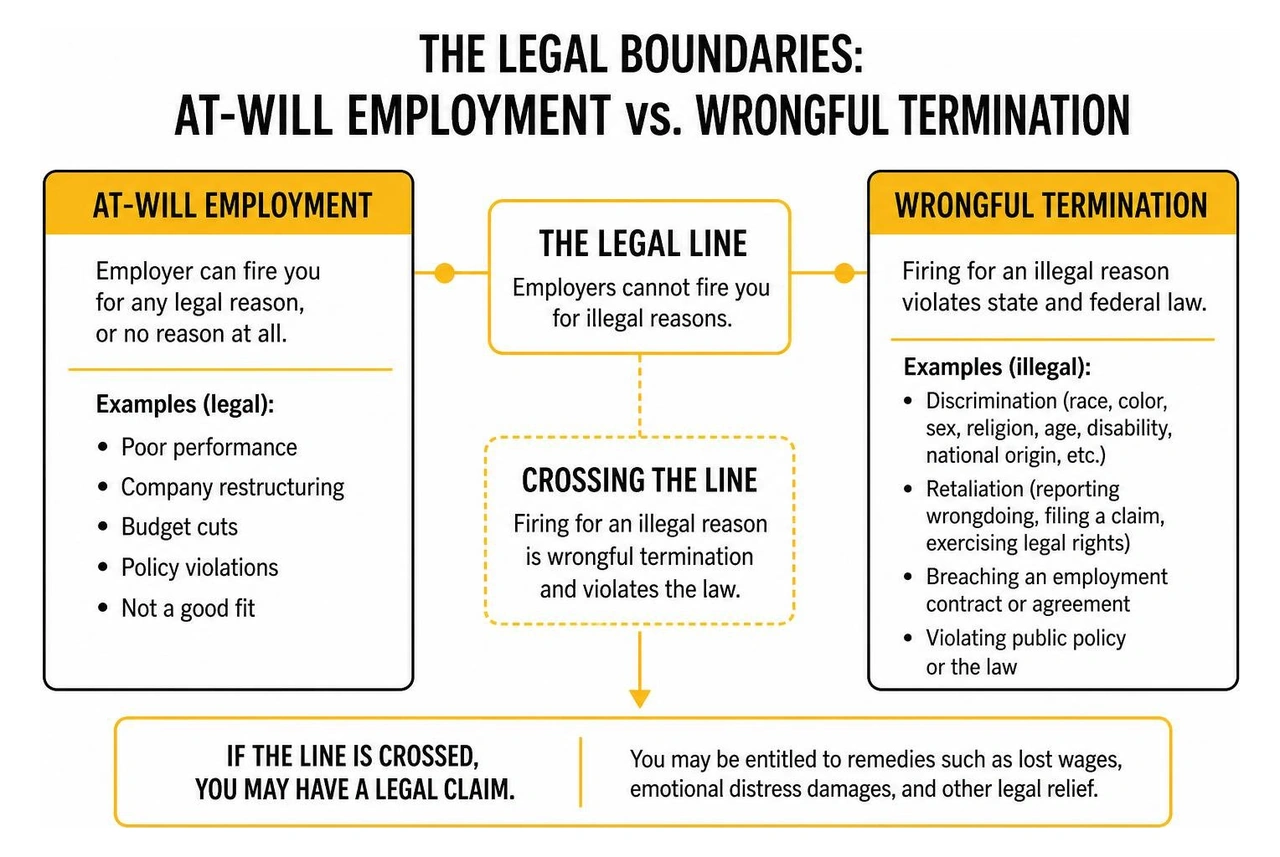
Federal protections and Michigan state labor laws place strict boundaries on what employers can do. If your employer crosses those boundaries, the "at-will" defense crumbles. To build a successful case, we must identify the specific laws your employer violated. For a deeper look at how these rules apply in our state, you can read more about Wrongful Discharge in Michigan.
Our focus here is protecting workers right here in Michigan, under Michigan and federal statutes.
Common Grounds: Discrimination, Retaliation, and Breach of Contract
If at-will employment allows employers to fire you for almost anything, what actually makes a firing illegal? The law generally groups wrongful termination into three primary categories:
1. Discrimination (Civil Rights Violations)
It is strictly illegal under both federal law (like Title VII of the Civil Rights Act) and Michigan state law (specifically the Elliott-Larsen Civil Rights Act) to terminate an employee based on protected characteristics. These characteristics include:
- Race, color, or national origin
- Religion
- Sex, gender identity, or sexual orientation
- Age (protecting workers over 40)
- Disability or genetic information
- Pregnancy status
- Marital status (which is protected under Michigan's Elliott-Larsen Civil Rights Act, providing broader coverage than federal law)
If your performance was stellar, but you were suddenly let go after revealing you were pregnant, or after celebrating your 55th birthday, discrimination may be the real driver behind your termination.
2. Retaliation and Whistleblower Protection
Employers cannot fire you for exercising your legal rights. This is known as retaliation. It is illegal to terminate an employee because they:
- Reported workplace harassment or discrimination
- Filed a workers' compensation claim after an on-the-job injury
- Requested or took protected leave under the Family and Medical Leave Act (FMLA)
- Participated in an internal or external investigation
- Reported illegal activities or safety hazards (whistleblowing)
For instance, if you notice financial fraud or a major safety hazard at a facility in Troy or Southfield, report it in writing, and find yourself escorted out of the building with a pink slip two weeks later, you likely have a strong retaliation claim.
3. Breach of Contract
While at-will is the default, some employees have written, oral, or implied contracts that guarantee employment for a certain period or state that termination can only occur "for cause." If an employer fires you in violation of these agreements, they have breached their contract.
To understand the boundaries of what is allowed, take a look at our detailed breakdown of Illegal Reasons to Fire Someone.
Constructive Discharge: Can You Sue If You Quit?
"But Scott, I wasn't technically fired. I quit because they made my life a living hell. Do I still have a case?"
This is one of the most common questions we hear. The short answer is: yes, you can still sue.
In the legal world, this is known as constructive discharge (or constructive termination). Constructive discharge occurs when an employer intentionally creates or permits working conditions so intolerable, hostile, or abusive that a reasonable person in your position would feel they had absolutely no choice but to resign.
Think of it as a forced resignation. Instead of firing you outright, the employer tries to freeze you out, cut your hours to zero, strip away your responsibilities, or subject you to constant harassment in hopes that you will quit and save them from a wrongful termination lawsuit.
However, the legal threshold for constructive discharge is high. You cannot simply quit because your boss yelled at you once or because you received a mediocre performance review. We must prove that:
- The working conditions were objectively intolerable.
- The employer created or permitted these conditions intentionally to force you out, or knew about them and did nothing to fix them.
- The intolerable conditions were tied to an illegal motive (such as retaliation for whistleblowing or discriminatory harassment).
If you are considering resigning because of an abusive workplace, or if you have already been forced to quit, check out our guide on how to Find out if your firing was illegal in Oakland County to learn how to protect your legal options before it is too late.
Why You Need an Attorney for Wrongfully Fired Workers to Fight Back

When you are fired, you are immediately at a disadvantage. Your former employer has an HR department, corporate defense lawyers, and deep pockets. They will immediately begin building a narrative to show that you were let go for poor performance, restructuring, or "budget cuts."
An experienced attorney for wrongfully fired workers acts as your shield and sword. We know how corporate defense lawyers think because we have spent decades dismantling their strategies. We know how to obtain internal emails, draft powerful demand letters, and force employers to the negotiating table.
One of the first things we evaluate is the scale of your financial and emotional losses. Wrongful termination damages are designed to make you whole again.
| Type of Damage | What It Covers | How It Is Calculated |
|---|---|---|
| Economic Damages | Lost wages (back pay), future lost wages (front pay), lost benefits (health insurance, 401k match), and job search costs. | Calculated based on your salary and the time it takes to find comparable employment. |
| Non-Economic Damages | Emotional distress, anxiety, depression, loss of professional reputation, and mental anguish caused by the firing. | Evaluated based on the severity of the psychological impact and professional harm. |
| Punitive Damages | Damages meant to punish the employer for especially malicious, fraudulent, or oppressive conduct. | Rarely awarded; requires proving the employer acted with deliberate malice or reckless indifference. |
How an Attorney for Wrongfully Fired Employees Proves Pretext
Employers rarely admit to breaking the law. A manager will never hand you a termination letter that says, "We are firing you because you are pregnant and we don't want to pay for maternity leave." Instead, they will say, "We are restructuring our department, and your role has been eliminated."
This cover-up is called pretext.
To win a wrongful termination case, your attorney must prove that the employer's stated reason for firing you is a lie designed to hide their illegal motive. We prove pretext by looking for cracks in their story:
- Inconsistent Explanations: Did your manager tell you you were fired for "performance issues," but your termination paperwork says "lack of work"?
- Sudden Performance Drops: Did you receive glowing annual reviews for five years, only to receive a sudden flood of write-ups immediately after you filed a harassment complaint?
- Unequal Treatment: Were other employees who committed the same minor policy infractions kept on the payroll while you were singled out and fired?
- Timing (Temporal Proximity): Were you let go hours or days after submitting a whistleblower report or requesting medical leave?
Establishing this paper trail is crucial. If you suspect your employer is setting you up for a pretextual termination, you should read our guide on whether you can Discover if you can sue for being fired without warning.
Navigating Damages and Financial Recovery
Securing financial recovery requires a strategic legal approach. We don't just ask for a random number; we meticulously calculate every penny you are owed.
For example, if you were earning $80,000 a year in Royal Oak or Farmington Hills and were fired illegally, and it took you nine months to find a comparable job, your back pay claim alone starts at $60,000. If your new job pays $10,000 less per year, we can pursue "front pay" to make up the difference.
Additionally, under certain civil rights and whistleblower statutes, we can fight for attorneys' fees and litigation costs. This means that if we win your case at trial or secure a favorable statutory settlement, the court can order your former employer to pay your legal fees directly, ensuring that your financial recovery goes where it belongs: into your pocket.
Preparing for Your Legal Consultation and Filing Deadlines
If you believe you have been wrongfully terminated, time is your greatest enemy. The law does not give you an infinite window to file a lawsuit.
In Michigan, the statutes of limitations vary wildly depending on the type of claim you are filing. Some federal discrimination claims require you to file an administrative charge with the Equal Employment Opportunity Commission (EEOC) within 180 days (which can be extended to 300 days in states like Michigan with their own civil rights agencies). The EEOC provides general guidance on filing deadlines for discrimination charges, but you should not rely on general information alone when your rights are at stake. Other state-level claims may give you up to three years, but waiting is always a mistake. Evidence gets lost, witnesses move away, and memories fade.
Before you take any legal action, it is vital to know the landscape. We highly recommend that you Read what Oakland County employees need to know first to understand how to preserve your claim.
What to Bring to Your First Meeting
When you sit down with an attorney for wrongfully fired claims, your consultation will be much more productive if you come prepared. Think of yourself as an investigator presenting a file.
Here is an evidence checklist of what you should bring to your first meeting:
- The Termination Letter: Any official paperwork your employer gave you when you were let go.
- Employment Agreements: Your original contract, offer letter, non-compete agreements, and the employee handbook.
- Performance Records: Annual reviews, commendations, promotions, or performance improvement plans (PIPs).
- Communication Logs: Printouts of emails, text messages, or Slack conversations that show harassment, retaliation, or shifting explanations for your termination.
- Your Own Timeline: Write down a chronological list of events while your memory is still fresh. Include dates, times, names of people involved, and what was said.
Choosing the Right Attorney for Wrongfully Fired Claims
Not all lawyers are created equal. You wouldn't hire a dermatologist to perform heart surgery, and you shouldn't hire a general practice attorney or a divorce lawyer to fight a multi-million-dollar corporation.
You need an attorney who specializes exclusively in employment law, with a deep understanding of Michigan courts, federal statutes, and local corporate legal teams.
At Scott Batey Law, we have spent more than 25 years representing workers in Bingham Farms, Birmingham, Southfield, Royal Oak, Troy, and across Metro Detroit. We bring award-winning, personalized representation to every case, ensuring you are never treated as just a file number. We understand the high stakes of whistleblower and employment representation, and we are prepared to stand by your side from the initial consultation all the way through trial.
Frequently Asked Questions About Wrongful Firing
What is the statute of limitations for a wrongful termination claim?
The filing deadlines depend entirely on the nature of your claim. For federal discrimination claims, you must file a charge with the EEOC within 180 to 300 days of your termination. For state law claims under Michigan's Elliott-Larsen Civil Rights Act, you generally have three years to file a lawsuit. However, because administrative requirements are complex, you should consult an attorney immediately to avoid missing a critical deadline.
Can I sue if I was fired without any prior warning?
Yes, under certain circumstances. While at-will employment generally allows employers to fire you without warning, there are major exceptions. If your employee handbook promises a "progressive discipline" policy (e.g., verbal warning, written warning, suspension, then termination) and your employer ignored it, or if the sudden firing was actually a cover for discrimination or retaliation, you may have grounds for a lawsuit. If you were fired out of the blue, you should Consult a wrongful termination lawyer in Bingham Farms to evaluate your options.
Are attorneys' fees recoverable in a wrongful discharge lawsuit?
It depends on the type of claim. Under common law wrongful discharge claims (such as firing in violation of public policy), attorneys' fees are generally not recoverable. However, if your claim is brought under civil rights statutes (like the Elliott-Larsen Civil Rights Act or Title VII) or whistleblower protection acts, these laws contain fee-shifting provisions that allow the court to order your employer to pay your legal fees if you win.
Conclusion
Losing your job is a heavy burden, but you do not have to carry it alone. If you suspect that your employer used "at-will" employment as an excuse to fire you for discriminatory, retaliatory, or illegal reasons, you have the right to fight back.
At Scott Batey Law, we have spent nearly three decades standing up for Metro Detroit workers. We serve clients throughout Bingham Farms, Birmingham, Southfield, Royal Oak, Beverly Hills, Farmington Hills, Oak Park, Troy, Ferndale, Berkley, Madison Heights, and the surrounding communities.
Don't let your employer have the final, illegal word. Contact an experienced wrongful termination attorney in Birmingham, MI today to schedule a consultation, protect your rights, and take the first step toward getting the justice and financial recovery you deserve.