.png)
How the Eliott Larsen Civil Rights Act Protects Michigan Workers
What the Elliott-Larsen Civil Rights Act Means for Michigan Workers
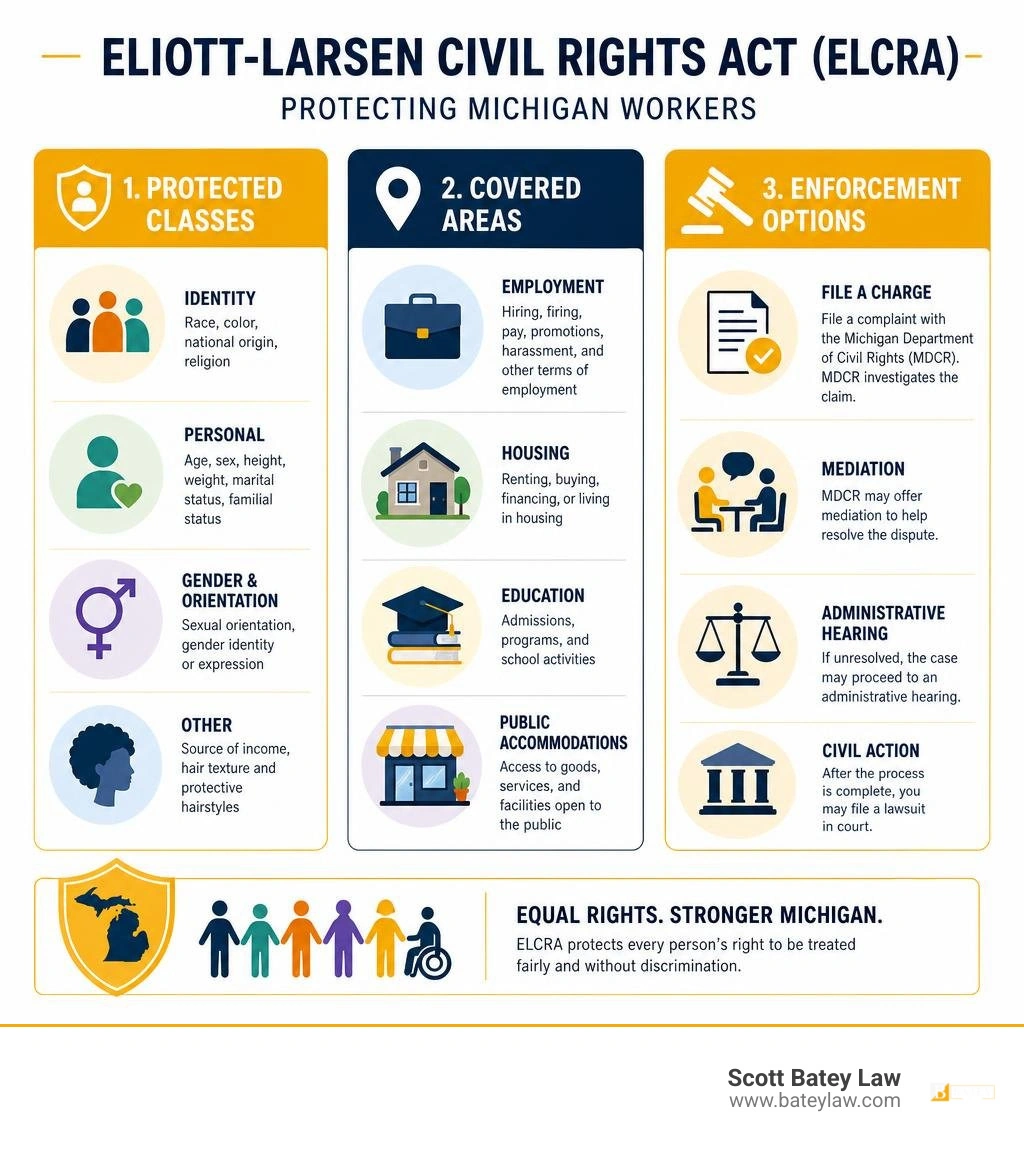
The Elliott-Larsen civil rights law — formally known as the Elliott-Larsen Civil Rights Act (ELCRA), Public Act 453 of 1976 — is Michigan's primary law protecting people from discrimination in the workplace, housing, education, and public accommodations.
Here's what it protects against, at a glance:
- Employment discrimination — being fired, passed over for hiring, or paid unfairly based on a protected characteristic
- Housing discrimination — being denied housing or treated differently as a renter or buyer
- Education discrimination — unfair treatment in admissions or school programs
- Public accommodations discrimination — being denied service or access in businesses open to the public
Protected characteristics under ELCRA include:
| Category | Protected Classes |
|---|---|
| Identity | Race, color, national origin, religion |
| Personal | Age, sex, height, weight, marital status, familial status |
| Gender & Orientation | Sexual orientation, gender identity or expression |
| Other | Source of income, hair texture and protective hairstyles |
If you've been fired, denied a promotion, harassed, or treated unfairly at work, ELCRA may give you the right to take legal action — even if your employer claims the decision was unrelated to your identity.
I'm Scott Batey, founder of Batey Law Firm, and I've spent nearly three decades representing Michigan employees in Elliott-Larsen civil rights claims — including discrimination, harassment, retaliation, and wrongful termination. If you're trying to figure out whether what happened to you is legally actionable, this guide will walk you through exactly what the law covers and what your options are.
Understanding the Eliott Larsen Civil Rights Act: History and Purpose
To understand how powerful this law is today, we have to look back at how it started. Before the eliott larsen civil rights act became the law of the land, Michigan’s anti-discrimination protections were a patchwork of older statutes. The Michigan Constitution of 1963 prohibited discrimination based on religion, race, color, or national origin, but it left massive gaps when it came to everyday issues like age, sex, and marital status.
Enter two state representatives who decided that "good enough" wasn't good enough. State Representative Daisy Elliott, a Democrat from Detroit, and State Representative Mel Larsen, a Republican from Oxford, joined forces in a rare display of bipartisan unity. They believed that civil rights shouldn't be a partisan issue, and they fought tirelessly to draft a comprehensive bill that would consolidate and expand Michigan's civil rights protections.
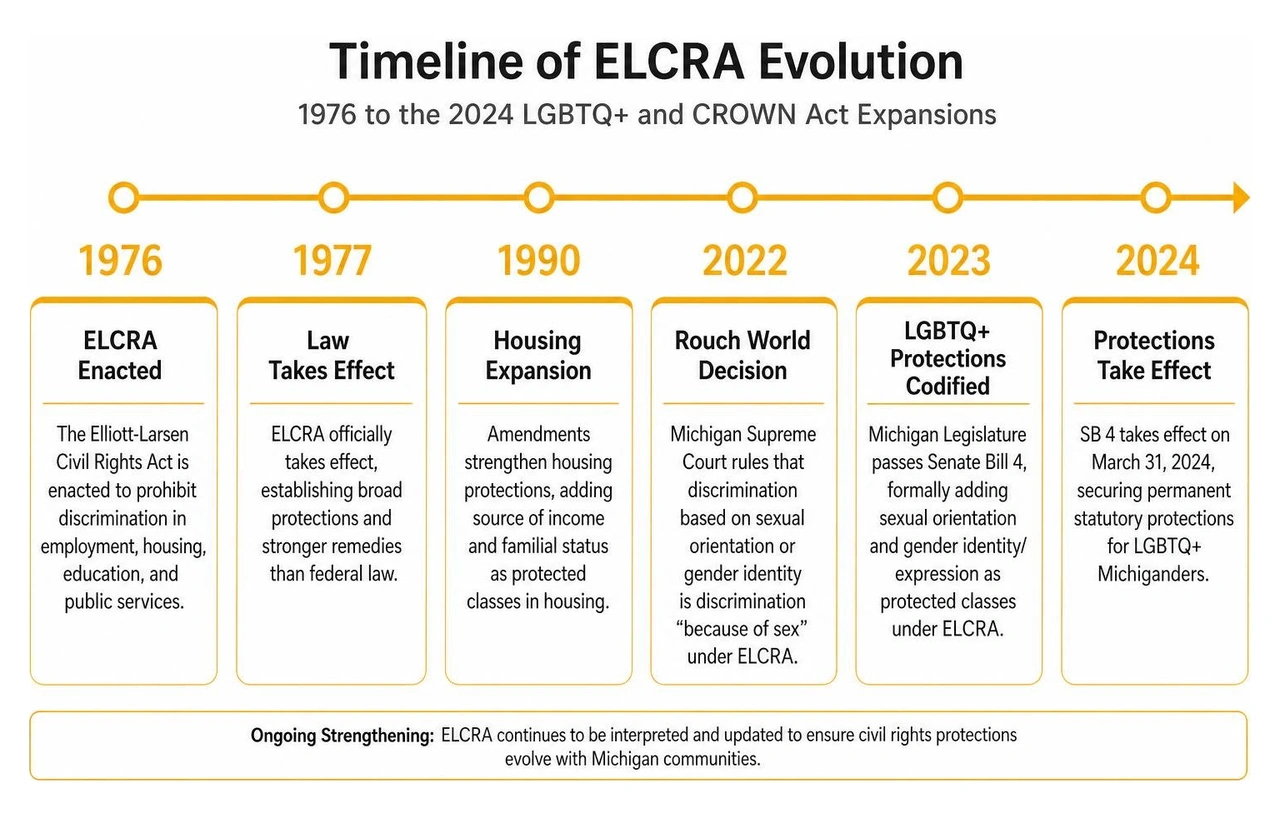
Their hard work paid off. Public Act 453 of 1976 passed the legislature with overwhelming support—earning 25 votes in the Michigan Senate and 79 votes in the Michigan House of Representatives. Governor William Milliken signed the landmark bill into law on January 13, 1977, and it officially went into effect on March 31, 1977.
Over the years, the significance of this bipartisan achievement has been widely recognized. In 2012, the State Bar of Michigan designated the Act as Michigan Legal Milestone #37, celebrating its historic role in advancing equal opportunity. Furthermore, the state honored its co-sponsors by naming a major state office building in Lansing the Elliott-Larsen Building. You can explore more about its legislative journey and the figures who built it by visiting this detailed Elliott-Larsen Civil Rights Act history page.
Scope of Protections: Employment, Housing, and Public Accommodations
The beauty of ELCRA is its sheer breadth. Unlike some federal laws that only apply to specific areas of life, ELCRA is a broad shield that covers several major sectors of Michigan society:
- Employment: Covers everything from job advertisements and hiring to compensation, promotions, and termination.
- Housing and Real Estate: Prohibits real estate brokers, landlords, and sellers from discriminating when renting, selling, or financing property.
- Education: Ensures public and private educational institutions cannot deny admission or subject students to discriminatory policies.
- Public Accommodations and Services: Guarantees equal access to businesses, restaurants, hotels, and public services open to the general public.
For a deep dive into how these broad categories translate into everyday workplace protections, check out our guide on More details on ELCRA 101.

How the Eliott Larsen Civil Rights Act Protects Against Workplace Discrimination
Under ELCRA, employers are strictly prohibited from making employment decisions based on any protected characteristic. This means an employer cannot refuse to hire you, fire you, demote you, or reduce your pay because of your race, age, sex, religion, or any other protected trait.
Crucially, ELCRA also explicitly defines sex discrimination to include sexual harassment. This means that if you are subjected to a hostile work environment or quid pro quo harassment (where employment benefits are conditioned on sexual favors), your employer can be held liable under state law.
How does ELCRA stack up against federal law? In many ways, Michigan's state law is actually much friendlier to employees than Federal Title VII of the Civil Rights Act of 1964. Here is a quick comparison:
| Feature | Michigan ELCRA | Federal Title VII |
|---|---|---|
| Employer Size Threshold | Applies to employers with 1 or more employees | Applies to employers with 15 or more employees |
| Height & Weight Protection | Explicitly protected classes | Not protected under federal law |
| Damage Caps | No cap on compensatory damages | Strict caps based on employer size (up to $300,000) |
| Administrative Exhaustion | You can file directly in court without waiting for the EEOC/MDCR | Must file an EEOC charge and receive a "Right to Sue" letter first |
Because ELCRA applies to employers of all sizes, it protects workers at small local businesses in places like Southfield, Troy, and Royal Oak who would otherwise have no recourse under federal law. For a closer look at how this impacts your rights, read our ELCRA workplace discrimination guide.
Protections in Housing, Education, and Public Services
Beyond the workplace, ELCRA ensures that you cannot be denied a place to live or access to public facilities.
In housing, the Act bans discriminatory practices in the leasing, buying, or financing of real estate. This includes refusing to rent to someone based on their familial status (such as having children) or their source of income.
In education, schools and universities cannot use discriminatory admission quotas or maintain policies that deny equal opportunities to students based on protected traits.
However, there are a few built-in limitations. For example, state and county correctional facilities are specifically excluded from some of the public service discrimination provisions, meaning inmates cannot use ELCRA to challenge certain operational decisions within prisons.
The Evolution of Michigan Civil Rights: Key Amendments and Court Rulings
The ELCRA of 1977 was a massive step forward, but it was not a static document. Over the last several decades, the law has been amended and interpreted to meet the needs of a changing society.
The most dramatic shift occurred in the early 2020s. For nearly fifty years, advocates fought to explicitly add LGBTQ+ individuals to the Act. In 2022, a major breakthrough occurred with the Michigan Supreme Court’s landmark decision in Rouch World v. Department of Civil Rights.
The court ruled that discrimination based on sexual orientation or gender identity inherently constitutes discrimination "because of sex" under ELCRA. This judicial milestone paved the way for legislative action. In 2023, the Michigan Legislature passed Senate Bill 4, which formally codified these protections into state law. Governor Gretchen Whitmer signed the bill on March 16, 2023, and it officially took effect on March 31, 2024, ensuring permanent statutory protection for hundreds of thousands of LGBTQ+ Michiganders.
To learn more about how these historic shifts impact your daily life at work, check out our article on LGBTQ+ discrimination under ELCRA.
Key Amendments to the Eliott Larsen Civil Rights Act
While the LGBTQ+ expansion grabbed national headlines, ELCRA has seen several other vital updates.
- Pregnancy Protections: The Act was amended to explicitly protect pregnant workers, ensuring they cannot be forced out of their jobs or denied reasonable accommodations.
- Abortion Seekers: Protections were clarified to prevent discrimination against individuals who have sought or obtained an abortion.
- The CROWN Act (Hair Texture): In recent years, Michigan joined a growing number of states in passing the CROWN Act, which amends ELCRA's definition of "race" to include traits historically associated with race, such as natural hair texture and protective hairstyles (like braids, locks, and twists).
For those who want to read the exact legal phrasing of these protections, you can access the Official ELCRA statutory text.
Enforcement, Remedies, and Legal Limitations Under ELCRA
If you experience discrimination, you have two primary paths to seek justice under ELCRA:
- Administrative Complaint: You can file a formal complaint with the Michigan Department of Civil Rights (MDCR), which investigates claims on behalf of the Michigan Civil Rights Commission. The MDCR can attempt to mediate the dispute or hold public hearings to resolve the issue.
- Direct Lawsuit: Unlike federal law, which forces you to go through the administrative process first, ELCRA allows you to bypass the MDCR entirely and file a civil lawsuit directly in a Michigan circuit court.
However, you must act quickly. The statute of limitations for filing an ELCRA claim in court is three years from the date the discriminatory act occurred. If you miss this window, you lose your right to sue.
It is also worth noting how the law handles religious exemptions. During the debate over Senate Bill 4, some groups pushed for broad religious exemptions that would allow certain employers or business owners to opt out of the non-discrimination requirements. However, after more than 75 faith leaders signed a letter opposing these carve-outs, the legislature passed the bill without broad religious exemptions, ensuring that the protections remain robust and inclusive.
For details on what you need to prove in court, read our breakdown of ELCRA discrimination claims and proof.
Remedies Available to Victims of Discrimination
If you win your ELCRA case, the law provides powerful remedies designed to make you "whole" again. These can include:
- Back Pay and Front Pay: Compensation for lost wages and benefits from the time you were fired up to the date of your trial, and potentially future lost earnings if you cannot find comparable work.
- Reinstatement: Getting your old job back (though in many cases, a financial settlement is preferred due to strained relationships).
- Compensatory Damages: Compensation for emotional distress, mental anguish, humiliation, and loss of professional reputation.
- Attorney Fees: The court can order your employer to pay your legal fees, making it possible for workers to stand up to wealthy corporations.
To find out how these remedies apply to your specific situation, read more about ELCRA legal representation.
Frequently Asked Questions About Michigan Civil Rights
What is the difference between ELCRA and federal civil rights laws?
The biggest differences are employer size and the scope of protected classes. While federal laws like Title VII only apply to businesses with 15 or more employees, ELCRA applies to any Michigan employer with one or more employees. Additionally, ELCRA protects traits like height and weight, which are completely uncovered by federal law.
ELCRA also provides stronger protections against age discrimination, allowing workers to hold employers accountable without facing some of the incredibly high legal hurdles found in federal age discrimination statutes. To learn more about identifying these workplace trends, see our analysis of Age discrimination patterns in Michigan.
How did the Rouch World decision change LGBTQ+ protections in Michigan?
Before the 2022 Rouch World decision, LGBTQ+ workers in Michigan had to rely on a patchwork of local municipal ordinances for protection. The Michigan Supreme Court's ruling changed everything by declaring that discrimination based on sexual orientation or gender identity is a form of sex discrimination, making these protections statewide and legally binding. This judicial interpretation was subsequently codified into law by the legislature, making it permanent.
What are the ongoing challenges and gaps in Michigan's civil rights protections?
Despite these massive leaps forward, gaps still remain. Michigan is home to over 373,000 LGBTQ+ residents, and while 83% of Michiganders support these non-discrimination protections, nearly two-thirds of LGBTQ+ Americans report experiencing discrimination in their daily lives.
Historically, Michigan received a mediocre "D" grade (64.7%) on LGBTQ-friendly policy scorecards due to legislative delays. Today, while workplace and housing protections are secure, advocates note that gaps still exist in healthcare access and criminal justice protections, meaning the fight for complete equality is far from over.
Conclusion
The Elliott-Larsen civil rights act is one of the strongest state-level civil rights laws in the nation, but it is only effective if workers know their rights and are willing to stand up for them.
If you believe you have been targeted, harassed, or wrongfully terminated in Bingham Farms, Troy, Southfield, or anywhere else in Oakland County and the Detroit metro area, you don't have to navigate this complex legal landscape alone. At Scott Batey Law, we bring nearly 30 years of hands-on experience fighting for workers' rights.
We provide the personalized, award-winning representation you need to hold employers accountable and secure the justice you deserve. Contact us today, and let's discuss how we can protect your career and your future.