.png)
Are You Legally Entitled to a Lunch Break? Federal Break Laws Explained

Why Knowing Your Rights Under Employee Break Laws Matters
Many workers are surprised to learn how employee break laws actually work in the United States, especially since federal law does not guarantee a single minute of rest.
If you need a quick answer about your rights, here is how the law works:
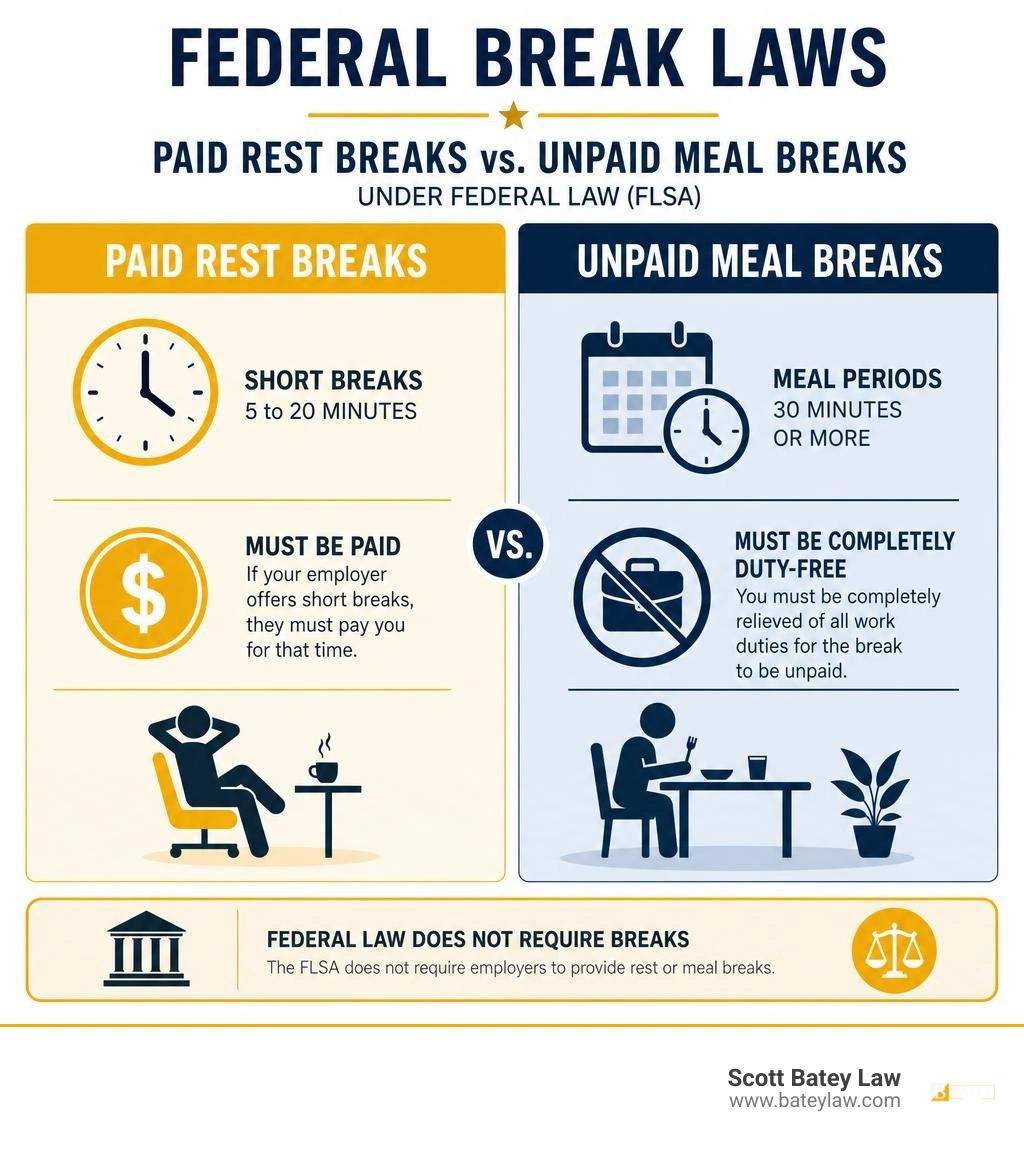
- Federal FLSA Rules: Federal law does not require employers to offer meal or rest breaks.
- Paid Rest Breaks: If your employer chooses to offer short breaks (5 to 20 minutes), they must pay you for that time.
- Unpaid Meal Breaks: Meal periods of 30 minutes or more can be unpaid, but only if you are completely relieved of all work duties.
- State Variations: Stricter laws exist in states like California and Oregon. However, Michigan has no state-mandated break laws for adult employees.
It is a common myth that every worker is legally entitled to a lunch break. In reality, your rights depend entirely on where you live, your age, and the exact nature of your job.
When employers get these rules wrong, it often leads to wage theft. If you are forced to answer emails during your lunch, or if your boss automatically deducts 30 minutes from your paycheck even when you work through your break, they are breaking the law.
I am Scott Batey, a Michigan employment attorney who has spent nearly thirty years helping workers protect their rights and hold employers accountable under employee break laws. Since 1996, my firm has fought for individuals facing wage theft, retaliation, and unfair work environments across Metro Detroit.
Federal Break Laws: What the FLSA Actually Requires
The primary federal law governing workplace wages and hours is the Fair Labor Standards Act (FLSA). When it comes to employee break laws, the FLSA is surprisingly quiet. It does not actually force employers to provide lunch, coffee, or rest periods of any kind.
Instead, federal law focuses on a different question: If an employer chooses to offer breaks, must that time be paid?
Under the FLSA, compensable time (time that must go on your paycheck) is determined by the length of the break and whether you are actually relieved of your job duties. To understand how the Department of Labor views these rules, we can look at the Minimum Paid Rest Period Requirements Under State Law for Adult Employees in Private Sector | U.S. Department of Labor , which highlights how the federal government leaves actual mandates to local jurisdictions while heavily regulating how break compensation is handled.
Paid vs. Unpaid Breaks: The 20-Minute Rule
Federal regulations draw a very clear line based on the duration of a rest period:
- Short Breaks (5 to 20 minutes): These rest periods are legally considered compensable hours worked. The Department of Labor views these brief intervals as beneficial to the employer because they help re-energize workers and boost productivity. Therefore, if your employer allows you to take a 10-minute coffee break, they cannot dock your pay for it, and this time must count toward your weekly overtime calculations.
- Meal Periods (Typically 30 minutes or longer): These are not considered work time and are non-compensable, meaning they can be unpaid. However, there is a major catch. For a meal break to be unpaid, you must be completely relieved of duty. If you are required to eat your sandwich at your desk while keeping an eye on the phones, waiting for a customer, or monitoring an inbox, you are still working.
What happens if an employee takes longer than authorized? If an employer has explicitly and unambiguously communicated that a break must only last 15 minutes and that extensions are strictly prohibited and subject to discipline, they may exclude unauthorized extensions from your paid hours—provided they actually enforce that disciplinary policy.
The Proposed Federal Worker Rights and Support Act: A Shift in Employee Break Laws
Because the FLSA currently lacks a nationwide break mandate, lawmakers have pushed for reform. A major piece of proposed legislation, the Worker Rights and Support Act H. R. 9008 , aims to fundamentally reshape federal workplace standards.
If passed, H.R. 9008 would amend the FLSA to establish a baseline of national rights:
- Mandatory Meal Breaks: A 30-minute meal break would be required for every 6 hours of work.
- Mandatory Rest Breaks: A 10-minute rest or restroom break would be guaranteed for every 4-hour work period.
- Premium Pay Penalties: If an employer fails to completely relieve an employee of duty or restricts them to the premises during their meal break, they would have to pay the employee a premium rate of 1.5 times their regular pay rate for that time.
- Protected Medical Breaks: The bill also protects paid medical breaks of up to 20 minutes when supported by a healthcare provider's documentation.
While we monitor this bill's progress in July 2026, the reality remains that federal law currently relies on a patchwork of state regulations to protect workers' day-to-day rest.
State vs. Federal Employee Break Laws: A Patchwork of Regulations
Because federal law does not mandate breaks, state-level employee break laws vary wildly across the country. This creates a highly complex landscape for multi-state employers and can leave workers confused about what they are actually entitled to.
According to a comprehensive breakdown by Meal & Rest Break Laws by State (2026) — SmallBizHandbook — SmallBizHandbook , about 20 states mandate meal breaks, while only 9 states explicitly guarantee paid rest breaks for adult, non-exempt employees in the private sector.
How State Employee Break Laws Differ Across the Country
In some states, you are legally entitled to multiple paid and unpaid rest periods. In other states, adult employees have no statutory right to a break at all. To see how these rules compare, let's look at the baseline requirements across five key states:
| State | Required Meal Breaks | Required Rest Breaks | Special State Rules |
|---|---|---|---|
| California | 30 minutes (unpaid) if working > 5 hours | 10 minutes (paid) for every 4 hours worked | Strict premium pay penalties for missed breaks |
| Oregon | 30 minutes (unpaid) if working $\ge$ 6 hours | 10 minutes (paid) for every 4-hour segment | Highly specific sliding-scale based on shift length |
| Minnesota | 30 minutes (unpaid) if working $\ge$ 6 consecutive hours | 15 minutes (paid) within every 4 consecutive hours | Strict new minute-based standards effective Jan. 1, 2026 |
| Massachusetts | 30 minutes (unpaid) if working > 6 hours | None mandated for adults | "Day of Rest" law mandates 1 day off after 6 consecutive days |
| North Carolina | None for adults | None for adults | Break laws only apply to youth under 16 |
Deep Dive: Strict Break Mandates in California, Oregon, and Minnesota
For workers in states with robust protections, the rules are highly technical and strictly enforced.
In California, the Industrial Welfare Commission Wage Orders require employers to provide a net 10-minute paid rest break for every four hours worked (or major fraction thereof, which is any shift block exceeding two hours). According to Assistance for employees and employers: Answering your questions , the term "net" means the 10 minutes only starts once you reach a suitable resting area away from your immediate workstation. Furthermore, on-call rest breaks are illegal; employers must completely relinquish control over your time. If they fail to provide a break, they owe you one hour of premium pay at your regular rate for each workday the violation occurs.
Oregon utilizes a strict sliding-scale chart. For a standard 8-hour shift, an employee must receive two 10-minute paid rest breaks and one 30-minute unpaid meal break. Oregon employers cannot allow workers to combine these breaks to leave early or extend a lunch hour.
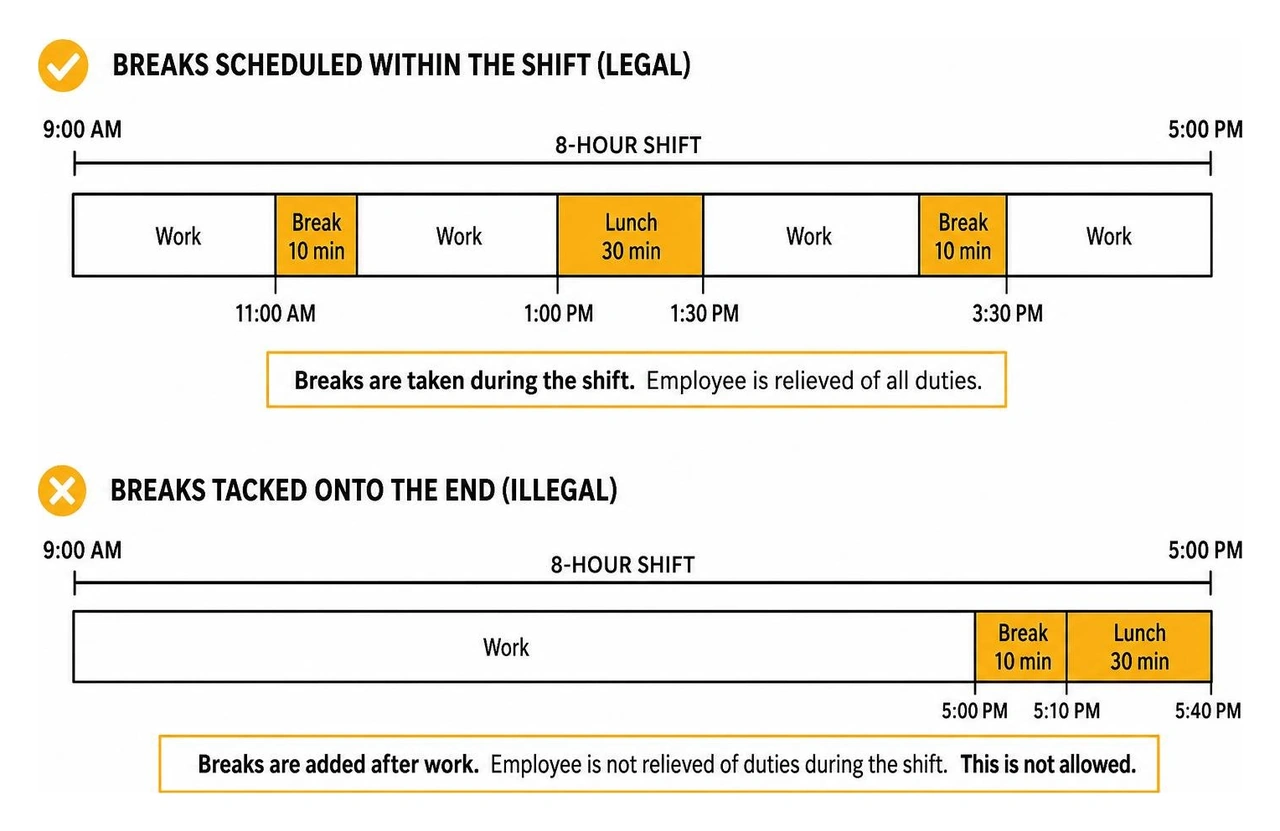
Minnesota recently underwent a major transition. Effective January 1, 2026, the state shifted from qualitative standards ("adequate time") to strict quantitative minimums. As detailed by the Work breaks, rest periods | Minnesota Department of Labor and Industry , employers must now provide a paid rest break of at least 15 minutes within every four-hour block of work, and an unpaid meal break of at least 30 minutes for shifts of six or more hours. These breaks must occur within the work period, meaning they cannot be tacked onto the end of a shift.
Massachusetts and North Carolina: Contrasting Approaches
On the other side of the spectrum, states like Massachusetts and North Carolina take vastly different approaches.
Massachusetts focuses primarily on meal periods, requiring a 30-minute break for anyone working more than six hours in a calendar day. This break is unpaid as long as the employee is free to leave the premises and use the time for personal activities, including prayer. Massachusetts also enforces a unique "Day of Rest" law, which requires most employers to provide one full day off after six consecutive days of work.
North Carolina represents the least regulated end of the spectrum. The state has no mandatory rest or meal breaks of any kind for adult employees. If you are 16 or older, your employer is not required by state law to give you a single break, regardless of how many hours you work. The state only mandates a 30-minute break after 5 hours of work for youth employees under the age of 16.
Special Protections: Nursing Mothers, Pregnant Workers, and Minors
While general employee break laws can feel like a regulatory wild west, federal and state laws provide strict, non-negotiable protections for specific groups of vulnerable workers.
Nursing Mothers and the PUMP Act
Under federal law, the Providing Urgent Maternal Protections for Nursing Mothers Act (PUMP Act) expanded critical workplace rights. Codified under 29 USC 218d: Breastfeeding accommodations in the workplace , this law requires employers to provide:
- Reasonable Break Time: Employees have the right to reasonable break times to express breast milk for up to one year after their child's birth.
- A Private, Secure Space: Employers must provide a private space that is completely shielded from view and free from intrusion by coworkers and the public. Crucially, this space cannot be a restroom.
These lactation breaks must be paid if the employee is not completely relieved of all work duties during the entire break. If you are required to answer emails or monitor a system while expressing milk, you must be paid for that time. Small businesses with fewer than 50 employees can only escape these requirements if they can prove that compliance would cause "undue hardship" involving significant difficulty or expense.
Pregnant Workers and Minor Employees
Pregnant workers are also entitled to additional break accommodations under federal law and various state statutes (such as the federal Pregnant Workers Fairness Act and Minnesota's Women's Economic Security Act). If a pregnant employee needs more frequent restroom visits or brief rest breaks to manage their health, employers must provide these accommodations unless it causes an undue operational hardship.
Minors also face much stricter limits. Almost every state—even those without adult break laws—mandates uninterrupted rest and meal periods for workers under 18 to protect their health, safety, and education.
Industry Exceptions, Collective Bargaining, and Scheduling Rules
Even in states with rigid break mandates, the law recognizes that certain industries require flexibility.
For example, in construction, logging, and maritime operations, employers are often permitted to stagger rest periods to maintain continuous operations, provided employees still receive their total mandated time off by the end of the day.
Collective Bargaining Agreements (CBAs)
In many jurisdictions, a valid collective bargaining agreement (CBA) negotiated by a labor union can supersede or modify state-mandated break rules. If a union contract outlines a specific break schedule that differs from state law, the terms of the CBA often govern, particularly in heavily unionized sectors like manufacturing and the building trades.
The Danger of "Auto-Deduct" Payroll Systems
One of the most common ways employers violate employee break laws is through the use of automated timekeeping systems. Many payroll platforms are configured to automatically subtract 30 minutes for a lunch break after an employee works a set number of hours.
If employees are routinely working through their lunches—even just answering quick phone calls or finishing a task at their desks—this automatic deduction constitutes wage theft. Under federal and state laws, if an employer knows or has reason to believe an employee is working during an unpaid break, they must pay for that time, regardless of what the automated time clock says. For more on how off-the-clock work and payroll manipulation impact workers, see our detailed guide on Wage Theft in Michigan: Overtime, Off-the-Clock Work, and Retaliation.
Frequently Asked Questions
Can employees voluntarily waive their break rights?
It depends entirely on the state. In some states, like California, an employee working six hours or less can voluntarily waive their meal break by mutual written consent, but employers cannot pressure or force them to do so. In other states, like Oregon, break rights are considered public policy mandates and cannot be waived by the employee, even if they prefer to skip lunch to go home early. To protect themselves from liability, employers should always document any legally permissible break waivers in writing.
What are the legal remedies for break law violations?
If your employer denies you mandated breaks or fails to pay you for short rest periods, you have several options. Depending on your state, you can recover back wages for the unpaid time, liquidated damages (often an amount equal to your unpaid wages), or premium pay penalties (such as California's one-hour pay penalty). If you are facing systematic break violations or retaliation for demanding your rights, consulting an experienced Michigan Employment Lawyer for Employees is the best way to evaluate your options and recover what you are owed.
Does Michigan have its own state-mandated break laws for adults?
No. Michigan state law does not require employers to provide rest or meal breaks for employees who are 18 years of age or older. Adult workers in Michigan must rely entirely on federal FLSA rules or the specific terms of their employment contracts.
However, Michigan does protect minors. Under the Youth Employment Standards Act, workers under the age of 18 cannot work more than five consecutive hours without a continuous, uninterrupted rest period of at least 30 minutes. You can review the state's official answers on this topic via the LEO - Breaks Meal and Rest Periods resource, or check the general guidelines outlined in Michigan Labor Laws for Meals and Breaks | MI Break Laws .
Conclusion
Understanding employee break laws is essential for protecting your hard-earned paycheck. While federal law and Michigan state law do not mandate lunch breaks for adults, they strictly regulate how breaks must be paid when they are offered. If you are being forced to work off the clock, having lunch hours automatically deducted when you didn't take them, or being denied protected lactation accommodations, your rights are being violated.
At Scott Batey Law, we have spent over 25 years fighting for the rights of workers in Bingham Farms, Southfield, Royal Oak, Troy, Oakland County, and across the Metro Detroit area. We provide personalized, award-winning representation to help employees hold dishonest employers accountable and recover the wages they deserve.
If you suspect your employer is violating wage and hour laws or retaliating against you for speaking up, contact us today. Let an experienced Wage and Overtime Lawyer in Metro Detroit review your case and help you stand up for your rights. If you need local representation, you can also connect with a dedicated Labor Lawyer in Southfield, MI to discuss your options.