.png)
No Rest for the Weary? A Guide to Employee Break Laws in Michigan

What Michigan Workers Need to Know About Employee Break Laws Right Now
Employee break laws in Michigan are not what most workers expect — and that gap between expectation and reality costs people real money.
Here is the short answer, optimized for a quick read:
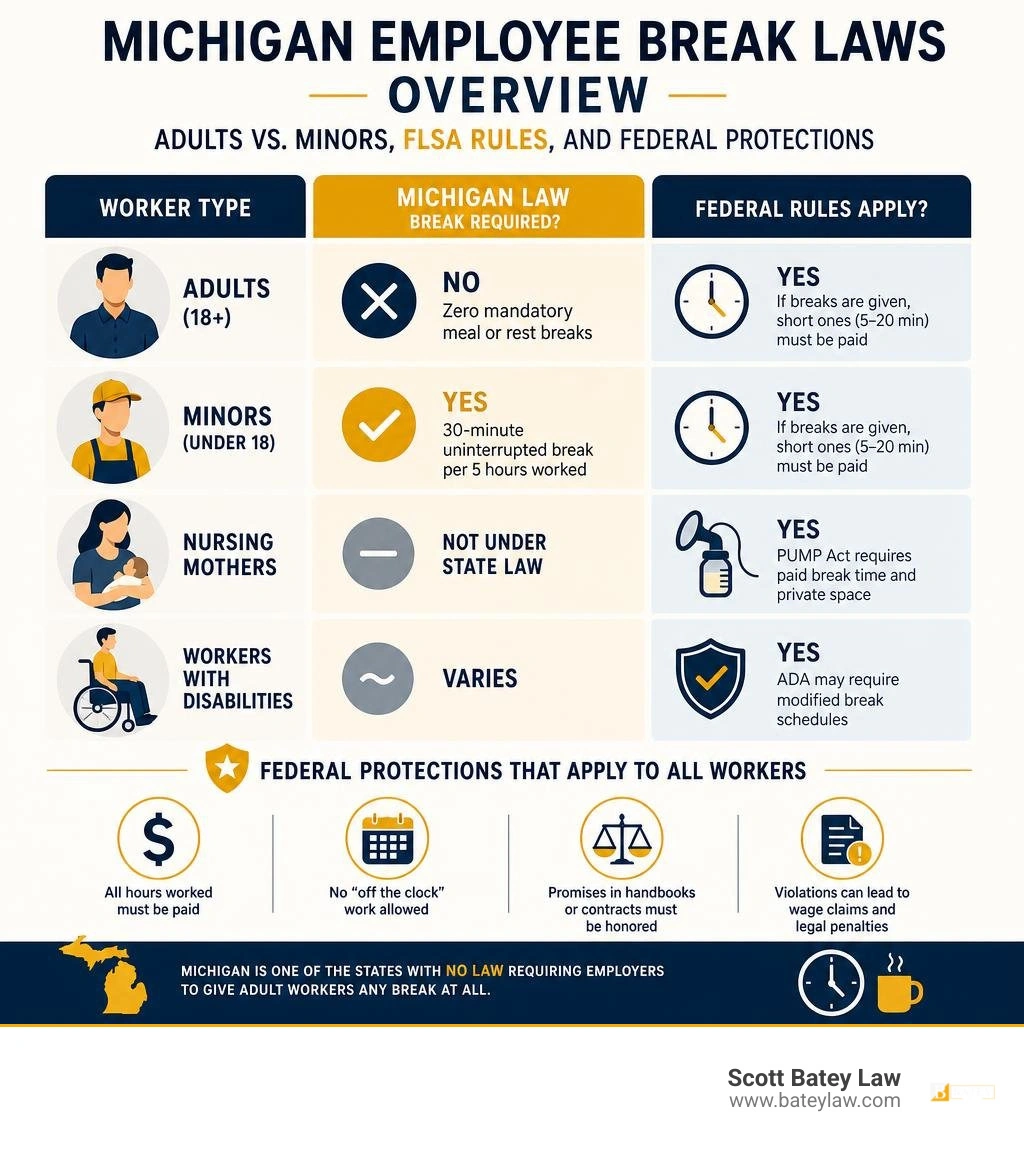
| Worker Type | Break Required by Michigan Law? | Federal Rules Apply? |
|---|---|---|
| Adults (18+) | No — zero mandatory meal or rest breaks | Yes — if breaks are given, short ones (5-20 min) must be paid |
| Minors (under 18) | Yes — 30-minute uninterrupted break per 5 hours worked | Yes — same federal pay rules apply |
| Nursing mothers | Not under state law | Yes — PUMP Act requires paid break time and private space |
| Workers with disabilities | Varies | Yes — ADA may require modified break schedules |
Michigan is one of the states with no law requiring employers to give adult workers any break at all — not a 15-minute rest, not a lunch break, nothing. A full 8-hour shift with zero breaks is technically legal under Michigan state law.
But that does not mean anything goes. Federal rules, special protections for minors, and the promises employers make in handbooks or contracts all create real legal obligations — and violations of those obligations can add up to wage theft.
I'm Scott Batey, a Michigan employment lawyer with nearly 30 years of experience representing workers in wage disputes, discrimination claims, and retaliation cases — including cases directly tied to employee break laws in Michigan and unpaid work time. If you believe your employer is violating your break rights, the sections below will help you understand exactly where you stand.
Understanding Employee Break Laws in Michigan for Adults

When adult workers in Metro Detroit start a new job in Troy, Southfield, or Farmington Hills, they often assume they are legally entitled to a lunch break or a couple of quick rest periods during an eight-hour shift. It is a incredibly common misconception. In reality, the legal landscape for adult workers in Michigan is highly discretionary.
Under Michigan state law, employers are under no legal obligation to provide rest breaks or meal periods of any duration to employees who are 18 years of age or older. If a business owner in Oakland County wants to run a retail shop, warehouse, or restaurant and require adult staff to work straight through an eight-hour shift without sitting down or eating a meal, state law does not stop them.
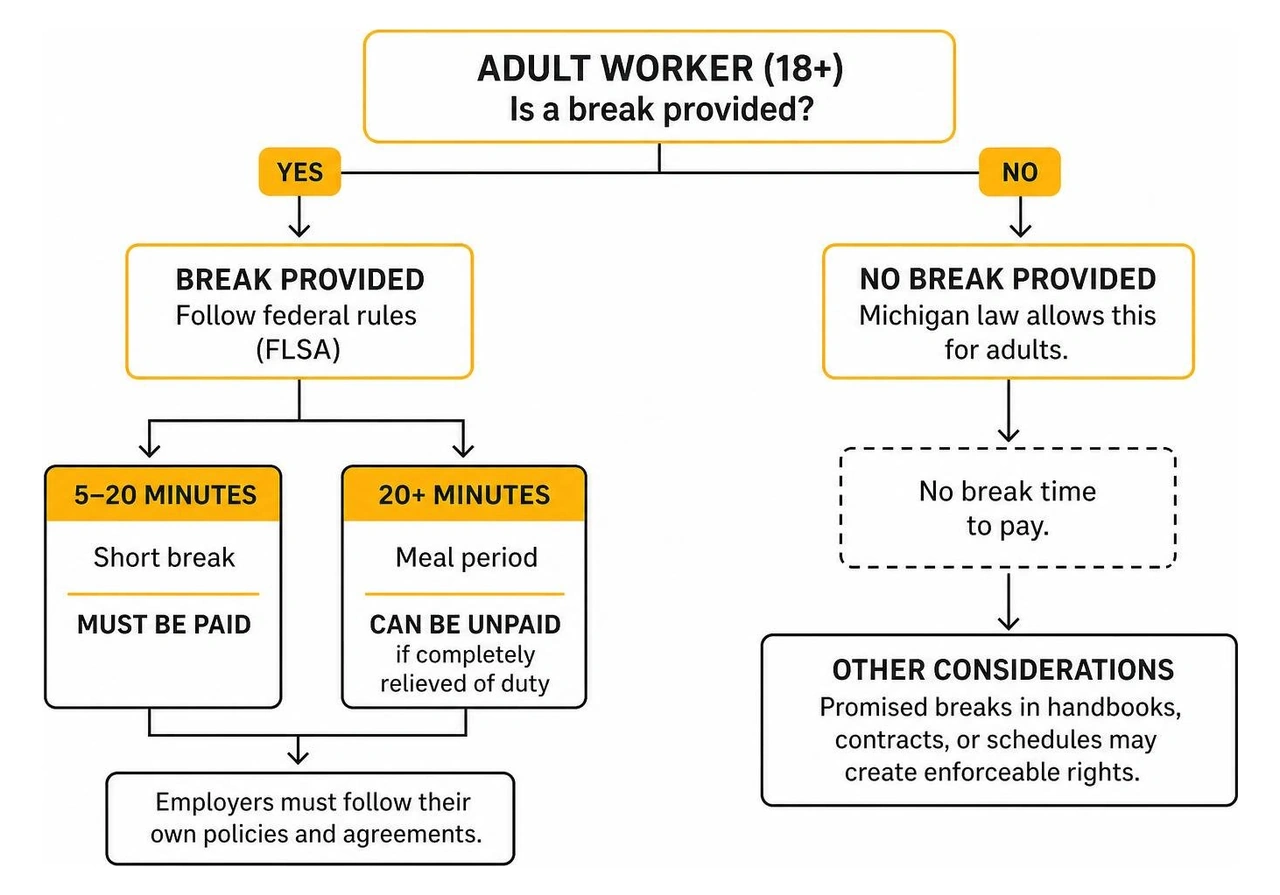
While this hands-off approach might seem harsh, many employers still choose to offer breaks voluntarily. They do this because tired, hungry employees make mistakes, get injured, and quit. However, when an employer chooses to offer these breaks, they must follow strict federal guidelines regarding how that time is counted and paid.
The General Rule for Workers Aged 18 and Older
The official stance of the Michigan Department of Labor and Economic Opportunity (LEO) is clear and unambiguous. According to the LEO - Breaks Meal and Rest Periods guidelines, there are zero requirements for meal or rest breaks for workers who are 18 years of age or older.
This state-level gap is further detailed in resources like the Michigan Labor Laws for Meals and Breaks | MI Break Laws overview. Because Michigan has no specific statute mandating these rest periods, adult workers must rely on federal protections or the specific policies outlined by their employers. If your employer does not have a written policy or a union contract guaranteeing breaks, they can legally demand that you work your entire shift continuously.
How Federal FLSA Rules Interact with Employee Break Laws in Michigan
Even though Michigan does not force employers to give you a break, the federal Fair Labor Standards Act (FLSA) steps in the moment your employer does decide to offer them. The FLSA has strict rules about what is considered "hours worked" (and therefore paid) versus what can be unpaid.
Under the FLSA, short rest periods — usually lasting anywhere from 5 to 20 minutes — are considered compensable work time. If your employer allows you to take a quick 15-minute coffee break to stretch your legs, they cannot dock your pay for that time. It must be paid.
On the flip side, bona fide meal periods (typically lasting 30 minutes or longer) do not have to be paid. However, for a meal break to be unpaid, the employee must be completely relieved of duty for the entire duration of the break. If you are required to eat your sandwich at your desk while keeping an eye on the office phones, or if you have to monitor machinery while eating lunch, you are not completely relieved of duty. In those scenarios, the entire break must be paid. If you are facing issues with unpaid work during your breaks, consulting a Wage & Overtime Lawyer – Metro Detroit can help you recover the compensation you are owed.
Youth Employment Standards Act (YESA): Mandatory Breaks for Minors

While adults are left to the discretion of their employers, the rules change completely when it comes to minor employees. Michigan’s Youth Employment Standards Act (YESA) was designed to protect young workers (those under the age of 18) from grueling, uninterrupted work shifts.
If you employ teenagers or are a minor working a job in Royal Oak, Berkley, or Detroit, you must understand these non-negotiable state rules.
The 30-Minute Uninterrupted Break Rule
Under YESA, minor employees must be provided with a documented, uninterrupted meal or rest period of at least 30 minutes if they are scheduled to work for five or more continuous hours.
Crucially, this break must occur before the minor completes their fifth consecutive hour of work. Employers cannot schedule a minor for a six-hour shift and then give them a 30-minute break at the very end of the day just to check a compliance box.
Additionally, the break must be completely uninterrupted. If a manager asks a 17-year-old cashier to step back to the register for "just two minutes" to help clear a long line during their lunch break, that break is no longer considered uninterrupted. Legally, the 30-minute clock must be completely restarted from zero, and the interrupted time must be paid as hours worked. Furthermore, these breaks cannot just be verbally agreed upon; YESA requires that minor breaks be explicitly documented in daily time records.
Penalties for YESA Violations
Because the state of Michigan takes child labor protections very seriously, failing to provide these mandatory, documented breaks to minors can result in steep consequences.
Employers who violate YESA face civil penalties, and repeat infractions can lead to formal investigations by the state. During a wage and hour audit, state investigators will meticulously review daily time records to verify that every minor working a shift longer than five hours received their full, uninterrupted 30-minute break. Keeping flawed records or failing to track these breaks is a fast track to legal and financial trouble for local business owners.
Federal Protections: The PUMP Act and ADA Accommodations
Beyond age-based rules, federal civil rights and labor laws provide additional break protections for specific classes of workers. Even though Michigan state law is silent on these matters, federal mandates apply to covered employers across Metro Detroit.
Lactation Breaks Under the PUMP Act
Under the federal Providing Urgent Maternal Protections for Nursing Mothers Act (PUMP Act), covered employers must provide reasonable break time for an employee to express breast milk each time such employee has need to express the milk. This protection lasts for up to one year after the child’s birth.
In addition to providing the break time, employers are legally required to provide a private space for lactation. This space must be:
- Shielded from view.
- Free from intrusion from coworkers and the public.
- Not a bathroom.
While Michigan law does not have a state-level equivalent mandating lactation breaks, the federal PUMP Act covers the vast majority of employers. There is a narrow exemption for small businesses with fewer than 50 employees, but only if they can demonstrate that complying would impose an "undue hardship" by causing significant difficulty or expense — a very high legal bar to clear.
ADA Accommodations and Modified Break Schedules
The Americans with Disabilities Act (ADA) is another powerful federal law that can override Michigan's lack of general break requirements. Under the ADA, covered employers must provide "reasonable accommodations" to employees with qualifying physical or mental disabilities, unless doing so would cause an undue hardship to the business.
For many workers, a reasonable accommodation comes in the form of a modified break schedule. For example:
- An employee with diabetes may need short, scheduled breaks throughout the day to monitor blood sugar levels and eat snacks.
- A pregnant worker may need more frequent restroom or hydration breaks.
- An employee returning from a medical leave may require brief rest periods to manage chronic pain.
When an employee requests a modified break schedule for medical reasons, the employer is legally obligated to engage in an "interactive dialogue" to find a workable solution. Simply denying the request because "company policy doesn't allow breaks" can expose the employer to a federal discrimination lawsuit. If your employer has refused to accommodate your medical need for breaks, an experienced Employment Law Attorney – Metro Detroit can help you protect your rights.
Contractual Rights and Wage Theft Concerns
Even though Michigan statutory law does not guarantee breaks for adult workers, many employees still have legally enforceable break rights. These rights are often established through private agreements, corporate policies, or union contracts.
When these rights are ignored, or when employers use breaks as an excuse to shortchange your paycheck, it crosses the line into wage theft.
When Violations of Employee Break Laws in Michigan Become Wage Theft
Wage theft occurs in many subtle ways, but break periods are one of the most common targets. Some of the most frequent violations we see include:
- Automatic Deductions: Many employers use time-tracking software that automatically deducts 30 minutes for a lunch break every day, regardless of whether the employee actually took the break. If you worked through your lunch to meet a deadline, but your employer automatically docked your pay, that is illegal.
- On-Call Duties: If you are told to take an unpaid lunch break but are required to keep your walkie-talkie on, answer customer questions, or stay at your workstation to monitor equipment, you are not fully relieved of duty. That time must be paid.
- Forced Off-the-Clock Work: Managers who pressure employees to clock out for their lunch break but continue working to keep up with demanding workloads are violating federal law.
Under Michigan's PAYMENT OF WAGES AND FRINGE BENEFITS (Act 390 of 1978), employers are strictly prohibited from making unauthorized deductions from your wages. For a deeper look at how these violations occur and what you can do about them, read our guide on Wage Theft in Michigan: Overtime, Off-the-Clock Work, Retaliation.
Enforceable Rights via Handbooks and Union Agreements
If you are a union member working in Detroit or Oakland County, your collective bargaining agreement (CBA) almost certainly contains strict, legally binding rules regarding meal and rest breaks. If your employer violates those rules, they are in breach of contract, and you can file a grievance through your union.
But even in non-union, at-will workplaces, an employee handbook can sometimes create enforceable rights. If an employer publishes a written policy promising specific breaks and then consistently denies them to certain workers, or fires an employee for taking a break that was explicitly authorized, it can create legal liability under the doctrine of promissory estoppel or constitute discriminatory enforcement. To understand how these handbook policies interact with Michigan's employment-at-will doctrine, see our analysis of At-Will Exceptions in Michigan: When a Firing Crosses the Line.
What to Document If Your Break Rights Are Violated
If you suspect your employer is violating employee break laws in Michigan — whether by forcing you to work off-the-clock, auto-deducting time you actually worked, or denying a legally required accommodation — you need to build a paper trail.
As employment lawyers, we cannot emphasize this enough: evidence is everything. If you decide to file a complaint with the Department of Labor or pursue a civil lawsuit, your case will live or die based on the documentation you gather. If you fear retaliation for speaking up, knowing how to protect yourself is vital; learn more about Wage & Hour Retaliation: Building Leverage After a WHD Complaint.
Here is a checklist of the essential evidence you should collect and keep in a safe place (not on your work computer or work phone):
- Pay Stubs and Timesheets: Keep copies of all your pay records. Look closely for auto-deductions on days you know you worked through lunch.
- Personal Time Logs: Keep a daily journal. Note the exact times you started and stopped working, when you took breaks, and any times you were interrupted or forced to work through a break.
- Supervisor Messages: Save all text messages, emails, or Slack chats where your boss tells you to work through lunch, stay on-call, or clock out while continuing to perform tasks.
- Shift Patterns and Workloads: Document situations where your workload was so high that taking a break was physically impossible, even if the handbook said you were allowed to take one.
- Witness Contact Information: Write down the names and personal phone numbers of coworkers who have witnessed your break denials or who are experiencing the same treatment.
Frequently Asked Questions about Michigan Break Laws
Is it illegal to work an 8-hour shift without a break in Michigan?
No. For adult workers (aged 18 and older), it is technically legal under Michigan state law for an employer to require you to work an 8-hour shift (or longer) without a single break. There is no state law mandating meal or rest periods for adults.
Can my employer automatically deduct 30 minutes for lunch if I worked through it?
Absolutely not. If you worked through your lunch break — even if you did so without explicit permission — your employer must pay you for that time under the FLSA. Automatically deducting time for a break you did not actually receive is a form of wage theft.
What are the break rules for 16 and 17-year-olds in Michigan?
Under the Youth Employment Standards Act (YESA), 16 and 17-year-olds (and all minors under 18) must receive a documented, uninterrupted 30-minute break if they are scheduled to work for 5 or more continuous hours. This break must be logged in their daily time records.
Conclusion
Navigating the gap between what feels fair and what is actually legal under employee break laws in Michigan can be incredibly frustrating. While the state gives employers immense freedom when it comes to adult workers, federal laws, minor labor protections, and contractual agreements provide robust safeguards that employers cannot ignore.
If your employer is stealing your time through automatic lunch deductions, forcing you to work off-the-clock, or denying you the accommodations you are legally owed, you do not have to handle it alone.
At Scott Batey Law, we provide award-winning, personalized representation backed by nearly 30 years of experience. We fight for workers across Metro Detroit — including Bingham Farms, Birmingham, Southfield, Troy, and Oakland County. Contact us today to discuss your situation and learn how we can help you recover your unpaid wages by visiting our Wage & Overtime Lawyer – Metro Detroit page.