.png)
The Ultimate Guide to Legal Breaks and Meal Periods at Work

What You Need to Know About Employment Law Breaks at Work
Employment law breaks at work is more complicated than most people realize — and getting it wrong can cost you real money.
Here is a quick answer to what the law generally requires:
| Break Type | Duration | Paid? | Federal Requirement? |
|---|---|---|---|
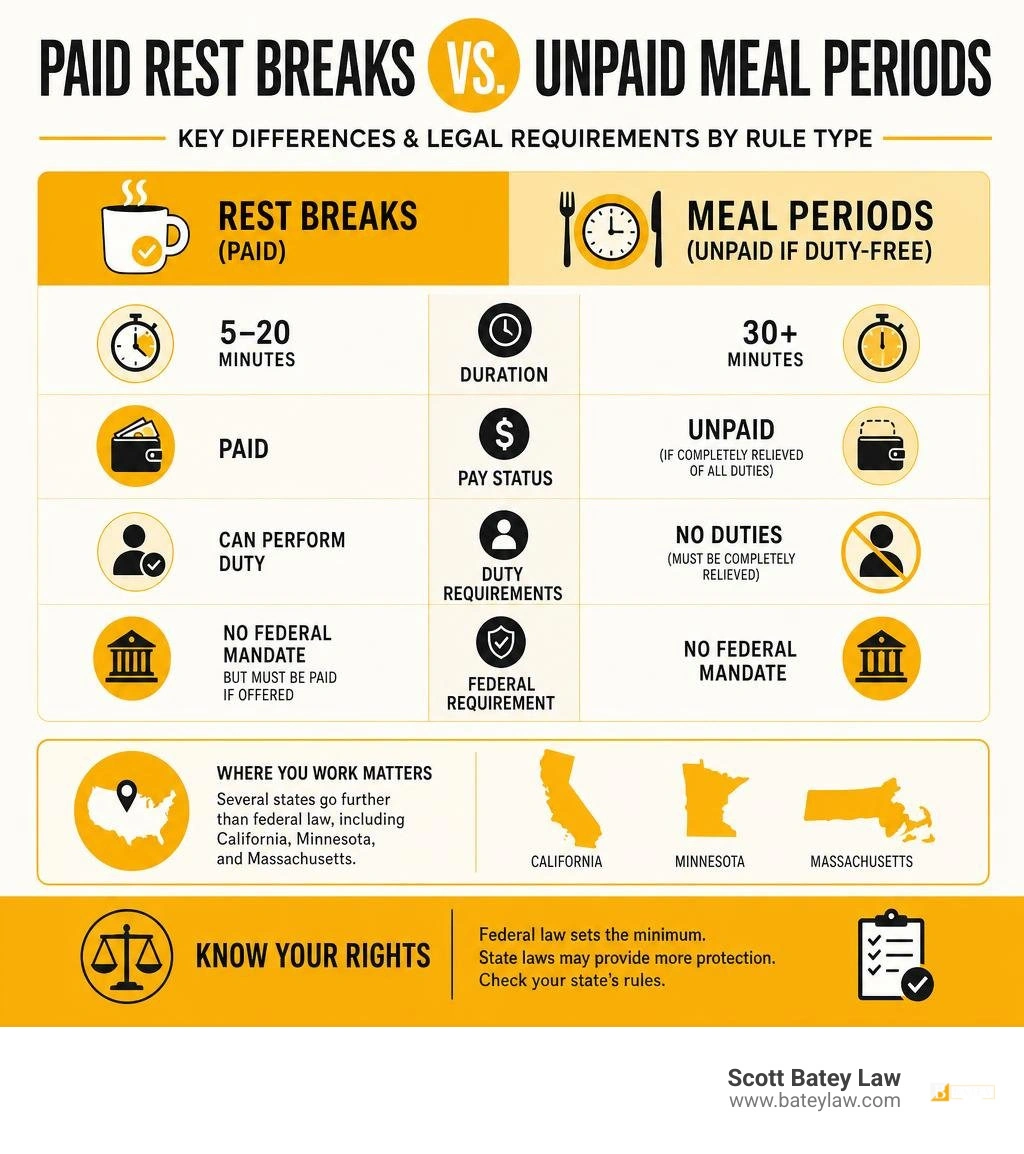
| Rest break | 5-20 minutes | Yes | No mandate, but must be paid if offered |
| Meal period | 30+ minutes | No (if duty-free) | No mandate |
| Nursing/lactation break | Reasonable time | Varies | Yes (federal PUMP Act) |
The key rules in plain English:
- Federal law does not require employers to give you rest or meal breaks
- But if your employer offers short breaks (5 to 20 minutes), those must be paid
- Meal breaks of 30 minutes or more can be unpaid — but only if you are completely relieved of all duties
- Several states go further than federal law, including California, Minnesota, and Massachusetts
Where you work matters a lot. Your rights depend heavily on your state.
I'm Scott Batey, a Michigan employment lawyer with nearly 30 years of experience helping workers understand and enforce their rights — including disputes involving employment law breaks at work, wage theft, and off-the-clock work. If you believe your employer has violated your break rights, this guide will walk you through exactly what the law requires and what you can do about it.
Federal FLSA Standards for Employment Law Breaks at Work

When it comes to workplace rights, many employees assume that federal law guarantees them a lunch hour or at least a couple of quick coffee breaks throughout the day. However, under the Fair Labor Standards Act (FLSA), which is enforced by the U.S. Department of Labor, there is no federal mandate requiring employers to offer rest or meal breaks of any kind.
Instead, the FLSA focuses on how breaks must be compensated if an employer chooses to offer them. The federal framework divides break time into two distinct categories: compensable (paid) time and non-compensable (unpaid) time. Understanding this distinction is vital to recognizing when an employer's break policy crosses the line into wage theft. For more details on federal rules, you can review the official Federal break guidelines.
Paid Rest Breaks vs. Unpaid Meal Periods
Under the FLSA, short rest breaks and coffee breaks lasting between 5 and 20 minutes are considered compensable work hours. This means your employer cannot dock your pay for taking a quick 10-minute breather to stretch your legs or grab a cup of coffee. These short periods are viewed as beneficial to the employer because they help sustain employee productivity and focus.
In contrast, true meal periods—which typically last 30 minutes or longer—are not considered work time and do not have to be paid. However, for a meal break to be legally unpaid, the employee must be completely relieved of all duties for the entire duration of the break.
This is where many employers get into legal trouble. If you are required to eat your lunch at your desk while answering the occasional phone call, monitoring an email inbox, or waiting for a customer, you are not completely relieved of duty. In the eyes of the law, you are still working, and that entire 30-minute block must be paid. When employers fail to pay for these "working lunches," it constitutes a serious violation. If you have been forced to work through your designated unpaid breaks, you may be facing Wage theft and off-the-clock work issues that warrant legal representation.
Federal Lactation and Nursing Break Requirements
While the FLSA does not mandate standard rest breaks, federal law does carve out a strict requirement for nursing mothers. Under the Providing Urgent Maternal Protections for Nursing Mothers Act (PUMP Act), employers of all sizes are required to provide reasonable break time for an employee to express breast milk for up to one year after the child's birth.
In addition to providing "reasonable time," employers must provide a private space for lactation. This space must meet specific criteria:
- It must be completely shielded from view.
- It must be free from intrusion by coworkers and the public.
- It cannot be a bathroom or toilet stall.
If a nursing employee is not completely relieved of duty during these lactation breaks, the time must be compensated as hours worked. Staying compliant with these standards is a major focus of federal workplace regulations. To understand how these requirements intersect with broader compensation rules, read our guide on 2026 pay changes and compliance.
How Collective Bargaining Agreements Affect Employment Law Breaks at Work
Collective bargaining agreements (CBAs) negotiated by labor unions play a massive role in shaping workplace break policies. Because federal law provides only a baseline framework, unions frequently negotiate highly structured break schedules directly into their employment contracts.
A CBA can establish mandatory paid rest periods, longer unpaid meal breaks, and specific timing requirements that exceed both federal and state minimums. In some jurisdictions, state law explicitly allows employers and unions to agree to alternative break structures that differ from standard state statutes. If you are a union member, your first step in any break dispute should always be to consult your union representative and review your specific collective bargaining agreement.
State-Specific Break Laws: California, Minnesota, Massachusetts, and North Carolina

Because federal law leaves break policies largely to the discretion of employers, individual states have stepped in to build their own legal frameworks. This has created a patchwork of regulations across the country.
For businesses operating in Metro Detroit—including Bingham Farms, Southfield, and Troy—understanding these state-by-state variations is increasingly important. Many local companies employ remote workers located in other states, and those remote employees are generally protected by the labor laws of the state where they physically perform the work.
Below is a diagram illustrating how state laws split into different tiers of worker protection:
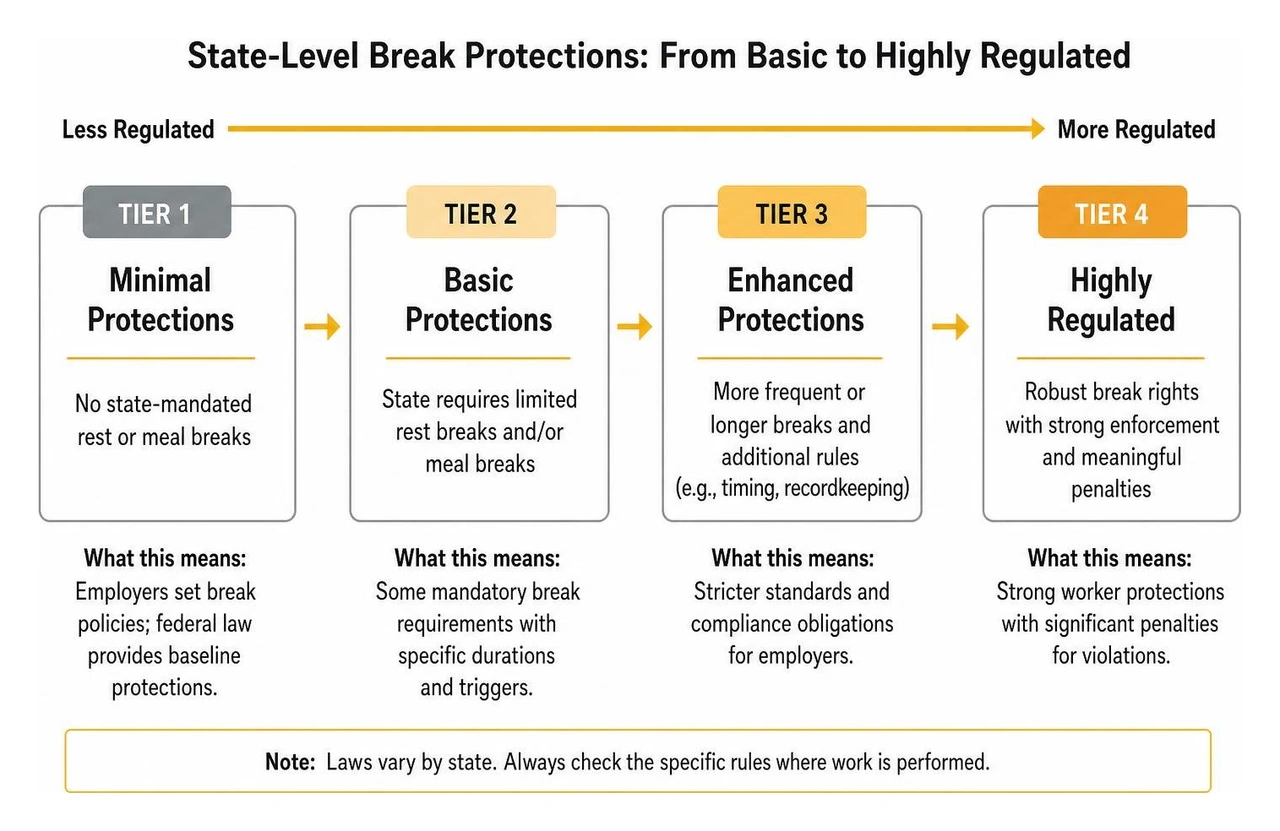
To see how these rules compare in detail, let's look at the specific requirements in several key states:
| State | Rest Break Requirement | Meal Break Requirement | Key Penalty / Remedy |
|---|---|---|---|
| California | 10 paid minutes per 4 hours worked | 30 unpaid minutes after 5 hours | 1 hour of regular pay per missed break |
| Minnesota | 15 paid minutes per 4 hours worked | 30 unpaid minutes after 6 hours | Liquidated damages equal to break value |
| Massachusetts | No state mandate | 30 unpaid minutes after 6 hours | Filing a wage complaint with the AG |
| North Carolina | No state mandate (adults) | No state mandate (adults) | Federal FLSA standards apply |
For employers managing multi-state workforces, referencing the official California DLSE guidelines is an excellent way to understand the most stringent compliance standards in the nation.
California Meal and Rest Break Rules
California has some of the most employee-friendly labor laws in the United States. Under California law, non-exempt employees are entitled to a net 10-minute paid rest break for every four hours worked (or major fraction thereof, which is defined as any shift longer than two hours). These breaks must be scheduled as close to the middle of the work period as is practically possible.
Additionally, California employers must provide a 30-minute uninterrupted, duty-free meal break if an employee works more than five hours in a day. If a shift exceeds ten hours, a second 30-minute meal break is required.
If an employer fails to provide an employee with a required rest or meal break, they must pay the employee a penalty of one additional hour of regular pay for each day the violation occurs, up to a maximum of two premium hours per day (one for meal violations and one for rest violations). For a deeper dive into these complex regulations, refer to the California rest break FAQ.
Minnesota's 2026 Updated Break Requirements
Minnesota enacted major updates to its workplace break laws that went into effect on January 1, 2026. Under the current law, Minnesota employers must allow employees to take a rest break of at least 15 minutes within each four consecutive hours of work. This break must be paid if it is under 20 minutes, and it must provide the employee with sufficient time to use the nearest restroom.
Minnesota also mandates a 30-minute meal break for any employee working six or more consecutive hours. Like federal law, this meal break can only be unpaid if the employee is completely relieved of all duties. If you want to review the statutory language or look up specific industry exemptions, check out the Minnesota DLI break rules.
Massachusetts and North Carolina Break Standards
Massachusetts takes a more streamlined approach. While the state does not mandate short rest breaks, it does guarantee workers the right to a 30-minute unpaid meal break if they work more than six hours in a calendar day. During this meal break, employees must be free to leave the workplace premises and must be entirely relieved of their duties.
North Carolina, on the other hand, represents the opposite end of the regulatory spectrum. The North Carolina Wage and Hour Act does not require rest breaks or meal breaks of any kind for employees who are 16 years of age or older. For adult workers, North Carolina defaults entirely to the federal FLSA standards. The state only mandates breaks for youth workers under the age of 16, who must receive a 30-minute break after working five consecutive hours.
Remedies, Penalties, and Retaliation for Break Violations
When an employer systematically denies employees their legal breaks or forces them to work off-the-clock during unpaid meal periods, they are violating the law. Employees have powerful legal mechanisms to recover unpaid wages, but timing and documentation are critical. If your employer has ignored your complaints about missed breaks, you can learn how to build strategic pressure by reading about Wage and hour retaliation leverage.
Legal Remedies for Missed Breaks and Wage Theft
If an employer fails to provide required breaks or refuses to pay for short rest periods, employees can pursue several remedies:
- Back Wages: Recovery of unpaid compensation for all hours worked off-the-clock.
- Premium Pay: In states like California, a full hour of regular pay for every day a break was missed.
- Liquidated Damages: In states like Minnesota, employers may be liable for the value of the missed break plus an additional equal amount as damages.
- Civil Citations: Government agencies can issue fines and citations directly to non-compliant businesses.
In Michigan, there is no state law requiring breaks for adult workers. However, if a Michigan employer does offer breaks, they must comply with the strict federal guidelines regarding paid versus unpaid time. To understand how Michigan handles these wage and hour disputes, you can consult the official Michigan wage and hour rules.
Retaliation Protections Under Employment Law Breaks at Work
Many workers hesitate to speak up about missed breaks or unpaid work because they fear they will be fired, demoted, or targeted by management. It is highly illegal for an employer to retaliate against you for asserting your rights under wage and hour laws.
If you report a break violation, file a complaint with the Department of Labor, or object to working off-the-clock, you are engaging in protected activity. If your employer takes adverse action against you shortly after you speak up, you may have grounds for a retaliation lawsuit. Our team regularly represents Metro Detroit workers in these exact situations. If you have faced adverse treatment in Southfield, contact a Retaliation lawyer in Southfield MI immediately. We also protect workers who speak up about broader workplace violations; read more about your rights regarding Retaliation after reporting safety issues.
Can Employees Voluntarily Waive or Skip Required Breaks?
In states with strict break mandates, a common question is whether an employee can simply choose to work through their breaks to leave early or earn extra money.
The short answer is yes, but with major caveats. Under the law, employers must make the breaks available and ensure employees are free to take them. If an employee genuinely wishes to skip a break, they may do so voluntarily. However, to protect themselves from liability, employers should always secure a voluntary waiver in writing.
Furthermore, if an employer orders an employee to take their scheduled break and the employee refuses, the employer has the right to discipline the employee for insubordination. Employees cannot unilaterally decide to ignore company scheduling policies.
Frequently Asked Questions about Workplace Breaks
Can an employer force me to stay on the premises during an unpaid meal break?
Yes. Under federal law and most state laws, an employer can legally require you to remain on the work premises during your 30-minute meal break. As long as you are completely relieved of all work duties and are free to spend your break relaxing, eating, or socializing, the break can remain unpaid. However, if your employer restricts your freedom to the point where you are still effectively performing work-related functions, the break must be paid.
Can I combine my rest breaks and meal periods to leave early?
Generally, no. In states with mandatory rest and meal breaks, the timing of those breaks is specifically regulated. For instance, rest breaks are designed to be taken near the middle of each work segment to prevent physical and mental fatigue. Tacking your 10-minute rest breaks onto your 30-minute lunch break—or using them to leave work 20 minutes early—violates the intent of the law and is typically prohibited by company policy.
Are smoking breaks legally required under federal or state law?
No. There is no federal or state law that requires employers to provide extra breaks specifically for smoking. If an employer permits smoking breaks, those breaks are treated as standard rest periods. This means that if they last 20 minutes or less, they must be paid. Employers are entirely within their rights to restrict smoking to designated areas or ban it on company property altogether.
Conclusion
Navigating the landscape of employment law breaks at work requires a clear understanding of both federal standards and state-specific regulations. Whether you are dealing with a complex multi-state wage dispute, off-the-clock work demands, or unlawful retaliation, you do not have to face your employer alone.
At Scott Batey Law, we have spent over 25 years fighting for the rights of workers across Metro Detroit, including Bingham Farms, Southfield, Troy, Royal Oak, and Farmington Hills. We provide the personalized, award-winning representation you need to hold non-compliant employers accountable and secure the compensation you deserve. If you believe your rights have been violated, schedule a consultation with an experienced Metro Detroit wage and overtime lawyer today.