.png)
Fired After Medical Leave? FMLA + ADA Red Flags Employees Should Know
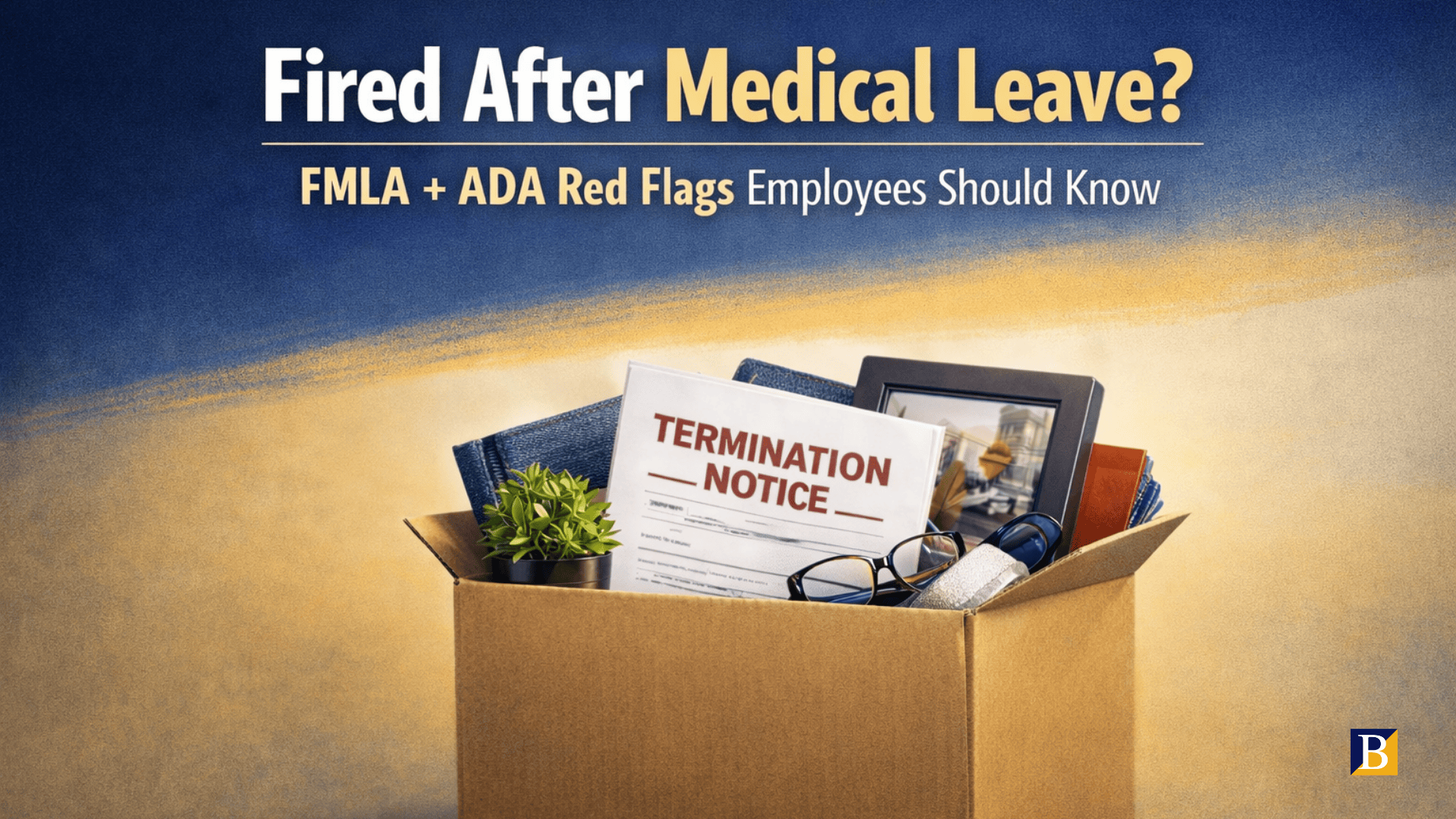
Few things are more jarring than returning to work after medical leave—only to be met with discipline, demotion, or termination. Many employees expect relief when they come back: the hardest part is over, their health is improving, and they’re ready to resume their job. Instead, they’re told their position has changed, their performance is suddenly an issue, or their job no longer exists.
Medical leave often changes how employers view employees. Once someone needs time off for a serious health condition, some employers begin to see them as inconvenient, unreliable, or expendable. Even when those assumptions are unspoken, they can quietly influence decisions made behind closed doors.
This is where job protection and disability rights overlap. Federal law recognizes that employees should not have to choose between their health and their livelihood. When adverse action closely follows medical leave, it’s not just unfortunate timing—it can raise serious legal concerns.
Understanding the Two Laws at Play: FMLA and ADA
The Family and Medical Leave Act (FMLA)
The Family and Medical Leave Act (FMLA) provides eligible employees with job-protected leave for serious health conditions, including their own medical issues or those of close family members.
Key FMLA protections include:
- Up to 12 weeks of unpaid, job-protected leave
- Coverage for serious physical or mental health conditions
- Protection from retaliation for taking leave
To be eligible, an employee must generally:
- Work for a covered employer
- Have worked a minimum number of hours
- Have sufficient length of employment
Critically, the FMLA gives employees the right to return to the same or an equivalent position after leave. Employers cannot lawfully punish employees for using protected medical leave.
The Americans with Disabilities Act (ADA)
The Americans with Disabilities Act (ADA) focuses on protection against disability discrimination, not just leave.
Under the ADA:
- Employers may not discriminate based on a disability
- Employers must engage in an interactive process when an employee has limitations
- Employers must provide reasonable accommodations, absent undue hardship
Accommodations can include modified duties, schedule adjustments, remote work, or additional leave. Importantly, ADA obligations often continue after FMLA leave ends.
Why These Laws Often Intersect
Medical leave frequently triggers disability protections. An employee who takes FMLA leave for a serious health condition may also be protected under the ADA once they return—or even before leave begins.
Problems arise when employers:
- Treat FMLA leave as a one-time obligation that ends all responsibility
- Demand employees be “100% healed” before returning
- Ignore or deny accommodation requests without discussion
These laws are meant to work together, not cancel each other out. When employers confuse the boundaries—or deliberately blur them—employees in Michigan and elsewhere often find themselves unlawfully pushed out after protecting their health.
FMLA Red Flags Employees Should Know
Termination Shortly After Leave Ends
One of the most common warning signs is temporal proximity—termination or discipline that closely follows protected leave.
Courts regularly look at:
- How soon after leave the adverse action occurred
- Whether issues appeared only after the employee returned
- Whether the employer’s explanation existed before the leave
Employees often notice increased scrutiny upon return: heightened monitoring, sudden performance concerns, or a colder tone from management. When nothing materially changed except the employee’s medical leave, that timing can be powerful evidence of retaliation.
Interference With FMLA Rights
The FMLA doesn’t just prohibit termination—it also prohibits interference with protected leave.
Red flags include:
- Discouraging an employee from taking leave
- Suggesting leave will “hurt” their career
- Counting protected leave against attendance, productivity, or performance metrics
Employers cannot lawfully penalize employees for time they were entitled to take. When leave is treated as a negative factor, that can violate the FMLA even if the employee isn’t immediately fired.
Retaliation for Taking Protected Leave
Retaliation doesn’t require an explicit threat or punishment. It often shows up through subtle changes in treatment.
Examples include:
- Discipline tied directly to absences covered by FMLA
- Demotions or undesirable reassignments after leave approval
- Exclusion from projects, meetings, or advancement opportunities
If the message after leave is “things are different now,” the law requires a closer look at why.
ADA Red Flags After Medical Leave
Refusal to Discuss Accommodations
One of the clearest ADA violations is refusing to engage in the interactive process.
Red flags include:
- Ignoring accommodation requests
- Making unilateral decisions without discussion
- Dismissing requests as “not workable” without analysis
The ADA requires dialogue. Employers don’t get to decide unilaterally that accommodations are unnecessary or impossible without engaging the employee in good faith.
“100% Healed” Return-to-Work Requirements
Employers sometimes insist employees must be fully healed before returning. These “100% healed” policies are legally risky and often unlawful.
The ADA does not require full recovery. It requires employers to assess:
- What the employee can do
- Whether reasonable accommodations would allow the employee to work
- Whether restrictions can be accommodated without undue hardship
The idea that an employee must be perfectly healthy to return is a myth—and one that frequently leads to liability.
Using Medical Information Against the Employee
Another red flag is how employers handle medical information after leave.
This includes:
- Overreliance on medical restrictions as a reason to terminate
- Treating limitations as automatic disqualifiers
- Assuming inability rather than evaluating accommodations
Medical information should guide accommodations—not become ammunition for termination.
Evidence That Strengthens FMLA and ADA Claims
Timing Evidence
Timing is often the backbone of these cases.
Key timing evidence includes:
- Leave approval dates
- The return-to-work date
- How soon discipline, demotion, or termination followed
When an employee is terminated days or weeks after returning from protected leave, courts look closely at whether the employer’s stated reason actually existed before the leave. A clean record going into leave followed by immediate adverse action upon return raises serious questions.
Documentation
Written records frequently determine whether a claim succeeds.
Important documents include:
- Medical certifications supporting the need for leave
- Accommodation requests and employer responses
- Performance reviews before and after leave
A sudden shift from positive evaluations to criticism—without a meaningful change in performance—can expose retaliation or disability bias. Documentation showing that expectations changed only after leave is often powerful evidence.
Comparator Evidence
Comparator evidence shows how others were treated.
This includes:
- How similarly situated employees were treated when they did not take leave
- Whether attendance, performance, or policy rules were enforced selectively
- Whether other employees were given flexibility denied to the employee returning from leave
If leave becomes the dividing line between favorable and unfavorable treatment, the employer’s explanation deserves scrutiny.
What Employees Should Do If Terminated After Medical Leave
Preserve Evidence Immediately
As soon as termination occurs, preserve:
- Emails, performance reviews, and HR communications
- Medical and leave documentation
- Any written explanation for the termination
Access to company systems often disappears quickly. Preserving evidence early protects your ability to prove what actually happened.
Avoid Common Mistakes
Strong claims are often weakened by avoidable missteps, including:
- Sending emotional or accusatory messages
- Posting about the situation on social media
- Signing severance agreements or releases without legal review
Severance agreements often include waivers of FMLA and ADA claims. Once signed, those rights are usually gone—even if the termination was unlawful.
Understand Deadlines
FMLA and ADA claims are subject to strict federal and state deadlines. Waiting too long can bar claims entirely, regardless of their strength. Delay also weakens evidence and reduces leverage.
If you work in Michigan and were terminated after medical leave, timing matters. Acting early preserves options. Waiting rarely helps.
When termination follows medical leave, the law doesn’t assume coincidence. With the right evidence—and the right strategy—employees can hold employers accountable for punishing them for protecting their health.
Medical Leave Shouldn’t Cost You Your Job
Being fired after medical leave is not automatically illegal—but when termination closely follows protected leave or an accommodation request, the law demands answers. Employers cannot punish employees for protecting their health, and they cannot sidestep their obligations by hiding behind timing, paperwork, or vague performance claims.
Batey Law Firm, PLLC focuses exclusively on employment law and regularly represents employees across Michigan who were terminated after taking medical leave or requesting accommodations. These cases are fact-driven, timing-sensitive, and evidence-dependent—and early legal guidance often makes the difference between a viable claim and a missed opportunity.
If you were fired after medical leave—or fear that taking leave has put your job at risk—speak with an employment lawyer before evidence disappears or deadlines expire.
Contact Batey Law Firm, PLLC
Batey Law Firm, PLLC
30200 Telegraph Rd., Suite 400
Bingham Farms, MI 48025
📞 Phone: 248-540-6800
📧 Email: sbatey@bateylaw.com
🌐 Website: https://www.bateylaw.com