.png)
Fired After Reporting Harassment: Retaliation and Your Rights

What It Means to Be Fired After Reporting Harassment — and What the Law Says
If you were fired after reporting harassment, that termination may be illegal retaliation under both federal and Michigan law. Here is what you need to know right away:
Quick Answer: Is It Illegal to Fire Someone for Reporting Harassment?
- Yes. Federal law (Title VII of the Civil Rights Act) and Michigan's Elliott-Larsen Civil Rights Act both prohibit firing an employee in retaliation for reporting workplace harassment.
- You don't need to prove the harassment happened. You only need to show you made a good-faith complaint and that your employer punished you for it.
- Retaliation isn't always a pink slip. It can also include demotions, negative performance reviews, schedule changes, or exclusion from meetings.
- Deadlines are strict. You typically have 180 to 300 days to file a charge with the EEOC, depending on your state.
- Act fast. Evidence disappears, witnesses move on, and filing windows close quickly.
The stakes are real. A federal jury in Yakima awarded a former Walmart employee $23 million after she was fired for reporting sexual harassment — two weeks after using the company's own ethics hotline. Her supervisor had dismissed her concerns, saying the accused "didn't look the type."
That case is an extreme example, but the pattern it reflects is common: an employee does the right thing, reports misconduct, and ends up worse off than before.
Nearly 38% of employees say they have witnessed workplace harassment in the past five years. About 21% say they have personally experienced it. Yet up to 90% of those who experience harassment never file a formal complaint with the EEOC — in part because they fear exactly this outcome.
If you are in Michigan and facing this situation, you are not powerless. Understanding your rights is the first step.
I'm Scott Batey, a Michigan employment lawyer with nearly 30 years of experience representing employees who have been fired after reporting harassment, retaliated against, or wrongfully terminated. This guide will walk you through exactly what to do, what the law protects, and how to build the strongest possible case.
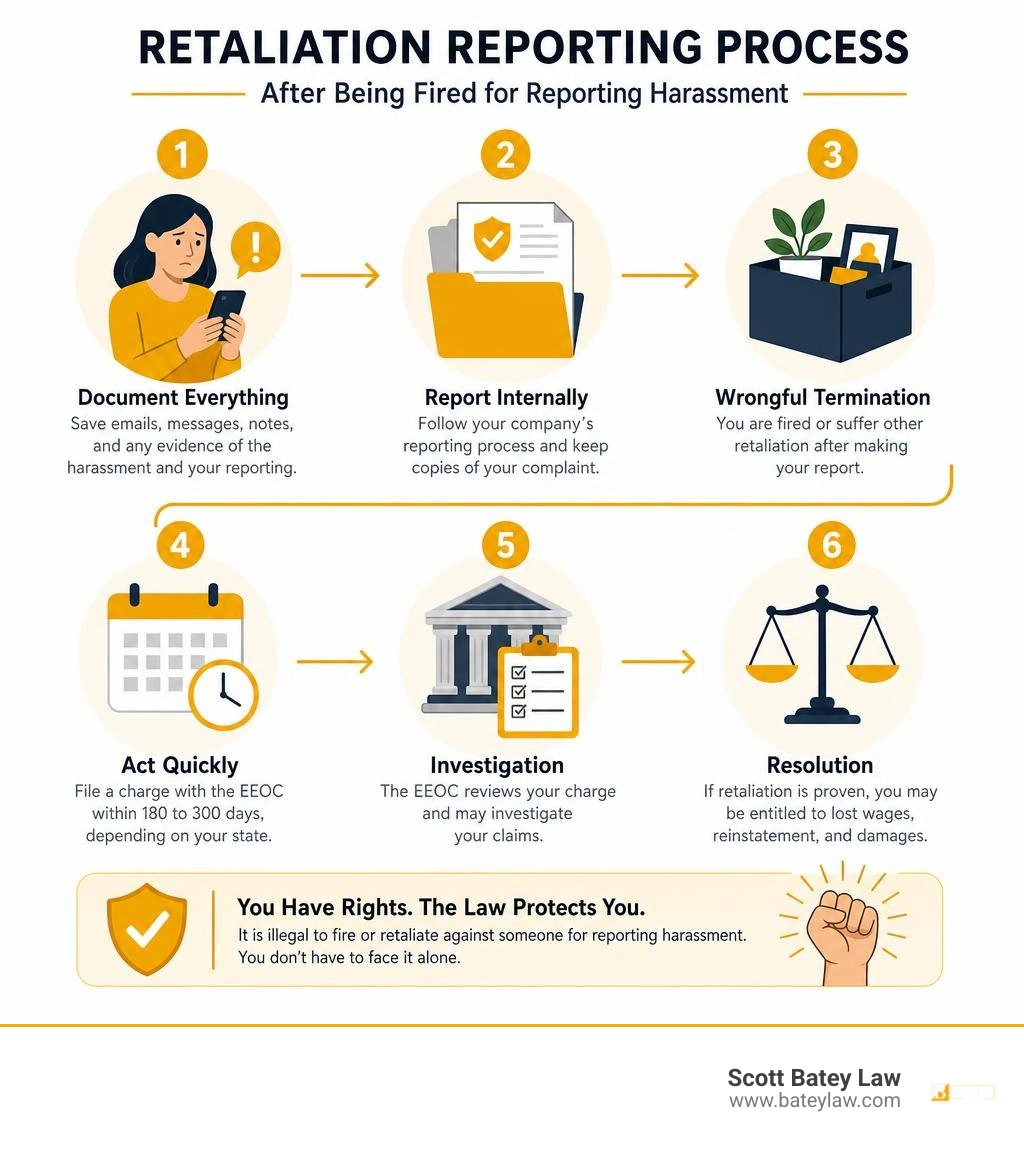
What to Do If You Are Fired After Reporting Harassment

Finding yourself suddenly out of a job after standing up for yourself or a colleague is an incredibly stressful experience. You might feel angry, betrayed, and anxious about your financial future. However, the actions you take immediately following a retaliatory termination can make or break your potential legal claim.
When you are let go, the power dynamic changes, but you still have leverage if you handle the transition strategically. To protect your rights and set yourself up for a successful legal challenge, you need to understand how to respond immediately. For a deeper dive into protecting your career during this transition, read our guide on Retaliation After You Speak Up: How Michigan Employees Can Protect Themselves.
Immediate Steps to Take After Being Fired after Reporting Harassment
If you have just been handed a pink slip, take a deep breath. Do not sign anything on the spot, especially a severance agreement or a release of claims. Employers often use high-pressure tactics to get terminated employees to waive their right to sue in exchange for a few weeks of pay.
Instead, follow these critical steps immediately:
- Preserve All Evidence: Do not delete any emails, text messages, or personal notes. If you still have access to your personal phone, back up any texts or call logs showing communication with your harasser, witnesses, or HR.
- Secure Your Personal Belongings and Records: Ensure you have copies of your employment contract, employee handbook, and any written performance reviews.
- Do Not Vent on Social Media: It is incredibly tempting to blast your former employer on LinkedIn or Facebook, but defense attorneys will search your social media accounts for anything they can use to paint you as unprofessional or dishonest.
- Consult an Experienced Employment Attorney: Before you negotiate severance or file an agency complaint, speak with a lawyer who understands Michigan employment law.
To make sure you do not miss a beat on your last day, review our checklist of 5 Evidence Moves to Make the Day You're Terminated.
How to Build a Strong Case When Fired after Reporting Harassment
To win a retaliation case, you must show a direct connection between your harassment report and your termination. Employers rarely admit they are firing you because you complained; instead, they will try to manufacture a "legitimate" reason, such as poor performance or a restructuring.
To defeat this defense, you must build a comprehensive evidence timeline.
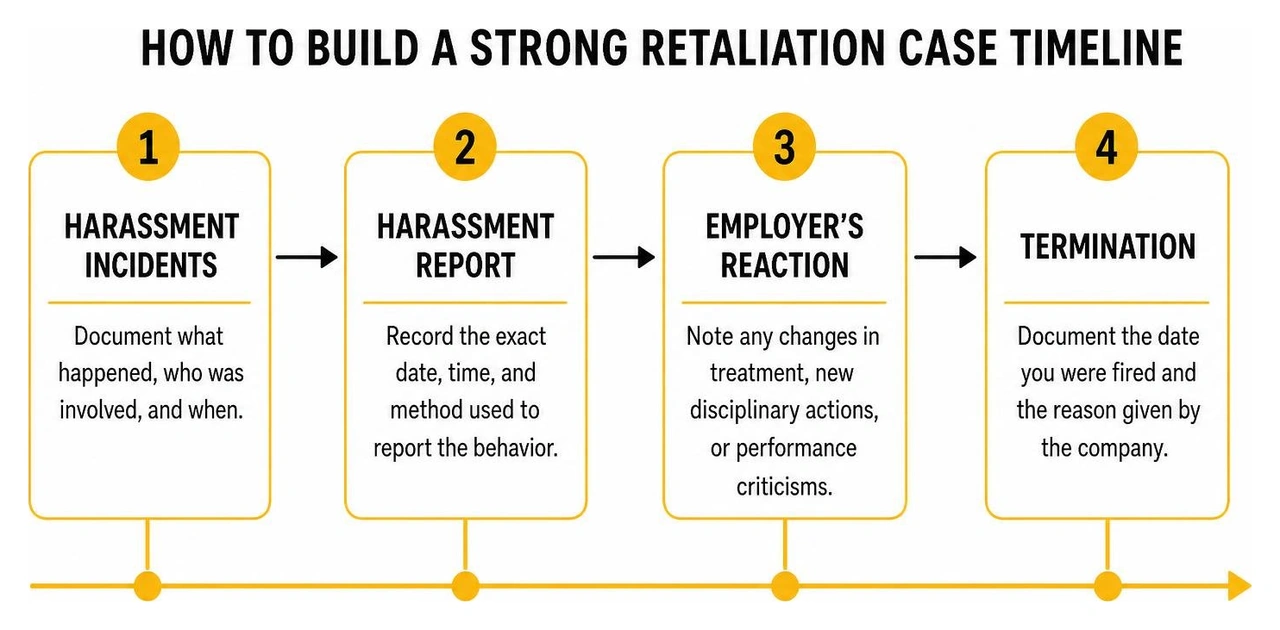
Your timeline should document:
- The Harassment Incidents: Exactly what happened, who was involved, and when.
- The Harassment Report: The exact date, time, and method you used to report the behavior (e.g., sending an email to HR or speaking to a supervisor).
- The Employer's Reaction: Any sudden changes in how you were treated, new disciplinary actions, or sudden performance criticisms.
- The Termination: The date you were fired and the reason given by the company.
Gathering witness statements from coworkers who saw the harassment or heard management's reactions is also incredibly helpful. Additionally, gather your past performance reviews showing a history of satisfactory or excellent work to prove that any sudden claims of "poor performance" are merely a cover-up. Learn how to structure this documentation with our guide on How to Build an Evidence Timeline After Termination.
Understanding Your Legal Protections Against Workplace Retaliation

The law is clear: you have a right to work in an environment free from discrimination and harassment, and you have a right to speak up when those boundaries are crossed. When an employer fires you for exercising these rights, they violate both federal and state laws.
If you are dealing with workplace pushback in areas like Birmingham, Southfield, or Royal Oak, check out our resource on being a Retaliation Lawyer in Birmingham MI: When Workplace Pushback Becomes a Legal Claim.
Federal and State Anti-Retaliation Laws
Employees in Michigan are protected by two primary legal frameworks:
- Title VII of the Civil Rights Act of 1964: This federal law prohibits employers with 15 or more employees from discriminating based on race, color, religion, sex (including pregnancy, sexual orientation, and gender identity), and national origin. It also strictly prohibits retaliation against anyone who opposes these illegal practices or participates in an EEO investigation.
- The Elliott-Larsen Civil Rights Act (ELCRA): This is Michigan's state-level civil rights law. It provides similar protections to Title VII but applies to all Michigan employers, regardless of size. This means even if you work for a small business in Troy, Ferndale, or Berkley with fewer than 15 employees, you are still protected against retaliatory termination under state law.
Under these laws, if you are fired after reporting harassment, you do not have to prove that the underlying harassment was severe enough to violate the law. You only need to show that you had a reasonable, good-faith belief that the conduct was illegal, and that your complaint was the motivating factor behind your firing.
What Constitutes "Protected Activity" Under the Law?
Not every workplace complaint is legally protected. To claim retaliation, you must have engaged in a "protected activity." Under the law, protected activities generally fall into two categories:
- Opposition: Complaining to HR, management, or a supervisor about harassment or discrimination; refusing to follow orders that would result in discrimination; or resisting unwelcome sexual advances.
- Participation: Filing a formal charge with the Equal Employment Opportunity Commission (EEOC), testifying as a witness in a coworker's discrimination lawsuit, or cooperating with an internal company investigation.
Even supporting a coworker's complaint is protected. If you backed up a colleague during an HR probe and were fired as a result, that is illegal retaliation. For more on how to safely stand by your colleagues, read How to Support a Coworker's Harassment Report Without Risking Retaliation.
However, you must be careful to follow company reporting procedures. In the federal case Kristie Alley v. Penguin Random House (7th Cir. 2023), the court ruled that an employee who received a harassment complaint from a coworker but decided to conduct her own independent investigation instead of reporting it to HR—as mandated by company policy—was not engaged in a protected activity. This case highlights why it is vital to follow your employer's official reporting channels to keep your legal protections intact. Read the full case details at Kristie Alley v. Penguin Random House (7th Cir. 2023).
How Employers Mask Retaliation (And How to Prove It)
Employers rarely hand you a termination letter that says, "We are firing you because you complained to HR." Instead, they will go to great lengths to hide their retaliatory motives behind a mask of legitimacy, often referred to in legal terms as "pretext."
A high-profile example of this occurred at Google, where a senior employee alleged she was made redundant after reporting a manager who shared explicit personal stories and inappropriate photos. While the company claimed her redundancy was part of a normal business restructuring affecting dozens of roles, internal messages from leadership suggested a desire to use the redundancy process as a convenient way to "exit" specific people from the team. Read more about this case on World Justice News.
The Redundancy and Layoff Excuse
One of the most common ways employers mask retaliation is by waiting for a scheduled reduction-in-force (RIF), corporate restructuring, or layoff, and then placing the complaining employee's name at the top of the termination list.
We see this tactic in cases across the country. For example, a pipeline technician sued Alyeska, alleging his employer used a reduction-in-force as an excuse to fire him after he opposed sexual harassment and participated in the company's internal investigation. The employer attempted to use disciplinary records—which the employee argued were manufactured in retaliation for his complaints—to justify his inclusion in the layoff. You can read more about this ongoing legal battle via the Human Resources Director.
To defeat this defense, we look for evidence of selective termination. Did the company only eliminate your role, or did they lay off others with similar performance records? Did they hire someone else to do your exact job under a different title shortly after you left? If so, the restructuring was likely a pretext.
Sudden Performance Scrutiny and Paper Trails
Another classic retaliatory tactic is the sudden "paper trail." You might go years with glowing performance reviews, only to receive a sudden barrage of write-ups, negative feedback, and a Performance Improvement Plan (PIP) within days of filing a harassment complaint.
This sudden shift in management's attitude is a major red flag. If your supervisor suddenly starts micromanaging your hours, criticizing minor details of your work that were previously ignored, or setting unrealistic goals designed to make you fail, they are likely trying to build a paper trail to justify firing you.
To counter this, you must keep meticulous records of your own. Save copies of past positive performance reviews, emails praising your work, and any written communications that show your performance did not suddenly decline. For a step-by-step guide on how to safely document these shifts, see Documenting Harassment the Right Way: Notes, Emails, and Screenshots MI.
Damages and Remedies Available in Retaliation Lawsuits
If you successfully prove that you were fired after reporting harassment, you may be entitled to significant financial compensation and other legal remedies. The law aims to make you "whole"—meaning it attempts to put you back in the financial position you would have been in had the retaliation never occurred.
To give you an idea of what is available, here is a comparison of the types of damages typically recovered under federal (Title VII) and Michigan state (ELCRA) laws:
| Remedy / Damage Type | Federal Law (Title VII) | Michigan Law (ELCRA) |
|---|---|---|
| Back Pay | Covers lost wages and benefits from termination to the date of judgment. | Covers lost wages and benefits from termination to the date of judgment. |
| Front Pay | Covers future lost wages if reinstatement is not possible. | Covers future lost wages if reinstatement is not possible. |
| Emotional Distress | Subject to statutory caps based on employer size ($50,000 to $300,000). | No statutory cap on emotional distress damages. |
| Punitive Damages | Available for malicious/reckless retaliation; subject to caps. | Generally not available, but high compensatory awards are common. |
| Attorney's Fees | Prevailing plaintiffs can recover reasonable attorney's fees. | Prevailing plaintiffs can recover reasonable attorney's fees. |
These damages can add up to substantial amounts. For instance, in the federal retaliation case involving Walmart in Yakima, a jury awarded the plaintiff $23 million in emotional distress and punitive damages after finding the company retaliated against her for reporting sexual harassment. You can read the full story on the Yakima Herald-Republic.
Financial Compensation and Reinstatement
The primary financial remedies in a retaliation lawsuit include:
- Back Pay and Lost Benefits: This includes your lost salary, bonuses, commissions, health insurance benefits, and pension or 401(k) contributions from the day you were fired until the day your case is resolved.
- Front Pay: If the relationship between you and your employer is completely broken—which is almost always the case—reinstatement is not a viable option. In these situations, the court may award front pay to cover your estimated future lost earnings while you search for a comparable job.
- Compensatory Damages: This covers out-of-pocket expenses caused by your termination (such as medical bills for therapy or job-hunting costs) as well as compensation for the pain, suffering, anxiety, and loss of enjoyment of life caused by the retaliatory firing.
Under the law, you have a duty to "mitigate" your damages. This means you must make a reasonable, good-faith effort to look for another job after being fired. Keeping a log of your job applications and interviews is essential to proving you have met this requirement. To learn more about how damages are calculated and what you need to do to protect your financial recovery, consult Retaliation After Reporting Harassment: The Michigan Employee Playbook.
Frequently Asked Questions about Workplace Retaliation
Navigating a wrongful termination claim can be incredibly confusing. Here are answers to some of the most common questions we hear from workers in Oakland County and the metro Detroit area.
What is the deadline to file a retaliation claim?
The deadlines—known as statutes of limitations—are incredibly strict, and if you miss them, you lose your right to seek justice forever.
- EEOC Filing Deadline (Federal Claims): To sue under Title VII, you must first file a formal Charge of Discrimination with the EEOC. In Michigan, you generally have 300 days from the date of the retaliatory action (the day you were fired) to file this charge.
- Michigan State Law (ELCRA): If you choose to file a lawsuit directly under Michigan's Elliott-Larsen Civil Rights Act in state court, you have three years from the date of your termination to file.
Even though three years sounds like a long time, you should never delay. Evidence gets lost, memories fade, and building a strong case takes time.
Can I sue if my harasser is the business owner or there is no HR?
Yes. Many small businesses in Oakland County do not have a formal HR department, and sometimes the person harassing you is the owner, a partner, or a high-level executive.
Under Michigan law, if there is no HR department, you should report the harassment to any supervisor, manager, or owner who is not involved in the behavior. If the harasser is the sole owner of the business, reporting internally may be futile. In these cases, you can bypass internal reporting entirely and file a complaint directly with the EEOC or the Michigan Department of Civil Rights, or consult an employment attorney to discuss filing a lawsuit. For specific strategies on handling harassment in small-business environments, read Reporting Sexual Harassment at Work in Michigan: What to Do and How to Protect Yourself.
What if the harassment itself cannot be proven?
This is one of the most important aspects of retaliation law: you do not have to prove the underlying harassment occurred to win a retaliation claim.
As long as you made your complaint in good faith—meaning you sincerely believed you were experiencing or witnessing illegal harassment—your employer cannot legally fire you for reporting it. Even if an HR investigation or a court later determines that the behavior did not technically rise to the legal definition of a hostile work environment, your termination can still be ruled illegal retaliation. To understand the legal boundaries of what constitutes a hostile work environment in Michigan, see Hostile Work Environment Lawyer in Michigan: When Workplace Harassment Becomes Illegal.
Conclusion
Being fired after reporting harassment is a painful, disruptive experience, but you do not have to go through it alone. The law provides powerful protections for workers who stand up against misconduct, and employers who retaliate must be held accountable.
At Scott Batey Law, we have spent nearly 30 years fighting for the rights of employees in Bingham Farms, Southfield, Troy, Royal Oak, and across metro Detroit. We provide personalized, award-winning representation to help you stand up to corporate retaliation, recover your lost wages, and reclaim your professional dignity.
If you believe you have been wrongfully terminated or retaliated against, do not wait. Contact us today to schedule a confidential consultation, and let us help you protect your career and your future. For more information on how we protect workers under state civil rights laws, visit our Workplace Discrimination and ELCRA Services.