.png)
Finding the Best Hostile Work Environment Attorney for Your Case

When Workplace Harassment Becomes a Legal Problem
A hostile work environment attorney can be one of the most important people in your corner when discrimination or harassment starts affecting your ability to do your job in Michigan.
Here is a quick overview of what you need to know:
| Question | Quick Answer |
|---|---|
| What is a hostile work environment? | Severe or pervasive harassment based on a protected characteristic (race, sex, age, disability, etc.) that interferes with your work |
| Is a rude or yelling boss enough? | No — the behavior must be linked to a protected class, not just general rudeness |
| What laws protect Michigan workers? | Title VII, the Elliott-Larsen Civil Rights Act, the ADA, the ADEA, and others |
| When should you contact an attorney? | As soon as harassment affects your job performance or HR fails to act |
| How long do you have to file? | As little as 180 days with the EEOC — act quickly |
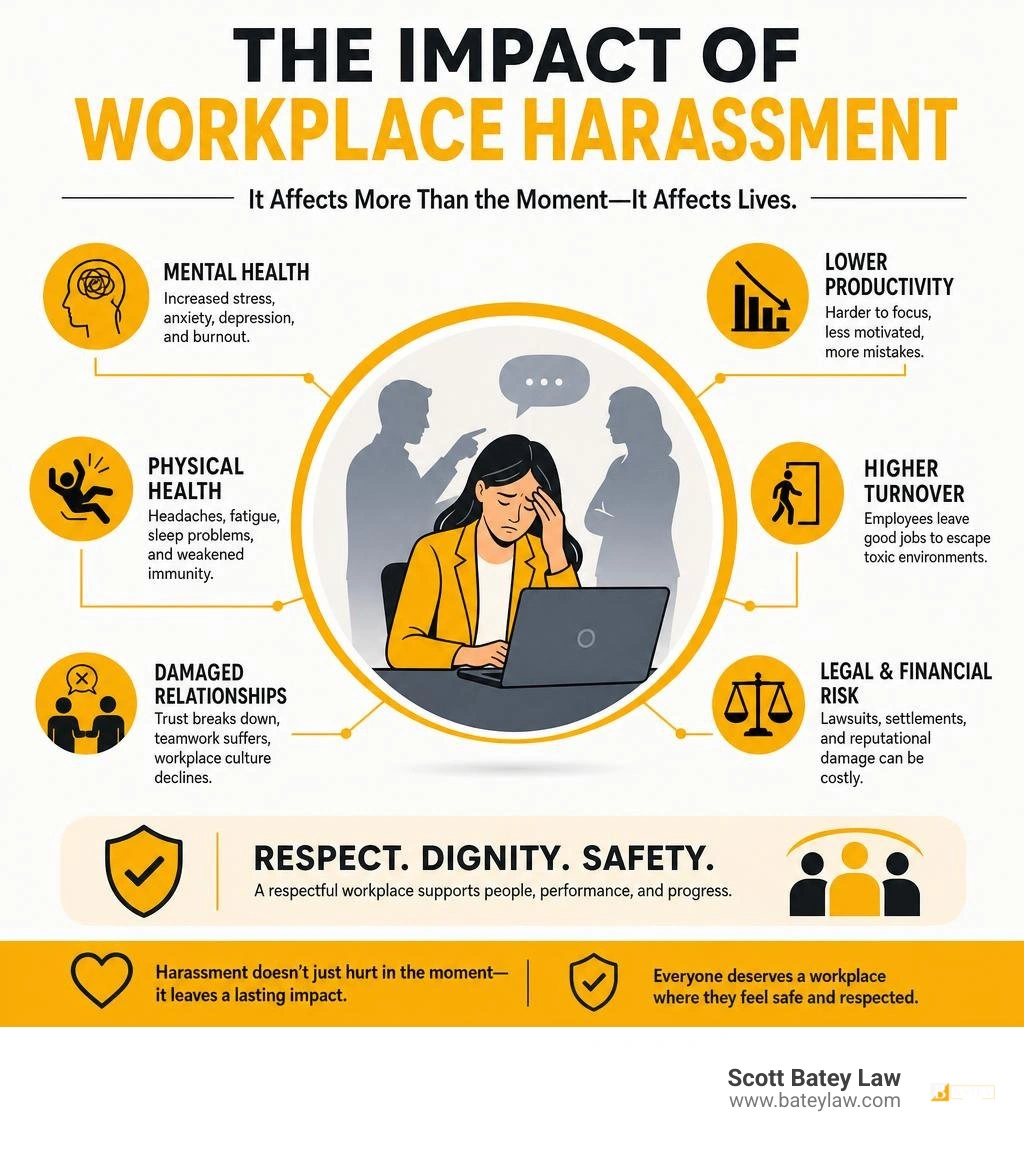
Going to work should not feel like a threat to your health, your dignity, or your livelihood. But for many Michigan employees, that is exactly what it becomes. Offensive slurs, unwanted advances, racially charged comments, or relentless retaliation after reporting misconduct — these are not just unpleasant experiences. When they are tied to who you are as a person, they may cross the line into illegal territory.
The challenge is that most employees do not know where that legal line is. According to available data, 72% of harassment victims never report the abuse — often because they fear it will damage their career rather than protect it. That silence can also hurt a legal case down the road.
I'm Scott Batey, a Michigan employment lawyer who has spent nearly 30 years representing employees in hostile work environment and harassment cases under both Michigan and federal law. As a hostile work environment attorney based in Bingham Farms, I help workers across Michigan understand their rights and take smart, strategic action when employers cross the line. This guide will walk you through everything you need to know to protect yourself.
Understanding the Legal Definition of a Hostile Work Environment
When people talk about a "hostile work environment," they often mean they have a difficult boss, annoying coworkers, or a stressful workload. However, the legal definition is much narrower. To have a legally actionable case, the hostility must cross from "unpleasant" into "unlawful."
Under federal laws like Title VII of the Civil Rights Act of 1964 and Michigan's state-level equivalent, the Elliott-Larsen Civil Rights Act (ELCRA), a hostile work environment is created when an employee is subjected to unwelcome conduct based on a protected characteristic that is so severe or pervasive that it alters the conditions of their employment.
To build a strong case, we must evaluate the situation using two distinct legal standards:
- The Subjective Standard: You, the employee, must personally find the environment hostile, offensive, or abusive.
- The Objective Standard: A "reasonable person" in your position must also find the environment hostile or abusive.
Understanding this distinction is the first step toward determining if you have a claim. You can read a deeper breakdown of this concept in our article Hostile Work Environment vs. Bad Boss: Drawing the Line in Michigan.
To help clarify how the law views these issues, here is a comparison of everyday workplace harassment versus a legally defined hostile work environment:
| Feature | Workplace Harassment (General) | Legally Hostile Work Environment |
|---|---|---|
| Underlying Motivation | Can be personal dislike, bad moods, or general rudeness. | Must be motivated by a protected characteristic (race, gender, age, etc.) or retaliation. |
| Frequency & Severity | May be an isolated rude comment or occasional yelling. | Must be severe or pervasive enough to alter your working conditions. |
| Impact on Employee | Annoying or frustrating, but doesn't legally prevent work performance. | Interferes with job performance or creates an intimidating, abusive atmosphere. |
| Employer Liability | Harder to establish unless company policies are explicitly broken. | Established if management knew (or should have known) and failed to take corrective action. |
If you are experiencing these issues in the Detroit metro area, working with a local employment law attorney can help you determine where your situation falls on this spectrum.
What Legally Constitutes a Hostile Work Environment?
For workplace behavior to meet the legal threshold of a hostile work environment, it must involve discriminatory conduct linked to a protected class. These protected classes include:
- Race, color, or national origin
- Sex, gender, pregnancy, or sexual orientation
- Religion or creed
- Age (specifically protecting workers over 40)
- Disability or genetic information
This discrimination can manifest in several ways, such as:
- Offensive Jokes and Slurs: Repeated use of epithets, derogatory comments, or "jokes" targeting a protected characteristic.
- Physical Threats or Assaults: Intimidating body language, blocking movement, or unwelcome physical contact.
- Visual Harassment: Displaying offensive images, posters, or digital content in the workplace.
- Interference with Work Performance: Sabotaging projects, denying necessary resources, or setting arbitrary rules designed to make you fail.
If you are dealing with these issues in Wayne County, consulting an experienced employment lawyer can give you localized guidance on how Michigan courts interpret these behaviors.
The Difference Between Harassment and a Hostile Work Environment
While the terms are often used interchangeably, there is a technical difference. Harassment refers to the offensive conduct itself—the slurs, the unwanted advances, or the discriminatory remarks. A hostile work environment is the cumulative, systemic impact of that harassment on your ability to do your job.
For example, a single inappropriate comment from a coworker is harassment, but it may not rise to the level of a hostile work environment. However, if that coworker makes those comments daily, and management ignores your complaints, the harassment has escalated into a hostile work environment.
It is also important to distinguish this from other forms of harassment, such as "quid pro quo" (where employment benefits are conditioned on sexual favors). For a plain-English guide on these differences, check out our resource on Quid Pro Quo vs. Hostile Environment: Plain English Guide for Michigan Workers.
How to Prove a Hostile Work Environment in Court

Proving a hostile work environment claim in a Michigan court requires more than just your word against theirs. Because employers rarely leave a clear paper trail of their own misconduct, the burden of proof falls on you and your legal team.
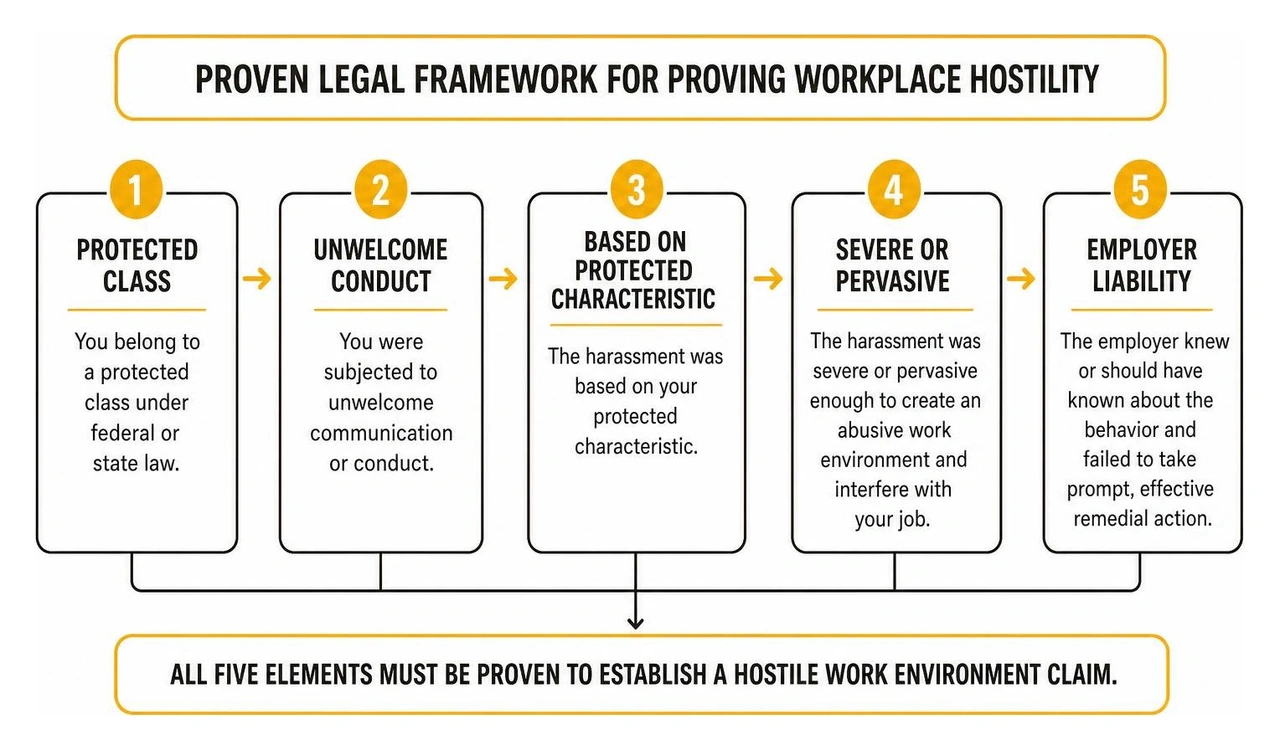
To win a case, we must prove five key elements:
- You belong to a protected class.
- You were subjected to unwelcome communication or conduct.
- The harassment was based on your protected characteristic.
- The harassment was severe or pervasive enough to create an abusive work environment and interfere with your job.
- The employer is liable (meaning they knew or should have known about the behavior and failed to take prompt, effective remedial action).
For a detailed look at how Michigan courts evaluate these elements, see our comprehensive guide on Hostile Work Environment in Michigan: Elements, Evidence, and Deadlines.
To help you visualize how these pieces fit together, we use a structured legal framework to build your case:
Essential Evidence to Gather
If you are currently facing hostility at work, you need to start gathering evidence immediately. Do not rely on your company's IT systems to save this information, as you could lose access to your work email or messaging accounts at any moment.
Be sure to collect and preserve:
- A Contemporaneous Log: Keep a private, handwritten or digital journal (stored on a personal device) detailing every incident. Include dates, times, locations, exactly what was said or done, and who witnessed it.
- Emails and Text Messages: Save copies of any offensive communications. If you sent emails to HR or management complaining about the behavior, forward those to your personal email or print them out.
- Written Complaints: Keep copies of every formal or informal complaint you submitted to your employer, along with their responses (or lack thereof).
- Witness Contact Details: Write down the names, personal phone numbers, and personal email addresses of coworkers who saw the harassment or experienced similar treatment.
- Performance Reviews: Gather your performance evaluations. If your employer suddenly claims your work quality dropped after you reported harassment, your positive past reviews will be crucial evidence to disprove their excuses.
Statutes of Limitations and Deadlines
Time is your enemy in employment law. If you wait too long to take action, you could lose your right to hold your employer accountable.
- Federal Claims (EEOC): To file a claim under federal law (Title VII, ADA, ADEA), you must first file a charge of discrimination with the Equal Employment Opportunity Commission (EEOC). In Michigan, you generally have 300 days from the date of the most recent discriminatory act to file this charge (though some circumstances limit this to 180 days).
- Michigan State Claims (ELCRA): Under Michigan's Elliott-Larsen Civil Rights Act, you do not have to file with an administrative agency first. You can file a lawsuit directly in court. The statute of limitations for ELCRA claims is three years from the date of the harassment.
Because these timelines are strict and can be complex, consulting a hostile work environment attorney early on is the best way to ensure you do not miss a critical deadline.
When to Hire a Hostile Work Environment Attorney
Many employees try to handle workplace abuse on their own, hoping that HR will do the right thing or that the harasser will eventually stop. Unfortunately, HR's primary job is to protect the company from legal liability, not necessarily to protect you.
If you are dealing with systemic hostility, you should consult an attorney as soon as possible. An experienced lawyer can evaluate your case, help you navigate the internal complaint process without falling into common traps, and prepare your case for litigation if necessary.
Signs You Need a Hostile Work Environment Attorney
You should reach out to a specialized employment lawyer if you experience any of the following:
- Unresolved HR Complaints: You reported the harassment to HR or management, but they ignored you, swept it under the rug, or did a mock investigation that changed nothing.
- Retaliatory Actions: After you complained, your employer started treating you worse. Retaliation is highly common—accounting for 52% of all charges filed with the EEOC—and can include demotions, sudden write-ups, or being "iced out" of meetings.
- Constructive Discharge: The working conditions have become so intolerable that any reasonable person would feel forced to quit. If you are thinking about resigning, talk to an attorney first to ensure you don't accidentally damage your legal claims.
- Mental and Physical Health Impacts: The stress of the hostile environment is causing anxiety, depression, sleep loss, or other health issues.
If you are ready to explore your options, you can read more about how we help workers in this situation on our service page: Hostile Work Environment Lawyer in Michigan.
How a Hostile Work Environment Attorney Protects Your Rights
An attorney does far more than just stand next to you in a courtroom. When we take on your case, we act as your shield and advocate by:
- Evaluating Your Claim: We analyze your evidence to determine if your situation meets the legal definition of hostility and identify your best path forward.
- Compiling Evidence: We help you organize your documentation and can legally demand internal company records, emails, and witness depositions that you wouldn't be able to get on your own.
- Handling Communication: Once you hire us, your employer and their legal team must communicate through us. This takes the emotional pressure off your shoulders and prevents them from tricking you into saying something that hurts your case.
- Negotiating Settlements: Many cases are resolved through mediation or negotiation before a trial. We fight to secure maximum compensation for your damages, including back pay, front pay, emotional distress, and attorney's fees.
If you are located in the Oakland County area, you can learn more about our local advocacy on our Hostile Work Environment Lawyer in Southfield, MI page.
Steps to Take If You Are Facing Workplace Harassment
If you find yourself in a hostile work environment, the actions you take right now will directly impact the success of your future legal claim. Here is a step-by-step guide to protecting yourself:
- Consult an Attorney Early: Before you make any major moves, speak with a hostile work environment attorney. We can help you draft your internal complaints and guide your strategy behind the scenes.
- Review the Company Handbook: Find your employer’s official harassment and discrimination policies. Follow their specific reporting procedures to the letter. This is crucial because if you don't give the employer an official chance to fix the problem, they may escape legal liability.
- Report the Behavior in Writing: When you report the harassment to HR or management, do it in writing (email is best). Clearly state that you are being harassed based on a protected characteristic (e.g., "I am being subjected to a hostile work environment based on my race/gender"). Keep a copy of this email for your personal records.
- Keep Doing Your Job: As hard as it is, continue to perform your job duties to the best of your ability. Do not give your employer an easy excuse to fire you for poor performance or insubordination.
- Do Not Quit Prematurely: Quitting your job can make it much harder to recover lost wages in a lawsuit. Unless your physical safety is in immediate danger, consult with an attorney before handing in your resignation.
If you live or work in the Royal Oak area, you can connect with us directly through our Hostile Work Environment Attorney in Royal Oak, MI resource page to discuss your specific situation. We also represent clients in Farmington Hills, Oak Park, and throughout the surrounding communities.
Frequently Asked Questions About Workplace Hostility
What is the difference between a bad boss and a legally hostile work environment?
A bad boss might yell, micromanage, be rude, or set unrealistic deadlines. While this makes for a miserable workday, it is not illegal. To cross the line into a legally hostile work environment, the bad behavior must be motivated by discriminatory intent against a protected characteristic (like your race, sex, age, or disability) or be done in retaliation for you reporting unlawful conduct.
Can I sue for a hostile work environment if I was forced to quit?
Yes. This is a legal concept known as constructive discharge. If the workplace conditions were so severe and intolerable that a reasonable person in your shoes would feel they had no choice but to resign, the law treats your resignation as a wrongful termination. However, constructive discharge has a very high standard of proof, so you should always speak with a lawyer before quitting.
How long do I have to file a claim in Michigan?
It depends on the path you take. If you are pursuing a federal claim, you generally have 180 to 300 days to file a charge with the EEOC. If you are filing a lawsuit under Michigan's Elliott-Larsen Civil Rights Act (ELCRA), you have three years from the date of the last discriminatory act to file. Because these timelines can be tight, it is best to act as quickly as possible to explore your legal avenues and protect your rights.
Conclusion: Partnering with Scott Batey Law for Justice
No one should have to choose between their paycheck and their dignity. If you are dealing with a hostile work environment in Michigan, you do not have to fight this battle alone.
At Scott Batey Law, we have spent nearly 30 years fighting for the rights of workers in Bingham Farms, Southfield, Royal Oak, Detroit, and throughout Oakland County. We provide the personalized, compassionate, and aggressive representation you need to hold your employer accountable and secure the justice you deserve.
Ready to take the first step toward reclaiming your peace of mind? Contact us today to schedule a confidential consultation.
Protect your rights under the Elliott-Larsen Civil Rights Act