
How Long Do You Have to Report Workplace Retaliation in Michigan?

Michigan Retaliation Reporting Deadlines: The Quick Answer
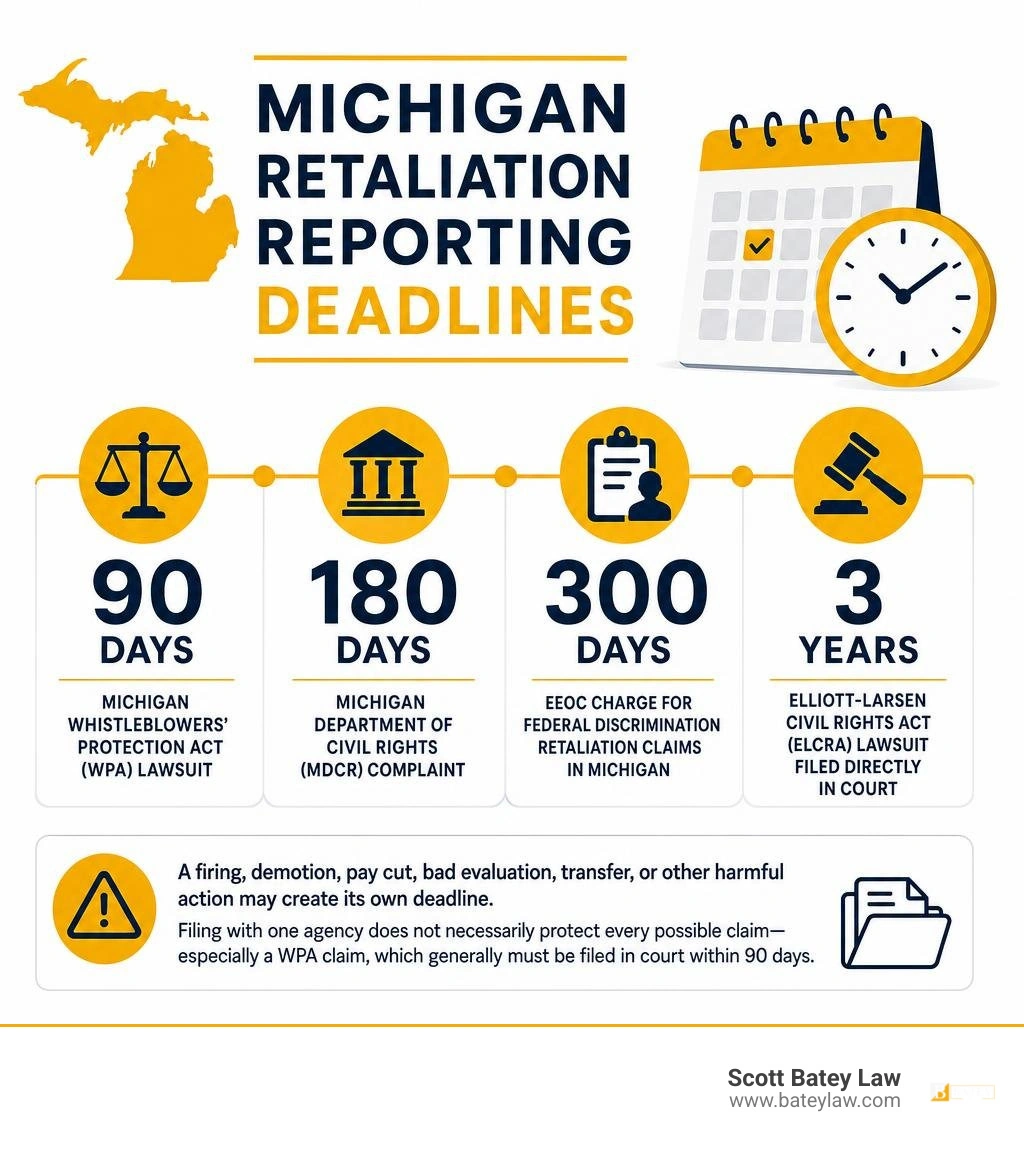
How long do i have to report retaliation in michigan depends on the law that protects your situation and where you file. The deadlines can be short, so it is important to identify the right claim quickly.
| Type of retaliation claim | Main deadline |
|---|---|
| Michigan Whistleblowers' Protection Act (WPA) lawsuit | 90 days from the retaliatory action |
| Michigan Department of Civil Rights (MDCR) complaint | 180 days from the act |
| EEOC charge for federal discrimination retaliation claims | 300 days from the act in Michigan |
| Elliott-Larsen Civil Rights Act (ELCRA) lawsuit filed directly in court | 3 years from the act |
A firing, demotion, pay cut, bad evaluation, transfer, or other harmful action may create its own deadline. Filing with one agency does not necessarily protect every possible claim - especially a WPA claim, which generally must be filed in court within 90 days.
I am Scott Batey, a Michigan employment lawyer who has represented employees in retaliation, discrimination, whistleblower, leave, and wrongful termination matters since 1996. I help workers understand how long do i have to report retaliation in michigan, preserve evidence, and make informed choices before critical deadlines expire.
How Long Do I Have to Report Retaliation in Michigan Under State Law?
When dealing with workplace retaliation in Michigan, state statutes provide distinct paths to relief, each bound by its own legal statute of limitations. Depending on whether you were punished for reporting illegal activity to a public body, speaking out against discrimination, or reporting an unsafe workplace, your reporting clock will run at vastly different speeds.
Choosing the wrong filing route or missing a statutory deadline will result in losing your legal rights permanently. Below is a quick comparison table breaking down state and federal retaliation deadlines applicable in Michigan:
| Statute / Agency | Claim Type / Cause of Action | Forum / Venue | Strict Deadline |
|---|---|---|---|
| Whistleblowers' Protection Act (WPA) | Reporting illegal conduct to a public body | Circuit Court Lawsuit | 90 Calendar Days |
| Michigan Dept. of Civil Rights (MDCR) | Administrative complaint for state civil rights retaliation | MDCR Administrative Filing | 180 Calendar Days |
| Equal Employment Opportunity Commission (EEOC) | Federal administrative charge (Title VII, ADA, ADEA) | EEOC Administrative Filing | 300 Calendar Days (via work-sharing) |
| Elliott-Larsen Civil Rights Act (ELCRA) | Direct lawsuit for civil rights retaliation | Circuit Court Lawsuit | 3 Years |
| Persons with Disabilities Civil Rights Act (PWDCRA) | Direct lawsuit for disability retaliation | Circuit Court Lawsuit | 3 Years |
| MIOSHA Safety Complaints | Reporting workplace health & safety violations | State Administrative Agency | 30 Calendar Days |
Navigating these timelines requires understanding which law covers your specific protected activity.
The 90-Day Whistleblowers’ Protection Act (WPA) Filing Window
The Michigan Whistleblowers’ Protection Act (MCL 15.361 et seq.) protects employees who report, or are about to report, a suspected violation of law, regulation, or rule to a public body. It also protects employees who are asked by a public body to participate in an investigation, hearing, or inquiry.
However, the WPA carries what is easily the most unforgiving deadline in Michigan employment law: you must file a lawsuit in circuit court within 90 calendar days of the retaliatory act.
Key elements you need to know about the WPA window include:
- Direct Court Action Required: Unlike discrimination claims under civil rights statutes, there is no state administrative board where you file a WPA charge. You must initiate a formal civil complaint in court.
- Strict Construction: Michigan courts enforce this 90-day window without leniency. If day 91 arrives and your complaint is not filed, your case is barred.
- Public Body Definition: To qualify under the WPA, the report must involve a public body (such as law enforcement, a regulatory agency, a state official, or a county board). Internal complaints to private HR departments generally do not trigger full WPA protection unless the employer believed an external report to a public body was imminent.
Because three months can pass in the blink of an eye while you are searching for a new job or attempting to resolve matters internally, understanding these statutory boundaries is critical. For a comprehensive dive into this strict window, review our guide on Michigan WPA Deadlines & Remedies: Don't Miss the 90-Day Window as well as our detailed breakdown of Michigan Whistleblowers' Protection Act Deadlines, Remedies, and Proof.
How Long Do I Have to Report Retaliation in Michigan Under ELCRA?
If your employer retaliates against you because you opposed unlawful discrimination, reported workplace sexual harassment, or participated in a civil rights proceeding, your primary state protection comes under Michigan’s Elliott-Larsen Civil Rights Act (ELCRA).
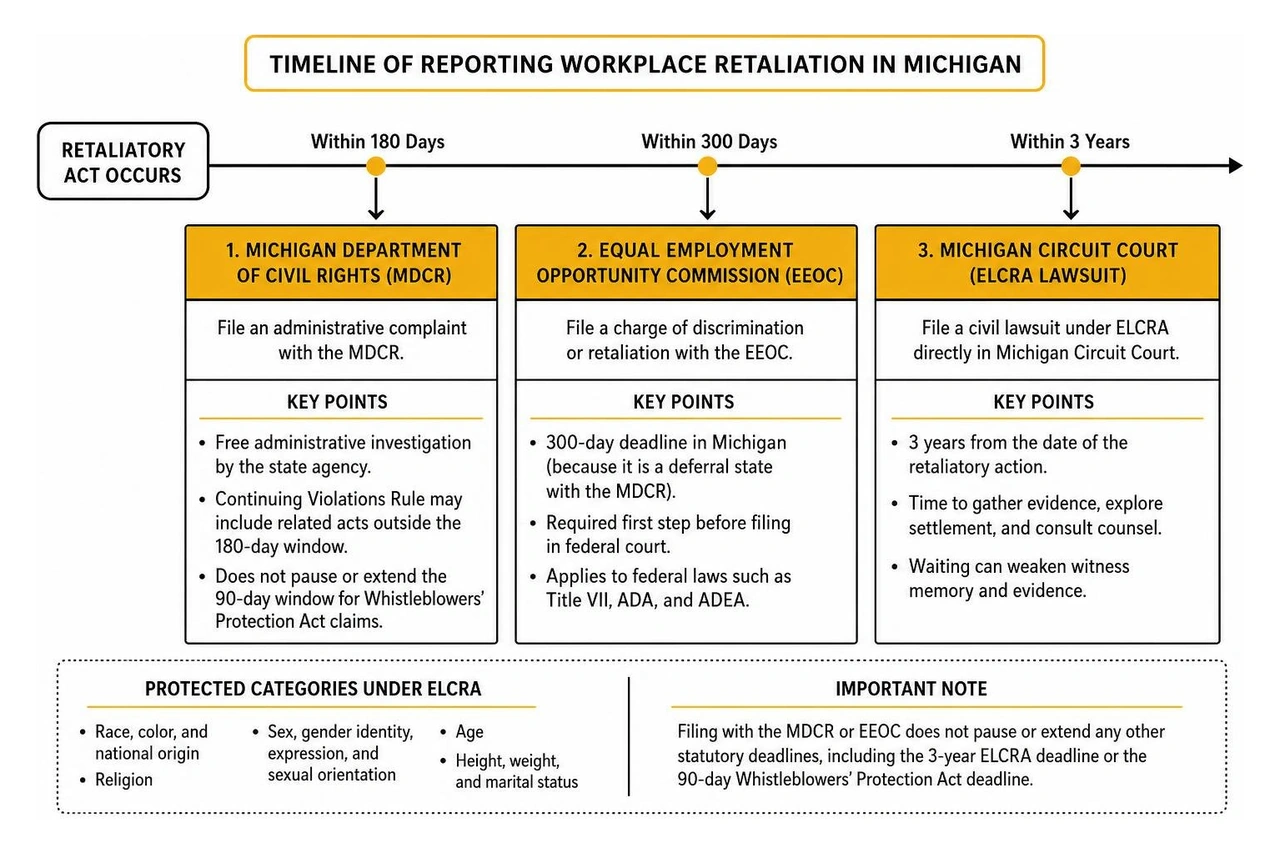
Under ELCRA, you have 3 years from the date of the retaliatory action to file a civil lawsuit directly in Michigan Circuit Court.
Protected civil rights categories under ELCRA include:
- Race, color, and national origin
- Religion
- Sex, gender identity, expression, and sexual orientation
- Age
- Height, weight, and marital status
The 3-year statute of limitations gives employees time to collect records, evaluate settlement possibilities, and consult counsel. However, waiting years to take action can weaken witness memory and critical documentary evidence. For additional clarity on how state limitations operate across various claims, see Michigan Workplace Retaliation Statute of Limitations | Filing Deadlines.
Michigan Department of Civil Rights (MDCR) 180-Day Deadline
Rather than filing directly in circuit court, employees who experience civil rights retaliation under ELCRA or the Persons with Disabilities Civil Rights Act (PWDCRA) can choose to file an administrative complaint with the Michigan Department of Civil Rights (MDCR).
The administrative deadline for filing with the MDCR is 180 calendar days from the date the retaliatory act occurred.
Important procedural aspects of filing with the MDCR:
- Free Administrative Investigation: The MDCR acts as an impartial state agency that investigates complaints, collects statements, and attempts conciliation without initial civil filing fees.
- The Continuing Violations Rule: If the retaliation involves an ongoing pattern of severe harassment or continuous discriminatory acts rather than a single discrete action (like a firing), acts older than 180 days may sometimes be evaluated if they are part of a continuous violation chain ending within the 180-day window.
- Effect on Lawsuits: Filing an administrative complaint with the MDCR option gives you access to state mediation, but filing with the MDCR does not pause or extend the 90-day filing window for separate Whistleblowers’ Protection Act claims.
Reporting Workplace Retaliation Under Federal Law and the EEOC
When workplace retaliation violates federal statutes—such as Title VII of the Civil Rights Act of 1964, the Americans with Disabilities Act (ADA), or the Age Discrimination in Employment Act (ADEA)—you must navigate a mandatory federal administrative process before you can take your employer to federal court.
The 300-Day EEOC Reporting Window in Michigan
Under federal law, employees normally have 180 days to file a charge of discrimination or retaliation with the Equal Employment Opportunity Commission (EEOC). However, because Michigan is a "deferral state" with its own state civil rights agency (the MDCR), this administrative reporting deadline is extended to 300 calendar days from the date of the unlawful retaliatory event.
This dual-filing framework works seamlessly thanks to an official administrative agreement:
- Work-Sharing Agreement: The EEOC and MDCR maintain a work-sharing agreement. When you file a timely charge with the EEOC, it is automatically cross-filed (dual-filed) with the MDCR, and vice versa. You do not need to submit two identical applications to preserve both state administrative rights under ELCRA and federal administrative rights under Title VII.
- Public Portal Access: You can initiate an EEOC charge online via the EEOC Public Portal, complete an intake interview, and submit your verified charge.
To understand how internal company complaints interact with state and federal rights, read our breakdown on Retaliation After You Speak Up: How Michigan Employees Can Protect Themselves.
How Long Do I Have to Report Retaliation in Michigan for Federal Claims?
Navigating federal retaliation claims under Title VII, the ADA, or the ADEA requires completing a specific administrative chain:
- File EEOC Charge (300 Days): Submit your administrative charge within 300 days of the adverse action.
- Investigation & Determination: The EEOC conducts an investigation. On average, an EEOC investigation takes approximately 10 months. The employer is formally notified within 10 days of the charge filing.
- Issuance of Right to Sue Notice: If the EEOC finishes its process, fails to resolve the matter, or dismisses the charge, it issues a formal Notice of Right to Sue letter.
- Federal Court Deadline (90 Days): Once you or your attorney receive that official EEOC Right to Sue letter, you have a strict 90 calendar day window to file a civil lawsuit in federal district court.
If you miss that 90-day federal court window after receiving your Right to Sue letter, your federal claim is extinguished forever, regardless of how strong your evidence is. For further legal insights on overlapping state and federal remedies, review Michigan Workplace Retaliation Laws, Rights, and Remedies - LegalClarity.
When the Clock Starts Ticking and Key Exceptions

A frequent point of confusion for employees asking how long do i have to report retaliation in michigan is determining the precise date the statute of limitations clock actually starts running.
Adverse Action Notification Dates vs. Last Day Worked
Under both Michigan and federal employment jurisprudence, the statute of limitations clock begins running on the date you were notified of the adverse employment action, NOT on your final physical day on the payroll or the day your benefits terminate.
Consider these key calculation rules:
- The Notification Rule: If your employer informs you on April 1 that you are being terminated effective April 30, the legal statute of limitations clock starts ticking on April 1.
- Calendar Days vs. Business Days: Deadlines are measured in strict calendar days, including weekends and official holidays. If your 90th day falls on a Sunday or court holiday, court rules generally extend the deadline to the next business day, but waiting until the last day introduces unnecessary risk.
- Separate Retaliatory Acts Start Separate Clocks: Reporting deadlines apply individually to each discrete retaliatory act. For example, if an employer demotes you in January and fires you six months later in July, each event triggers its own independent 300-day EEOC clock and 90-day WPA clock.
- The Discovery Rule Does Not Apply: In most Michigan employment cases, courts do not delay the deadline clock simply because you discovered the employer’s retaliatory motive later. The clock starts when the tangible harmful action is communicated to you.
What Happens If You Miss the Filing Deadline?
Missing a statutory reporting window or statute of limitations deadline in Michigan brings severe, non-negotiable legal consequences:
- Mandatory Dismissal: The court or administrative body must dismiss your claim as time-barred upon the employer's motion. Courts lack the legal authority to grant extensions out of sympathy.
- The Settlement Talks Trap: Ongoing internal grievances, HR reviews, or informal severance negotiations do not toll (pause) your legal filing deadline. Employers will sometimes intentionally drag out informal discussions until statutory deadlines pass, leaving you with zero legal leverage.
- Signing Severance Releases: If an employer offers you a severance contract with a general release, reviewing and signing it waives your right to bring retaliation claims. The clock continues ticking while you decide whether to sign.
To learn how to protect yourself when facing workplace pressure after reporting misconduct, read Retaliation After Reporting Harassment: The Michigan Employee Playbook.
Step-by-Step Actions to Protect Your Retaliation Claim

When you experience illegal workplace payback, taking deliberate, organized steps will preserve your rights and support your claim before key deadlines run out.
Documenting Retaliation and Gathering Personnel Records
To build a compelling retaliation claim, collect and safeguard objective evidence right away:
- Maintain a Personal Documentation Log: Record every relevant conversation, performance review, write-up, schedule shift change, or hostile remark. Include specific dates, times, locations, direct quotes, and named witnesses. Store this log on a personal device or notebook, not on your work computer.
- Save Evidence Externally: Preserve personal copies of performance evaluations, commendation emails, award certificates, text messages, and attendance records before your employer cuts off your system access.
- Request Your Personnel File: Under Michigan's Bullard-Plawecki Employee Right to Know Act (MCL 423.501 et seq.), current and former employees have the legal right to inspect and receive copies of their personnel records up to twice per calendar year. Submit a formal written request for your complete file.
- Submit a Written Rebuttal: If your employer placed false disciplinary write-ups or reviews in your file to build a fake paper trail, the Bullard-Plawecki Act allows you to submit a written rebuttal of up to five pages, which your employer must permanently attach to the disputed record.
Proving Retaliation When Employers Claim Other Reasons
Employers rarely admit to illegal retaliation. Instead, they routinely manufacture alternative excuses, claiming an employee was let go due to "poor performance," "restructuring," "budget cuts," or "attitude issues."
To win a retaliation case, workers rely on the legal burden-shifting framework established by courts:
- Prima Facie Case: You must show that (a) you engaged in protected activity (e.g., reported harassment, blew the whistleblower whistle), (b) your employer knew about it, and (c) you suffered a materially adverse employment action.
- Employer's Legitimate Business Reason: The burden shifts to the employer to state a non-retaliatory reason for their action.
- Proving Pretext: The burden shifts back to you to show that the employer's stated reason is a false pretext designed to hide retaliatory motives.
What Counts as Retaliation?
Following the groundbreaking decision in White v. Department of Transportation (Mich. App. 2020), Michigan employees under ELCRA do not need to show direct monetary or economic loss to establish an adverse employment action. Actions that would deter a reasonable worker from speaking up—such as placements on performance improvement plans (PIPs), unjust counseling notices, stripped job duties, or involuntary lateral transfers—can all qualify as actionable retaliation for a jury to decide.
Additionally, strong timing (known as temporal proximity)—such as being disciplined or fired days after filing an internal sexual harassment complaint—provides powerful circumstantial evidence of unlawful retaliation.
Frequently Asked Questions About Michigan Retaliation Deadlines
Is it retaliation even if my original complaint is not upheld?
Yes. As long as you made your initial discrimination, harassment, or legal violation report in good faith and with a reasonable belief that the conduct was illegal, you are fully protected under Michigan and federal anti-retaliation laws. Even if an internal HR or administrative investigation later determines that the underlying issue did not violate civil rights laws, your employer cannot legally punish you for raising the issue or for serving as a witness in someone else's complaint.
Does filing with the MDCR extend my Whistleblowers' Protection Act deadline?
No. Filing an administrative civil rights complaint with the MDCR or EEOC does not toll or preserve your 90-day statute of limitations under the Michigan Whistleblowers’ Protection Act. The WPA requires a separate civil lawsuit filed directly in Michigan Circuit Court within 90 calendar days. Relying on an administrative MDCR investigation to hold your WPA deadline is one of the most common legal errors employees make.
Do I need to file with the EEOC or MDCR before going straight to court?
It depends on which legal statute you are suing under:
- Elliott-Larsen Civil Rights Act (ELCRA): No administrative filing is required. You can bypass the MDCR/EEOC entirely and file a civil lawsuit directly in Michigan Circuit Court within 3 years.
- Federal Claims (Title VII, ADA, ADEA): Yes. Federal law requires "administrative exhaustion." You must file a charge with the EEOC within 300 days and receive a Notice of Right to Sue before you can file a lawsuit in federal court.
- Whistleblowers’ Protection Act (WPA): No administrative agency handles WPA claims. You must go directly to circuit court within 90 days.
Conclusion
Understanding how long do i have to report retaliation in michigan is crucial for protecting your career, your financial recovery, and your legal rights. Whether you are facing a tight 90-day window under the Whistleblowers' Protection Act, a 180-day MDCR limit, a 300-day EEOC window, or a 3-year ELCRA court filing limit, taking immediate action is the best way to safeguard your future.
At Scott Batey Law, we represent employees across Oakland County, Wayne County, Detroit, Birmingham, Bingham Farms, Southfield, Royal Oak, Ferndale, Troy, and throughout Michigan. With over 25 years of dedicated employment law experience, we help workers stand up against wrongful termination, illegal retaliation, and workplace harassment.
If you believe your employer took adverse action against you for speaking up, contact our office right away before important deadlines expire. Reach out directly to a dedicated Retaliation Lawyer in Birmingham, MI to review your case and protect your rights.