.png)
The Long Shift Survival Guide: Legal Break Requirements for 6 to 12-Hour Workdays

What the Law Actually Requires: How Many Breaks in a 12-Hour Shift
How many breaks in a 12-hour shift by law you're entitled to depends almost entirely on where you work — not just how long your shift is.
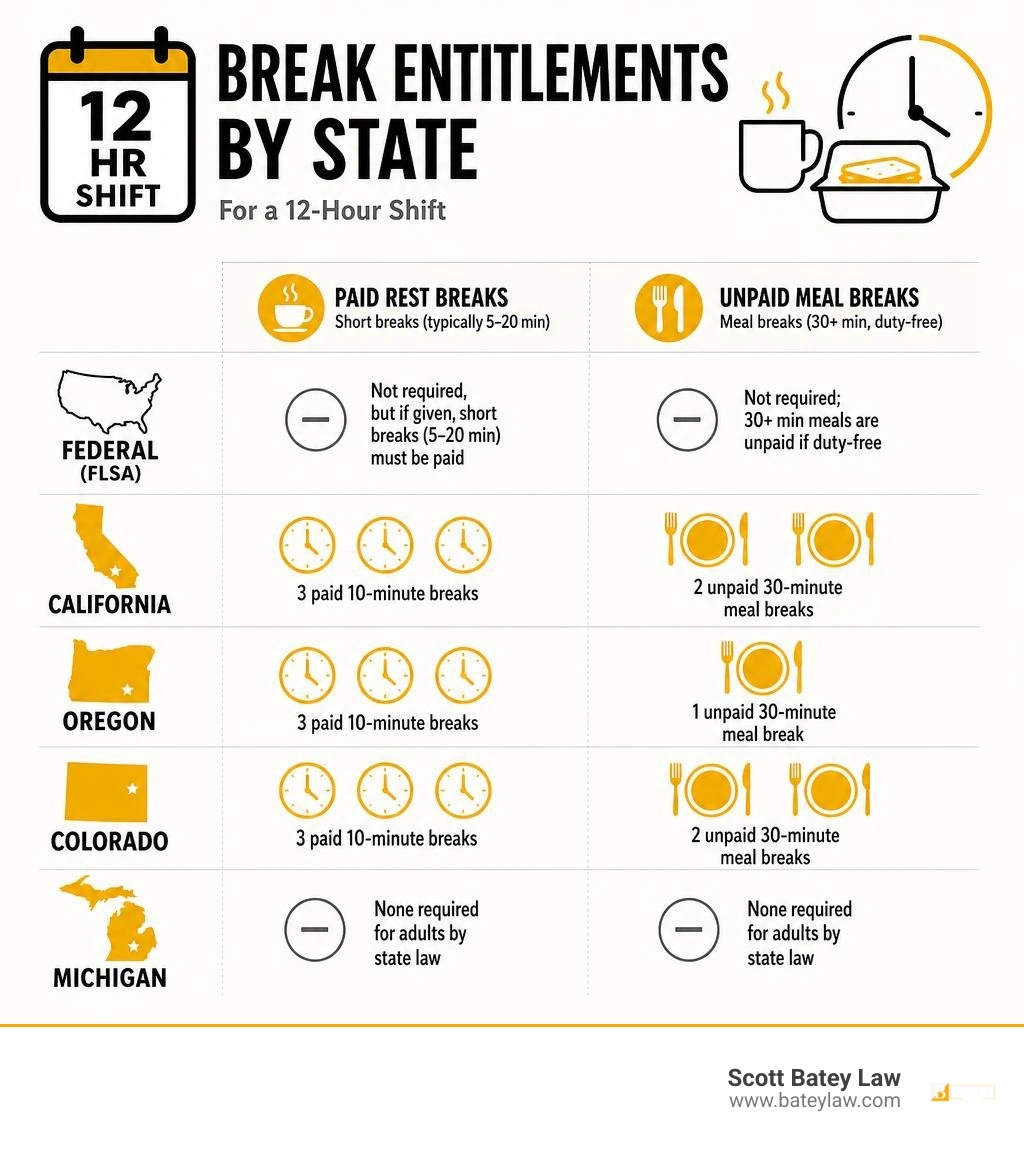
Here's a quick answer by jurisdiction:
| Location | Paid Rest Breaks | Unpaid Meal Breaks |
|---|---|---|
| Federal (FLSA) | Not required, but if given, short breaks (5-20 min) must be paid | Not required; 30+ min meals are unpaid if duty-free |
| California | 3 paid 10-minute breaks | 2 unpaid 30-minute meal breaks |
| Oregon | 3 paid 10-minute breaks | 1 unpaid 30-minute meal break |
| Colorado | 3 paid 10-minute breaks | 2 unpaid 30-minute meal breaks |
| Michigan | None required for adults by state law | None required for adults by state law |
Federal law sets a floor, not a ceiling. Many states add stronger protections on top. And some states — like Michigan — leave adult workers with almost no state-mandated break rights at all.
That gap between what workers expect and what the law actually guarantees is where most disputes begin.
I'm Scott Batey, a Michigan employment lawyer with nearly 30 years of experience representing workers in wage and hour disputes — including employees denied the breaks they were legally owed or promised. Understanding how many breaks in a 12-hour shift by law apply to your situation is the first step toward knowing whether your employer is crossing a line.
Federal Law vs. State Law: How Many Breaks in a 12-Hour Shift by Law?
When you look at a grueling 12-hour workday, it seems only natural that there would be a single, unified federal law ensuring you get to sit down, eat a sandwich, and rest your eyes. Unfortunately, the reality of American labor law is a bit more fragmented.
The primary federal law governing wages and hours is the Fair Labor Standards Act (FLSA), enforced by the U.S. Department of Labor (DOL). However, the FLSA is surprisingly silent on the physical well-being of workers when it comes to rest periods. To understand your rights, we have to look at how federal rules interact with individual state mandates.
Federal FLSA Standards for Long Shifts
Let's clear up a massive misconception right out of the gate: Federal law does not require employers to provide meal or coffee breaks.
If you work a 12-hour shift in a state that strictly follows federal guidelines, your employer could legally require you to work all 12 hours straight without a single official break. While that sounds incredibly harsh—and is certainly a recipe for high employee turnover and workplace accidents—it is entirely legal under the FLSA.
However, the FLSA does have very strict rules about how breaks must be paid if an employer chooses to offer them:
- Short Rest Breaks (5 to 20 minutes): Federal law views these short periods as compensable work time. If your employer allows you to take a quick 10-minute coffee break to stretch your legs during a 12-hour shift, they cannot dock your pay for that time. It must be counted as hours worked.
- Meal Periods (typically 30 minutes or longer): These are not considered work time and are therefore non-compensable (unpaid). However, for a meal break to be unpaid, the employee must be completely relieved of duty for the purpose of eating regular meals. If you are required to eat your lunch at your desk while answering phones, or if you are "on-call" during your lunch, that is not a true meal period. You must be paid for that time.
For a detailed breakdown of how the federal government views these periods, you can review the official Federal meal and rest break guidelines.
State-Level Variations: How Many Breaks in a 12-Hour Shift by Law Apply to You?
Because federal law leaves such a massive gap, state governments have stepped in to create their own jurisdictions. This has resulted in a patchwork of local labor laws.
If you work in a state with its own break laws, your employer must comply with whichever standard is more generous to the employee. For example, if a state law mandates paid rest breaks, an employer in that state cannot point to the FLSA and say, "Well, federal law doesn't make us do this." The state mandate wins.
Conversely, if you live in a state without local break laws, the bare-minimum federal standards apply. This means your employer only has to pay you for short breaks if they grant them, but they don't have to grant them in the first place.
Deep Dive: California, Oregon, Colorado, and Michigan Break Rules
To see how drastically these state-level variations can affect your workday, let's take a closer look at four states with very different approaches to scheduling, rest periods, and meal breaks for non-exempt employees.

California 12-Hour Shift Break Requirements
California is widely known for having some of the most stringent and employee-friendly labor laws in the country. If you are working a 12-hour shift in the Golden State, your break schedule is highly regulated.
Under California law, a 12-hour shift entitles you to:
- Three paid 10-minute rest breaks: Non-exempt employees are entitled to one paid 10-minute rest break for every four hours worked (or "major fraction thereof"). For a 12-hour shift, this math works out to three distinct rest periods. These breaks should, as much as practical, be scheduled in the middle of each work segment.
- Two unpaid 30-minute meal breaks: California requires a first duty-free meal period of at least 30 minutes before the end of the fifth hour of work. A second 30-minute meal break is required if you work more than 10 hours in a day.
The Waiver Exception: For a 12-hour shift, the second meal break can be waived, but only if:
- The first meal break was fully taken and not waived.
- The total hours worked do not exceed 12 hours.
- Both the employer and the employee mutually consent to the waiver (ideally in writing).
If your shift runs even a few minutes over 12 hours, that second meal break can no longer be waived under 2026 standards.
Oregon and Colorado 12-Hour Shift Break Requirements
Oregon and Colorado also provide robust protections for long-shift workers, though their exact formulas differ slightly from California's.
Oregon (BOLI Rules)
The Oregon Bureau of Labor & Industries (BOLI) dictates that rest breaks must be paid and must last at least 10 minutes. They must be provided for every four-hour segment (or major portion) worked.
- For a 12-hour shift (which falls into Oregon's "10 hours and 1 minute to 13 hours and 59 minutes" bracket), workers are entitled to three paid 10-minute rest breaks and one unpaid 30-minute meal break.
- The meal break must be taken between the second and sixth hour of the shift.
Colorado (COMPS Order)
Under the Colorado Overtime and Minimum Pay Standards (COMPS) Order, employees working a 12-hour shift are entitled to:
- Three paid 10-minute rest periods: Colorado requires one 10-minute break for every four hours of work. A 12-hour shift fits squarely into the "over 10 up to 14 hours" category, triggering the third break.
- Two unpaid 30-minute meal breaks: Colorado requires a 30-minute meal period once a shift exceeds 5 consecutive hours. Because a 12-hour shift spans two full 5-hour blocks, a second meal break is required, provided it is practical to schedule it.
Michigan 12-Hour Shift Break Requirements
Now, let's talk about our home state. If you are an adult employee (18 years or older) working in Detroit, Troy, Southfield, or anywhere else in Michigan, the state-level rules might come as a shock.
Michigan does not require employers to provide rest breaks or meal breaks of any kind for adult employees.
Whether you are working a 6-hour shift or a grueling 12-hour shift, Michigan state labor standards do not force your employer to give you a lunch hour or a coffee break.
However, there is a major exception for minor employees (under 18):
- Michigan law mandates that minors cannot work more than 5 continuous hours without a documented, uninterrupted 30-minute meal or rest break.
For adults, your break rights in Michigan are governed entirely by:
- Your employer's written policies (such as an employee handbook).
- Your employment contract or a collective bargaining agreement (union contract).
If your employer has a written policy promising breaks, or if they offer unpaid lunch breaks but force you to work through them, they may be violating wage and hour laws. For example, if a hospital in Royal Oak or a manufacturing plant in Farmington Hills automatically deducts 30 minutes from your pay daily for a lunch break, but your 12-hour shift is so hectic that you never actually get to stop working, that is a form of wage theft.
Waiving, Skipping, and Scheduling Breaks Legally
Managing breaks during a long shift requires a balance between operational efficiency and legal compliance. Let's look at how employers must handle the scheduling and potential waiving of these rest periods.
When Can an Employer Require On-Duty Meals?
In some industries, completely relieving an employee of duty for a 30-minute lunch is virtually impossible. Think of a solo overnight security guard in Southfield, or a lone gas station attendant in Beverly Hills.
In these rare circumstances, an on-duty meal period may be permitted. An on-duty meal break is legal only if:
- The nature of the work prevents the employee from being relieved of all duty.
- The employee and employer agree to the on-duty, paid meal period in a written agreement.
- The break is fully paid because the employee is still technically working.
If an employer simply claims they are "too busy" to let people take lunch, that does not meet the legal standard of operational necessity.
Can Employees Voluntarily Skip Breaks to Leave Early?
It is a common request: "Can I just work through my lunch break and two 10-minute rests so I can head home 50 minutes early?"
While this seems like a win-win, from a legal and management standpoint, the answer is generally no.
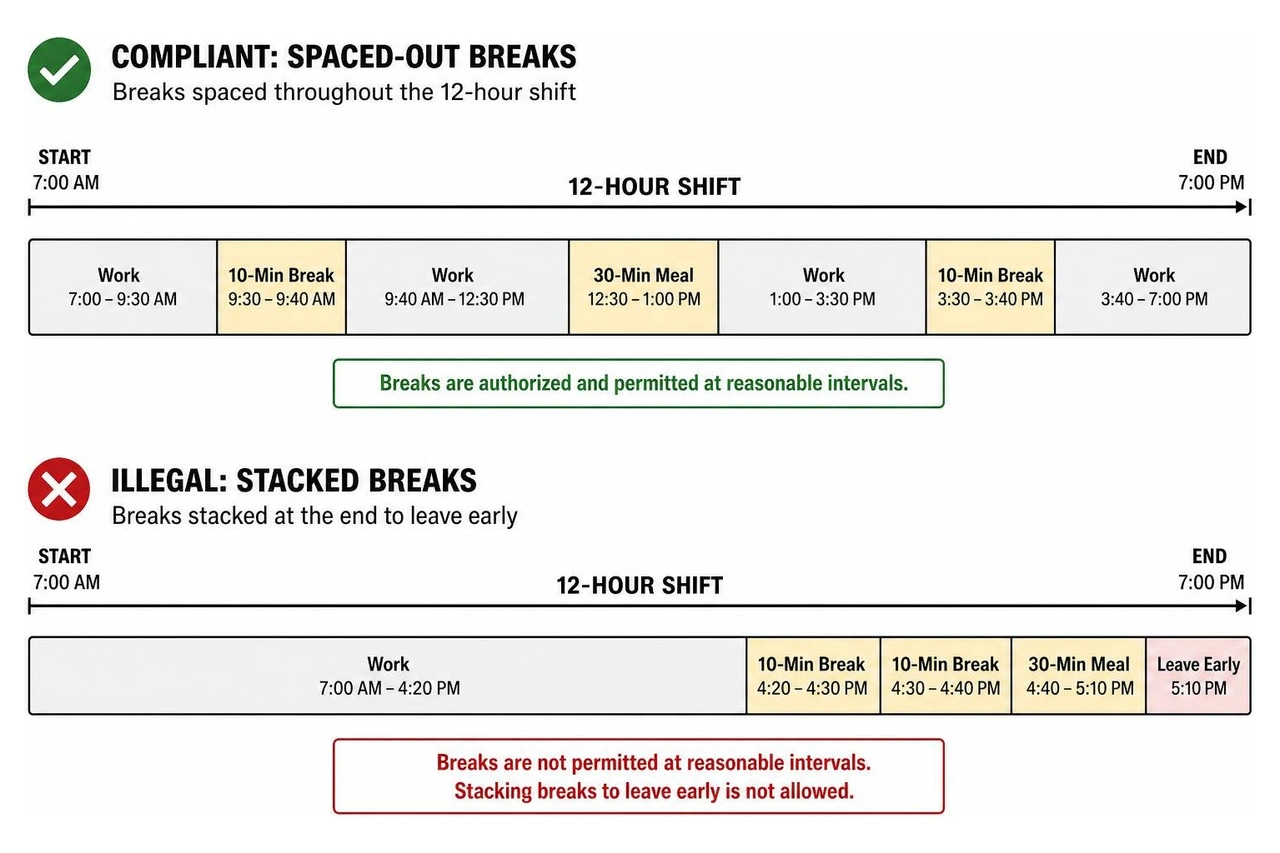
Employers have a legal obligation to "authorize and permit" breaks at reasonable intervals throughout the shift. Allowing employees to stack their breaks at the very end of the day to leave early defeats the health and safety purpose of the rest periods.
Furthermore, in states like California, if an employer permits this practice without a formal, legally compliant waiver, they could still be held liable for failing to provide the breaks during the workday. Employers have the right to enforce their schedules and discipline employees who refuse to take their designated breaks.
Penalties, Exemptions, and Legal Remedies for Missed Breaks
What happens when the rules are broken? Whether it is an oversight or systematic wage abuse, employers face steep consequences for denying required breaks.
Penalties for Break Violations during a 12-Hour Shift
In states with strict break laws, the penalties for non-compliance add up incredibly fast.
- California: If an employer fails to provide an employee with a required rest break, they must pay the employee one additional hour of pay at their regular rate for each workday the rest break violation occurred. If they also miss a meal break on that same day, they owe another hour of pay (up to a maximum of two penalty hours per day).
- Colorado: Missed rest periods are treated as hours worked. If those missed breaks occurred during overtime hours (which are common in 12-hour shifts), they must be compensated at the overtime rate (time-and-a-half). Employers can also face compliance orders and hefty state fines.
- Michigan (and Federal): While there is no direct "missed break penalty" for adults, the legal remedy usually involves unpaid wages. If your employer deducted time for an unpaid meal break but you worked through it, they owe you back pay for that time—which often triggers overtime premiums if those extra minutes pushed you past 40 hours in a workweek.
Exempt vs. Non-Exempt Employees: Who is Entitled to Breaks?
Not every worker is covered by these break laws. The legal protections we have discussed primarily apply to non-exempt employees (typically hourly workers entitled to overtime pay).
Exempt employees (often salaried professional, administrative, or executive workers) are generally excluded from state-mandated meal and rest break laws. For instance, a salaried department manager in Troy working a 12-hour shift is expected to manage their own time and take breaks as their workload permits, without the employer facing penalties if they choose to work straight through.
However, misclassifying hourly workers as "exempt salaried employees" is a common tactic used by some employers to avoid paying overtime and providing required breaks. Just because you receive a salary does not automatically mean you are legally exempt.
Frequently Asked Questions About 12-Hour Shift Breaks
How many breaks in a 12-hour shift by law are paid?
Under federal law, any rest break lasting between 5 and 20 minutes must be fully paid. Meal periods lasting 30 minutes or longer can be unpaid, provided you are completely relieved of all work duties.
In states like California, Oregon, and Colorado, you are legally entitled to three paid 10-minute rest breaks during a 12-hour shift. Any required 30-minute meal breaks in those states are typically unpaid, unless your job duties prevent you from taking a true off-duty break.
What are the legal break requirements for international 12-hour shifts?
If you are looking at operations abroad, the rules are quite different:
- United Kingdom: Under the Working Time Regulations 1998, adult workers are entitled to just one uninterrupted 20-minute rest break if their workday exceeds 6 hours. Interestingly, this minimum does not scale up automatically just because a shift is 12 hours long, though guidance suggests employers should offer more to manage fatigue. For more, see the UK legal break times for 12-hour shifts.
- Ireland: Under the Organisation of Working Time Act 1997, workers must receive a 15-minute break after 4.5 hours of work, and a 30-minute break after 6 hours (which can include the first 15-minute break).
What should I do if my employer denies my required breaks?
If your employer is systematically denying you the breaks you are legally entitled to or promised by contract, you should take the following steps:
- Document everything: Keep a personal log of your shifts, the breaks you were allowed to take, and the breaks you were forced to work through or skip. Note the dates, times, and names of supervising managers.
- Review your handbook: Check your company's written policies regarding rest and meal periods.
- Report the issue in writing: Bring the issue to HR or your supervisor. Having a written paper trail is crucial.
- Consult an attorney: If the company ignores your complaints or retaliates against you, it is time to speak with an experienced wage and hour lawyer.
Conclusion
Working 12-hour shifts is physically and mentally demanding. Whether you are in healthcare, manufacturing, security, or retail, you deserve the time to rest and recharge. While Michigan law does not mandate breaks for adult workers, employers must still respect the terms of their own employment contracts, collective bargaining agreements, and federal compensation laws regarding paid work time.
If your employer is forcing you to work through unpaid lunches, automatically deducting break time you didn't get to take, or misclassifying your role to avoid giving you the benefits you deserve, you don't have to navigate it alone.
At Scott Batey Law, we have spent more than 25 years fighting for the rights of workers in Bingham Farms, Birmingham, Southfield, Royal Oak, and across metro Detroit. We provide personalized, award-winning representation to help you recover the unpaid wages and peace of mind you deserve.
Are you facing a wage or break dispute at work? Consult a Michigan wage and overtime lawyer at Scott Batey Law today for a confidential evaluation of your case.