.png)
Wrongfully Terminated: Your Step-by-Step Guide to Fighting Back

When You Feel You Were Wrongfully Terminated From Your Job
If I feel I was wrongfully terminated from my job, here is what you need to know right away:
- Not every unfair firing is illegal — but many are, and you may have real legal options
- You likely have a valid claim if you were fired for a discriminatory reason, in retaliation for reporting misconduct, or in violation of a contract or company policy
- Deadlines are strict — you may have as few as 180 days to file a federal claim
- Do not sign a severance agreement before speaking with an employment attorney
- Evidence disappears fast — start documenting and saving records immediately
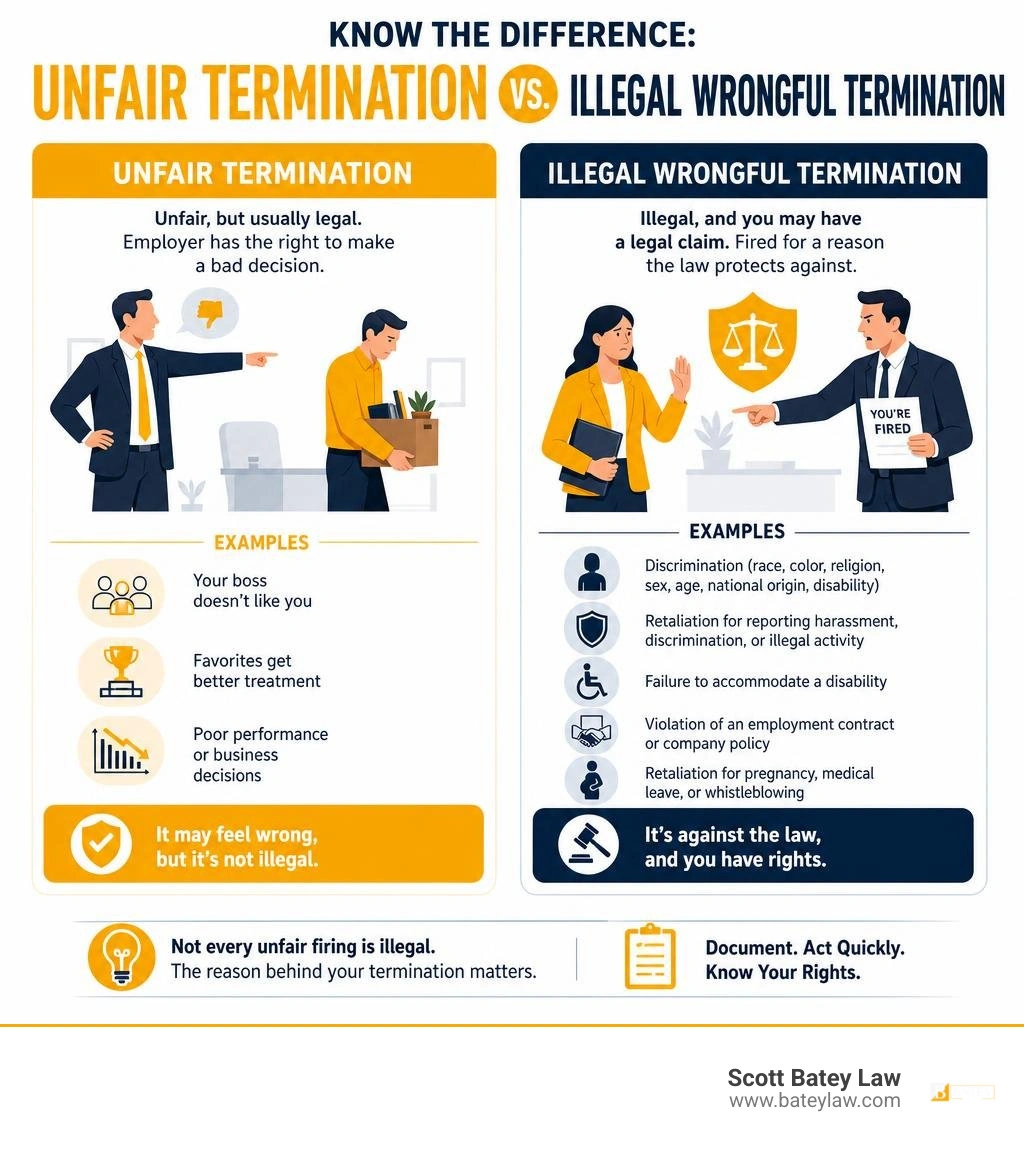
The difference between feeling wronged and having a legal claim comes down to one question: did your employer fire you for an illegal reason? Being fired unfairly — because your boss dislikes you, plays favorites, or simply makes a bad call — is painful, but it is generally legal under at-will employment. Being fired because of your race, age, disability, or because you reported harassment? That is a different matter entirely.
Many employees do not realize they have a viable case. Others wait too long and lose their right to file. The first step is understanding exactly where your situation falls.
I'm Scott Batey, a Michigan employment attorney with nearly 30 years of experience representing employees who feel they were wrongfully terminated from their jobs — helping them evaluate their claims, preserve critical evidence, and fight back against employers who crossed the line.
What to Do If "I Feel I Was Wrongfully Terminated From Your Job"
The hours and days immediately following a firing are incredibly stressful. You may feel a mix of shock, anger, and panic. However, this is also the most critical window for protecting your legal rights. What you do—and what you avoid doing—can make or break your potential case.
First, do not act on impulse. Sending an angry, emotional email to your former boss or HR representative might feel satisfying in the moment, but it can severely damage your credibility. In employment law, your post-termination conduct is highly scrutinized. Employers will not hesitate to use hostile communications as "Exhibit A" to paint you as a difficult, combative employee.
Instead, take a deep breath and shift your focus to gathering and preserving information. The moment your employment is severed, your access to company networks, emails, Slack channels, and databases is typically cut off. This means you must act quickly to secure any personal documentation you legally have access to before it is gone forever.
Reviewing What Do I Do If I Was Wrongfully Terminated? can help you structure your immediate thoughts, but we highly recommend focusing on several key tactical moves right away.
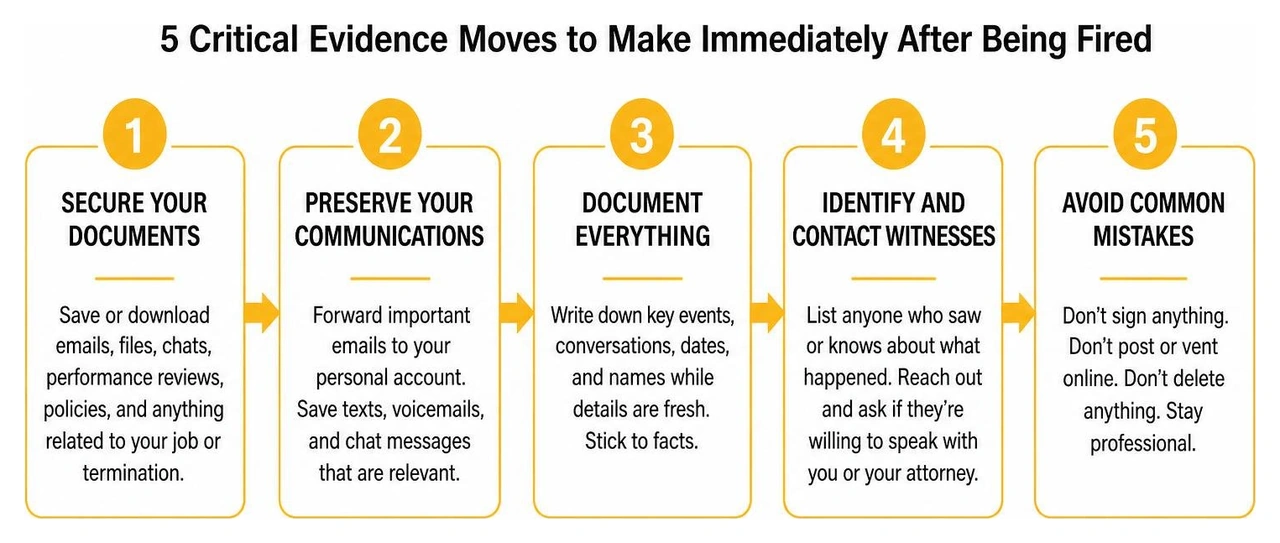
To help our clients in Metro Detroit and Oakland County navigate this chaotic period, we have developed a clear roadmap. To protect yourself, execute these 5 Evidence Moves to Make the Day You're Terminated to ensure you do not leave critical proof behind.
Once you have secured your initial files, your next objective is to organize them. Memories fade, and timelines get muddy. We advise clients to learn How to Build an Evidence Timeline After Termination to create a clear, chronological narrative of performance reviews, complaints, and shifting managerial attitudes. This organized timeline is often the most valuable tool you can hand to an employment lawyer during your initial consultation.
Evaluating My Case: Why "I Feel I Was Wrongfully Terminated From My Job"
When clients come to our Bingham Farms office and say, "I feel I was wrongfully terminated from my job," we begin by analyzing the legal boundaries of their employment relationship.
Like 49 other states, Michigan is an "at-will" employment state. This means that, by default, either you or your employer can terminate the employment relationship at any time, with or without cause, and with or without warning. However, many employers mistakenly believe "at-will" gives them a license to act with absolute impunity. It does not.
There are powerful, legally binding exceptions to this rule. To understand where the line is drawn, it is helpful to look closely at At Will Exceptions in Michigan. If your employer fired you for a reason that violates federal or state law, their at-will defense crumbles.
Furthermore, if you were let go suddenly, you should explore what happens when you are Fired Without Warning in Michigan to understand how the at-will doctrine operates in practice—and when an abrupt dismissal crosses the line into illegal territory.
To help you run through the warning signs of an illegal firing, we suggest referencing this comprehensive Wrongful Termination: Signs, Examples & What to Do Next (2026 Guide), which outlines how to spot the difference between a harsh-but-legal termination and one that violates your civil rights.
Legal Options When "I Feel I Was Wrongfully Terminated From My Job"
If your evaluation reveals that your termination was indeed illegal, you have several avenues of legal recourse. However, you cannot simply walk into a federal court and file a lawsuit on day one.
For claims involving workplace discrimination or harassment under federal law, you must first exhaust your administrative remedies. This means filing a formal charge of discrimination with the Equal Employment Opportunity Commission (EEOC). The EEOC acts as a gatekeeper. They will investigate your claim and, in some cases, attempt to mediate a settlement. If they do not resolve the issue, they will issue you a "Right to Sue" letter, which officially clears the path for you to file a civil lawsuit.
The deadlines for these filings are incredibly strict:
- Federal EEOC Deadline: Generally 180 calendar days from the date of your termination. This is extended to 300 days if a state or local agency (such as the Michigan Department of Civil Rights) enforces a similar state law.
- Michigan State Law Deadlines: Under Michigan's civil rights statutes, you may have different timelines. For example, claims under the Elliott-Larsen Civil Rights Act do not require you to go through the EEOC first, allowing you to file directly in state court, but waiting too long can still destroy your case.
To understand the broader landscape of state-level claims, you should read our guide on Wrongful Discharge Michigan to see how Michigan courts handle these disputes. Additionally, if you were let go without a clear reason, our resource on MI Employment Law Fired Without Cause explains how we dissect an employer's vague explanations to find evidence of hidden, illegal motives (often referred to as "pretext").
Common Illegal Reasons for Termination
When we represent workers in Oakland County and the broader Detroit metro area, we often have to dismantle the employer's manufactured narrative. Companies rarely admit they are firing you for an illegal reason. Instead, they will claim you were let go due to "budget cuts," "restructuring," or sudden "performance issues."

Our job is to dig beneath the surface. If you suspect your employer's stated reason is a lie, you should review our breakdown of the Illegal Reasons to Fire Someone. Generally, illegal terminations fall into three major buckets: discrimination, retaliation, and breach of contract or public policy.
Workplace Discrimination and Protected Classes
Federal and state laws make it strictly illegal to terminate an employee based on their membership in a protected class.
Under federal law, Title VII of the Civil Rights Act of 1964, the Age Discrimination in Employment Act (ADEA), and the Americans with Disabilities Act (ADA) protect employees from discrimination based on:
- Race, color, or national origin
- Religion
- Sex, pregnancy, sexual orientation, and gender identity
- Age (protecting workers aged 40 and older)
- Physical or mental disability
In Michigan, we have an even broader shield: the Elliott-Larsen Civil Rights Act (ELCRA). The ELCRA protects employees from discrimination based on race, color, national origin, age, sex, height, weight, familial status, and marital status.
If you believe your firing was motivated by bias, working with a Wrongful Termination Lawyer in Oakland County MI is essential. We can help you analyze "comparator evidence"—which involves looking at how employees outside of your protected class were treated when they committed similar infractions or had similar performance metrics—to prove that discrimination was the real driver behind your termination.
Retaliation and Whistleblower Protections
Another highly common illegal reason for termination is retaliation. It is illegal for an employer to fire you because you engaged in a "protected activity." Protected activities include:
- Reporting sexual harassment or racial discrimination to HR
- Filing a formal complaint with the EEOC
- Requesting or taking legally protected medical leave under the Family and Medical Leave Act (FMLA)
- Filing a workers' compensation claim after an on-the-job injury
- Reporting illegal financial practices, safety violations, or environmental hazards (whistleblowing)
Whistleblower protections are enforced across various federal and state agencies. For example, safety-related retaliation is handled by the Occupational Safety and Health Administration (OSHA), while financial fraud reporting is protected by the Securities and Exchange Commission (SEC).
In our state, the Michigan Whistleblowers' Protection Act (WPA) provides robust protections for employees who report, or are about to report, a violation of a law or regulation to a public body. If you are facing this situation in Southeast Michigan, our analysis of Wrongful Termination in Oakland County can help you understand how local courts interpret retaliation and what evidence is required to win.
Breach of Contract and Constructive Dismissal
While at-will employment is the default, it can be overridden by a contract. This can be an explicit, written employment contract guaranteeing employment for a specific term, or a collective bargaining agreement in a unionized workplace.
However, contracts can also be implied. If your employer’s handbook outlines a strict, mandatory "progressive discipline" policy (e.g., verbal warning, written warning, suspension, then termination) and the company skips these steps to fire you immediately, they may have breached an implied contract—provided the handbook does not contain clear, prominent disclaimers stating it is not a contract.
What if you weren't technically fired, but you felt you had no choice but to quit? This is known as constructive dismissal (or constructive discharge). If your employer intentionally created or permitted working conditions so hostile, intolerable, or abusive that a reasonable person would feel compelled to resign, the law treats your resignation as a formal termination.
Proving this in court is a high hurdle. To see if your situation meets this strict legal standard, read our guide on Constructive Discharge in Michigan before you hand in your resignation letter.
Severance Agreements and Recoverable Damages
If your employer knows they are on shaky legal ground, they may offer you a severance package. While a lump-sum payment can be incredibly tempting when you have just lost your income, it is vital to understand that severance is rarely given out of the goodness of the employer's heart. It is a business transaction. In exchange for the money, they will require you to sign a release of claims—meaning you permanently waive your right to sue them for wrongful termination.
Before you sign anything, you must understand the potential value of your claims. Many employees make critical errors during this high-pressure period. To protect your leverage, review the Top 10 Mistakes Employees Make Before Calling an Employment Lawyer so you don't accidentally sign away your rights for pennies on the dollar.
Understanding Severance Waivers and the OWBPA
If you are 40 years of age or older, you have extra protections under federal law. The Older Workers Benefit Protection Act (OWBPA), which is part of the ADEA, establishes strict guidelines that employers must follow for a severance waiver to be legally valid:
- Consideration Period: You must be given at least 21 days to review the agreement (this increases to 45 days if you are being laid off as part of a group or exit incentive program).
- Revocation Period: You have 7 days after signing the agreement to change your mind and revoke your signature.
- Plain Language: The agreement must be written in a clear, understandable manner.
- Encouragement of Counsel: The agreement must explicitly advise you, in writing, to consult with an attorney before signing.
Even if you are under 40, you should never sign a severance agreement on the spot. Use your consideration window to have an experienced employment lawyer review the terms and negotiate for a better package.
Calculating Your Potential Damages
If you decide to pursue a wrongful termination claim, either through negotiation or a lawsuit, you may be entitled to recover various types of damages.
- Back Pay: The wages, bonuses, commissions, and benefits you lost from the date of your termination up to the date of a settlement or trial verdict. You have a "duty to mitigate" these damages by actively seeking substantially equivalent employment.
- Front Pay: If reinstatement to your old job is not feasible (which is usually the case due to fractured relationships), you may be awarded future lost wages to cover the time it is expected to take you to find a comparable job.
- Compensatory Damages: Compensation for emotional distress, mental anguish, reputational harm, and loss of enjoyment of life caused by the illegal firing.
- Punitive Damages: Awarded in egregious cases to punish the employer for malicious or reckless behavior.
- Attorney's Fees: In many successful civil rights and discrimination cases, the court can order the employer to pay your legal fees separately.
Under federal law (Title VII), compensatory and punitive damages are subject to strict statutory caps based on the size of the employer. However, state laws like Michigan's ELCRA often allow for uncapped recovery of emotional distress damages.
| Employer Size (Number of Employees) | Federal Compensatory & Punitive Damage Caps |
|---|---|
| 15 to 100 | $50,000 |
| 101 to 200 | $100,000 |
| 201 to 500 | $200,000 |
| More than 500 | $300,000 |
If you were let go abruptly and want to explore your options for financial recovery, read our detailed analysis on whether Can I Sue for Being Fired Without Warning to understand how damages are calculated and when sudden terminations warrant legal intervention.
Frequently Asked Questions About Wrongful Termination
What is the difference between wrongful termination and unfair termination?
An unfair termination is a firing that feels unjust, harsh, or morally wrong—such as being let go because your boss wants to hire their sibling, or because you had a minor, subjective disagreement. Under the at-will employment doctrine, unfair terminations are generally legal.
A wrongful termination is a specific legal term meaning your employer fired you in violation of a state or federal law, a public policy, or a binding employment contract. To have a viable legal claim, you must prove your firing was illegal, not just unfair.
How long do I have to file a wrongful termination claim?
Deadlines vary significantly depending on the nature of your claim:
- EEOC Charges: Generally 180 days from the date of termination, which can be extended to 300 days if a state agency is involved.
- Michigan Whistleblowers' Protection Act: An incredibly short statute of limitations of just 90 days from the date of the retaliatory act.
- Michigan Civil Rights Claims (ELCRA): Generally three years from the date of the adverse action.
- Breach of Contract: Up to six years in Michigan, depending on the terms of the contract.
Because these deadlines are strict and missing them will permanently invalidate your case, you should consult an attorney as soon as possible.
Can I collect unemployment benefits if I was wrongfully terminated?
Yes, in most cases. In Michigan, you are eligible for unemployment benefits as long as you were not terminated for "misconduct." Misconduct is defined as a deliberate, willful disregard of the employer's interests or reasonable workplace rules.
Ordinary performance issues, a poor fit, or an illegal firing do not qualify as misconduct. Furthermore, your unemployment hearing can serve as a valuable "preview" of your wrongful termination case, as your employer will be forced to state their official reason for firing you under oath.
Conclusion

If you are sitting at home thinking, "I feel I was wrongfully terminated from my job," do not let uncertainty prevent you from protecting your future. The laws surrounding employment in Michigan are complex, and employers have teams of HR professionals and corporate lawyers working to protect their bottom line. You deserve an advocate in your corner.
At Scott Batey Law, we have spent over 25 years fighting for the rights of workers in Bingham Farms, Birmingham, Southfield, Detroit, and throughout Oakland County. We provide the personalized, award-winning representation you need to hold your former employer accountable, negotiate a fair severance, or pursue a civil lawsuit.
Let us help you evaluate your situation and determine your best path forward. Contact a dedicated Wrongful Termination Attorney Birmingham MI today to schedule your consultation and start fighting back.