
Surviving the Clock: Smart Strategies for Interviewing While on a PIP

Interviewing While on a PIP: Start Quietly and Move Fast
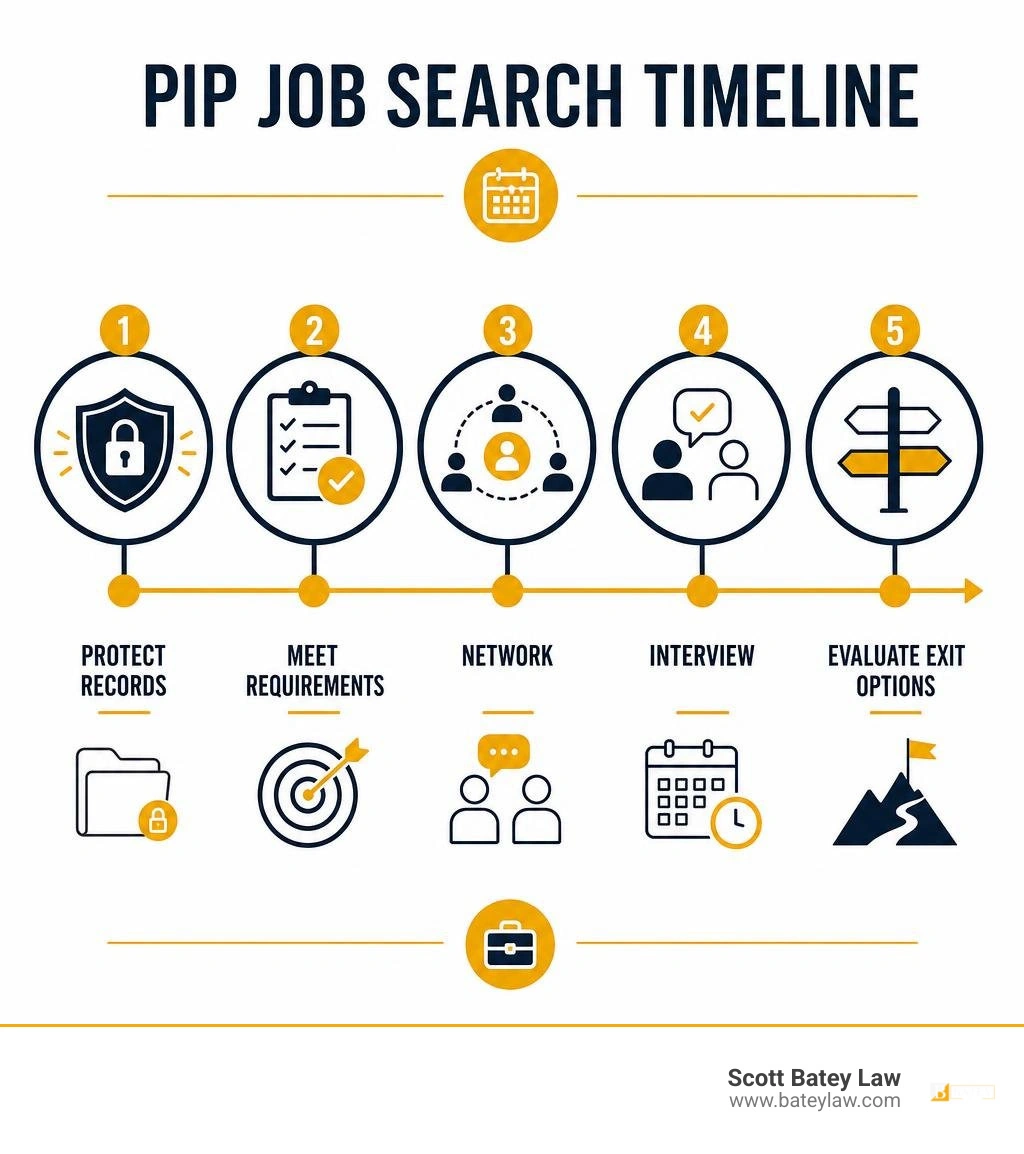
If you are interviewing while on a PIP, protect your position at work while starting a confidential search immediately. Keep meeting the plan's clear requirements, use only personal devices and email for your search, contact trusted people for referrals, and schedule interviews around genuine personal time or approved leave.
A PIP means Performance Improvement Plan, but many employees call it a "paid interview period." That label can be useful as a mindset shift, not as a legal conclusion. Some plans are legitimate efforts to improve performance. Others may be part of a broader reduction in force, retaliation, discrimination, or a paper trail toward termination.
The timing matters. PIPs often last 30 to 90 days, while many hiring processes take weeks or months. A 30-day plan leaves little room for a cold job search. Do not wait for the final review to update your resume, prepare your interview story, and activate your network.
If the PIP came soon after you reported harassment, requested a disability accommodation, took or sought medical leave, raised safety concerns, or engaged in other protected activity, preserve records and consider getting legal advice before signing an agreement or resigning.
I am Scott Batey, a Michigan employment lawyer who has represented employees in workplace disputes since 1996, including matters involving PIPs, retaliation, discrimination, leave, and severance. I help workers assess their legal risks and practical options when interviewing while on a PIP so they can protect both their next opportunity and their current leverage.
What a PIP Really Signals: Performance Reality vs. Disguised Layoff

In corporate life, receiving a Performance Improvement Plan often feels like a sudden blindside—especially if your previous performance evaluations rated you as "Exceeds Expectations" or "Strong Meets." While human resources will frame the document as a constructive coaching mechanism, the statistical reality is stark: the majority of employees placed on PIPs either resign or are let go within the plan period or shortly after, regardless of whether they technically meet every milestone.
Understanding what is driving the plan determines how you allocate your time. In our practice assisting workers across Oakland County, Birmingham, Troy, and Detroit, we see PIPs fall into three distinct buckets:
- Legitimate Performance Coaching: Rare, but real. These plans contain objective, measurable metrics, offer access to training or support, and involve a manager who actively wants you to succeed.
- Disguised Layoffs and Stack Ranking: Companies facing budget contractions or mandatory stack-ranking quotas (such as forcing managers to rate the bottom 5% of staff as underperforming) often use PIPs as "silent layoffs" to trim headcount without paying severance packages or triggering WARN Act disclosures.
- Pretextual Paper Trails: A manager building a paper trail to push out an employee due to personal friction, unlawful discrimination, or whistleblowing.
Recognizing whether your document is a genuine plan or a manufactured exit ramp is essential. For a deeper breakdown of how to handle these documents, reviewing our guide on performance improvement plan pip or paper trail how to respond smartly can help you identify bad-faith metrics. Similarly, corporate timing plays a major role; annual cycles frequently bring targeted plans, as detailed in our analysis of year end reviews pips and job security your michigan survival guide and the january pip how to respond without hurting your case michigan guide.
The First 48 Hours: Protecting Your Career and Legal Rights
The initial 48 hours after being handed a PIP set the tone for both your job hunt and your legal leverage. Emotionally, it is natural to feel panic, anger, or deep embarrassment. Channel that adrenaline into structured action rather than impulsive confrontation.
- Do Not Sign Immediately Under Pressure: Acknowledge receipt if required, but note in writing that signing only confirms you received the document, not that you agree with subjective criticisms.
- Secure Your Evidence Base: Roughly 70% of intellectual property disputes arise near employee separations, but compiling your own personal performance proof is vital. Forward non-proprietary praise emails, client thank-you notes, past positive reviews, and project logs to a personal cloud storage account.
- Keep Job Search and Legal Notes Off Company Devices: Never use company laptops, phones, or network connections to research employment law or look for outside positions. Nearly 89% of former employees retain lingering system credentials after leaving, but enterprise IT monitoring tracks internal browser histories, calendar updates, and file downloads in real time.
- Establish a Factual Event Log: Create an unedited, dated record of every interaction, meeting, and shifting expectation. Using a structured timeline template how to document workplace issues the right way ensures you capture critical details while fresh.
If your plan followed an internal complaint or an accommodation request, precise documentation is crucial. Follow our advice on documenting harassment the right way notes emails and screenshots mi to protect yourself against retaliation after you speak up how michigan employees can protect themselves.
Timeline Math: 30, 60, and 90-Day Plans
The core tension of any PIP search is mathematical. The time between receiving a plan and facing potential termination is typically 30 to 90 days. Meanwhile, standard hiring loops run between 4 and 8 weeks from initial screening to signed offer letter, extending to 8 to 12 weeks for cold applications. If your PIP is 60 days, and the average professional job search takes 2 to 4 months, you start the clock at an immediate timeline deficit.
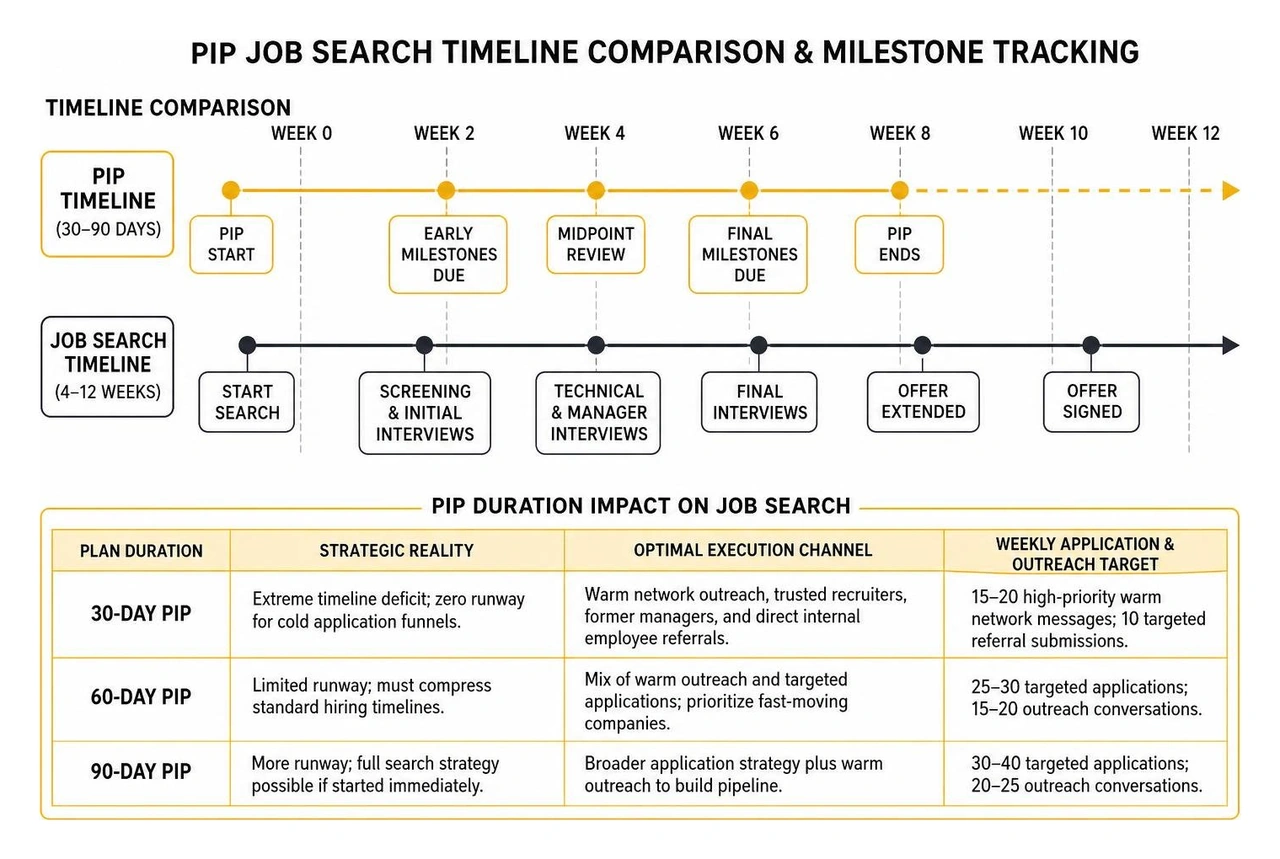
To navigate these constraints, you must tailor your search strategy directly to the length of your plan, leveraging insights like those in this tactical timeline guidance.
| Plan Duration | Strategic Reality | Optimal Execution Channel | Weekly Application & Outreach Target |
|---|---|---|---|
| 30-Day PIP | Extreme timeline deficit; zero runway for cold application funnels. | Warm network outreach, trusted recruiters, former managers, and direct internal employee referrals. | 15–20 high-priority warm network messages; 10 targeted referral submissions. |
| 60-Day PIP | Tight timeline; requires dual-tracking external applications while meeting baseline deliverables. | Hybrid approach: combine daily automated application pipelines with aggressive second-degree LinkedIn networking. | 10–15 automated matched applications per day; 5 direct connection requests. |
| 90-Day PIP | Workable timeline; provides room for multi-stage enterprise interview loops and full vetting. | Full multi-channel campaign: direct applications, executive recruiters, portfolio updates, and structured skill prep. | 10 high-match applications per day; structured weekly recruiter outreach blocks. |
A direct referral from someone inside an organization can cut an interview cycle from 10 weeks down to 4. When time is scarce, bypass anonymous applicant portals wherever possible.
Master Guide to Interviewing While on a PIP

Executing an external job search while working under heightened management scrutiny requires operational discipline. The goal is to present yourself as a calm, highly capable passive candidate rather than an anxious employee running out of runway. Streamlining your workflow with automated application strategies can help you maintain high application volume without spending your entire work day on manual submissions.
Tactical Job Search Execution When Interviewing While on a PIP
- Lock Down Profile Privacy: Keep your LinkedIn profile updated gradually. Turn off the setting that broadcasts profile edits to your network. When enabling career preferences, choose "Recruiters only" rather than displaying the public green "Open to Work" banner on your avatar, which signals vulnerability to your current employer.
- Use Completely Isolated Hardware: Run all interview communication, resume drafting, and recruiter correspondence through personal computers, personal email accounts, and personal cell phones. Never store interview notes in company cloud folders.
- Discreet Interview Logistics: Book multi-hour virtual interview rounds during early morning or late afternoon hours. Label these blocks on your work calendar simply as "Personal Appointment" or "Doctor Visit." If you work on-site or in a hybrid office, take phone screens from your car or a quiet private study room at a local library.
- Reposition Your Professional Brand: Shift your personal branding to showcase your core competencies, recent project wins, and technical capabilities, utilizing established professional branding and narrative tips.
Strategic Communication When Interviewing While on a PIP
How you frame your departure is critical to interview success. A foundational principle of effective interviewing is Pull Framing vs. Push Framing:
- Push Framing (What to Avoid): Explaining that you want to leave because your manager is unfair, the metrics are unrealistic, or company politics have turned toxic. Even if entirely true, interviewers often interpret push framing as workplace friction or unaddressed performance gaps.
- Pull Framing (What to Use): Framing your transition around the positive attributes pulling you toward the prospective employer. For example: "I’ve enjoyed leading key projects at my current firm, but our internal scope recently shifted toward operational maintenance. I’m looking for an environment where I can focus on end-to-end product architecture and client growth."
If an interviewer asks why you are open to opportunities right now, keep your response brief, confident, and future-focused.
When handling reference requests, you are under no obligation to provide your current supervisor. Check the "Do not contact current employer" box on applications—every standard recruiter understands that active employees must protect search confidentiality. Instead, compile a reference list featuring:
- Prior managers from previous companies.
- Skip-level leaders or project directors who have moved on to new organizations.
- Trusted senior peers or cross-functional department heads.
If your PIP is tied to unfair treatment, understanding legal concepts like comparator evidence finding the someone like me for your case and proving timing pretext the close temporal proximity play will help you assess whether your manager's actions represent unlawful retaliation.
Legal and Financial Crossroad: Resigning vs. Termination and Severance
As the end date of a PIP approaches, many workers ask: Should I resign now to save face, or wait for the company to let me go?
From an employment law perspective, voluntarily quitting before the plan concludes is usually a significant tactical error. Resigning forfeits crucial safety nets:
- Unemployment Benefits: In Michigan, voluntary resignation generally disqualifies you from state unemployment compensation unless you prove you left under conditions qualifying as constructive discharge.
- Severance Leverage: Employers rarely offer severance pay to an employee who resigns voluntarily. When an employer initiates an involuntary separation, they frequently offer a severance agreement with a liability waiver.
- Legal Claims: Quitting undermines potential claims for wrongful termination or retaliation unless you meet the high legal bar for constructive dismissal.
Before signing separation paperwork, review our analysis of the top 10 mistakes employees make before signing a severance. Understanding at will employment exceptions in michigan the laws every employee should know and the strict rules governing constructive discharge in michigan when quitting counts as being fired will keep you from forfeiting valuable rights.
Balancing PIP Deliverables and High-Volume Searching Without Burnout
Navigating the emotional pressure of a monitored work environment while running a full job search can quickly lead to exhaustion. To protect your well-being:
- Execute "Good Enough" Baseline Compliance: Deliver what is explicitly required in the PIP documentation, but stop volunteering for extra after-hours tasks. Your remaining energy belongs to your next career step.
- Batch Daily Preparation: Dedicate 30 focused minutes each morning to interview prep (such as reviewing common scenario questions or technical case studies) rather than cramming late at night.
- Practice Psychological Detachment: Separate your self-worth from a corporate review process. Treat the remaining period pragmatically as paid runway designed to support your career pivot.
Frequently Asked Questions About Interviewing on a PIP
Do I have to disclose that I am on a PIP during job interviews?
No. A PIP is an internal personnel document, not a public record. You are under no legal or professional obligation to volunteer that you are on a performance plan. Focus your narrative on your broader career accomplishments and why the prospective position aligns with your goals.
Can prospective employers find out about my PIP during background checks?
Standard third-party background checks do not uncover internal PIPs or performance reviews. Standard employment verification services confirm dates of employment, job titles held, and sometimes eligibility for rehire. Corporate HR policies generally restrict disclosures to neutral facts to protect against defamation and liability claims.
Should I quit my job immediately once placed on a PIP?
In almost all circumstances, no. Quitting eliminates your regular income stream, forfeits eligibility for unemployment insurance, and eliminates your leverage to negotiate a separation package. Unless the workplace environment is severely impacting your health, stay employed, fulfill baseline requirements, and use the paid runway to secure your next role. For further guidance on sudden dismissals, consult our breakdown on fired without warning in michigan what at will really means and doesnt.
Conclusion
Being placed on a Performance Improvement Plan is a challenging career moment, but it does not define your professional capabilities or your future success. By treating the timeline with clear-eyed urgency, keeping your search completely confidential, and mastering the logistics of interviewing while still employed, you can transition into a stronger, healthier role on your own terms.
If you suspect your plan is a retaliatory response to a workplace complaint, medical leave, or unlawful discrimination, you do not have to navigate the situation alone. At Scott Batey Law in Bingham Farms, MI, we have spent over 25 years helping workers across Metro Detroit protect their legal rights, evaluate separation agreements, and hold employers accountable.
To understand your options and evaluate your situation, learn more about your performance improvement plan legal rights or reach out to our team today for a confidential legal consultation.