.png)
When to Hire a Michigan Disability Discrimination Lawyer

Michigan and Federal Laws Protecting Employees with Disabilities
#
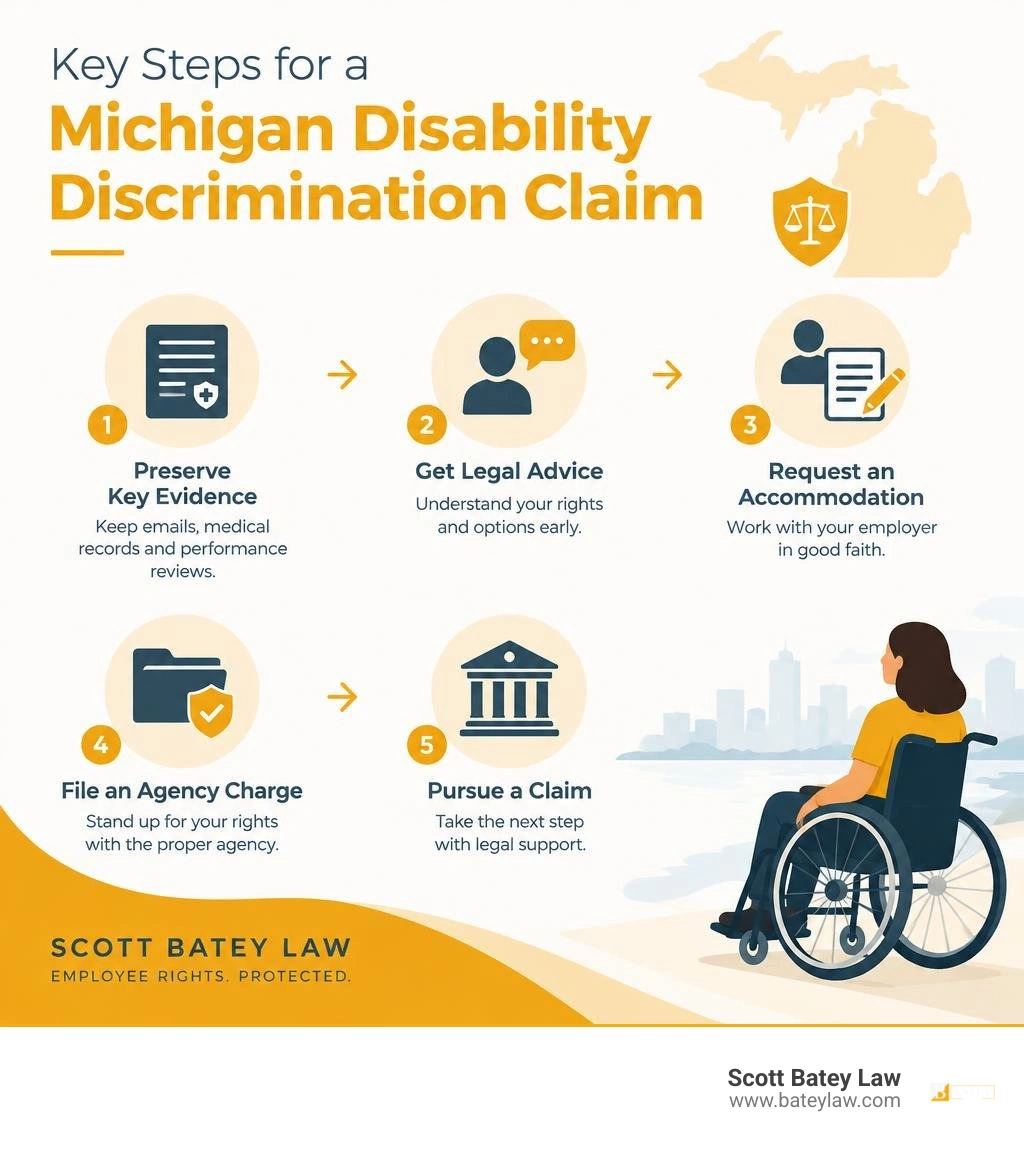
If your employer denied a disability accommodation, punished you after a medical disclosure or leave request, harassed you, or fired you because of a disability, speak with a Michigan disability discrimination lawyer as soon as possible. Early legal advice can help you preserve emails, medical records, performance reviews, and deadlines while you decide whether to request an accommodation, report the problem, file an agency charge, or pursue a claim.
Michigan employees may have rights under both the federal Americans with Disabilities Act (ADA) and Michigan's Persons with Disabilities Civil Rights Act (PWDCRA). These laws can protect workers with physical conditions, mental health conditions, a record of disability, or an employer's mistaken belief that they have a disabling condition.
A lawyer can assess whether the employer had notice of your condition, whether you could perform the job with a reasonable accommodation, and whether the stated reason for discipline or termination may be a cover for discrimination. Common accommodations include schedule changes, medical leave, remote work, modified duties, and assistive equipment.
I am Scott Batey, a Michigan employment lawyer who has represented employees in disability accommodation, discrimination, retaliation, leave, and wrongful termination matters since 1996. As a Michigan disability discrimination lawyer, I help workers identify the strongest facts, protect key evidence, and make informed choices about what comes next.
Essential michigan disability discrimination lawyer terms:
Navigating workplace disability rights requires understanding two core statutes: federal law and Michigan state law. Both frameworks prevent employers from treating qualified workers unfairly simply because of medical conditions, health diagnoses, or physical limitations.
Under both systems, a protected disability generally involves a determinable physical or mental impairment that substantially limits one or more major life activities. These activities include fundamental functions like walking, seeing, hearing, speaking, breathing, learning, performing manual tasks, and working. Coverage also extends to bodily functions, such as immune system performance, normal cell growth, and neurological health.
| Feature / Protection | Americans with Disabilities Act (ADA) | Michigan Persons with Disabilities Civil Rights Act (PWDCRA) |
|---|---|---|
| Employer Size Threshold | 15 or more employees | 1 or more employees (covers nearly all Michigan employers) |
| Administrative Exhaustion | Mandatory (EEOC charge required before federal lawsuit) | Optional (Can file directly in Michigan Circuit Court) |
| Statute of Limitations | 300 days to file EEOC charge | 3 years to file directly in state court |
| Perceived Disability Standard | Broadened under ADA Amendments Act (ADAAA) | Requires present-tense perception of substantial limitation |
| Available Damages | Back pay, front pay, emotional distress, statutory capped punitive damages | Back pay, front pay, uncapped emotional distress damages, attorney fees |
Americans with Disabilities Act vs. Michigan PWDCRA
While federal and state laws share the goal of eliminating workplace discrimination, their mechanisms and scopes contain critical distinctions.
The federal ADA applies strictly to private employers with 15 or more employees, as well as state and local government entities. Before bringing an ADA claim in federal court, a worker must first exhaust administrative remedies by filing a charge of discrimination with the Equal Employment Opportunity Commission (EEOC).
In contrast, Michigan's Persons with Disabilities Civil Rights Act (PWDCRA) covers employers with one or more workers, making it vital for employees at smaller companies across Oakland County, Detroit, and throughout Southeast Michigan. Even better for workers, the PWDCRA does not force you to wait on administrative agency backlogs; an injured employee can file a complaint directly in Michigan Circuit Court within the state's three-year statute of limitations.
How a Michigan Disability Discrimination Lawyer Evaluates 'Regarded As' Claims
You do not need to have an active, severe medical condition to suffer disability discrimination. Both the ADA and the PWDCRA protect workers who are mistreated because an employer perceives them as disabled.
Under Michigan law, proving a "regarded as" claim requires specific attention to judicial precedent. In the landmark decision Michalski v. Bar-Levav, Michigan Supreme Court, 2001, the court clarified how perceived disability claims operate under the state statute.
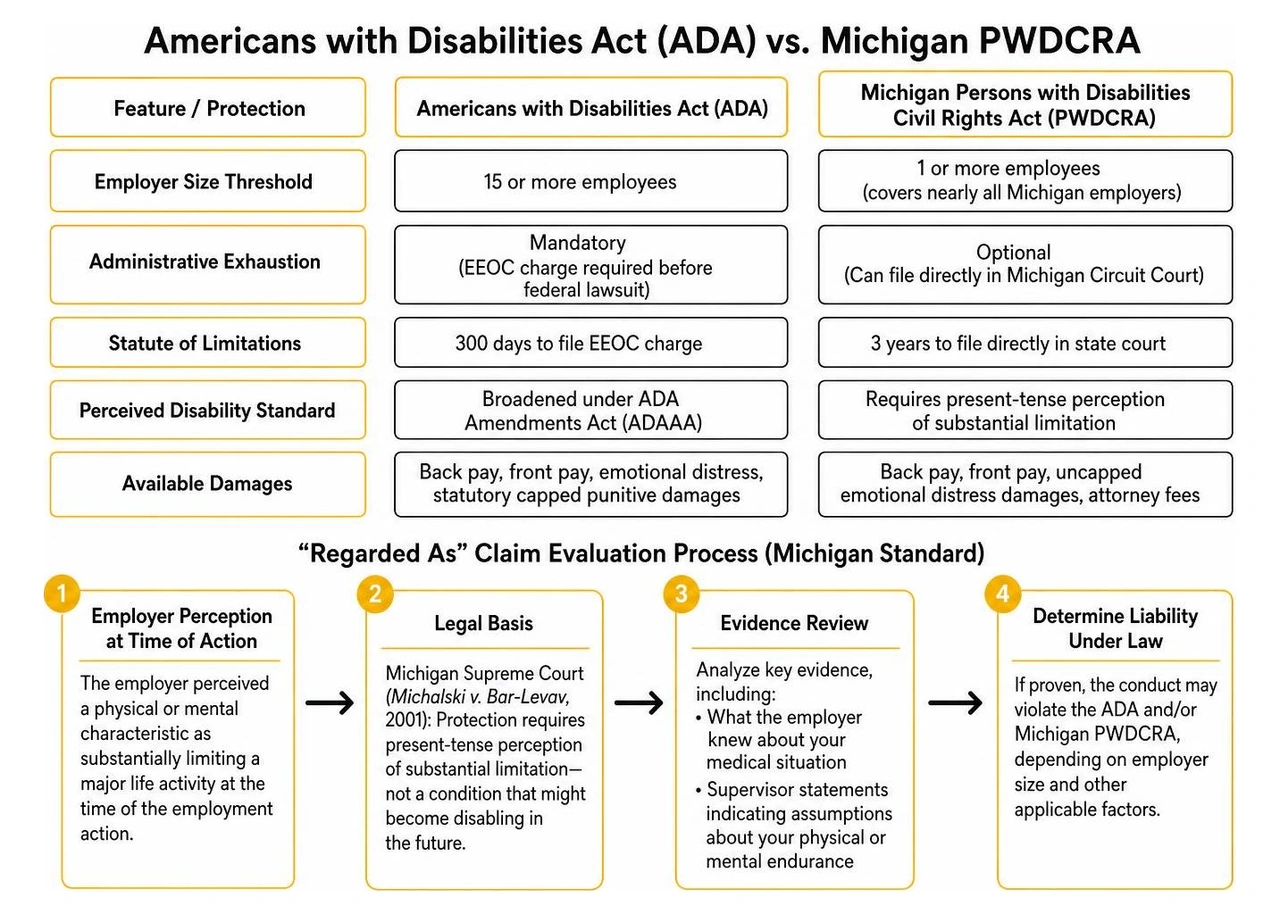
The Michigan Supreme Court held that to succeed on a "regarded as" claim under Michigan's act, the plaintiff must prove that the employer perceived the employee's physical or mental characteristic as substantially limiting a major life activity at the time of the employment action—not merely that the condition might become disabling in the future.
When evaluating these cases, we analyze:
- What the employer knew about your medical situation
- Supervisor statements indicating assumptions about your physical or mental endurance
- Whether decisions were driven by unfounded myths, fears, or stereotypes rather than objective medical evidence
Common Signs of Workplace Disability Discrimination
Disability discrimination is rarely announced openly. Supervisors seldom say, "We are firing you because of your medical diagnosis." Instead, bias usually appears through subtle shifts in workplace dynamics, sudden procedural changes, and pretextual disciplinary measures.

Common warning signs include:
- Suspicious Timing: Receiving your first negative review or being placed on a Performance Improvement Plan (PIP) days after requesting medical leave or disclosing a diagnosis.
- Unwarranted Micromanagement: Facing sudden scrutiny over minor issues that other coworkers routinely get away with.
- Discriminatory Comments: Remarks from managers questioning your stamina, asking if you are "fit to handle the stress," or expressing frustration over medical appointments.
- Stripping Job Duties: Removing core responsibilities, reassigning high-value projects, or isolating you from key team meetings after learning about a health condition.
Failure to Accommodate and the Interactive Process
Under both the ADA and PWDCRA, employers have an affirmative duty to provide reasonable accommodations to qualified employees with known disabilities, provided the modification does not impose an undue hardship on business operations.
When an employee requests help, the law mandates an "interactive process"—a flexible, good-faith dialogue between the worker and the employer to explore practical solutions.
Common examples of employer accommodation failures include:
- Issuing blanket flat denials like "we don't allow light duty" or "we don't offer flexible schedules."
- Refusing to engage in an interactive dialogue and ignoring medical documentation.
- Delaying responses for months while an employee struggles without needed equipment or scheduling relief.
- Forcing an employee onto unpaid leave when they can continue working with a minor accommodation.
- Denying remote work or modified shift arrangements without demonstrating concrete financial or operational disruption.
Employers frequently cite "undue hardship" to reject accommodations, but legal standards require them to prove significant difficulty or expense based on objective business resources, not mere inconvenience.
Wrongful Termination, Retaliation, and Hostile Work Environments
When an employee requests an accommodation or takes protected medical leave, retaliatory conduct is strictly unlawful. Retaliation often mirrors classic wrongful termination patterns: an employee with years of sterling evaluations is suddenly branded an "underperformer" and let go shortly after requesting surgery leave or workplace modifications.
Disability-based hostile work environments also violate the law. If an employee is subjected to persistent insults, derogatory slurs regarding mental or physical abilities, offensive jokes, or purposeful exclusion that creates an intimidating or abusive atmosphere, the employer can be held liable for failing to stop the harassment.
When to Consult a Michigan Disability Discrimination Lawyer
Seeking counsel early is the most effective way to protect your livelihood and avoid irreversible mistakes. Waiting until after you are escorted out the door leaves fewer options for preserving your job or shaping the documentary record.

If you are experiencing mounting pressure at work, dealing with accommodation roadblocks, or facing disability claims issues, consulting dedicated legal professionals is essential. In addition to employment counsel, individuals seeking assistance with benefits and administrative programs can explore community services, administrative agencies, or regional practitioners to coordinate their broader legal strategy.
Steps to Take Before Calling an Attorney
Before your initial legal consultation, taking structured steps will clarify the strength of your claims:
- Keep Written Records: Save emails, text messages, performance evaluations, company handbooks, and written accommodation requests to a personal device or hard-copy file outside of work.
- Document the Timeline: Create a factual, chronological journal of events, noting dates, times, witnesses, and exact conversations with supervisors and HR representatives.
- Obtain Medical Support: Secure clear, functional notes from your healthcare provider detailing your limitations and suggested workplace modifications without disclosing unnecessary diagnostic details.
- Follow Internal Policies: Comply with your company's formal accommodation request procedures whenever possible to establish that the employer had clear notice.
Why Working with a Michigan Disability Discrimination Lawyer Protects Your Career
Retaining an experienced legal advocate shifts the power balance back in your favor. Corporate human resources departments are designed to protect the company, not you.
When you partner with our firm, we:
- Conduct a thorough case evaluation to identify every federal and state violation.
- Uncover pretext in employer justifications by comparing your treatment against similarly situated non-disabled coworkers.
- Take over high-stakes communications to prevent your employer from manufacturing false grounds for discharge.
- Build aggressive leverage for pre-suit settlement negotiations or take your case directly into state or federal court.
Legal Remedies and Available Damages in Michigan
Victims of unlawful disability discrimination in Michigan are entitled to comprehensive remedies designed to make them whole financially, professionally, and personally.
Potential recovery includes:
- Back Pay: Compensation for lost wages, bonuses, overtime, healthcare benefits, and retirement contributions from the date of wrongful termination to the present.
- Front Pay: Future earnings awarded when reinstatement to your prior job is impracticable due to workplace hostility.
- Emotional Distress Damages: Compensation for mental anguish, loss of professional reputation, humiliation, anxiety, and depression caused by workplace mistreatment.
- Punitive Damages: Available under federal claims when an employer acts with malice or reckless indifference to civil rights.
- Attorney's Fees and Costs: Reimbursement of legal expenses, requiring the discriminating employer to pay for your representation upon a successful outcome.
- Job Reinstatement: Court-ordered return to your position or restoration of seniority status where appropriate.
Frequently Asked Questions About Disability Discrimination in Michigan
What qualifies as a disability under Michigan law?
Under Michigan's PWDCRA, a disability is defined as a determinable physical or mental characteristic resulting from disease, injury, congenital condition, or functional disorder that substantially limits one or more major life activities. The definition also covers individuals with a history or record of such an impairment, as well as workers who are mistakenly regarded by their employers as having a substantially limiting condition.
What constitutes a reasonable accommodation under the PWDCRA?
A reasonable accommodation is any adjustment or modification to a job, work environment, or hiring process that enables a qualified individual with a disability to perform essential job duties. Common examples include ergonomic equipment, modified work schedules, part-time or remote work, restructuring non-essential tasks, providing readers or interpreters, and granting short-term medical leave.
How long do I have to file a disability discrimination claim in Michigan?
Deadlines depend heavily on the statute you use. For federal claims under the ADA, you must file a charge of discrimination with the EEOC within 300 days of the discriminatory act. If filing under Michigan's PWDCRA, you have up to 3 years from the date of the adverse action to file a lawsuit directly in Michigan Circuit Court without first filing with an administrative agency.
Conclusion
Facing disability discrimination or retaliation at work can threaten both your health and your career. You do not have to navigate complex state and federal statutes alone against corporate defense teams.
Scott Batey Law represents workers across Bingham Farms, Birmingham, Southfield, Royal Oak, Beverly Hills, Farmington Hills, Oak Park, Troy, Ferndale, Berkley, Madison Heights, Oakland County, and Detroit. With over 25 years of dedicated experience representing employees in wrongful termination, retaliation, and harassment matters, our team delivers personalized, award-winning legal advocacy.
If your employer has mistreated you due to a medical condition or denied your accommodation, explore our comprehensive workplace discrimination legal services to schedule a confidential case assessment and protect your legal rights today.