.png)
How to Beat a Michigan Non-Compete with the Right Attorney

What a Michigan Non Compete Lawyer Can Do for You
If you're dealing with a restrictive covenant at work, a Michigan non compete lawyer can help you understand whether your agreement is actually enforceable — and what your real options are.
Quick answer: Non-compete agreements in Michigan are only enforceable if they meet specific legal standards. Here's what matters most:
- Governed by: Michigan Antitrust Reform Act (MCL § 445.774a)
- Must protect: A legitimate business interest (trade secrets, customer relationships, specialized training)
- Duration: Courts generally accept up to 1 year; 3+ years is usually unreasonable
- Geography: Must match the employer's actual market area — nationwide restrictions are often too broad
- Scope: Must be limited to work that directly competes, not all jobs in an industry
- Courts can: Modify (not just void) an overly broad agreement using the "blue pencil" doctrine
Michigan employers often draft these agreements as broadly as possible. That doesn't mean they'll hold up in court.
Many employees sign non-competes without realizing that the agreement may be unenforceable as written — or that they have real options even after signing. Whether you've received a cease-and-desist letter, been sued by a former employer, or are simply trying to understand your rights before starting a new job, the stakes are high and the details matter.
I'm Scott Batey, founder of Batey Law Firm, PLLC, and I've spent nearly three decades representing Michigan employees in workplace disputes — including non-compete, non-solicitation, and confidentiality agreement conflicts — as a Michigan non compete lawyer focused exclusively on the employee side. If you're facing a restrictive covenant dispute, this guide will walk you through exactly what the law requires, what courts look at, and how to protect your right to work.
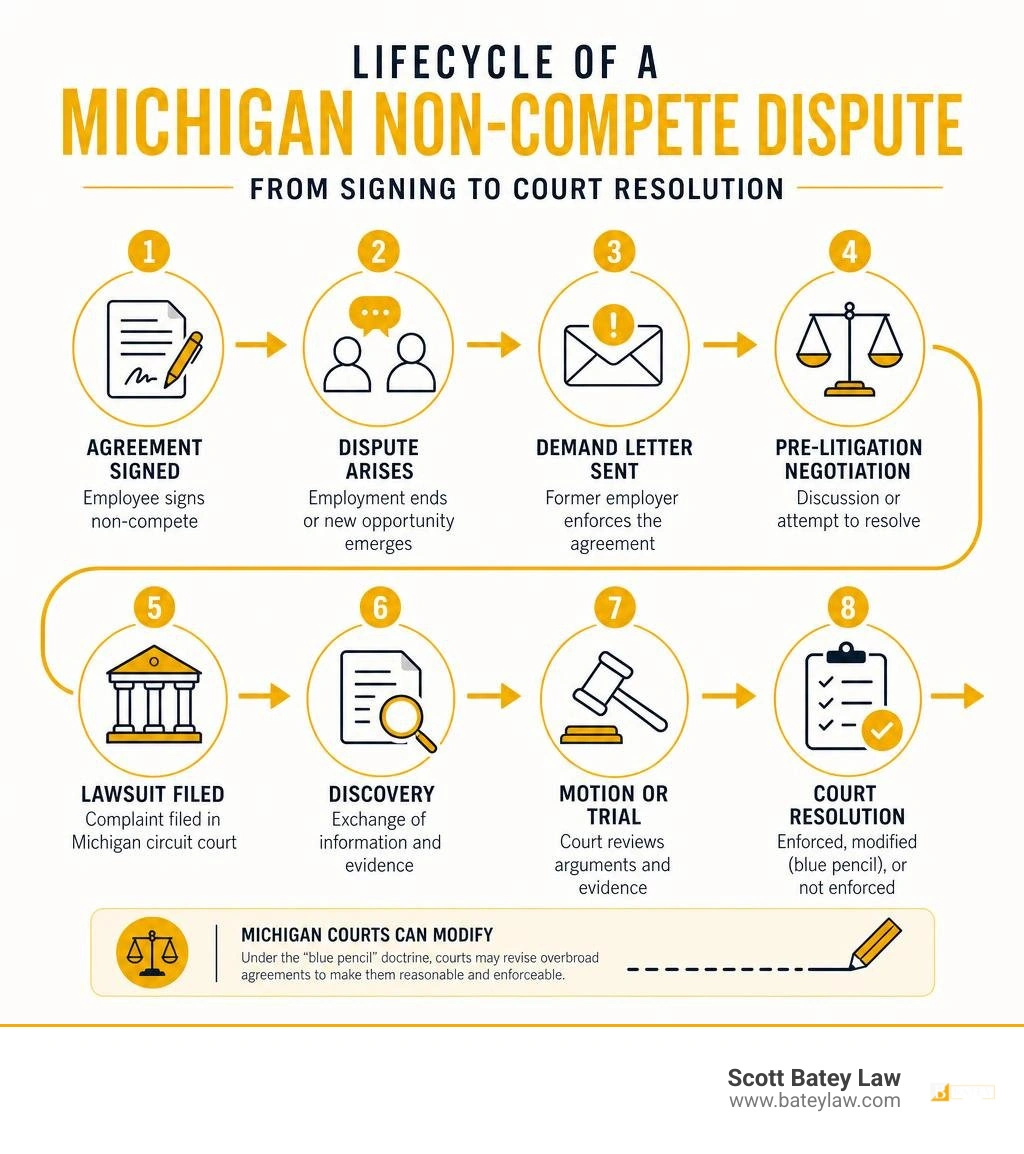
Is Your Agreement Enforceable? The Michigan Legal Standard

In Michigan, non-compete agreements are not automatically valid. Under the Michigan Antitrust Reform Act, specifically MCL § 445.774a, an employer cannot simply force you to sign away your right to earn a living just because they do not want you working for a competitor. To be legally enforceable, a non-compete must protect a "legitimate business interest" and be reasonable in its duration, geographical reach, and line of business.
What exactly qualifies as a legitimate business interest? Under Michigan law, this includes:
- Trade secrets: Highly sensitive, proprietary formulas, processes, or software.
- Confidential information: Non-public financial data, marketing strategies, or business plans.
- Customer relationships: Goodwill and close client connections that you built specifically on the employer's dime.
- Specialized training: Extraordinary training that goes far beyond basic industry standards.
Preventing ordinary competition is not a legitimate business interest. If your employer’s only goal is to keep you from taking a similar job down the street because you are good at what you do, Michigan courts will reject that restriction.
It is also important to distinguish between different types of restrictive covenants. A non-compete prevents you from working in a specific industry or for a specific competitor altogether. A non-solicitation agreement, on the other hand, only prevents you from poaching your former employer's clients or employees. To understand how these differences impact your career mobility, read our detailed breakdown on Noncompete vs Nonsolicitation in Michigan: What's the Difference and Why It Matters.
State and federal courts, including those reviewing disputes in the Metro-Detroit area, analyze these agreements with a critical eye. Understanding how litigation plays out under Michigan's statutory framework is essential for protecting your career mobility and ensuring your rights are respected.
The Four-Factor Reasonableness Test in Michigan
When a non-compete agreement ends up in front of a Michigan judge, the court does not just look at whether you signed the document. Instead, the judge applies a strict four-factor reasonableness test to balance the employer's business interests against your constitutional right to work and support your family.
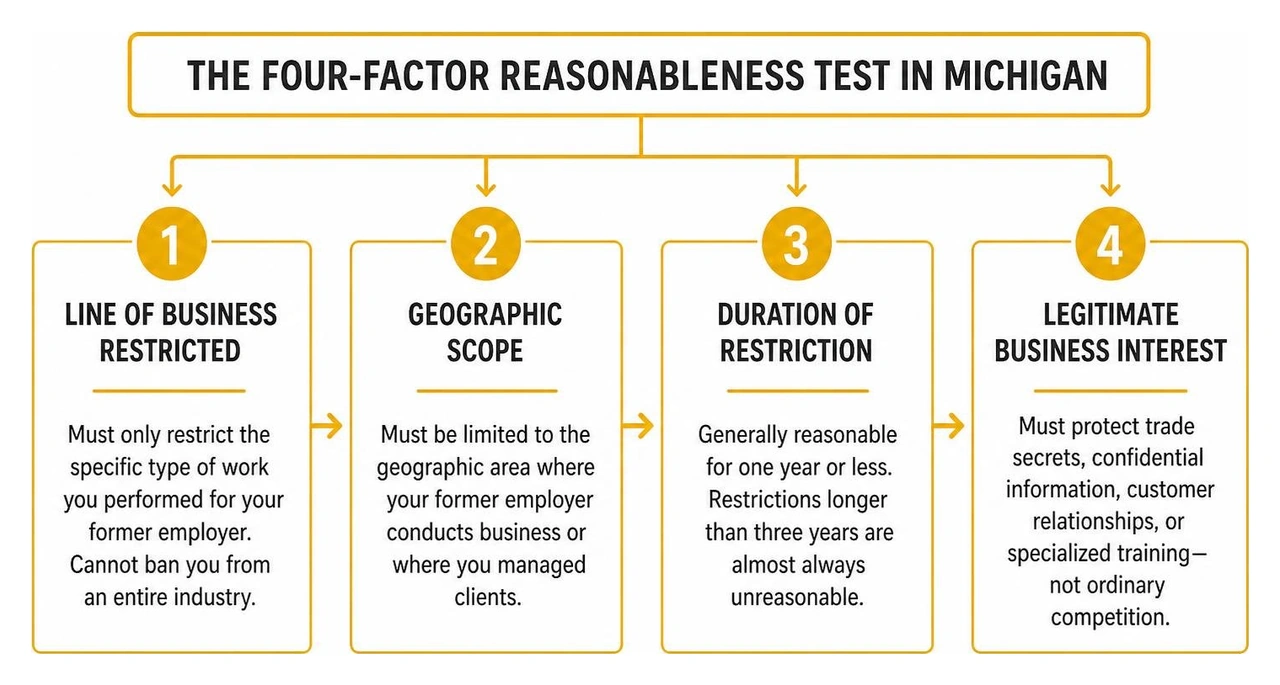
The four factors Michigan courts evaluate are:
- The Line of Business Restricted: The agreement must only restrict you from performing the specific type of work you did for your former employer. It cannot ban you from an entire industry if your new role has nothing to do with your old one. For example, if you worked as a specialized sales representative for a medical device manufacturer, a non-compete cannot legally bar you from working as an administrative assistant at a software company.
- The Geographic Scope: The restriction must be limited to the geographic territory where your former employer actually conducts business or where you personally managed clients. In the Metro-Detroit area, which has a massive population of 4.3 million across Wayne, Oakland, and Macomb counties, a local restriction of a few miles around your former office may be reasonable. However, a blanket nationwide ban is almost always deemed unreasonable unless the employer operates on a truly national scale and you held an executive-level position with broad influence.
- The Duration of the Restriction: How long does the ban last? Michigan courts consistently view a duration of one year or less as reasonable. Conversely, restrictions lasting longer than three years are almost always struck down as unreasonable, absent extraordinary circumstances like the sale of a multi-million-dollar business.
- The Competitive Business Interest Protected: The employer must prove that the restriction is absolutely necessary to protect their goodwill, trade secrets, or client base. If the restriction is designed simply to "punish" you for leaving or to suppress wages, it fails this part of the test.
To see the difference between what is typically upheld and what is thrown out, consider this comparison table:
| Restriction Feature | Generally Reasonable | Generally Unreasonable |
|---|---|---|
| Duration | 6 months to 1 year | 3 years or longer |
| Geographic Scope | A 10-mile radius around the office; the specific counties you serviced | Nationwide or global bans (for non-executive roles) |
| Scope of Work | Restricting the exact services you provided to direct competitors | Banning any employment whatsoever in the same broad industry |
| Business Interest | Protecting active client lists or proprietary software trade secrets | Restricting general skills, basic industry knowledge, or cold calling |
Understanding these limits is vital when planning your next career move. To learn more about how these restrictions specifically limit your employment options, check out our guide on Noncompete vs Nonsolicit in Michigan: What Really Limits Your Next Job.
How a Michigan Non Compete Lawyer Can Help You Fight Back
If you are trapped under an overly broad restrictive covenant, you do not have to sit on the sidelines and wait for the clock to run out. An experienced michigan non compete lawyer can help you proactively challenge the agreement, negotiate with your former employer, and defend your rights in court if necessary.
When an employee decides to transition to a new job or launch a startup, we typically employ a multi-step defense strategy:
- Comprehensive Contract Review: We analyze the exact language of your agreement to identify loopholes, lack of consideration, or unreasonable terms.
- Evaluating Competitor Status: We determine if your new employer actually competes with your old one. If there is no overlap in products, services, or customer bases, the non-compete shouldn't apply.
- Responding to Cease-and-Desist Letters: If your former employer sends a threatening letter, we draft a strong, legally grounded response. This shows them we are prepared to fight and often deters them from filing an expensive lawsuit.
- Negotiating a Release or Modification: Often, we can negotiate directly with the employer's legal counsel to narrow the geographic or temporal scope, allowing you to take your new job without fear of litigation.
If you live or work in the Oakland County suburbs, you should read our localized advice in Noncompete Agreements in Michigan: What Southfield Employees Should Watch For to understand how these disputes are handled locally.
Challenging Overly Broad Terms with a Michigan Non Compete Lawyer
What happens if your non-compete is clearly unreasonable, but your employer refuses to budge? In Michigan, courts utilize the blue-pencil doctrine. This means that if a judge finds a non-compete agreement to be overly broad, they do not have to throw out the entire contract. Instead, they have the authority to "blue-pencil" (modify) the agreement to make it reasonable.
For example, if your employer wrote a non-compete banning you from working in the entire United States for five years, a Michigan judge might modify those terms down to a 15-mile radius around Detroit for one year.
While this sounds like a win, the blue-pencil doctrine can be a double-edged sword. It means employers sometimes write incredibly aggressive agreements, knowing that the worst-case scenario is a judge simply scaling them back rather than voiding them completely. Working with a skilled attorney allows you to present a compelling argument showing why the agreement is so fundamentally flawed or coercive that the court should refuse to enforce it in any capacity.
Negotiating Severance and Exit Strategies with a Michigan Non Compete Lawyer
The best time to handle a non-compete dispute is before you walk out the door. If you are being laid off, terminated, or are negotiating an exit, your non-compete will likely be bundled into a severance agreement.
Employers frequently try to slip restrictive covenants or expanded non-compete terms into severance packages in exchange for a few weeks of pay. We help employees audit these agreements to ensure they aren't signing away their future livelihood for a temporary payout. We can negotiate to have the non-compete completely waived or dramatically scaled back as part of your exit terms.
Before you sign any exit paperwork, make sure to read our guide on Severance Red Flags in Michigan: Noncompetes, Nonsolicits, NDA Overreach to protect your rights.
Consequences of Violating a Non-Compete in Michigan
Ignoring a non-compete agreement and hoping your employer won't notice is a highly risky strategy. If you violate a valid agreement, the legal and financial consequences can be severe for both you and your new employer.
Typically, an employer who discovers a violation will take the following legal steps:
- Cease-and-Desist Letter: A formal warning demanding that you immediately stop working for the competitor.
- Temporary Restraining Order (TRO): An emergency court order that can be issued quickly—sometimes without prior notice to you—to immediately halt your employment for up to 14 days while the court reviews the case.
- Preliminary Injunction: A court order that stops you from working at your new job for the entire duration of the lawsuit, which can take months or even years to resolve.
- Damages and Lost Profits: If the employer wins the lawsuit, you may be held liable for financial damages, including the profits they lost due to your competitive activities.
- Attorney Fees: Many non-compete agreements contain clauses requiring the losing party to pay the other side's legal fees, which can easily reach tens of thousands of dollars.
- Tortious Interference Claims: Your former employer may also sue your new employer for "tortious interference" with a contract. To avoid expensive litigation, many new employers will simply fire an employee the moment they receive a legal threat from a competitor.
Because the stakes are so high, we always advise consulting a professional before making a job transition to ensure you are fully protected from potential legal action.
Frequently Asked Questions About Michigan Non-Compete Laws
Navigating restrictive covenants can be incredibly confusing. Below are answers to some of the most common questions we receive from employees in Bingham Farms, Southfield, and across Metro-Detroit.
Are non-compete agreements enforceable in Michigan if I was fired?
Yes, they can be. In Michigan, there is no automatic rule that voids a non-compete agreement simply because you were laid off or fired. However, a court is far less likely to enforce an aggressive non-compete if the employer terminated you without cause.
If you were let go because of budget cuts or downsizing, we can argue that the employer has unclean hands or that enforcing the agreement would create an unfair hardship, especially since they were the ones who ended the relationship.
What is the maximum reasonable duration for a Michigan non-compete?
While there is no strict statutory limit, Michigan case law has established clear boundaries. A duration of one year or less is consistently viewed as reasonable by local courts.
Restrictions lasting between one and three years require strong justification, such as protecting highly sensitive trade secrets. Any restriction lasting longer than three years is highly likely to be struck down or heavily modified by a judge.
Are there recent legislative changes or bans on non-competes in Michigan?
The legal landscape surrounding non-competes is shifting rapidly. Nationally, the Federal Trade Commission (FTC) proposed a sweeping ban on non-compete agreements, though that rule has faced ongoing legal challenges in federal courts.
At the state level, Michigan lawmakers have introduced bills like HB 4874, which aim to place strict limits on non-competes, such as banning them for low-wage workers and requiring employers to disclose non-compete terms in writing before hiring. As of July 2026, it is critical to consult with a knowledgeable attorney who is up-to-date on the latest state and federal rulings to ensure you are making decisions based on current law.
Conclusion
A non-compete agreement can feel like a professional prison sentence, but you have more power than you think. Employers frequently write overly broad, intimidating contracts in the hope that you will simply give up and stay put. With the right legal strategy, many of these agreements can be negotiated, narrowed, or completely invalidated.
At Scott Batey Law, we have spent over 25 years fighting for the rights of workers across Oakland County and the greater Metro-Detroit area, including Bingham Farms, Southfield, Birmingham, Royal Oak, and Troy. We understand the stress of facing a career-threatening legal dispute, and we provide the personalized, award-winning representation you need to fight back.
If you are ready to take control of your career and challenge an unfair restrictive covenant, contact us today. Let us help you protect your right to work. To get started, visit our Noncompete Agreement Attorney Southfield MI page and schedule a consultation.