.png)
Michigan Workplace Injuries: Rights, Responsibilities, and Next Steps

Michigan Workplace Injury Rights: A Quick Starting Point
A Michigan workplace injury may qualify you for workers' compensation when it arises out of and during your employment. The claim can cover reasonable medical care and, when you cannot earn your usual wages, wage-loss benefits - but it generally does not pay for pain and suffering.
| If you are injured at work | Quick answer |
|---|---|
| What should you do first? | Report the incident to a supervisor right away, get medical care, and keep records of what happened. |
| Who pays medical bills? | Workers' compensation should cover reasonable and necessary treatment for a work-related injury or illness. |
| Can you choose your own doctor? | Usually, the employer may direct treatment for the first 28 days. |
| When do wage benefits begin? | Wage-loss benefits generally begin on the eighth day of disability. If disability lasts 14 days or longer, the first seven days may be paid retroactively. |
| Can your employer fire you for filing a claim? | Michigan law prohibits discharge or discrimination because a worker exercised rights under the workers' compensation law. |
| Can you sue someone besides your employer? | Sometimes. A negligent contractor, driver, property owner, or product manufacturer may be liable in a separate third-party claim. |
Michigan reported 78,900 nonfatal private-industry workplace injuries and illnesses in 2023. A job injury can also put a worker in a difficult spot with an employer: medical restrictions, missed pay, pressure to return too soon, or retaliation after reporting the incident can all create separate legal concerns.
I am Scott Batey, a Michigan employment lawyer who has represented employees in workplace disputes since 1996, including retaliation, wrongful termination, leave, and disability-related matters that can follow a Michigan workplace injury. Understanding the rules early can help you protect both your benefits and your job.
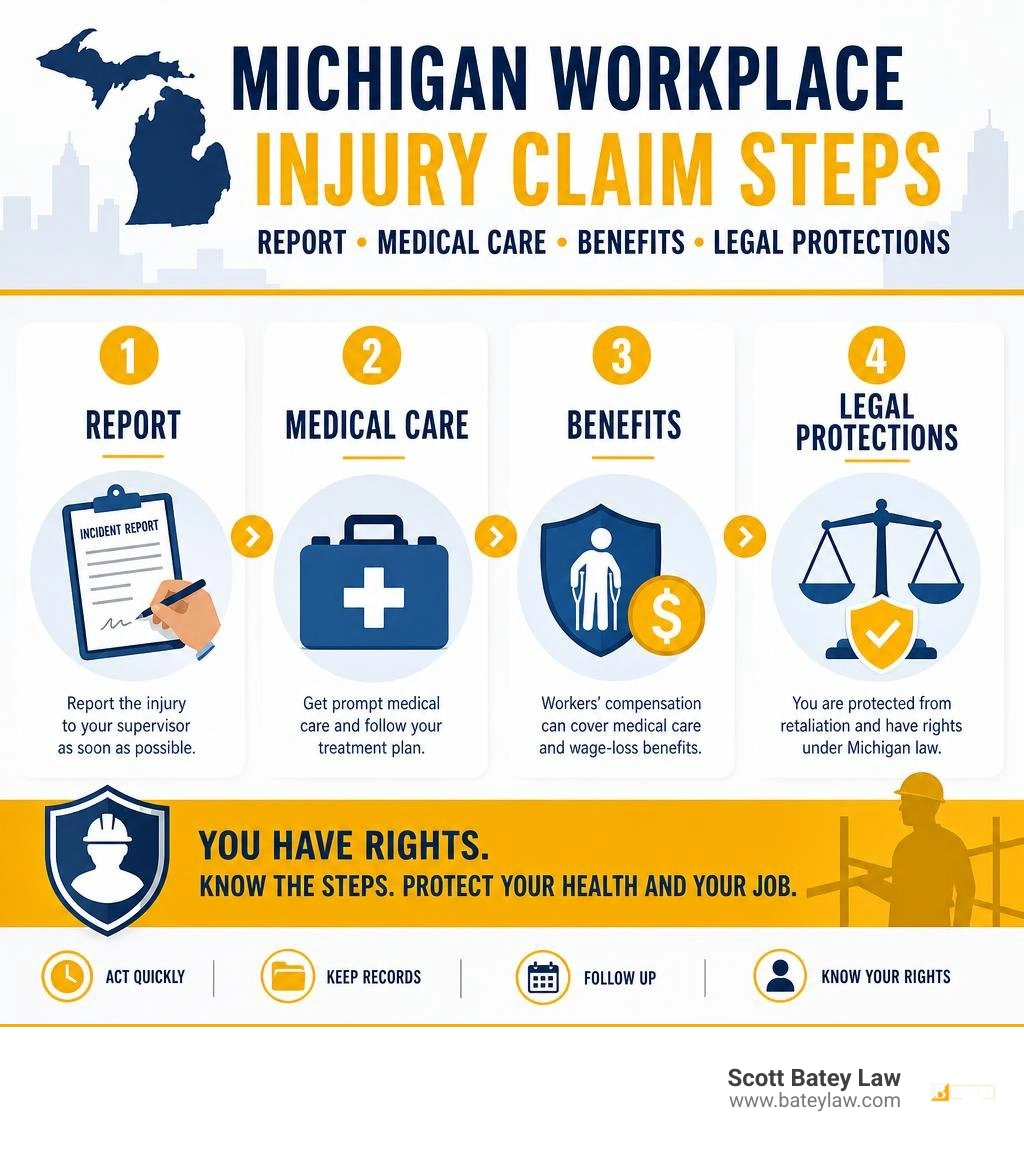
Essential Immediate Steps Following a Michigan Workplace Injury
Sustaining a Michigan workplace injury can instantly turn an ordinary workday upside down. Under MCL - Section 418.301 - Michigan Legislature, the Worker's Disability Compensation Act (WDCA) establishes that an employee who receives a personal injury arising out of and in the course of employment is entitled to mandatory statutory compensation. However, securing those rights requires quick, deliberate action.
When an accident happens, your immediate priority must always be safety and personal health. If you suffer a severe acute injury—such as a deep laceration, broken bone, or head trauma—emergency medical care takes precedence over everything else. Call 911 or head straight to the nearest emergency department.
If the condition is non-life-threatening, you must notify your employer as quickly as possible. Michigan law allows up to 90 days to provide formal notice of an injury to your employer, but waiting even a few days can give insurance adjusters a reason to question whether the harm actually occurred at work. Always give written notice to your immediate supervisor or human resources department detailing exactly when, where, and how the incident occurred.
Step-by-Step Actions After an On-the-Job Incident
To keep your claim moving smoothly and prevent common administrative hurdles, follow a structured post-incident routine:
- Notify Your Supervisor Immediately: Send an email or fill out an internal incident report so there is a clear written record.
- Seek Prompt Medical Attention: Inform the treating doctor that your injury or illness occurred on the job so they bill the workers' compensation carrier rather than your private health insurance.
- Document Everything: Take photographs of the scene, machinery, hazardous conditions, or physical injuries. Collect contact details from co-workers or bystanders who witnessed the event.
- Follow Up on Employer Filings: Ensure your employer completes their official paperwork.

When an employee is off work for more than seven consecutive calendar days due to a work-related disability, the employer is legally obligated to submit an official claim report to the state's administrative body.
Reporting a Michigan Workplace Injury: The 28-Day Medical Rule
One of the most unique aspects of Michigan workers' compensation law is the employer's right to control your initial medical care. Under state law, your employer or their insurance carrier has the right to direct your medical treatment to a doctor or occupational clinic of their choice for the first 28 days following your initial medical treatment.
During these first 28 days, you must attend appointments with the designated occupational health provider to ensure your medical bills remain covered. However, once 28 days have passed from the date treatment began, you gain the statutory right to select your own qualified physician, surgeon, or specialist.
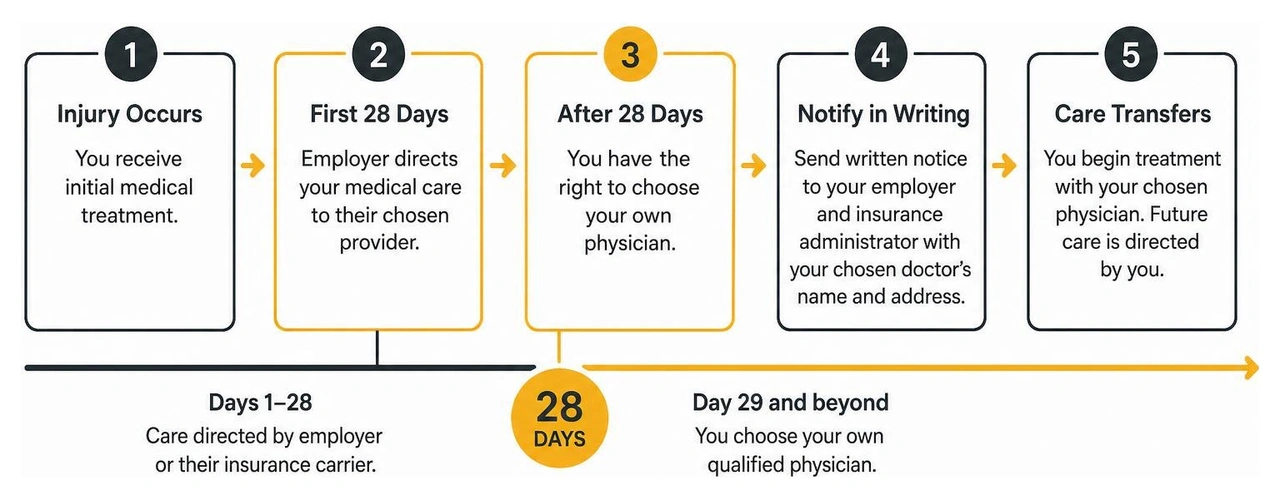
To transfer your care after 28 days, you must notify your employer and their insurance administrator (such as Sedgwick) in writing. Include the name and address of your chosen physician. For additional details regarding state administrative guidelines, check the official Workers' Compensation FAQs - State of Michigan.
Understanding Compensation and Benefits Under Michigan Law
When you suffer a Michigan workplace injury, the Workers' Disability Compensation Act provides a specific package of statutory benefits designed to make you financially and medically whole. However, it is equally important to recognize what workers' compensation does not provide: under Michigan law, no-fault workers' comp benefits cover medical treatment and a portion of lost wages, but they completely exclude payments for pain and suffering, emotional distress, or loss of enjoyment of life.
Covered medical benefits include 100% of reasonable and necessary treatment directly related to your workplace injury. This encompasses doctor visits, hospital stays, surgical procedures, physical therapy, prescription medications, medical devices, and even travel reimbursement for transportation to and from medical appointments.
Wage Loss Calculations, AWW, and Benefit Coordination
If your Michigan workplace injury prevents you from returning to work, you may qualify for weekly wage-loss benefits. Under Michigan law, wage loss compensation is generally calculated at 80% of your after-tax Average Weekly Wage (AWW), subject to statutory annual maximum caps (which are capped at 90% of the State Average Weekly Wage).
Your AWW is typically calculated using your gross earnings from the highest 39 weeks out of the 52 weeks immediately preceding the date of injury. If you worked multiple jobs at the time of injury, earnings across all employers covered under the Act can be combined.
Wage benefits depend heavily on how long your disability keeps you off the job:
| Disability Duration | Wage Loss Coverage Rules |
|---|---|
| Fewer than 7 calendar days | No wage-loss benefits are paid under workers' comp. You may use accrued sick leave, annual leave, or paid medical leave if available. |
| 8 to 13 calendar days | Wage-loss benefits begin on the 8th day. The initial 7 days remain unpaid by workers' compensation. |
| 14 calendar days or longer | Wage-loss benefits retroactively pay back to day 1 of your disability. Any personal leave credits used during the first week are typically reimbursed or credited back. |
To learn more about how statutory benefit formulas operate, review the official guidance on LEO - Wage Benefits.
Furthermore, Michigan law includes benefit coordination rules. If you receive employer-funded pension benefits, old-age Social Security retirement benefits, or wage-continuation payments, your workers' compensation check may be reduced proportionally under Section 354. However, Social Security Disability Insurance (SSDI) benefits generally do not trigger a state workers' comp reduction.
Total vs. Partial Disability and Residual Wage Earning Capacity
Michigan law distinguishes between total disability and partial disability:
- Total Disability: You are physically unable to perform any suitable work within your qualifications, training, and experience, entitling you to full weekly wage loss benefits.
- Partial Disability: You retain some physical capacity to work, but your post-injury earning capacity is less than your pre-injury AWW.
Under legislative updates to the WDCA, insurance carriers heavily utilize the concept of residual wage earning capacity. Insurers can evaluate your educational background, work history, and physical restrictions to argue that you possess the theoretical capacity to perform available light-duty jobs in the labor market (such as phone sales or customer service desk positions)—even if you haven't been offered one.
To protect your full weekly benefits, injured workers in Michigan have an affirmative legal obligation to conduct a good-faith, active job search for positions within their medical restrictions and report those search efforts regularly. When returning to work under restrictions, ensure your physician provides comprehensive documentation. Read our detailed guide on Light Duty Return to Work Notes in Michigan: What Your Doctor Must Include to Protect You to safeguard your rights.
Pre-Existing Conditions and Aggravation Standards
A frequent issue in Michigan workplace injury claims involves pre-existing health conditions, such as degenerative disc disease or arthritis. Under the landmark Michigan Supreme Court precedent Rakestraw v. General Dynamics Land Systems, Inc. (codified in MCL 418.301), merely experiencing an increase in pain or symptoms at work is legally insufficient to establish a compensable injury.
To receive workers' compensation for a pre-existing condition or aging process, you must medically prove that your work duties caused, contributed to, or aggravated your pathology to create a medically distinguishable change in your underlying physical structure. Detailed diagnostic imaging (such as MRIs or CT scans) and strong medical opinions from treating specialists are often critical in meeting this burden of proof.
Employer Obligations, Reporting Duties, and Retaliation Protections
Employers in Michigan carry strict statutory duties when a worker suffers an injury on the job site. Once notified of a Michigan workplace injury causing more than seven days of disability, an employer must complete and submit the EMPLOYER'S BASIC REPORT OF INJURY (Form WC-100) to the LEO - Workers' Disability Compensation Agency.
Many employers utilize third-party administrators (TPAs) like Sedgwick to handle claims, process medical bills, and issue benefit checks. While TPAs manage administrative tasks, your employer remains legally accountable for adhering to state workplace laws.
Employer MIOSHA Reporting and Occupational Illness Obligations
Beyond filing workers' compensation reports, employers must comply with state health and safety standards under the MICHIGAN OCCUPATIONAL SAFETY AND HEALTH ACT (MIOSHA, Act 154 of 1974).
Employers must record qualifying injuries on their annual MIOSHA logs and keep those records on file for at least five years. Furthermore, under Part 56 of the Michigan Public Health Code (P.A. 368 of 1978), employers and medical providers must report any known or suspected occupational illness or workplace-aggravated disease within 10 days using the official Occupational Disease Report Form (Form MIOSHA-TSD-51).
Protection Against Retaliation and Illegal Discharge
One of the most crucial employee protections in state law is found in MCL 418.301(13). This statutory anti-retaliation provision strictly prohibits an employer from discharging, demoting, harassing, or discriminating against an employee because the worker filed a workers' compensation claim, reported a job site safety violation, or exercised rights under the WDCA.
Unfortunately, retaliatory discharge still occurs. An employer might suddenly fabricate performance issues, write you up for minor infractions, cut your work hours, or refuse to honor doctor-ordered light-duty restrictions after you report a Michigan workplace injury.
If your employer fires or penalizes you for reporting an injury or taking medical leave, you may have a distinct civil claim for illegal employment retaliation or wrongful termination. Read our in-depth guides on Retaliation After Reporting a Safety Issue in Michigan and Fired After Medical Leave in Michigan to understand how employment protections shield your job security.
Third-Party Claims and Legal Options Beyond Workers' Comp
Under Michigan law, workers' compensation operates as the "exclusive remedy" against your direct employer. This means you generally cannot file a civil personal injury lawsuit against your boss or co-workers for ordinary negligence, even if their carelessness caused your harm.
However, the exclusive remedy rule applies only to your employer and direct co-employees. If a third party—someone other than your employer—caused or contributed to your Michigan workplace injury, you have the right to bring a separate civil third-party personal injury lawsuit alongside your workers' compensation claim.
Third-Party Lawsuits for a Michigan Workplace Injury
Third-party personal injury lawsuits arise in numerous workplace scenarios, including:
- Subcontractor Negligence: A construction worker injured on a job site due to the unsafe actions of a separate general contractor or subcontractor.
- Defective Equipment & Machinery: A worker injured by a malfunctioning industrial press, power tool, or safety harness, creating a product liability claim against the manufacturer.
- Motor Vehicle Accidents: An employee involved in a car crash caused by a negligent driver while making deliveries or traveling for work duties.
- Property Owner Liability: An employee injured by hazardous premises conditions on property owned by a third-party client or vendor.
Unlike workers' compensation, a civil third-party lawsuit allows you to recover full economic damages as well as noneconomic damages for pain and suffering, loss of enjoyment of life, and mental anguish.
That under Michigan law, workers' compensation insurance carriers usually maintain a statutory lien against third-party personal injury recoveries to avoid double compensation. Managing this lien reimbursement requires legal coordination to maximize your net financial settlement.
Comparative Fault and Statute of Limitations
Navigating legal deadlines and fault allocations is essential when handling both workers' comp and third-party claims following a Michigan workplace injury:
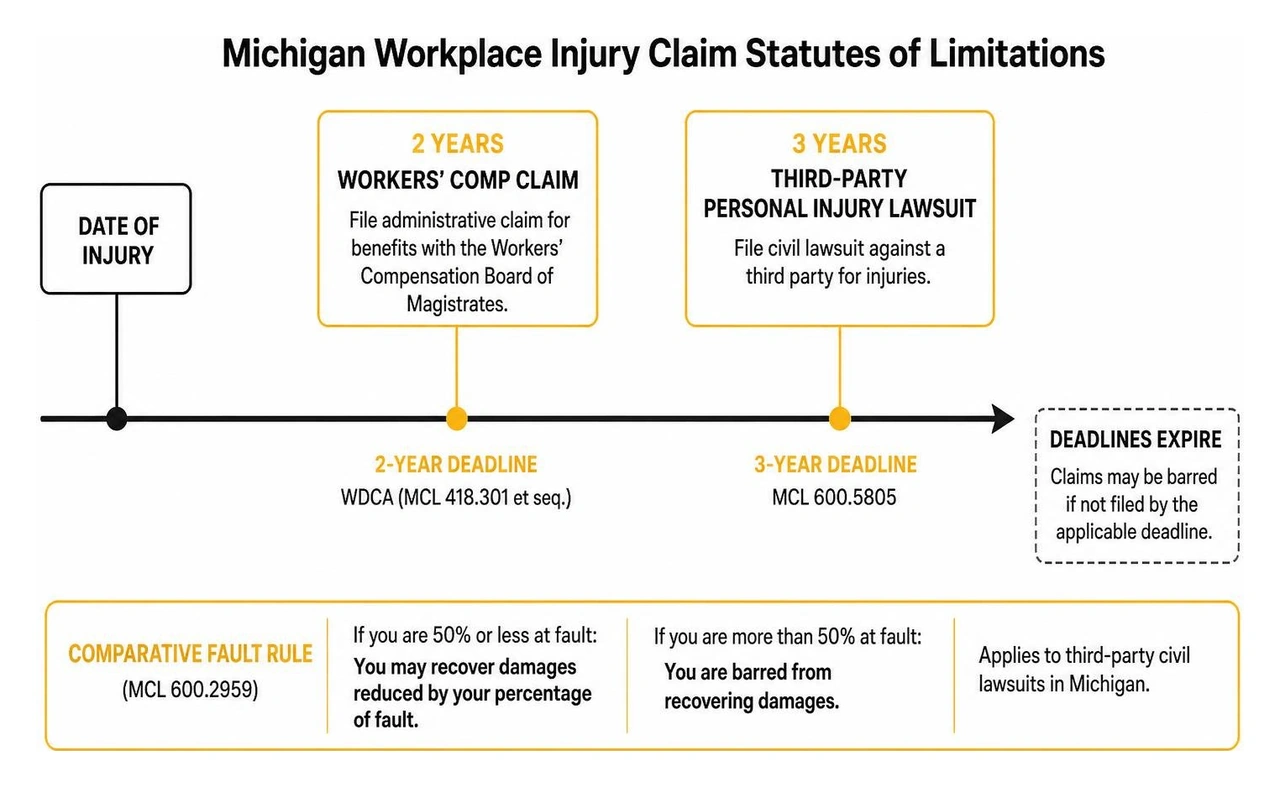
- Workers' Compensation Deadline: Under the WDCA, you generally have 2 years from the date of injury (or date disability manifests) to file an administrative claim for benefits before the Board of Magistrates.
- Third-Party Personal Injury Deadline: Under MCL 600.5805, civil third-party personal injury lawsuits carry a strict 3-year statute of limitations from the date of the incident.
Additionally, third-party civil lawsuits in Michigan are governed by the state's modified comparative fault rule (MCL 600.2959). Under this rule, if a jury finds you were partially at fault for your injury:
- Your economic damages are reduced by your percentage of fault.
- If you are found to be more than 50% at fault, you are completely barred from recovering any noneconomic damages (pain and suffering).
Frequently Asked Questions About Michigan Workplace Injuries
How long do I have to report a work injury to my employer in Michigan?
Under Michigan law (MCL 418.381), you must give notice of an injury to your employer within 90 days of its occurrence, or within 90 days of when you knew or should have known that the injury was work-related. However, you should report the injury immediately in writing to prevent processing delays or claim denials by insurance adjusters.
Can I choose my own doctor for my workplace injury treatment?
During the first 28 days following your initial medical treatment, your employer or their insurance provider has the statutory right to direct your care to a medical facility or doctor of their choice. After 28 days have passed, you have the legal right to select your own physician by providing written notice and provider details to your employer.
Does workers' compensation cover pain and suffering in Michigan?
No. Workers' compensation is a statutory no-fault system that provides defined medical care and wage-loss benefits, but it does not cover pain and suffering, loss of companionship, or emotional distress. To recover pain and suffering compensation, you must be able to pursue a separate third-party personal injury lawsuit against a negligent non-employer party.
Conclusion
A Michigan workplace injury can create immediate financial uncertainty and physical stress. While the Workers' Disability Compensation Act provides essential medical and wage benefits, navigating 28-day medical rules, residual earning capacity disputes, and claim proceedings before the Board of Magistrates can feel overwhelming.
At the same time, workplace injuries can trigger complex employment disputes. If your employer pressures you to work beyond medical restrictions, denies your statutory rights, or retaliates against you for reporting an injury, you need experienced legal guidance to defend your job and career.
We at Scott Batey Law have spent over 25 years protecting workers across Michigan—including in Bingham Farms, Birmingham, Southfield, Royal Oak, Farmington Hills, Troy, Detroit, and Oakland County. We provide dedicated, personalized representation in employment disputes, wrongful termination, and retaliation matters. Explore our insights on At-Will Employment Exceptions in Michigan or speak directly with an expert Employment Lawyer in Bingham Farms, MI to review your workplace rights today.