.png)
Michigan Workplace Safety: Your Rights and How to Enforce Them
Why Michigan Workplace Safety Laws Matter for Every Worker in the State
Michigan workplace safety is governed by a state law called the Michigan Occupational Safety and Health Act (MIOSHA), which gives workers clear legal rights and puts real obligations on employers. Here is a quick overview of what that means for you:
Your core rights as a Michigan worker:
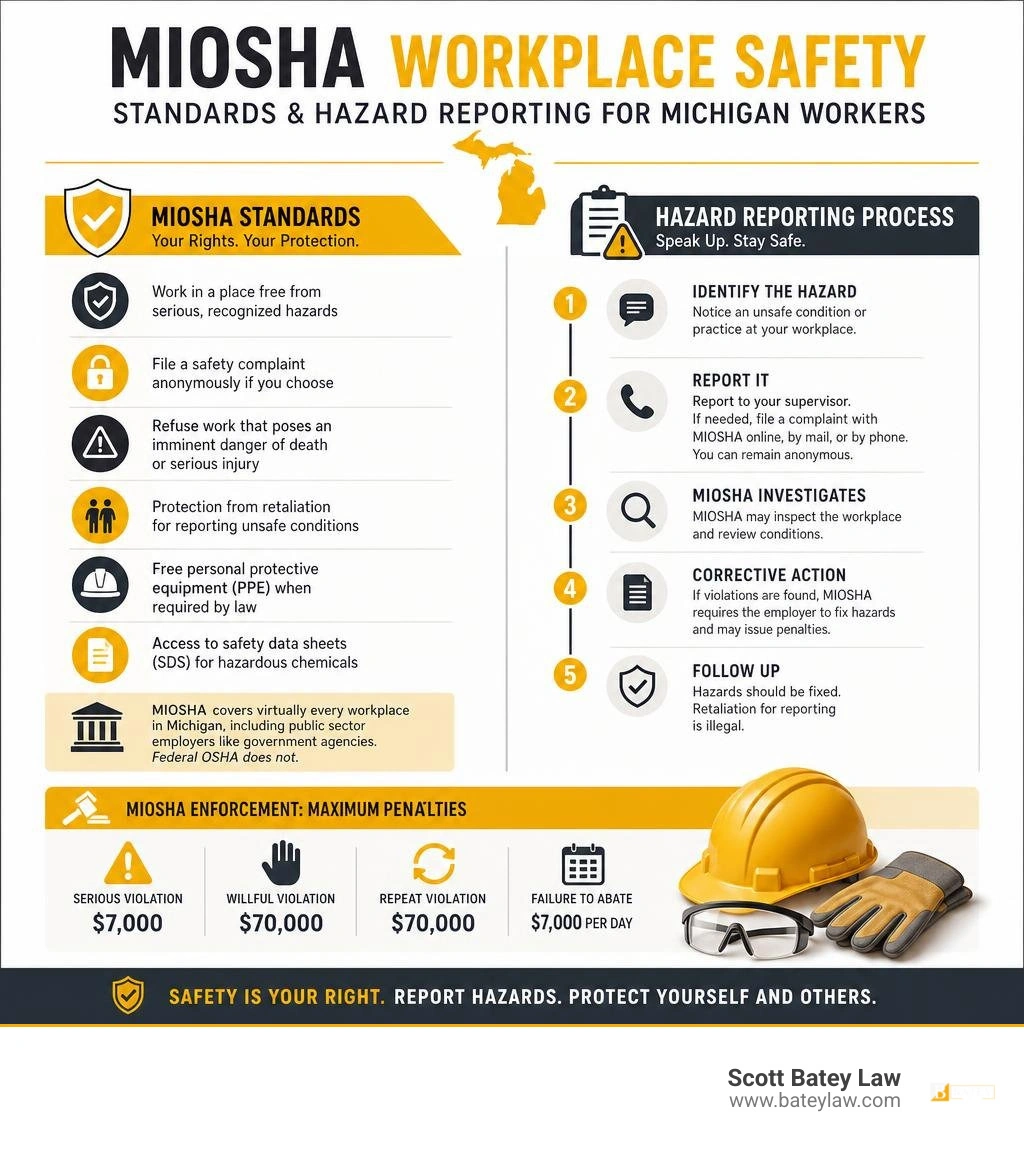
- Your employer must provide a workplace free from serious, recognized hazards
- You can file a safety complaint with MIOSHA — anonymously if you choose
- You can refuse to perform work that poses an imminent danger of death or serious injury
- Your employer cannot fire or retaliate against you for reporting unsafe conditions
- You are entitled to free personal protective equipment (PPE) when required by law
- You have the right to access safety data sheets (SDS) for hazardous chemicals at your worksite
Key facts about MIOSHA enforcement:
Violation TypeMaximum PenaltySerious violation$7,000Willful violation$70,000Repeat violation$70,000Failure to abate$7,000 per day
These are not just guidelines. They are legally enforceable standards backed by Michigan's Act 154 of 1974, which took effect on January 1, 1975 and covers virtually every workplace in the state — including public sector employers like government agencies, which federal OSHA does not cover.
Every year, workers across Michigan face injuries, illnesses, and even death because of preventable workplace hazards. In 2016 alone, Michigan recorded 162 on-the-job fatalities. Behind each of those numbers is a real person — and often a legal violation that went unchecked.
If you have been fired, demoted, or punished for raising a safety concern, that is not just unfair. It may be illegal.
I'm Scott Batey, founder of Batey Law Firm, PLLC, and I have spent nearly three decades representing Michigan employees whose employers crossed the line — including workers who faced retaliation after speaking up about michigan workplace safety violations. If you believe your rights have been violated, this guide will help you understand exactly where the law stands and what options you have.
Understanding Michigan Workplace Safety Laws and MIOSHA Coverage
When we talk about job safety across the Great Lakes State, everything anchors back to Act 154 of 1974, officially known as the Michigan Occupational Safety and Health Act. This foundational statute created MIOSHA, a dedicated state agency under the Michigan Department of Labor and Economic Opportunity (LEO).
Under Section 9 of Act 154 (often referred to as the General Duty Clause), every Michigan employer has a legal duty to furnish a place of employment that is free from recognized hazards causing or likely to cause death or serious physical harm. Whether you spend your days on a noisy manufacturing floor in Detroit, an office in Southfield, or a municipal garage in Oak Park, your employer must actively eliminate workplace hazards rather than just hoping nothing goes wrong.
MIOSHA's jurisdiction is surprisingly broad. For a comprehensive overview of how state authority operates, you can review the Michigan State Plan overview. Unlike federal OSHA, which only covers private sector employers, MIOSHA extends its protective umbrella to cover public sector workers as well. That means state, county, and municipal employees—from city workers in Beverly Hills or Royal Oak to public school staff in Troy—enjoy the exact same workplace safety protections as private assembly line workers or retail employees.
Specific industries also operate under customized MIOSHA regulatory divisions:
- Construction Safety and Health Division: Handles specialized rules for trenching, scaffolding, fallout protection, and heavy equipment operation across build sites.
- General Industry Safety and Health Division: Covers factories, warehouses, health care facilities, commercial offices, and retail establishments.
- Agricultural Standards: Regulates sanitation, field equipment safety, hazardous machinery guarding, and field sanitation facilities. For instance, agricultural employers must provide potable drinking water at no cost and ensure accessible toilet and hand-washing stations regardless of workforce size.
Exemptions from MIOSHA coverage are extremely limited: domestic household workers, certain underground mining operations covered by federal mine safety acts, federal government employees, United States Postal Service operations, aircraft cabin crews in flight, and tribal reservation-owned businesses.
Key Employer Duties for Michigan Workplace Safety Compliance
Employers cannot simply play passive observers when it comes to job safety. Michigan law mandates proactive compliance across several specific areas:
- Hazard Reduction and Elimination: Employers must conduct frequent hazard assessments, implement engineering controls (like machine guards and ventilation systems), and eliminate recognized dangers before exposing employees to risks.
- Mandatory Free PPE: If engineering and administrative controls cannot completely eliminate a hazard, employers must provide Personal Protective Equipment (PPE) at absolute zero cost to the worker. This includes respirators, hard hats, eye protection, specialized gloves, and fall arrest harnesses.
- Posting Required Notices: Employers must conspicuously post MIOSHA Poster No. 2010 ("Michigan Safety and Health Protection on the Job") in central areas frequented by staff. Additionally, between February 1 and April 30 each year, employers must post their annual summary of work-related injuries and illnesses (OSHA Form 300A).
- Mandatory Safety Training: Companies must deliver clear, understandable training on job-specific risks, safety protocols, equipment operation, emergency action plans, and chemical safety before workers handle hazardous tasks.
- Accurate Recordkeeping Rules: Employers must track and maintain detailed logs of work-related injuries and illnesses using OSHA Forms 300 and 301, keeping these records accessible to employees and regulatory inspectors.
How MIOSHA Rules Differ from Federal OSHA Standards
A common point of confusion for workers and business owners alike is how MIOSHA interacts with federal OSHA rules. While Michigan is a "state plan" state operating under federal oversight, MIOSHA operates with distinct administrative rules and statutory powers.
First, as noted earlier, public sector inclusion is a major structural difference. Federal OSHA excludes state and local government workers from its direct reach, but MIOSHA explicitly covers them.
Second, Michigan maintains faster administrative triggers for matching new federal safety regulations. When federal OSHA adopts a new safety standard, the MIOSHA director must initiate state administrative rulemaking within 10 working days to adopt a substantially similar rule. Federal standards are automatically incorporated by reference into Michigan law unless superseded by specific state administrative rules.
Third, Michigan updates industry codes rapidly. Recent updates align state safety rules with modern 2022 North American Industry Classification System (NAICS) codes rather than legacy classification systems, ensuring high-hazard designation targets real-world modern industries.
Finally, MIOSHA maintains unique state-specific safety standards in areas where federal OSHA lacks specific rules or where Michigan enacted stricter requirements. Examples include state-specific standards governing tree care operations, specialized walking-working surfaces, industrial power trucks, and lockout/tagout procedures.
Workplace Safety Violations, Hazard Communication, and Enforcement Penalties
When MIOSHA inspectors conduct a worksite evaluation and uncover hazards, citations are categorized based on risk severity, employer knowledge, and history. The legal mechanics governing these classifications stem directly from the full MICHIGAN OCCUPATIONAL SAFETY AND HEALTH ACT text.
Understanding how citations are graded helps clarify how seriously the law takes workplace danger:
Violation TypeLegal Criteria & DefinitionMaximum Financial PenaltyOther-Than-SeriousA condition directly related to job safety or health, but unlikely to cause death or serious physical harm (e.g., minor recordkeeping errors).Up to $7,000 per violationSerious ViolationExists when there is a substantial probability that death or serious physical harm could result from a hazard, and the employer knew or should have known of its presence with reasonable diligence.Up to $7,000 per violationWillful ViolationCommitted when an employer intentionally and knowingly demonstrates conscious indifference or disregard for MIOSHA requirements and worker safety.Minimum $5,000 up to $70,000 per violation (Potential criminal penalties if death occurs)Repeat ViolationIssued when an employer is cited for a substantially similar violation within 3 years (Construction) or 5 years (General Industry).Up to $70,000 per violationFailure to AbateOccurs when an employer fails to correct a cited safety hazard by the mandatory abatement date specified in a citation.Up to $7,000 per day past the deadlineImminent DangerAny condition or practice where a danger exists that could reasonably be expected to cause death or serious physical harm immediately or before the danger can be eliminated through standard enforcement.Immediate order to restrain/tag equipment; court injunctions
Hazard Communication Standards and Chemical Labeling Rules
Chemical safety is one of the most frequently cited compliance areas across Michigan worksites. Under Michigan law incorporating federal 29 CFR 1910.1200, workers have a fundamental "right to know" about chemical hazards in their workplace.
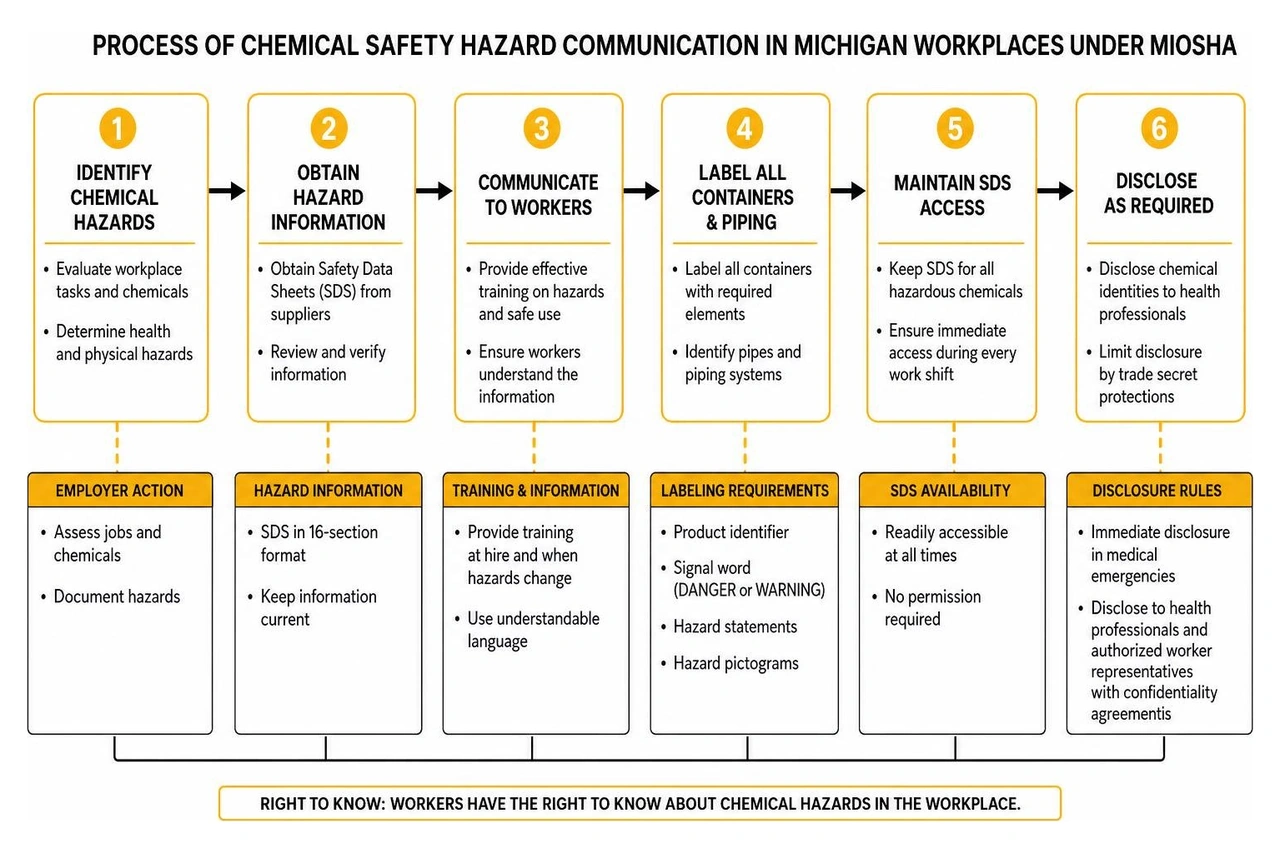
Employers handling dangerous substances must strictly maintain three chemical safety pillars:
- Container Labeling: Every container holding hazardous chemicals—including secondary spray bottles and stationary process containers—must be clearly labeled with product identifiers, signal words (e.g., "DANGER" or "WARNING"), hazard statements, and hazard pictograms. Furthermore, pipes and piping systems conveying hazardous liquids or gases must be identified using clear placards, tags, or written operating procedures.
- Safety Data Sheets (SDS): Employers must maintain accessible, standardized 16-section Safety Data Sheets for every hazardous chemical on site. Workers must be granted immediate access to these SDS documents during every work shift without having to ask management permission. In fact, under MIOSHA rules, an unlabeled hazardous container or a missing SDS can automatically qualify as an "imminent danger."
- Trade Secret Disclosure Limits: While companies can protect genuine proprietary trade secret chemical formulas on SDS forms, Michigan law strictly mandates that chemical identities must be disclosed immediately to treating health care professionals during medical emergencies. In non-emergency situations, chemical identities must be disclosed to health professionals and authorized worker representatives who sign confidentiality agreements.
Asbestos Hazards, Imminent Danger Tags, and Temporary Variances
Asbestos exposure remains a grave occupational risk, particularly in older industrial plants across Detroit, Flint, and Oakland County undergoing renovation or demolition. MIOSHA defines friable asbestos material as any material containing more than 1% asbestos by weight that can be pulverized, crumbled, or reduced to powder by hand pressure when dry. Employers involved in asbestos abatement or working around friable asbestos must enforce stringent containment, air monitoring, negative pressure enclosures, and specialized medical surveillance programs.
When MIOSHA inspectors discover a workplace hazard so extreme that it poses an immediate threat of death or serious injury, they don't wait weeks for paperwork to clear. Inspectors place an official Imminent Danger Tag directly on the dangerous machinery or work area. Operating equipment tagged with an imminent danger tag is illegal, and employees have explicit statutory rights to refuse operating tagged equipment.
In rare instances, an employer may be unable to comply with a newly enacted MIOSHA standard by its effective date due to technical unavailability of equipment, facility construction delays, or lack of professional personnel. Under Senate Bill No. 49 amendments, an employer can apply for a Temporary Variance. However, temporary variances are not free passes to ignore safety. To obtain one, the employer must prove:
- They are unable to comply due to factors beyond their control.
- They are taking all available interim steps to safeguard workers against the hazard.
- They have an effective, actionable plan to achieve full compliance as quickly as possible.
Temporary variances last up to one year and can be renewed up to two times. During the application process, employers must give formal notice to employee representatives and post physical notices in accessible workplace locations so workers can voice objections.
Employee Rights and Reporting Hazards Under Michigan Workplace Safety Regulations
As a worker in Michigan, you do not have to wait for an accident to happen before taking action. You have strong statutory rights to monitor your work environment, review safety records, and request official regulatory interventions.
Specifically, Michigan workers have the legal right to:
- Review workplace injury and illness logs (OSHA Form 300).
- Request and review medical exposure records if exposed to toxic materials, lead, asbestos, or industrial chemicals.
- Request an official MIOSHA safety or health inspection when dangerous conditions exist.
- Accompany a MIOSHA compliance officer during a physical inspection walkaround of your worksite.
- Discuss safety concerns privately with the inspector without manager supervision or fear of employer discipline.
Before submitting a formal regulatory report, documenting conditions thoroughly is key to a swift regulatory response. You can read our detailed guide on MIOSHA Safety Complaints: What to Document Before You Report to make sure your submission contains precise dates, photo evidence, equipment serial numbers, and specific safety rule violations.
How Workers Can File Anonymous Michigan Workplace Safety Complaints
Many employees hesitate to report safety violations because they fear losing their jobs or facing subtle workplace harassment. MIOSHA addresses this concern directly by offering clear avenues for confidential reporting.
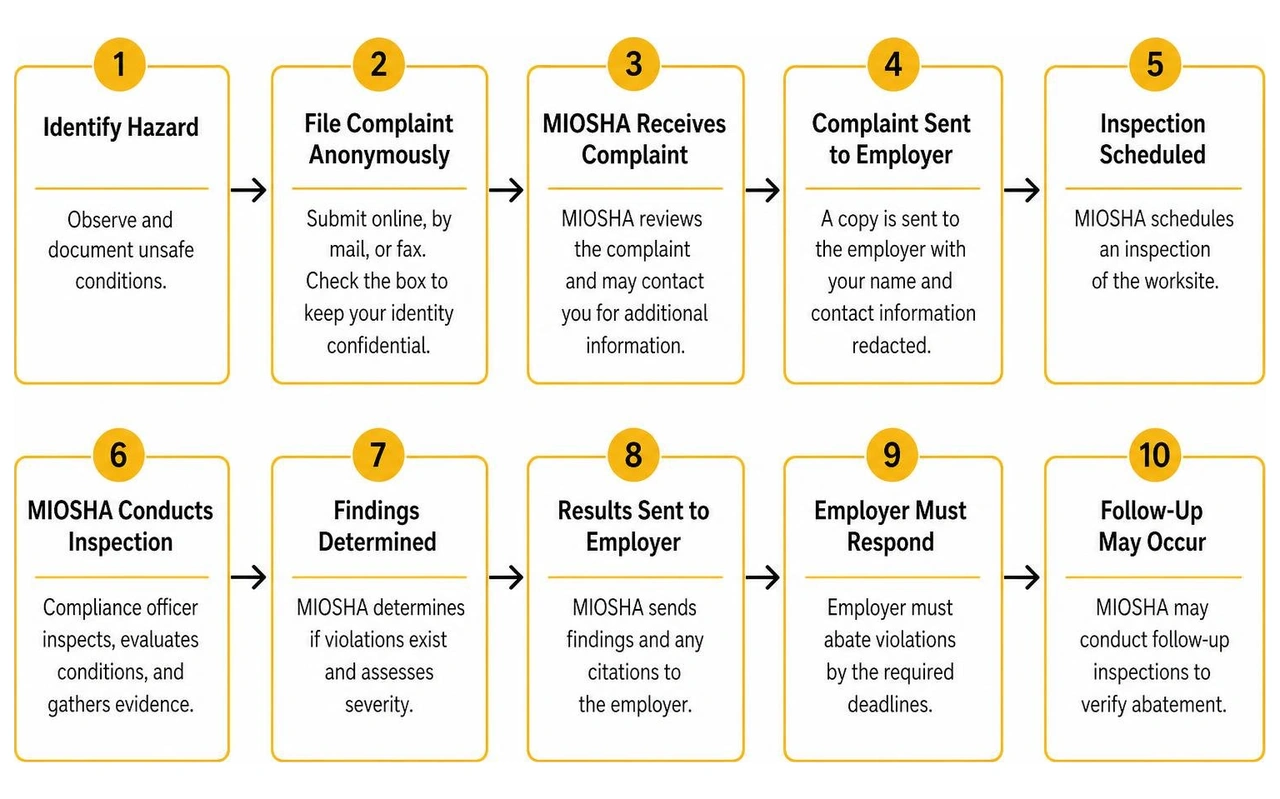
Workers or their authorized representatives can file a safety complaint online through the official MIOSHA complaint portal, or submit a complaint by mail or fax. When filling out the form, you can simply check a box requesting that MIOSHA keep your identity completely confidential. By law, when MIOSHA delivers a copy of the complaint to your employer, your name and personal contact details are redacted.
For immediate, life-threatening emergencies or urgent construction hazards (such as an un-shored deep excavation trench), you do not need to wait for a written form to process. Call the MIOSHA Emergency Hotline immediately at 800-866-4674.
Here is how the regulatory reporting and inspection process flows once a complaint is submitted:
The Legal Right to Refuse Unsafe Work in Michigan
Can you simply refuse to perform a dangerous task in Michigan? The short answer is yes—but only under specific, legally defined conditions.
Under Michigan law, you have a protected right to refuse unsafe work if all of the following criteria are met:
- The work condition poses an imminent danger of death or serious physical harm.
- The danger is so urgent that there is insufficient time to eliminate the hazard through standard MIOSHA complaint and inspection channels.
- You have alerted your employer or supervisor to the hazard and requested that it be corrected, but the employer failed or refused to fix it.
- A reasonable person under the same circumstances would conclude that an real danger of death or serious injury exists.
When exercising this right, notify your manager immediately in writing, state clearly that you are refusing the specific assignment due to an imminent hazard, and remain at the worksite available for safe alternative duties.
Whistleblower Protections and Retaliation Claims for Reporting Violations
It is flatly illegal for an employer in Michigan to fire, demote, discipline, harass, reduce hours, reassign to undesirable shifts, or otherwise retaliate against an employee for exercising workplace safety rights.
Section 65 of MIOSHA (MCL 408.1065) protects workers who:
- File a safety complaint with MIOSHA or alert their employer to hazards.
- Institute or participate in any MIOSHA proceeding or inspection walkaround.
- Testify in safety hearings or administrative enforcement reviews.
- Refuse to perform dangerous tasks under legal imminent hazard conditions.
If you suffer an adverse action after speaking up, you must act fast. You have a strict 30-day statutory deadline from the exact date the retaliation occurred to file a formal discrimination complaint with the MIOSHA Employee Discrimination Section (phone: 313-456-3109). Missing this 30-day cutoff can permanently bar your state administrative remedy!
For more detail on protecting your employment rights, read our full analysis on Retaliation After Reporting a Safety Issue in Michigan.
MIOSHA Discrimination Complaints vs. Whistleblower Protection Act Claims
Workers facing retaliatory discharge often have two distinct legal pathways under Michigan law: filing an administrative discrimination complaint under MIOSHA Section 65, or filing a civil lawsuit under the Michigan Whistleblowers' Protection Act (WPA), MCL 15.361.
Understanding the differences between these options is vital when building a case:
- MIOSHA Section 65 Administrative Complaint:
- Filing Deadline: 30 calendar days from the retaliatory act.
- Forum: Investigated internally by the state agency (MIOSHA Employee Discrimination Section).
- Process: State investigators evaluate the claim. If retaliation is verified, LEO orders administrative remedies including back pay, expungement of disciplinary records, and job reinstatement.
- Michigan Whistleblowers' Protection Act (WPA) Lawsuit:
- Filing Deadline: 90 calendar days from the retaliatory act.
- Forum: Civil lawsuit filed directly in Michigan Circuit Court (such as Oakland County Circuit Court or Wayne County Circuit Court).
- Process: Handled via formal litigation with legal counsel. Remedies can include economic damages, emotional distress compensation, reinstatement, attorney fees, and litigation costs.
To evaluate which timeline and legal strategy fits your specific situation, review our guide on Michigan Whistleblowers' Protection Act Deadlines, Remedies, and Proof.
MIOSHA Consultation Services and the Employer Appeal Process
While MIOSHA enforces strict safety penalties, the agency also operates under a public philosophy motto: "Educate Before We Regulate."
Through its Consultation Education and Training (CET) Division, state health and safety specialists offer free and low-cost safety seminars, educational publications, hazard evaluations, and voluntary on-site consultation services for Michigan businesses. Small businesses in places like Birmingham, Farmington Hills, or Berkley can request CET consultants to audit their facilities without fear of receiving citations or monetary fines—provided the employer agrees to correct any identified serious hazards within an agreed timeframe.
For official agency guidance and consultative requests, visit LEO - Michigan Occupational Safety and Health Administration.
Penalty Reduction Agreements and Citation Appeals Timelines
When MIOSHA issues official citations following an inspection, employers have specific administrative avenues to contest or reduce fines:
- Penalty Reduction Agreements (PRA): Within 5 working days of receiving a citation, an employer can apply for a Penalty Reduction Agreement. Under a PRA, MIOSHA grants an immediate 50% reduction in total financial penalties if the employer agrees to abate all cited hazards quickly and waives its right to appeal the citation.
- First Appeal (Informal Conference): If an employer disputes the violation or abatement timeline, it can file a written first appeal within 15 working days of receiving the citation. An informal conference is held with the issuing division to adjust citations, penalty amounts, or abatement dates.
- Second Appeal: If unresolved after the first appeal, the employer has another 15 working days to submit a second appeal to the independent Board of Health and Safety Compliance and Appeals.
While these appeal mechanisms give businesses fair due process, employers cannot use appeals simply to stall necessary hazard abatement while workers remain exposed to ongoing danger.
Frequently Asked Questions About Michigan Workplace Safety
How quickly must severe injuries or fatalities be reported to MIOSHA?
Michigan law sets mandatory reporting windows for serious workplace incidents:
- Workplace Fatalities: Must be reported to MIOSHA within 8 hours of the incident by calling 800-858-0397.
- Severe Injuries: Any work-related inpatient hospitalization, amputation, or loss of an eye must be reported to MIOSHA within 24 hours by calling 844-464-6742 or submitting an online report.
Can an employer force a worker to pay for required Personal Protective Equipment (PPE)?
In almost all circumstances, no. Under MIOSHA standards, employers must provide required PPE—such as respirators, face shields, hard hats, fall harnesses, and chemical-resistant aprons—at zero cost to workers.
The rare legal exceptions involve highly non-specialized safety gear that can be worn off the job site and is personal in nature, such as standard non-specialized steel-toe safety boots or prescription safety eyewear, provided the employer allows the employee to take the gear home.
What protection exists if an employee is fired after filing a MIOSHA complaint?
If you are fired for submitting a safety complaint or raising safety concerns, you are protected against retaliatory discharge. You should document all text messages, performance evaluations, emails, and witness accounts immediately, and file an administrative retaliation claim within 30 days of your termination. You can read more about how these protections apply in practice in our overview on Retaliation After Reporting a Safety Issue: MIOSHA Basics for Employees.
Conclusion
No worker in Michigan should ever have to choose between keeping their job and protecting their physical safety. State law gives you strong protections—from the legal right to work in a hazard-free environment to statutory whistleblower shields that prevent employers from punishing you for speaking up.
However, safety laws are only as strong as your ability to enforce them. Strict statutory deadlines—like the 30-day window for MIOSHA retaliation claims or the 90-day window for Whistleblowers' Protection Act lawsuits—mean that waiting too long to take legal action can lock you out of the compensation and reinstatement you deserve.
If you have experienced workplace retaliation, illegal discharge, or safety discrimination across Bingham Farms, Detroit, Oakland County, or anywhere in Michigan, we are here to fight for you. At Scott Batey Law, we bring over 25 years of hands-on employment law experience to help workers hold non-compliant employers accountable. To learn more about how state employment law protects your job, explore our resource on At-Will Employment Exceptions in Michigan or contact our team today to schedule a confidential consultation.