.png)
Do You Need a Non Competition Agreement Lawyer? Here is What to Look For

What a Non-Compete Lawyer Does — and When You Need One
If you've just been handed a contract with restrictive language, or a former employer is threatening legal action over your new job, a non compete lawyer can be the difference between protecting your career and making a costly mistake.
Here's what a non-compete lawyer can help you with:
- Review a contract before you sign — identify overly broad or unenforceable terms
- Negotiate better terms — push back on restrictive language before it becomes binding
- Respond to a cease-and-desist letter — quickly and strategically, ideally within 24–48 hours
- Defend you in court — challenge injunctions, temporary restraining orders, or damages claims
- Challenge an existing agreement — argue it is unenforceable due to overbroad scope, lack of consideration, or changed circumstances
- Advise on risk — tell you honestly whether your new job puts you in legal jeopardy
Non-compete agreements can restrict where you work, who you work for, and for how long — sometimes for years after you leave a job. Courts have found agreements that prevent a dental hygienist from working anywhere in a major metropolitan area for two years, or that bar a pharmacist from working at any business that has a pharmacy — including a grocery store. These restrictions are real, and the legal consequences of violating them can be serious.
At the same time, many non-competes are poorly drafted, overly broad, or simply unenforceable under state law. The problem is that most employees don't know which category their agreement falls into — and employers count on that uncertainty to keep workers in place.
I'm Scott Batey, a Michigan employment lawyer and founder of Batey Law Firm, PLLC, with nearly three decades of experience helping employees understand and challenge restrictive covenants, including non-compete agreements, non-solicitation clauses, and confidentiality provisions. As a non compete lawyer focused entirely on the employee side, my work is built around one goal: making sure you understand your rights and have a clear strategy before you make any move that could cost you.
What is a Non-Compete Agreement and How Does It Differ From an NDA?
To navigate the complex world of employment contracts, we must first understand exactly what these documents are doing to your career mobility.
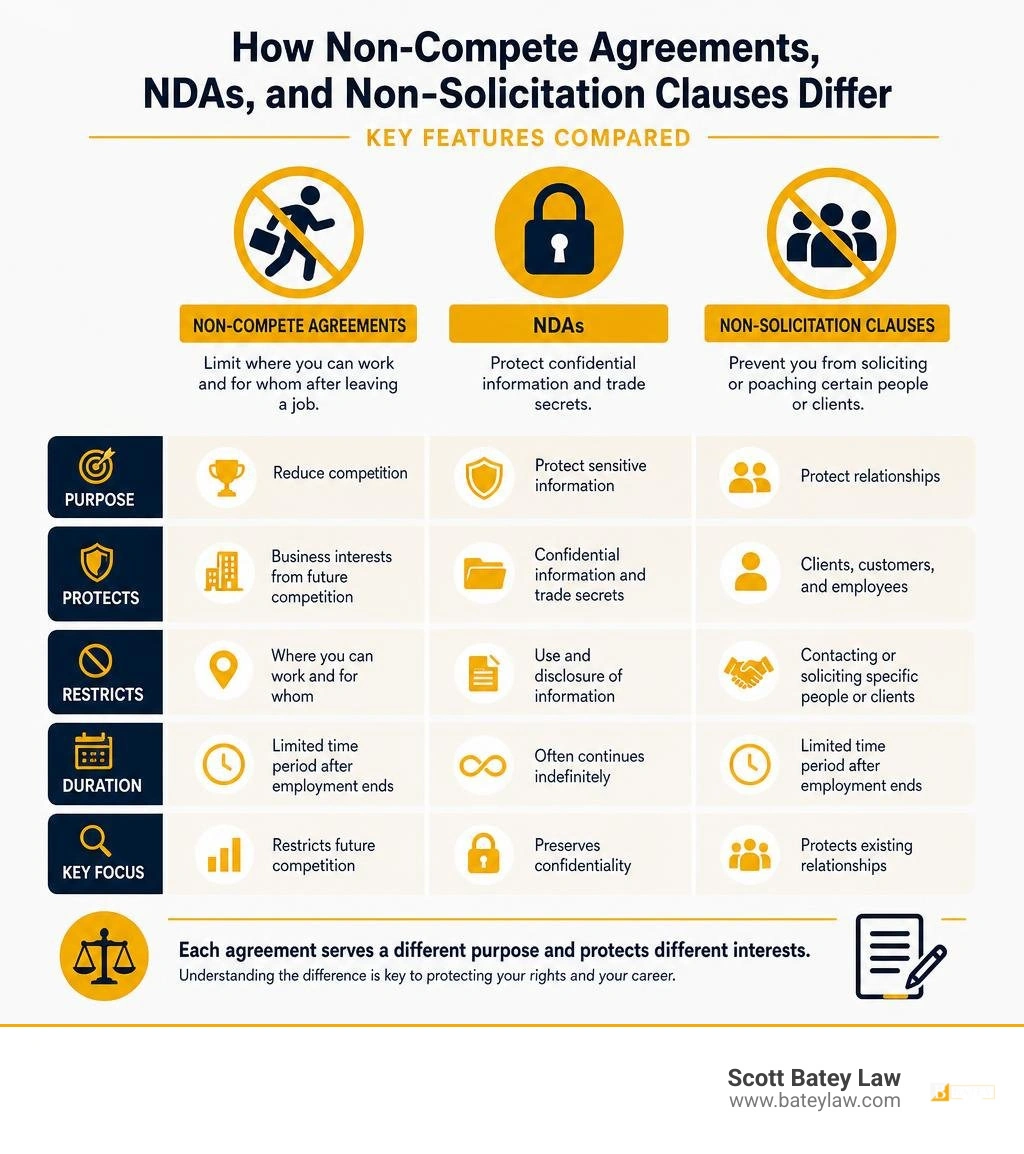
A non-compete agreement is a restrictive covenant that legally bars you from working for a competing business or starting a rival company within a specific geographic area for a set period after your employment ends. It is designed to stop you from taking your skills and industry knowledge directly to the competition.
However, employers often bundle several types of restrictive covenants together, which leads to confusion. The most common mix-ups occur between non-competes, non-disclosure agreements (NDAs), and non-solicitation agreements.
| Feature | Non-Compete Agreement | Non-Disclosure Agreement (NDA) | Non-Solicitation Agreement |
|---|---|---|---|
| Primary Purpose | Prevents you from working for a direct competitor or starting a competing business. | Protects proprietary information and trade secrets from being shared. | Prevents you from poaching clients, customers, or former coworkers. |
| Scope of Restriction | Broadly limits physical employment options and industry roles. | Narrowly limits the use of specific, confidential data. | Limits who you can contact or hire at your new company. |
| Geographic Limits | Usually restricted to a specific radius, city, state, or region. | Rarely has geographic limits (confidentiality applies globally). | Usually tied to the employer's active client base. |
| Impact on Career | High impact; can prevent you from taking a new job in your field. | Low-to-moderate impact; you can work anywhere as long as you keep secrets. | Moderate impact; limits your sales or recruitment activities. |
While an NDA simply says, "You cannot share our secret recipe," a non-compete says, "You cannot work for any other bakery." It is a massive difference. One protects data; the other restricts your physical right to earn a living.
Understanding this distinction is critical because an employer might try to slip a non-compete clause into a document labeled as a standard confidentiality agreement. If you want to dive deeper into how these clauses interact and what they mean for your career, read our guide on Noncompete vs Nonsolicitation in Michigan: What's the Difference and Why It Matters.
Why Employers Use Restrictive Covenants
Employers do not just write these agreements to be difficult (though it can certainly feel that way when you are trying to switch jobs). From a business perspective, companies invest significant time and money into building their operations. They use restrictive covenants to protect several core interests:
- Business Goodwill: This represents the reputation and customer loyalty a company has built over time. If a star sales representative leaves and immediately takes half their clients to a competitor, the original business suffers a major blow to its goodwill.
- Confidential Data & Trade Secrets: Companies want to prevent proprietary software, marketing strategies, product designs, or pricing models from falling into the hands of rivals.
- Employee Training: If an employer spends thousands of dollars training you in highly specialized skills, they want to prevent you from taking that training directly to a competitor the following week.
- Market Competition: In highly competitive fields, keeping talent from moving to rivals is a strategic advantage.
While these are legitimate business concerns, many employers overreach. They use blanket non-compete agreements for low-level employees who have no access to trade secrets or client lists, turning a protective tool into a tool of corporate intimidation.
Are Non-Compete Agreements Enforceable? State Laws and Reasonableness Standards

A common myth among workers is that non-compete agreements are "completely illegal" or, conversely, "completely ironclad." Neither is true. The enforceability of a non-compete depends heavily on state law and how reasonably the contract is drafted.
Across the United States, the legal landscape is a patchwork of shifting rules. For example, Texas heavily regulates these agreements under the Texas Business and Commerce Code, requiring them to be ancillary to an otherwise enforceable agreement. In Illinois, the Freedom to Work Law sets strict wage thresholds, prohibiting non-competes for workers earning below a certain salary. New Jersey courts evaluate enforceability on a case-by-case basis, balancing the employer's interests against the employee's right to work without undue hardship.
Because we practice right here in Michigan, our focus is on how these rules apply to workers in Metro Detroit, Oakland County, and surrounding areas. In Michigan, non-compete agreements are legal and enforceable, but only if they protect a legitimate business interest and are reasonable in duration, geographic area, and line of business.
If you are a local professional, you must know what local courts look for. To understand how Michigan judges view these agreements, check out our article on Noncompete Agreements in Michigan: What Southfield Employees Should Watch For.
How Courts Determine Reasonableness
If an employer sues to enforce a non-compete, or if you sue to challenge one, a judge will subject the agreement to a "reasonableness test." Courts do not want to see workers forced into unemployment or welfare because of a contract.
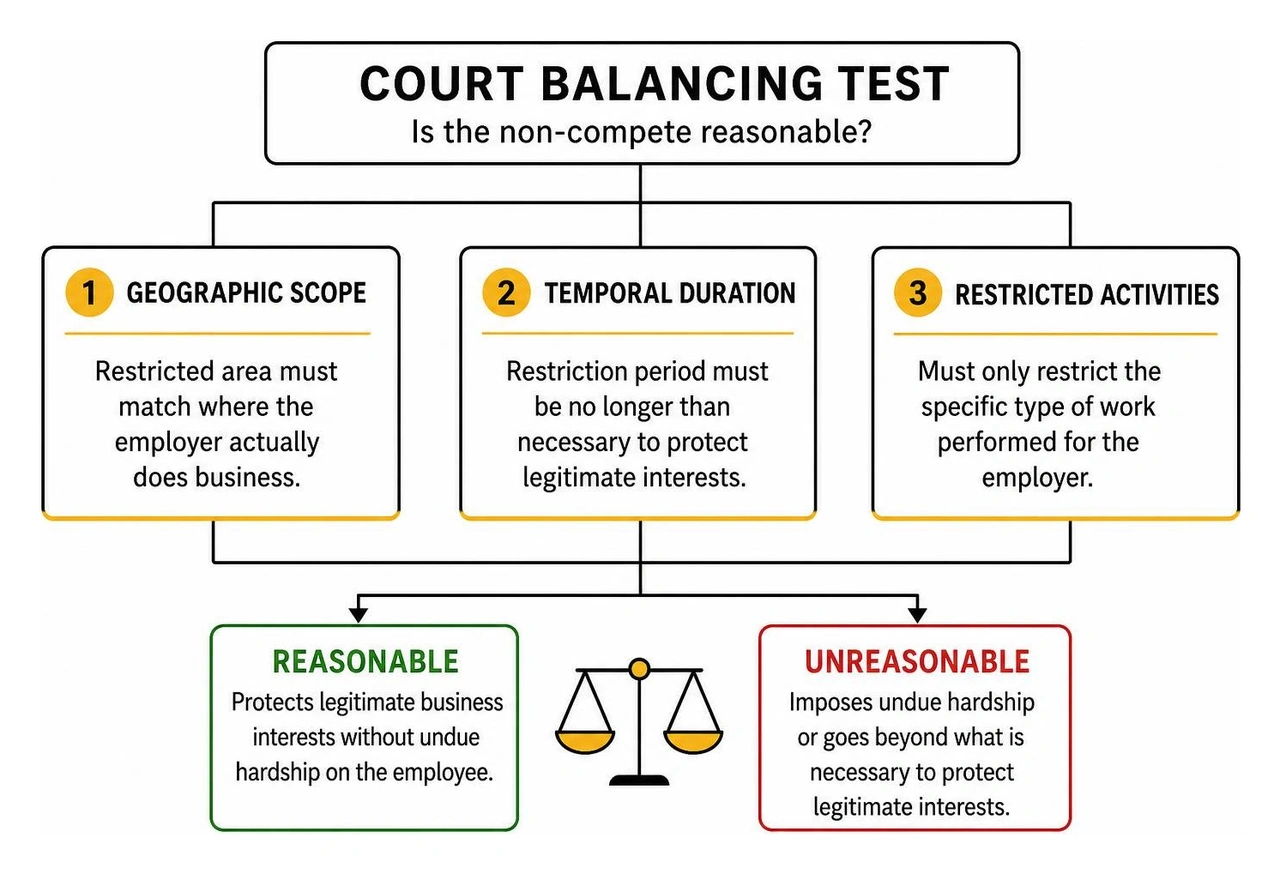
When evaluating whether an agreement is reasonable, judges look at three primary pillars:
- Geographic Scope: The restricted area must match where the employer actually does business. If you worked at a dental office in Farmington Hills, a non-compete blocking you from practicing anywhere in the state of Michigan is wildly unreasonable. A restriction limiting you within a 5-mile radius of the office is far more likely to be upheld.
- Temporal Duration: How long does the restriction last? In employment contexts, courts rarely look favorably on restrictions lasting longer than one year. Six months to one year is generally considered the standard window for protecting temporary business advantages. Anything beyond two years is highly suspect unless tied to the sale of a business.
- Restricted Activities: The agreement must only restrict you from performing the specific type of work you did for your employer. If you were a software developer, the contract cannot ban you from working as an administrative assistant at another tech firm. It must be narrowly tailored.
If any of these elements are too broad, Michigan courts have the authority to "blue pencil" (rewrite) the agreement to make it reasonable, or they may throw the entire contract out of court.
Recent Legislative Changes and the FTC Ban
As we navigate July 2026, the legal framework surrounding non-compete agreements is undergoing its most dramatic shift in decades. For years, federal regulators and state lawmakers have argued that non-competes stifle wage growth and block worker mobility.
In 2024, the Federal Trade Commission (FTC) issued a historic nationwide ban on most employee non-compete agreements. While that rule faced immediate legal challenges in federal courts, it sparked a massive wave of state-level reforms. Many states have completely banned non-competes for hourly and low-wage workers, while others have introduced mandatory "garden leave" provisions (where the employer must continue paying your salary during the non-compete period).
Even where non-competes remain legal, the tide has turned. Judges are increasingly hostile to employers who use these agreements to bully workers. If you are operating under an old contract, there is a strong chance that recent legislative and case law updates have made your non-compete completely unenforceable.
When to Hire a Non Compete Lawyer for Your Career

Many professionals make the mistake of waiting until they get sued to consult a non compete lawyer. By then, you are already in a defensive, high-stress position. The best time to hire an attorney is before you make a major career move.
You should consult an employment lawyer in any of the following scenarios:
- Before Signing a New Employment Contract: If a prospective employer includes a non-compete in your offer letter, do not just sign it and hope for the best. A lawyer can help you negotiate narrower geographic limits or remove the clause entirely.
- During a Job Transition: If you are planning to leave your current job in Detroit or Troy for a competitor, have an attorney review your current contract first. We can help you build a transition plan that minimizes your risk of facing a lawsuit.
- When Negotiating a Severance Package: Severance agreements often contain hidden traps, including brand-new or reinforced non-compete clauses. To learn what to watch out for, read our guide on Severance Red Flags in Michigan: Noncompetes, Nonsolicits, NDA Overreach.
How a Non Compete Lawyer Evaluates Your Contract
When we sit down with a client to review an agreement, we do not just skim the text. We conduct a rigorous legal analysis of several hidden contract mechanisms:
- Consideration Requirements: For a contract to be legally binding, there must be an exchange of value (consideration). If your employer forced you to sign a non-compete mid-employment without giving you a raise, a promotion, or a bonus, the agreement may fail for lack of consideration.
- Choice-of-Law Clauses: If you work remotely from Madison Heights, MI, but your employer is headquartered in Boston, which state's law applies? We analyze these clauses to determine if your employer is trying to bypass protective Michigan laws.
- Trade Secret Overlap: We evaluate whether your new role actually threatens any legitimate trade secrets, or if your former employer is simply trying to prevent fair competition.
While national legal trends and federal regulatory updates shape the overall landscape, your career is local. You need an attorney who understands how Oakland County and Wayne County judges rule on these specific issues.
What to Expect When Working with a Non Compete Lawyer
When you work with us, you can expect clear, practical guidance. We do not speak in confusing legalese; we give you straight answers.
First, we will perform a comprehensive legal analysis of your contract to identify its weak points. Next, we provide a risk assessment — telling you on a scale of 1 to 10 how likely your employer is to sue, and what your defenses look like. If you are in the pre-signing phase, we offer contract redrafting services to write terms that protect your career. If your employer has already threatened action, we provide aggressive representation services to defend your rights.
What to Do If You Receive a Cease-and-Desist Letter or Face a Lawsuit
Receiving a cease-and-desist letter from a former employer's attorney can make your stomach drop. These letters are often aggressive, demanding that you immediately resign from your new job and threaten "immediate legal action" if you do not comply.
First, take a deep breath. Second, do not panic, and do not ignore it.
You must act quickly. In non-compete disputes, employers often file for a Temporary Restraining Order (TRO) or a preliminary injunction. If they succeed, a judge can order you to stop working at your new job before a full trial even begins. You typically have a window of only 24 to 48 hours to respond to a demand letter before the employer takes the next legal step.
For more context on how these disputes play out and what actually limits your next career move, read our breakdown of Noncompete vs Nonsolicit in Michigan: What Really Limits Your Next Job.
Strategies for Challenging or Negotiating an Agreement
If your former employer is acting unreasonably, you have several strategic options:
- Out-of-Court Settlement: Many disputes can be resolved without a single courtroom appearance. We can often negotiate with your former employer to narrow the scope of the non-compete, allowing you to keep your new job in exchange for agreeing not to contact specific clients.
- Declaratory Judgment: If an employer is using an obviously illegal non-compete to block your career, we can take the offensive. By filing a lawsuit for a declaratory judgment, we ask a judge to rule that the agreement is void, shifting the legal pressure back onto the employer.
- Garden Leave Negotiation: We can demand that if the employer insists on you sitting out of the industry, they must pay your salary during that period.
- Selective Enforcement: If your former employer has let five other employees leave for competitors without enforcing their non-competes, we can argue they are selectively targeting you, which weakens their legal standing.
Potential Consequences of Violating a Non-Compete
If you ignore a valid non-compete and your former employer wins a lawsuit against you, the consequences can be devastating:
- Injunctions: A court can force you to resign from your new job immediately, leaving you unemployed while you look for work outside the restricted industry or geographic area.
- Monetary Damages & Lost Profits: You could be ordered to pay your former employer for any financial losses they suffered because of your breach, including lost profits from clients who followed you.
- Attorney Fees: Many non-compete agreements contain clauses requiring the losing party to pay the winner's legal bills. These fees can easily climb into tens of thousands of dollars.
- Job Loss: Your new employer may terminate your employment simply to avoid being dragged into a costly lawsuit as a co-defendant.
Frequently Asked Questions about Non-Compete Agreements
Can an employer force me to sign a non-compete after I have already started working?
Yes, but with an important caveat: there must be "adequate consideration." In Michigan, continued employment is often considered sufficient consideration to support a mid-employment non-compete. However, if you are forced to sign an agreement under threat of termination without receiving any new benefits (like a raise or promotion), we will carefully evaluate the contract to see if we can challenge its validity based on a lack of real exchange.
How do choice-of-law clauses affect my non-compete if my employer is in another state?
If your employer is based in another state, your contract likely contains a "choice-of-law" clause stating that the laws of their home state govern any disputes. However, if you live and work in Michigan, Michigan courts may refuse to enforce another state's laws if doing so would violate Michigan's public policy or strip you of essential worker protections. This is a highly technical area of law that requires a skilled non compete lawyer to analyze.
Are non-competes enforceable for low-wage or hourly workers?
While some states have explicit income thresholds under laws like the Illinois Freedom to Work Law, Michigan evaluates these on a case-by-case basis under our reasonableness standard. Generally, courts are highly skeptical of non-competes applied to low-wage, hourly, or entry-level workers. If you do not have access to trade secrets, specialized training, or key customer relationships, an employer will have an incredibly difficult time proving they have a "legitimate business interest" worth protecting by restricting your employment.
Conclusion
Your career, your financial security, and your professional freedom are too important to leave to chance. If you are facing an unfair non-compete agreement, dealing with a threatening letter, or trying to safely transition to a new job, you do not have to fight this battle alone.
At Scott Batey Law, we represent workers across Metro Detroit, including Bingham Farms, Southfield, Troy, and Oakland County. We specialize in defending employee rights, handling wrongful termination, discrimination, harassment, and restrictive covenant disputes. With over 25 years of experience, we provide the personalized, aggressive representation you need to protect your future.
Do not let an overly broad contract hold your career hostage. Contact us today to schedule a confidential consultation with an experienced Noncompete Agreement Attorney Southfield MI and let us help you find a clear path forward.