.png)
Why Every Business Partnership Needs a Non-Compete Agreement

Understanding the B2B Restrictive Covenant
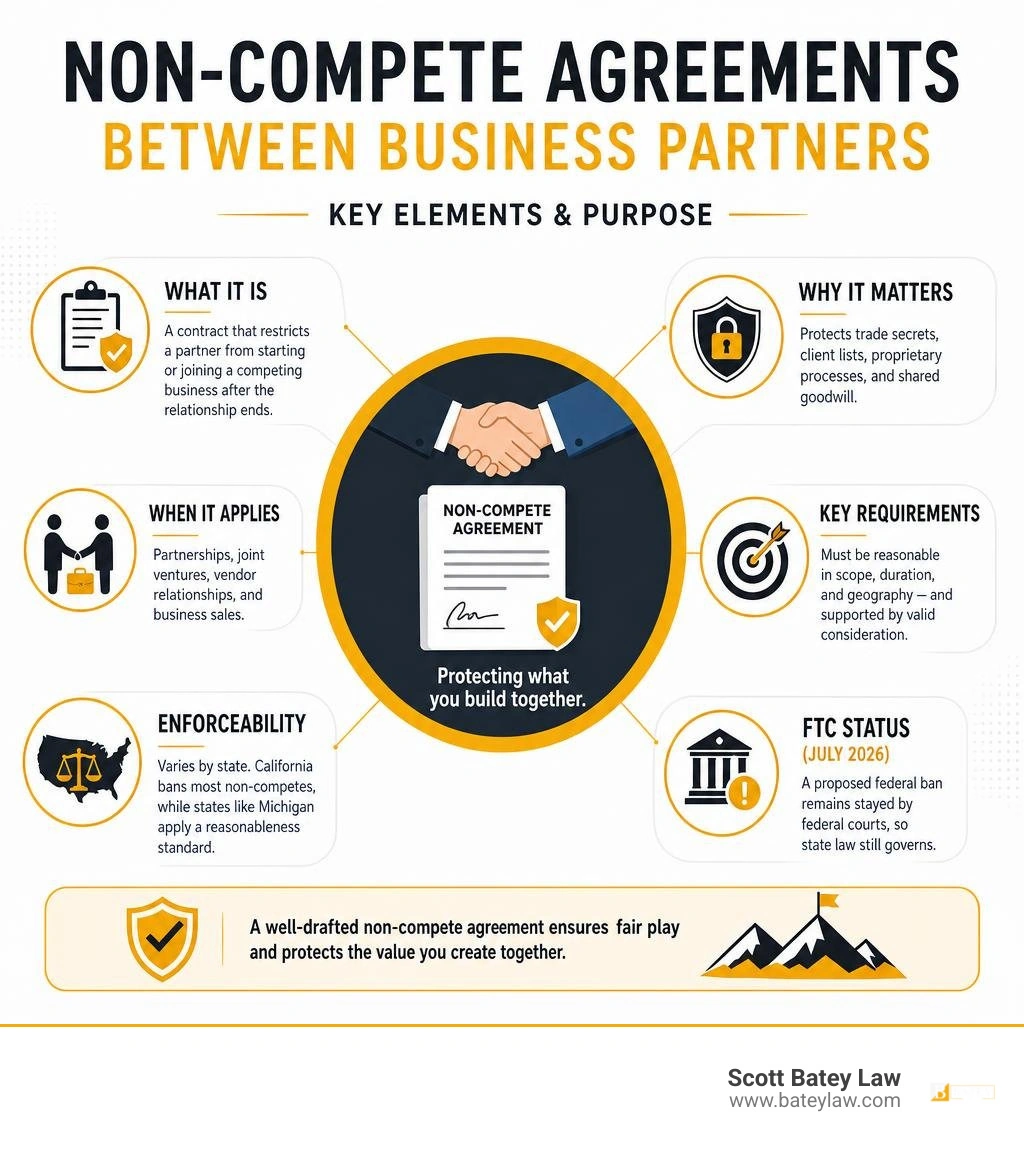
A non-compete agreement between business partners is a legally binding contract that prevents one business entity from competing against another after a partnership, joint venture, or vendor relationship ends.
Here is a quick summary of what you need to know:
- What it is: A contract restricting one partner from starting or joining a competing business after the relationship ends
- Why it matters: Protects trade secrets, client lists, proprietary processes, and shared goodwill
- When it applies: Partnerships, joint ventures, vendor relationships, and business sales
- Key requirements: Must be reasonable in scope, duration, and geography — and supported by valid consideration
- Enforceability: Varies significantly by state; California bans most non-competes, while states like Michigan apply a reasonableness standard
- FTC status (July 2026): A proposed federal ban remains stayed by federal courts, so state law still governs
When two businesses collaborate — whether through a formal partnership, a joint venture, or a vendor arrangement — they often share things that are hard to put a dollar value on: proprietary processes, client relationships, internal data, and competitive strategies. Without a written agreement restricting how that information can be used after the relationship ends, a former partner can walk away and use everything they learned to compete directly against you.
That risk is real, and it is exactly why non-compete agreements between business partners exist.
Unlike employee non-competes, which courts examine very closely because of the power imbalance between employers and workers, partner non-competes are treated differently. Courts generally recognize that business partners have more equal bargaining power — and apply a less strict standard of review as a result. But that does not mean these agreements are automatically enforceable. A poorly drafted agreement, an overbroad restriction, or a breach by the party trying to enforce it can all destroy your legal protection.
I'm Scott Batey, a Michigan employment lawyer with nearly 30 years of experience advising clients on restrictive covenants — including reviewing, drafting, and challenging non-compete agreements between business partners across industries. If you are entering a partnership or facing a non-compete dispute, understanding the rules before you sign is the most important step you can take.
In the business-to-business (B2B) world, collaboration is the name of the game. But when you open your doors to a vendor, launch a joint venture, or bring on a new business partner, you are also opening your vault. You share resources, introduce them to your most prized clients, and teach them your proprietary methods.
A B2B non-compete agreement acts as a legal guardrail. Its purpose is not to stifle fair competition or prevent someone from earning a living, but to ensure fair play. It prevents a collaborating entity or partner from weaponizing your shared resources against you once the relationship ends.

Without these protections, a joint venture partner could easily walk away with your operational blueprint, or a vendor could cut you out entirely and offer your proprietary services directly to your client base.
Why a Non Compete Agreement Between Business Partners is Unique
When an employee signs a non-compete, courts look at it with a magnifying glass. Why? Because there is a massive power imbalance. An individual worker usually has to sign whatever the company puts in front of them just to pay their mortgage.
But a non-compete agreement between business partners sits in a different legal realm. Courts view this as a "middle tier" of judicial scrutiny.
In landmark cases like Habif, Arogeti & Wynne, PC v. Baggett , legal systems have recognized that professional partners, co-owners, and shareholders typically possess equal bargaining power. When you negotiate a partnership, you are usually represented by counsel, you have a financial stake in the business, and the restrictions are often mutual. If Partner A is restricted from competing, Partner B is usually bound by the exact same rules.
Because of this equal footing, courts are much more willing to enforce a non-compete agreement between business partners than a standard employee contract. They respect the freedom of contract among business owners who knew exactly what they were signing.
B2B vs. Employee Non-Compete Agreements
To understand how these agreements differ, it helps to look at the levels of judicial scrutiny. Under common law, restrictive covenants generally fall into three categories:
- Strict Scrutiny (Employment Contracts): High judicial skepticism. Courts hate restricting an individual's ability to earn a livelihood.
- Middle Tier Scrutiny (Partnerships & Professional Shareholders): Moderate skepticism. Courts weigh the protection of the business's goodwill against the partner's professional freedom, but respect the equal bargaining power.
- Lesser Scrutiny (Sale of a Business): Low skepticism. If you buy a business, you are paying for its goodwill. It is completely reasonable to restrict the seller from opening a identical shop next door.
A critical difference here is how "consideration" (the legal value exchanged to make a contract binding) is handled. For an employee, continued employment might barely suffice. For business partners, consideration is built directly into the transaction — such as receiving equity, sharing profits, or gaining access to trade secrets.
| Feature | Employee Non-Compete | Partner / B2B Non-Compete |
|---|---|---|
| Bargaining Power | Unequal (Employer holds the cards) | Generally Equal (Co-owners/Partners) |
| Court Scrutiny | High (Strictly scrutinized) | Moderate (Middle-tier scrutiny) |
| Common Duration | Often limited to 6 months to 1 year | Can extend to 2 years or more |
| Consideration | Job offer or continued employment | Equity, profits, corporate restructuring |
If you are trying to understand how these differences impact your rights in Michigan, it is essential to distinguish between non-competes and non-solicitation clauses. You can read our detailed breakdown on Noncompete vs Nonsolicitation in Michigan – What’s the Difference and Why It Matters to see how these covenants operate in practice.
Legal Requirements for a Non Compete Agreement Between Business Partners
Just because courts apply a more lenient "middle tier" standard to partner agreements does not mean you can write whatever you want. To be legally enforceable, a non-compete agreement between business partners must meet strict legal criteria.

First, the agreement must protect a legitimate business interest. You cannot restrict a former partner simply because you do not want them to be your rival. You must prove that they possess specialized trade secrets, highly confidential client lists, or unique proprietary processes that would give them an unfair advantage if used against you.
Second, the agreement must be supported by adequate consideration. If you are drafting a partnership agreement, using a structured template like the Partnership Agreement with Covenant not to Compete | US Legal Forms ensures that the exchange of partnership rights and equity is clearly documented as the legal consideration.
Drafting a Reasonable Non Compete Agreement Between Business Partners
To survive a legal challenge, the restrictions in your agreement must be reasonable in three areas: geography, duration, and scope of activity.
- Geographic Scope: The restriction must align with where your business actually operates. If your partnership runs a dental practice in Southfield, MI, you cannot restrict your departing partner from practicing in Tokyo. A reasonable radius around your actual office locations is standard.
- Duration Limits: While a standard employee non-compete is often limited to 6 months to be deemed reasonable, partner agreements can often justify longer periods, such as 12 to 24 months.
- Prohibited Activities: You must define the restricted activities with high specificity. You cannot ban a former partner from working in "any business." It must be limited to direct competition with the specific services your partnership offered.
If you are looking for a baseline structure to customize, you can review this Free Non-Compete Agreement Template between Business Partners - (2026) to see how these clauses are organized.
The Importance of Clear Definitions and Exclusions
Vague language is the absolute death of a restrictive covenant. When drafting your agreement, you must define exactly what a "Competing Business" is.
To keep the agreement from being struck down as overly restrictive, it is best practice to include standard exclusions. For example, a "passive investment" carve-out is vital. This clause allows a departing partner to own a tiny percentage (typically less than 2%) of publicly traded stock in a competitor, provided they have no management or operational role.
Additionally, you should clearly define "lookback periods" for clients. If a partner leaves, are they restricted from contacting all clients, or only those who were active in the last 12 or 24 months? Using a clear Free Non-Compete & Non-Solicitation Agreement Template | Montague Law can help you structure these specific lookback windows.
Finally, do not forget federal compliance. Under the Defend Trade Secrets Act (DTSA), any contract dealing with confidentiality must include a whistleblower immunity notice. Failing to include this can prevent you from recovering punitive damages or attorney fees if a partner steals your trade secrets.
Navigating the Evolving Regulatory Landscape in 2026
The legal landscape surrounding restrictive covenants is shifting rapidly. If you are operating a business in Oakland County, Southfield, or Detroit, you must keep a close eye on both federal regulations and state-level changes.
At the state level, states are increasingly hostile to non-competes. In California, under Business and Professions Code Section 16600, non-compete agreements are generally void and completely unenforceable, regardless of the employee's level, except in very narrow circumstances like the sale of a business. Washington, D.C., also heavily restricts non-competes, exempting only highly compensated employees earning over $150,000 annually.
Federal and State Non-Compete Restrictions
At the federal level, the Federal Trade Commission (FTC) proposed a sweeping, categorical nationwide ban on worker non-competes. The FTC's proposed rule is incredibly broad, defining "workers" to include not just employees, but also independent contractors, sole proprietors, and even unpaid interns.
However, there is a massive silver lining for business partners: the FTC's proposed ban includes a "sale of business" exception. Under this exception, non-compete agreements are still allowed when entered into by a person selling a business or selling their ownership interest, provided they are a "substantial owner" or member.
Furthermore, as of July 2026, the FTC's nationwide ban remains stayed by federal courts (following major rulings like Ryan, LLC v. FTC). This means that, for now, state laws still govern the enforceability of your agreements.
In Michigan, non-competes are legal and enforceable as long as they are reasonable. However, because the legal tide is turning, you must ensure your agreements are drafted with extreme care. To learn more about what to watch out for locally, check out our guide on Noncompete Agreements in Michigan – What Southfield Employees Should Watch For.
Enforcement, Breaches, and Legal Remedies
What happens when a partner ignores the agreement and starts a competing business down the street in Troy or Birmingham? Enforcing a non-compete agreement between business partners requires quick, decisive legal action.
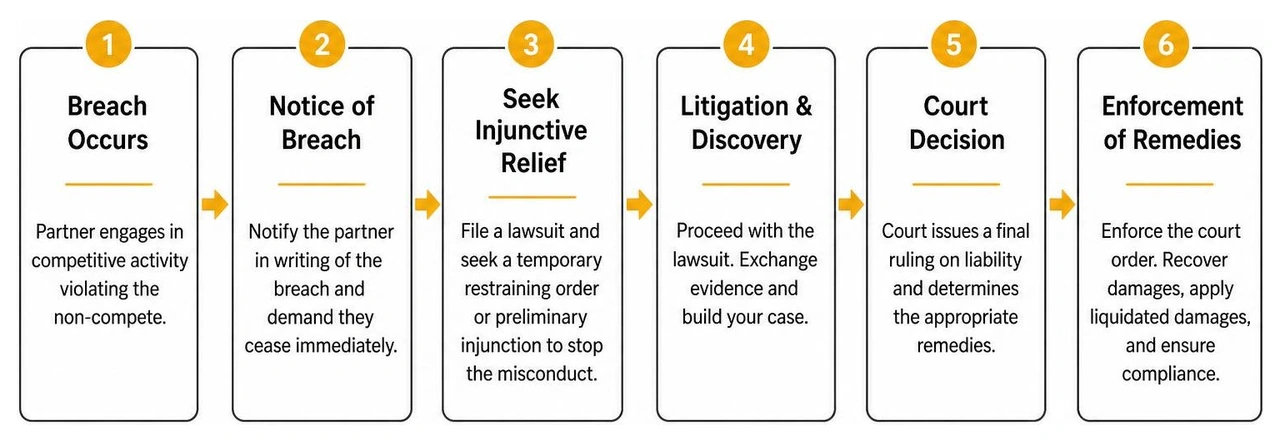
When a breach occurs, the primary goal is to stop the bleeding. This is done by seeking injunctive relief — a court order forcing the former partner to immediately stop their competitive activities while the lawsuit proceeds. To win an injunction, you must prove that the breach is causing your business "irreparable harm" (damage that cannot be easily fixed with money, such as the loss of client goodwill or the disclosure of trade secrets).
What Happens When a Partner Breaches the Agreement?
In high-stakes partnerships, relying solely on a court's calculation of damages is risky. That is why sophisticated agreements often include liquidated damages clauses. These clauses set a pre-determined financial penalty for a breach — for example, requiring the breaching partner to pay 1.5 times the historical billings of any client they poach.
To ensure the breaching partner actually pays, some companies use a Pledge Agreement. Under this setup, partners pledge their corporate shares or equity back to the company as collateral. If they violate their non-compete, the company can claim those shares to satisfy the liquidated damages.
You can view a highly structured corporate example of this in the SEC's FORM OF NON-COMPETITION AGREEMENT , which demonstrates how global firms secure non-compete obligations using equity and stock collateral.
Additionally, many well-drafted agreements include a tolling provision. This clause states that if a partner breaches the agreement, the restricted period is "paused" for the duration of the breach. This ensures that if a partner is bound by a 12-month non-compete but spends 3 months actively competing, the clock stops, and they still owe the business a full 12 months of compliance.
How a Prior Breach Can Void a Non-Compete
Here is a critical warning for business owners: if you breach the contract first, you lose your right to enforce the non-compete.
Under contract law, a material breach by one party excuses the other party from performing their obligations. This concept was highlighted in the 2024 South Dakota Supreme Court case FDJ, LLC v. Determan . In that case, a business buyer failed to make the required purchase payments to the seller. When the seller went back into business and began competing, the court ruled that the buyer's payment default was a material breach that completely voided the seller's non-compete agreement.
Furthermore, the court clarified that individual LLC members cannot be held personally liable for the LLC's breach of contract unless there are specific grounds to pierce the corporate veil.
The lesson? If you buy out a partner or purchase a business, you must strictly meet your payment and contractual obligations, or you will completely destroy your legal protection.
Frequently Asked Questions about Partner Non-Competes
Are non-compete agreements between business partners enforceable in California?
Generally, no. Under California Business and Professions Code Section 16600, almost all non-compete agreements are void and unenforceable. However, California law does provide a narrow exception for the sale of a business or the dissolution of a partnership. If a partner is selling all of their ownership interest or the partnership is dissolving, they can legally agree not to compete in a specified geographic area where the business was carried on.
How much does it cost to litigate a partner non-compete dispute?
On average, non-compete cases cost $10,000 or less to litigate. Because these cases are heavily focused on legal interpretations of the contract and immediate injunctive relief rather than extensive, years-long factual discovery, they are often resolved much faster and cheaper than standard commercial lawsuits.
Can a partner non-compete agreement be secured with equity?
Yes. In professional partnerships and closely held corporations, it is common practice to require partners to sign a Pledge Agreement. This agreement uses their corporate shares or partnership units as collateral security. If a partner breaches their non-compete, the business has the legal right to seize or cancel those shares to satisfy liquidated damages.
Conclusion
A non-compete agreement between business partners is one of the most powerful tools you have to protect your business's goodwill, trade secrets, and client relationships. But because the laws governing restrictive covenants are constantly shifting, you cannot rely on a generic, one-size-fits-all template.
At Scott Batey Law, we have spent nearly 30 years helping business owners, partners, and key employees navigate the complexities of restrictive covenants. Whether you are drafting a new partnership agreement, restructuring your business, or facing a high-stakes non-compete dispute, we provide the personalized, award-winning representation you need.
If you are a business owner or partner in Bingham Farms, Southfield, Birmingham, or anywhere in the Detroit metro area, do not leave your business's future to chance. If you need clarity on your next steps, we can also help you understand related issues like Noncompete vs Nonsolicit in Michigan – What Really Limits Your Next Job or review potential Severance Red Flags in Michigan – Noncompetes, Nonsolicits, NDA Overreach.
Protect your hard work and secure your partnership's future today. Contact a skilled Noncompete Agreement Attorney Southfield MI at Scott Batey Law to schedule a consultation.