.png)
How to Cure Your Career from Restrictive Physician Noncompetes

When Your Employment Contract Becomes a Career Trap
A physician noncompete agreement lawyer can be the difference between practicing medicine in your own community and being forced to uproot your life — or your patients' care — because of a clause buried in your employment contract.
Here is a quick answer to what you need to know:
| Question | Quick Answer |
|---|---|
| What does a physician noncompete lawyer do? | Reviews, negotiates, and litigates restrictive covenants in physician employment contracts |
| Are physician noncompetes enforceable? | Depends entirely on your state, contract terms, and circumstances of departure |
| Can you fight a noncompete? | Yes — through buyout provisions, geographic challenges, lack of consideration, or state-specific bans |
| When should you hire one? | Before signing any contract — but also if you are already bound by one |
| What does it cost to fight one? | Legal evaluations run $1,500–$5,000; litigation can reach $25,000–$100,000+ |
You spent years in medical school, residency, and training. Then you signed an employment contract. And somewhere in that contract — often in dense legal language — was a clause that could lock you out of practicing medicine within miles of your own home for years.
The American Medical Association's own code of medical ethics states that noncompete agreements are unethical when they "fail to make reasonable accommodation of patients' choice of physician." In 2024, the AMA went further, adopting official policy opposing all restrictive covenants between employers and physician employees. Yet these agreements remain common — and courts in many states still enforce them.
The legal landscape is shifting fast. State legislatures across the country are rewriting the rules. Some states now ban physician noncompetes outright. Others are adding strict geographic and financial limits. And in states like Michigan, the enforceability of your agreement still depends heavily on how the contract was written, where you practice, and what the courts consider "reasonable."
This guide walks you through how physician noncompetes work, what makes them enforceable (or not), and what your options are if one is standing between you and your next opportunity.
I'm Scott Batey, a Michigan employment lawyer with nearly three decades of experience representing employees in workplace disputes — including contract review, noncompete challenges, and restrictive covenant negotiations — and as a physician noncompete agreement lawyer serving Metro Detroit and throughout Michigan, I have seen how a single clause can derail a physician's career if left unchecked. Let's break down exactly what you are dealing with and what you can do about it.
What is a Medical Restrictive Covenant and Why Do Employers Use Them?
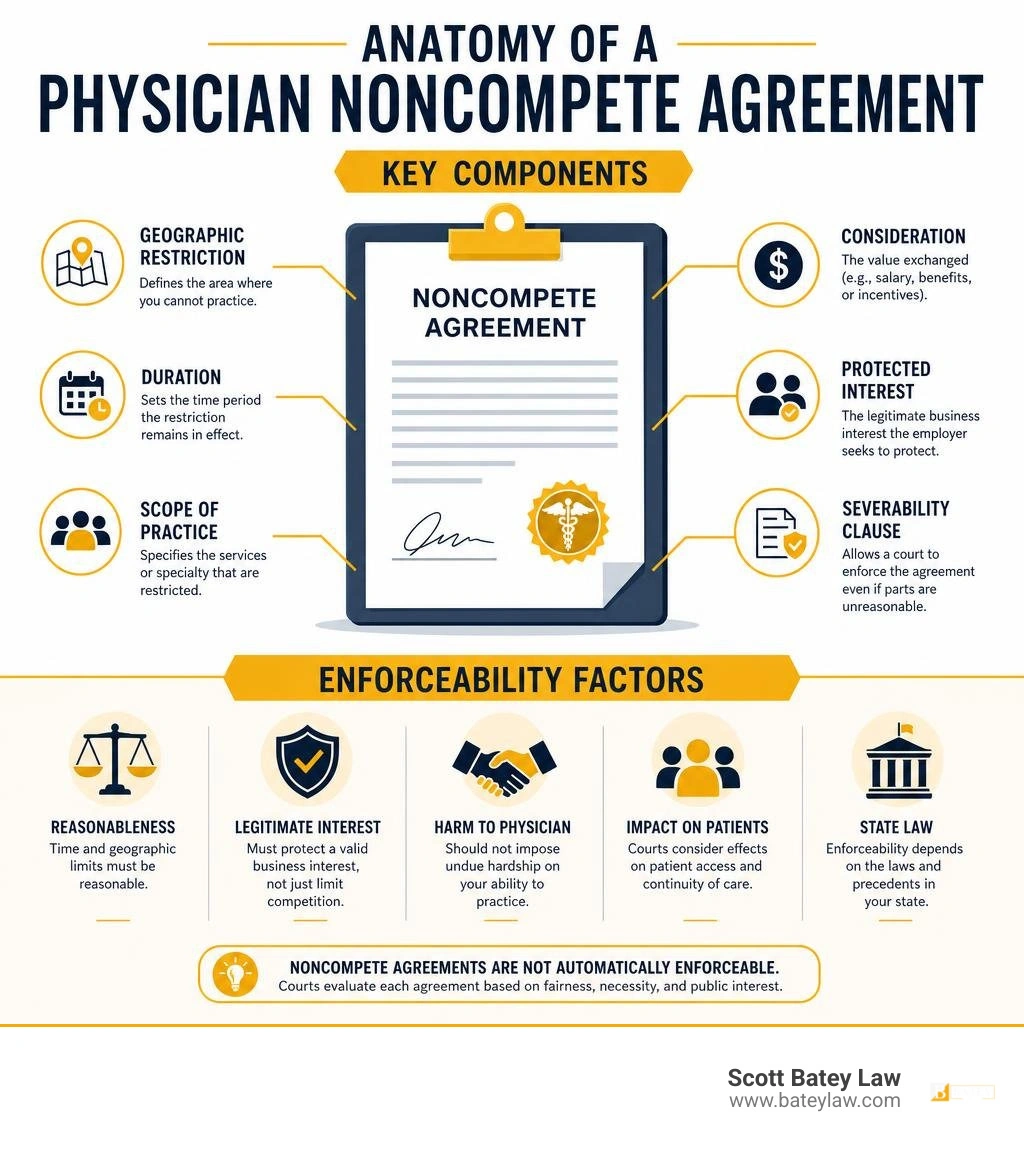
At its core, a medical restrictive covenant is a clause in an employment agreement that limits a healthcare provider’s freedom to practice medicine within a specific geographic area for a set period after leaving an employer. These clauses are designed to protect the employer's business interests, but they often leave physicians feeling trapped in toxic work environments.
Large hospital systems, private equity-backed medical groups, and private practices invest heavily in recruiting doctors, marketing their services, and building clinical infrastructure. To safeguard this investment, they use restrictive covenants to protect three main things:
- Employer Goodwill: The brand equity and reputation of the practice.
- Patient Lists and Referral Networks: Preventing a departing physician from immediately "stealing" the patient base they treated while employed.
- Specialized Training: Protecting proprietary clinical methodologies or expensive training programs provided to the doctor.
While these business motivations are understandable in a commercial market, medicine is not a standard retail business. The American Medical Association (AMA) has long raised ethical concerns about these restrictions. According to the What employed physicians should know about noncompete clauses | American Medical Association, restrictive covenants can severely disrupt the patient-physician relationship. When a trusted doctor is suddenly barred from practicing nearby, patients are often forced to find new care, wait months for appointments, or travel long distances to stay with their preferred physician.
The Conflict Between Patient Care and Business Interests
The tension between corporate healthcare profits and patient care is at an all-time high in July 2026. Hospital systems frequently argue that without noncompete clauses, they cannot afford to recruit top-tier talent or build specialized clinics in competitive areas. They view physicians as highly compensated professionals who freely sign contracts in exchange for lucrative salaries and sign-on bonuses.
On the other side of the stethoscope, physicians face immense pressure. Forcing a doctor out of their local community can cause massive personal disruption — forcing families to relocate, children to change schools, and spouses to find new jobs. Ethically, it compromises patient access to care and continuity of treatment, particularly in highly specialized fields where finding a replacement physician can take a hospital more than a year.
How a Physician Noncompete Agreement Lawyer Evaluates Your Contract
When you consult a specialized attorney, they do not just look at the mileage radius and the number of months. They analyze the contract as a holistic, interconnected document.
A dedicated physician contract review services provider will evaluate:
- The Triggering Event: Does the noncompete apply if you are fired without cause? Or only if you resign voluntarily?
- The Scope of "Restricted Activities": Does it bar you from practicing your specific specialty, or does it broadly prohibit you from "practicing medicine" in any capacity? (For example, preventing an anesthesiologist from taking a pain management role).
- The True Geographic Radius: Does the restriction apply only to your primary practice location, or does it extend from every clinic, satellite office, or hospital affiliate owned by the employer?
- The Intersecting Clauses: How do malpractice tail coverage, sign-on bonus clawbacks, and non-solicitation terms affect your financial ability to leave?
The Evolving State-by-State Legal Landscape of Physician Noncompetes
If you feel like the ground is shifting beneath your feet, you are not wrong. The legal landscape surrounding physician noncompetes is a rapidly evolving patchwork of state laws.
At the federal level, the Federal Trade Commission's (FTC) highly publicized attempt to implement a nationwide ban on noncompete agreements faced immense legal challenges. By early 2026, those federal efforts stalled in the courts, leading the FTC to shift toward case-by-case enforcement. This has left individual states as the primary battleground for regulating healthcare restrictive covenants.
Here is a comparison of how different states handle physician noncompetes in 2026:
| State | Enforceability Status | Key Restrictions / Statutory Limits |
|---|---|---|
| California | Completely Unenforceable | Broad ban under B&P Code § 16600; SB 351 (2026) voids PE/MSO noncompetes |
| Indiana | Severely Restricted | Banned for primary care physicians; void if doctor leaves for cause or is fired without cause |
| Texas | Highly Regulated | Limits to 1-year, 5-mile radius; requires a reasonable buyout provision capped at annual salary |
| Maryland | Compensation-Based | Completely banned for medical professionals earning $350,000 or less per year |
| Michigan | Enforceable if "Reasonable" | Adheres to a case-by-case "reasonableness" standard; must protect a legitimate business interest |
Strict Bans and Compensation Thresholds in Other States
Several states have taken aggressive steps to protect healthcare mobility. In California, employee noncompetes have been banned since 1872. As outlined in the guide on Are Non-Compete Clauses Enforceable for Physicians in California? - Bay Legal PC, recent laws like SB 351 (effective January 1, 2026) have shut down corporate attempts to bypass these bans through private equity management services organization (MSO) structures.
Other states have targeted specific sectors or income brackets:
- Indiana: Under laws like Senate Enrolled Act No. 475 (effective July 1, 2025), noncompetes between physicians and hospital systems are heavily restricted, as detailed in the legal update Indiana Adds More Restrictions On Physician Noncompete Agreements - Employee Rights/ Labour Relations - United States.
- Maryland: Recognizing that noncompetes disproportionately harm lower-to-mid-earning practitioners, Maryland bans these restrictions for any medical professional earning $350,000 or less annually.
- Arkansas: Effective August 5, 2025, Act 232 banned physician noncompetes in the employment context entirely.
Michigan Rules: What Southfield and Metro Detroit Doctors Must Know
If you practice in Southfield, Troy, Detroit, or anywhere else in Metro Detroit, the strict bans of California or Indiana do not apply to you. Michigan operates under a reasonableness standard (MCL 445.774a).
To be enforceable in Michigan, a physician noncompete must:
- Protect a legitimate business interest of the employer (such as trade secrets, highly specialized training, or established patient relationships).
- Be reasonable in duration (typically 1 year or less, though up to 2 years is occasionally tolerated depending on the specialty).
- Be reasonable in geographic scope (restricted to the actual area where the physician drew patients).
- Be reasonable in the line of business restricted (it cannot prevent you from practicing medicine entirely if a narrower restriction would protect the employer).
As we discuss in our detailed guide on Noncompete Agreements in Michigan What Southfield Employees Should Watch For, Michigan courts are generally skeptical of hospital systems that try to lock down entire counties or prevent primary care doctors from treating patients in underserved communities. However, because Michigan still allows these agreements, you cannot simply ignore a noncompete and hope it goes away.
Key Enforceability Factors: Geography, Duration, and Buyouts
When a court reviews a physician noncompete, it balances the employer's business interests against your right to earn a living and the public’s right to access healthcare. Three core factors dictate whether your agreement will stand up to legal scrutiny: geography, duration, and buyout options.

Reasonable Geographic Scope and Duration Limits
What is considered "reasonable" varies wildly based on where your clinic is located.
- Urban vs. Rural Markets: In a densely populated area like Royal Oak, Farmington Hills, or Southfield, a 10-mile radius is massive. It can cover dozens of competing hospitals and hundreds of thousands of potential patients. In these urban environments, courts often favor much smaller radii (e.g., 2 to 5 miles). Conversely, in rural parts of Michigan, a 30-mile radius might be deemed reasonable because patients routinely travel those distances for specialized care.
- Overlapping Practice Zones: Beware of "multi-site" clauses. If your employer operates 15 clinics across Metro Detroit and your noncompete applies to a 10-mile radius around every facility, you could be effectively locked out of the entire tri-county area, even if you only ever worked at one clinic in Bingham Farms.
- Duration Limits: Most courts view a 1-year restriction as standard. Some states have statutory baselines; for example, Florida law establishes a presumption that restrictions under six months are reasonable, while those over two years are unreasonable. Tennessee permits healthcare noncompetes up to two years post-employment. In Michigan, anything beyond one year for a standard physician employee will face heavy skepticism from a judge.
The Role of Buyout Provisions and Liquidated Damages
A buyout provision (or "liquidated damages" clause) is a contractual escape hatch. It allows a physician to pay a pre-determined sum of money to nullify the noncompete restriction entirely.
As discussed in the guide Trapped by a Physician Non-Compete? Here's How to Get Out (2026), a buyout clause typically ranges from six months to a full year of the physician's total compensation package. While this sounds incredibly expensive, it offers predictability. If you are being recruited by a competing hospital system or large group practice, your new employer will often agree to fund this buyout as part of your sign-on package.
In some states, buyout provisions are legally mandated. Under Texas law, a physician noncompete is completely void if it does not contain a reasonable buyout provision. Furthermore, Texas's 2025 laws capped these buyouts at the practitioner's annual salary and wages. If an employer fails to include a valid buyout option in states that require it, the entire noncompete can be declared void ab initio (from the beginning), and courts may refuse to "fix" or reform the contract.
How a Physician Noncompete Agreement Lawyer Can Help You Fight Back
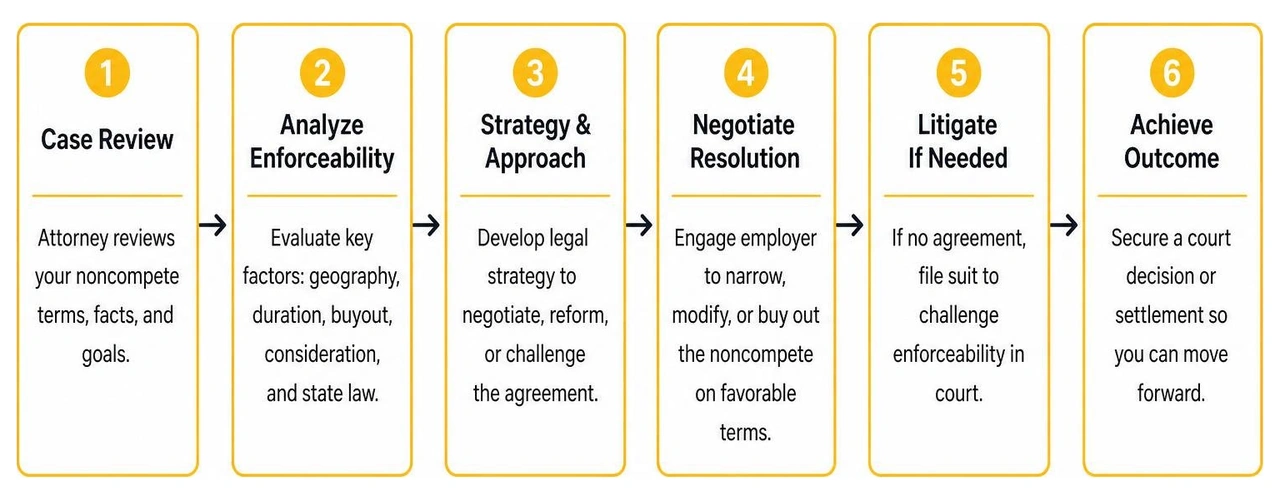
If you are currently bound by an aggressive noncompete and want to transition to a new role, you are not powerless. An experienced employment lawyer can utilize several legal strategies to challenge the agreement or negotiate a favorable exit.
Defenses Against Enforceability and the Blue-Pencil Rule
When we represent physicians in Metro Detroit, we analyze the contract for specific legal vulnerabilities:
- Lack of Consideration: To be a valid contract, there must be an exchange of value. If you were forced to sign a noncompete mid-employment without receiving a raise, bonus, promotion, or additional benefits, the agreement may fail for lack of adequate consideration.
- Prior Material Breach by the Employer: If your employer failed to pay your bonuses on time, reduced your clinical support staff in violation of your contract, or forced you to work in unsafe conditions, they may have breached the contract first. In Michigan, a party that commits a material breach cannot turn around and enforce a restrictive covenant against the other party.
- The Blue-Pencil Doctrine: In some states, if a noncompete is deemed overbroad (e.g., a 50-mile radius), the court will throw out the entire agreement. However, Michigan courts utilize the "blue-pencil" rule. This allows a judge to modify or edit the unreasonable portions of the contract (e.g., shrinking a 20-mile radius down to 5 miles, or shortening a 2-year term to 12 months) rather than striking down the entire agreement.
- Declaratory Judgment Actions: Rather than waiting to get sued by your former employer, your lawyer can proactively file a lawsuit asking a judge to declare the noncompete unenforceable. This puts you in the driver's seat and can force a quick settlement.
When to Hire a Physician Noncompete Agreement Lawyer
The absolute best time to hire a lawyer is before you sign the contract. Once your signature is on that paper, your legal leverage drops significantly.
During pre-signing reviews, we routinely negotiate:
- Termination Carveouts: Ensuring the noncompete only triggers if you resign without cause or are terminated for cause. If the employer fires you without cause, the noncompete should be completely void.
- Specialty Narrowing: Restricting the noncompete strictly to your specific clinical focus, leaving you free to practice general medicine or take administrative roles elsewhere.
- Sunset Clauses: Ensuring the noncompete expires entirely after you have been with the practice for a certain number of years.
If you have already signed and are planning your departure, understanding the nuances between different restrictive covenants is vital. For instance, we highly recommend reviewing our analysis of Noncompete vs Nonsolicit in Michigan What Really Limits Your Next Job to evaluate your practical exposure before making your move.
Frequently Asked Questions About Physician Noncompetes
What happens if a physician violates a noncompete agreement?
If you ignore your noncompete and begin working for a competitor, your former employer can take immediate, aggressive legal action.
Typically, they will file a lawsuit and seek a Temporary Restraining Order (TRO). A TRO can be obtained ex-parte (meaning without you or your attorney present in court) if the employer can show immediate, irreparable harm. In Michigan, a TRO can last no longer than 14 days before a formal preliminary injunction hearing must be held.
If the court grants a preliminary injunction, you will be legally barred from working at your new job while the lawsuit proceeds. In addition to injunctions, employers can seek monetary damages (such as lost profits from patients who followed you) and, in many cases, make you pay their court costs and attorney's fees.
Can an employer enforce a noncompete if I am terminated without cause?
In Michigan, yes, unless your contract explicitly states otherwise. This is why we call it a "career trap." It is a terrible result when an employer can lay you off or terminate you without cause and still legally prevent you from practicing medicine down the street.
When reviewing a new job offer, always negotiate a carveout so that the noncompete is nullified if the employer terminates your employment without cause. In contrast, some states like Indiana have established statutory protections making noncompetes unenforceable if the physician is terminated without cause or if the physician terminates the contract for cause.
What is the difference between a noncompete and a nonsolicitation clause?
While they are often lumped together under the umbrella of "restrictive covenants," they do very different things:
- Noncompete Clauses: Bar you geographically. They prevent you from practicing your medical specialty within a certain radius of your former employer's facilities, regardless of whether you treat your former patients or not.
- Nonsolicitation Clauses: Bar you from reaching out to specific people. They do not stop you from working down the street, but they prohibit you from actively soliciting former patients, referral networks, or clinical staff to join your new practice.
To understand how these overlapping restrictions can impact your daily practice, read our breakdown of Noncompete vs Nonsolicitation in Michigan Whats the Difference and Why It Matters.
Conclusion: Protect Your Medical Career and Patient Care
A physician noncompete is not just a standard employment term; it is a powerful legal mechanism that can dictate where you live, how you support your family, and how you care for your patients. With the rapid legislative changes occurring across the country in 2026, navigating these agreements requires deep, localized legal expertise.
At Scott Batey Law, we have spent over 25 years providing award-winning, personalized representation to employees navigating complex workplace disputes in Bingham Farms, Southfield, Troy, Detroit, and across Oakland County. We understand the unique professional and ethical pressures that physicians face, and we know how to identify the contractual loopholes, overbroad terms, and statutory defenses needed to protect your career mobility.
Whether you are looking at a new employment offer, planning to transition out of a hospital system, or actively facing a noncompete dispute, do not try to diagnose your legal risks alone.
Contact a dedicated Noncompete Agreement Attorney Southfield MI at Scott Batey Law today to schedule a comprehensive review of your contract and take control of your professional future.