.png)
How a Michigan Workplace Discrimination Attorney Protects Your Career

When Your Job Is on the Line, a Workplace Discrimination Attorney in Michigan Can Make All the Difference
If you need a workplace discrimination attorney in Michigan right now, here is what you need to know first:
Who qualifies for legal protection?
- Employees treated unfairly because of race, sex, age, disability, religion, national origin, height, weight, marital status, or other protected traits
- Workers fired, demoted, or harassed after reporting discrimination or harassment
- Employees denied reasonable accommodations for a disability or religious practice
What should you do immediately?
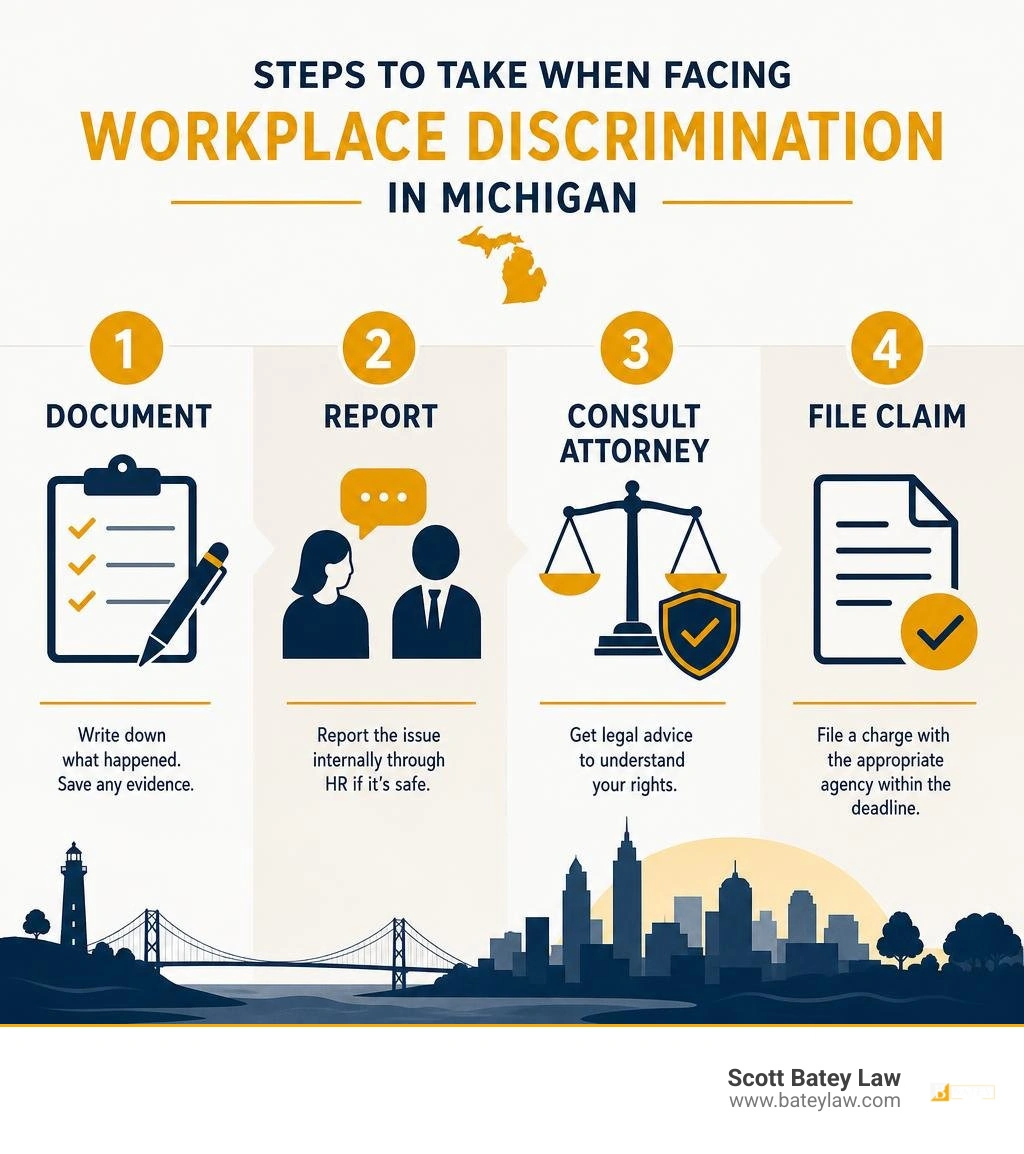
- Write down exactly what happened — dates, names, and what was said or done
- Save emails, texts, performance reviews, and any related documents
- Report the issue internally through HR if it is safe to do so
- Contact an employment attorney — deadlines can be as short as 180 days
What can a Michigan discrimination attorney do for you?
- Evaluate whether your situation is legally actionable
- Identify which state and federal laws apply to your case
- Handle agency filings with the EEOC or Michigan Department of Civil Rights
- Negotiate a settlement or take your case to court
Workplace discrimination is more than just unfair treatment — it can derail your career, drain your savings, and damage your reputation. Michigan workers face a real challenge: most are employed "at will," meaning an employer can technically end the job at any time. But that does not mean anything goes. Both Michigan state law and federal law draw clear lines around how employees can be treated, and crossing those lines is illegal.
Michigan's primary workplace protection law — the Elliott-Larsen Civil Rights Act (ELCRA) — goes further than federal law in several important ways. It covers smaller employers, protects additional characteristics like height, weight, and marital status, and gives employees a longer window to file a claim. Combined with federal laws like Title VII, the ADA, and the ADEA, Michigan workers have some of the strongest legal protections in the country.
Yet many employees who experience discrimination, harassment, or retaliation never take action — often because they are not sure what their rights are, or they fear making things worse. That uncertainty is exactly where an experienced attorney makes a difference.
I'm Scott Batey, founder of Batey Law Firm, PLLC, and I have spent nearly three decades as a workplace discrimination attorney in Michigan, representing employees across Metro Detroit and throughout the state in cases involving wrongful termination, harassment, retaliation, disability accommodation, and more. If you are facing a workplace crisis right now, this guide will walk you through your rights, your options, and the steps that matter most.
Understanding Workplace Discrimination Under Michigan and Federal Law
When you walk into your job in Bingham Farms, Southfield, or Detroit, you deserve to be judged solely on your performance, your work ethic, and the value you bring to the table. Unfortunately, workplace bias still creeps into hiring, promotions, assignments, and terminations. To hold an employer accountable, we must first understand how both state and federal laws define illegal discrimination.
In Michigan, we are fortunate to have dual layers of protection. You are shielded by federal statutes enforced by the Equal Employment Opportunity Commission (EEOC) and state statutes enforced by the Michigan Department of Civil Rights (MDCR).
Under state law, the cornerstone of employee protection is the workplace discrimination elcra framework, which prohibits employers from making employment decisions based on a broad list of personal characteristics.
To see how these laws interact, let's look at a comparison of who is protected and when these laws apply:
| Feature / Protection | Michigan ELCRA | Federal Law (Title VII, ADA, ADEA) |
|---|---|---|
| Minimum Employer Size | 1 or more employees (covers almost every business) | 15 or more employees (20+ for age discrimination) |
| Core Protected Classes | Race, color, religion, national origin, sex, age | Race, color, religion, national origin, sex, age (40+), disability |
| Unique State Protections | Height, weight, marital status, arrest records | None (though federal rules cover genetic info) |
| LGBTQ+ Protections | Explicitly protected (codified in 2023) | Protected under "sex" discrimination (Bostock ruling) |
| Standard Filing Deadline | 3 years to file directly in state court | 300 days to file an EEOC charge |
Protected Classes Under the Elliott-Larsen Civil Rights Act (ELCRA)
Michigan’s Elliott-Larsen Civil Rights Act is one of the most robust state-level civil rights laws in the nation. For a comprehensive look at how this law operates, you can read our guide on elcra 101 michigans civil rights law explained for employees.
What makes ELCRA unique is that it protects several classes that federal law completely ignores. For example, ELCRA explicitly bans discrimination based on:
- Marital Status: An employer cannot refuse to hire you, fire you, or pay you less because you are single, married, divorced, or widowed.
- Height and Weight: Michigan is one of the few states where employers cannot make hiring or promotion decisions based on physical attributes like your height or weight, unless it is a bona fide occupational qualification (which is incredibly rare).
- Arrest Records: While federal law only limits how employers use criminal history, ELCRA strictly prohibits employers from even asking about or using misdemeanor arrest records that did not lead to a conviction.
Additionally, as of 2023, the Michigan legislature officially codified protections for sexual orientation and gender identity under ELCRA. This means LGBTQ+ employees in Royal Oak, Ferndale, and throughout Michigan have explicit statutory protections against bias. For more on this, check out our articles on lgbtq discrimination at work in michigan what elcra protects and learn about your options under lgbtq discrimination under elcra what michigan employees can do.
Federal vs. State Protections: Title VII, ADA, and ADEA
While ELCRA is highly effective, federal laws remain vital, especially for larger employers. Federal protections include:
- Title VII of the Civil Rights Act of 1964: Covers race, color, religion, sex, and national origin for employers with 15 or more employees.
- The Americans with Disabilities Act (ADA): Requires employers with 15 or more employees to provide reasonable accommodations to qualified individuals with physical or mental disabilities. If you are facing barriers or bias due to a medical condition, consulting a disability discrimination attorney michigan can help you secure the accommodations you need or hold your employer liable for discrimination.
- The Age Discrimination in Employment Act (ADEA): Protects workers aged 40 and older from age-related bias.
It is important to note that while the ADEA protects workers over 40, Michigan’s ELCRA protects workers of all ages. If you believe your employer is pushing you out due to your age, read our detailed analysis on age discrimination in michigan the patterns employees should not ignore.
Common Forms of Workplace Discrimination and Harassment
Discrimination rarely announces itself. Modern employers are usually smart enough not to put discriminatory motives in writing. Instead, discrimination shows up through subtle patterns and "adverse employment actions."
An adverse employment action is a material, negative change in the terms and conditions of your employment. This includes:
- Wrongful termination
- Demotion or being passed over for a well-deserved promotion
- Unjustified salary cuts or denial of equal pay
- Undesirable transfers or sudden shifts in job duties
- Negative performance reviews that do not match your actual work quality

One common area where we see these adverse actions is pregnancy. If you are treated differently, denied light duty, or suddenly terminated after sharing your pregnancy news, you may need to speak with a pregnancy discrimination lawyer birmingham mi to protect your rights and your career.
Hostile Work Environment and Sexual Harassment
Harassment becomes illegal when it is based on a protected characteristic (such as race, gender, religion, or age) and becomes so severe or pervasive that it alters the conditions of your employment and creates an abusive working environment.
Under both state and federal law, sexual harassment generally falls into two categories:
- Quid Pro Quo: "This for that." This occurs when a supervisor conditions a job benefit (like a promotion, raise, or even keeping your job) on your submission to unwelcome sexual advances or conduct.
- Hostile Work Environment: This occurs when unwelcome verbal, physical, or visual conduct of a sexual nature is so frequent or severe that it makes your workplace intolerable.
If you are experiencing a hostile environment or harassment in Oakland County, talking to a workplace discrimination lawyer royal oak mi is a crucial step.
Retaliation and Whistleblower Protections
Many employees suffer in silence because they are terrified that complaining will get them fired. But you should know that retaliation is strictly illegal. In fact, retaliation is the most common claim filed with civil rights agencies.
According to historical EEOC data, 49 percent of all claims filed between 1997 and 2018 were for retaliation.
Retaliation occurs when an employer takes an adverse action against you because you engaged in a "protected activity." Protected activities include:
- Filing an internal complaint about discrimination or harassment
- Requesting a reasonable accommodation for a disability or religious belief
- Participating in an internal investigation or testifying in a discrimination lawsuit
- Opposing illegal practices in the workplace
If you complain about discrimination on Monday and are fired on Friday, that is a classic retaliatory pattern. If you suspect your employer is retaliating against you in Southfield or surrounding areas, contacting a workplace discrimination lawyer southfield mi immediately is critical to protecting your career.
How to Prove Your Case with a Workplace Discrimination Attorney in Michigan
To win a discrimination lawsuit, we must meet the legal burden of proof. Because employers rarely admit to bias, we rely on two types of evidence:
- Direct Evidence: This is the "smoking gun." It includes statements where an employer explicitly links an action to a protected trait (e.g., a manager saying, "We need someone younger for this role," or using racial slurs).
- Circumstantial Evidence: This is far more common. We build a case by showing a pattern of behavior that allows a judge or jury to infer that discrimination was the real reason behind the employer's actions.
When you partner with a workplace discrimination attorney in Michigan, we will help you analyze the facts to build a strong foundation. If you work in Birmingham, consulting a workplace discrimination attorney in birmingham mi can help you determine the best path forward.
Gathering Evidence and the Paper Trail
A successful case is built on a solid paper trail. Employers will almost always claim they fired or demoted you for "poor performance" or "restructuring." To beat this defense, you need to preserve evidence:
- Performance Reviews: Keep copies of all past evaluations. If you had five years of glowing reviews and suddenly received a terrible review right after disclosing a pregnancy or complaining about bias, that is key evidence.
- Emails, Texts, and Chat Logs: Save any messages that contain offensive comments, double standards, or shifting instructions.
- Witness Statements: Write down the names and contact information of coworkers, clients, or vendors who witnessed the unfair treatment.
- Comparators: Identify coworkers who do the same job but are outside your protected class. If they committed the same minor infraction but were not disciplined, while you were fired, that demonstrates unequal treatment.
If you are dealing with race-based bias, working with a race discrimination attorney in royal oak mi can help you organize this evidence to prove systemic bias.
Proving Pretext and Retaliatory Timing
The core of most employment lawsuits is proving pretext. Pretext means the employer's stated reason for firing or disciplining you is a lie designed to cover up discrimination.
We prove pretext by showing:
- Shifting explanations (the employer changes their story about why you were fired)
- Deviations from company policy (the employer ignored standard disciplinary steps just to fire you)
- Suspicious timing (the negative action occurred immediately after you engaged in protected activity)
For a deeper dive into how timing and evidence work together under state law, read our article on elcra discrimination claims in michigan protected classes proof and timing.
The Legal Process: Filing Deadlines and Statutes of Limitations
When it comes to civil rights claims, time is of the essence. If you miss a filing deadline, you lose your right to seek justice forever.
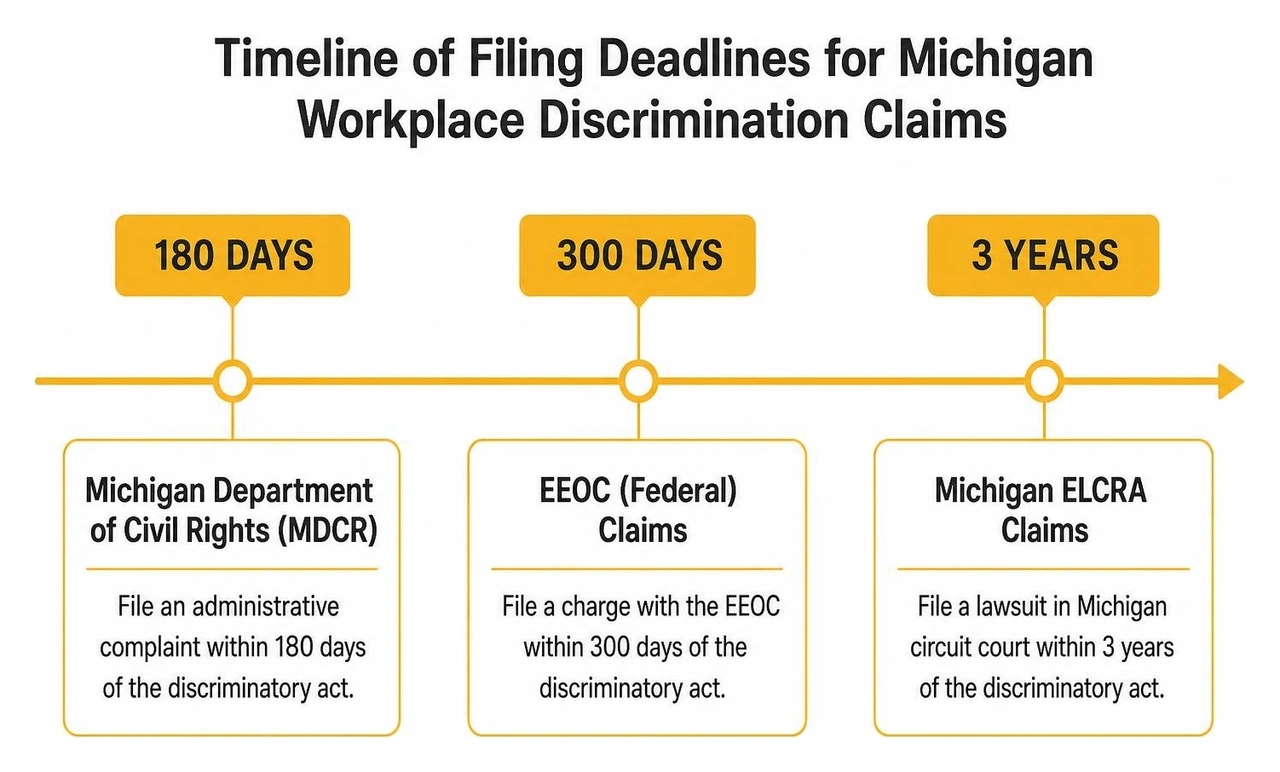
As shown above, the deadlines vary wildly depending on whether you are pursuing a state or federal claim:
- Michigan ELCRA Claims: You generally have three years from the date of the discriminatory act to file a lawsuit directly in a Michigan circuit court. For more details on why this state law is so powerful, read elcra 101 michigans civil rights law stronger than you think.
- Michigan Department of Civil Rights (MDCR): If you choose to file an administrative complaint with the state agency, you must do so within 180 days of the discriminatory act.
- EEOC (Federal) Claims: To preserve your federal claims under Title VII, the ADA, or the ADEA, you must file a charge with the EEOC within 300 days of the incident.
Filing with the EEOC and the Michigan Department of Civil Rights
Before you can file a federal discrimination lawsuit in court, you must "exhaust your administrative remedies." This means you must first file a formal charge of discrimination with the EEOC.
Because the EEOC and the MDCR have a "cooperative agreement," a claim filed with one agency is typically dual-filed with the other to protect both your state and federal rights. Once the EEOC completes its investigation, it will issue a "Right to Sue" letter, giving you 90 days to file a federal lawsuit.
Navigating these agency filings can be incredibly confusing. For more information on filing requirements, you can visit the official Equal Employment Opportunity Commission website.
Why You Need a Workplace Discrimination Attorney in Michigan Immediately
You should not wait until you are fired to contact an attorney. In fact, consulting a workplace discrimination attorney in Michigan while you are still employed is often the smartest move you can make.
An attorney can help you:
- Draft internal complaints that clearly establish your "protected activity" (preventing the employer from claiming they "didn't know" you were complaining about discrimination)
- Ensure you do not accidentally violate company policies regarding data downloads while trying to preserve evidence
- Build a strong leverage position for severance negotiations
If you are working in Southfield or surrounding areas, reaching out to workplace discrimination attorneys southfield mi early can help you regain control of your career before it is too late.
Remedies and Compensation Available to Victims
If we successfully prove that your employer violated state or federal anti-discrimination laws, you are entitled to significant financial remedies designed to make you "whole" again.
These remedies and damages can include:
- Back Pay: Compensation for the wages, benefits, and bonuses you lost from the date of the wrongful termination up to the date of your trial or settlement.
- Front Pay: If reinstatement to your old job is impossible due to hostile relationships, the court may award you future lost wages to cover the time it will take you to find a comparable position.
- Emotional Distress Damages: Compensation for the mental anguish, stress, anxiety, loss of sleep, and damage to your professional reputation caused by the discrimination.
- Punitive Damages: Available under certain federal claims if we can prove the employer acted with malice or reckless indifference to your rights.
- Attorney’s Fees and Costs: Under both ELCRA and federal civil rights laws, a prevailing employee can have their attorney’s fees paid by the employer.
Recovering Lost Wages and Damages
While these remedies are powerful, employees have a legal duty to mitigate their damages. This means you must make a reasonable, good-faith effort to look for a new job after being terminated. If you sit on the couch and do not apply for work, the employer can argue that your back pay should be cut off.
To understand how courts assess damages and how state laws protect your rights, you can consult resources provided by the Michigan Department of Civil Rights.
Selecting the Best Workplace Discrimination Attorney in Michigan
When your career, livelihood, and reputation are on the line, choosing the right advocate is the most important decision you will make.
Here is what you should look for when choosing an attorney:
- Personalized Attention: You want a lawyer who actually handles your case directly, not an associate who passes you off to an assistant.
- Proven Trial Experience: Employers know which attorneys are willing to go to trial and which ones just want a quick, cheap settlement. A strong courtroom reputation gives you maximum leverage.
- Contingency Fee Structure: Most reputable employment lawyers work on a contingency basis, meaning you pay no upfront fees, and we only get paid if we win your case.
- Responsive Communication: Your attorney should return your calls, answer your questions, and keep you updated every step of the way.
If you are ready to discuss your case in Bingham Farms or Metro Detroit, we invite you to connect with a workplace discrimination lawyer in bingham farms mi for a confidential consultation.
Frequently Asked Questions About Michigan Employment Law
Can I be fired for no reason in Michigan?
Yes. Michigan is an "at-will" employment state, meaning either you or your employer can end the employment relationship at any time, for any reason, or for no reason at all. However, "at-will" is not a license to discriminate. An employer cannot fire you for an illegal reason — such as your race, age, sex, disability, or in retaliation for complaining about unfair treatment.
How long do I have to file a discrimination claim in Michigan?
Under Michigan’s ELCRA, you have three years from the date of the discriminatory act to file a lawsuit in state court. However, if you wish to file an administrative complaint with the Michigan Department of Civil Rights (MDCR), you must do so within 180 days. For federal claims with the EEOC, the deadline is 300 days. Because these deadlines are strict, you should speak with an attorney as soon as possible.
What is constructive discharge?
Constructive discharge occurs when an employer does not formally fire you, but instead makes your working conditions so intolerable, hostile, or abusive that any reasonable person would feel forced to resign. Under the law, a constructive discharge is treated exactly like a wrongful termination, allowing you to pursue full damages.
Conclusion

You do not have to endure workplace discrimination, harassment, or retaliation in silence. Your career, your dignity, and your family's financial stability are worth protecting.
At Scott Batey Law, we have spent over 25 years standing up for workers in Bingham Farms, Southfield, Royal Oak, and across Michigan. We provide the award-winning, deeply personalized representation you need to stand up to powerful employers and secure the justice you deserve.
If you are ready to take control of your career and explore your legal options, contact an experienced employment lawyer bingham farms mi at Scott Batey Law today. We are here to listen, guide you, and fight for your rights.