.png)
Bingham Farms Workplace Harassment Lawyer and Legal Help

When Your Job Feels Like a Trap: Getting the Right Legal Help in Bingham Farms
If you are looking for a workplace harassment lawyer in Bingham Farms, here is what you need to know right away:
Quick answers for employees in Bingham Farms:
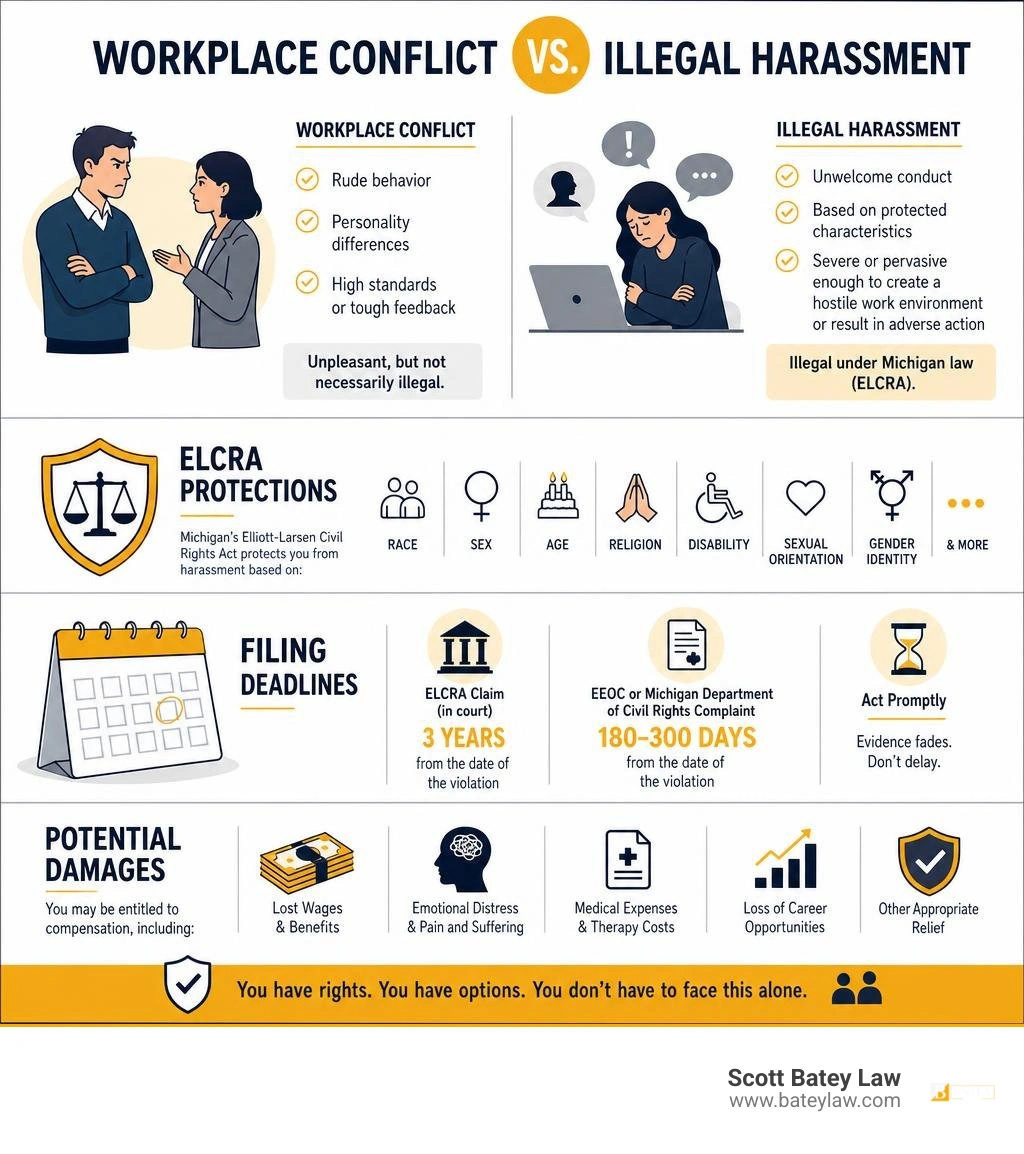
- Michigan's Elliott-Larsen Civil Rights Act (ELCRA) protects you from harassment based on race, sex, age, religion, disability, sexual orientation, gender identity, and more
- You generally have 3 years to file an ELCRA claim in court — longer than most federal deadlines
- Most EEOC or Michigan Department of Civil Rights complaints must be filed within 180-300 days
- You do not have to quit your job to pursue a harassment claim
- A lawyer can help you document evidence, navigate HR reporting, and avoid retaliation
- Consultations with Batey Law Firm are free and confidential
Workplace harassment is one of the most stressful things an employee can face. It can threaten your income, damage your reputation, and make every workday feel impossible. But not every uncomfortable or rude situation at work is legally actionable — and knowing the difference matters enormously before you take action.
Michigan law gives employees real, enforceable rights. The challenge is knowing how to use them correctly and on time.
I'm Scott Batey, founder of Batey Law Firm, PLLC, located right here in Bingham Farms — and for nearly 30 years I have focused exclusively on representing employees as a workplace harassment lawyer in Bingham Farms and across Michigan. If your job, finances, or career are at risk because of how you have been treated at work, I can help you understand your options clearly and move forward strategically.
Understanding Workplace Harassment Under Michigan Law
It is incredibly common for people to confuse general workplace conflict with illegal workplace harassment. Workplaces are high-pressure environments, and it is completely normal to run into a difficult boss, a rude coworker, or a passive-aggressive team lead. However, under Michigan law, a "bad boss" or a "toxic office" is not automatically illegal.
For workplace conflict to cross the line into illegal conduct, the harassment must be directly motivated by a protected civil rights characteristic. If your supervisor is screaming at everyone equally because they have poor management skills, that is a toxic workplace conflict. But if your supervisor is targeting you specifically with demeaning comments, harsher disciplinary actions, or unfair scheduling because of your race, sex, or age, that is illegal harassment.
When you work with a Workplace Harassment Lawyer - Oakland County MI, we help you analyze the behavior to determine whether it meets the strict legal definitions of harassment, ensuring you have a viable path forward.
Elliott-Larsen Civil Rights Act (ELCRA) vs. Federal Protections
In Michigan, employees are protected by both state and federal laws, but they operate differently—especially when it comes to employer size and filing deadlines.
The primary state law protecting Michigan workers is the Elliott-Larsen Civil Rights Act (ELCRA). This landmark piece of legislation is incredibly broad. While federal laws like Title VII of the Civil Rights Act of 1964 generally apply only to businesses with 15 or more employees, Michigan’s ELCRA covers almost all employers with one or more employees. This means if you work for a small boutique, a local medical office, or a family-owned business in Bingham Farms, you are still fully protected under state law.
Additionally, while federal claims require you to navigate strict administrative agency timelines (often just 180 to 300 days to file a charge with the Equal Employment Opportunity Commission), the ELCRA allows you to file a lawsuit directly in court within three years of the discriminatory act.
If you are trying to determine whether to pursue your claim under state or federal jurisdiction, consulting with resources like the Best Employment Lawyers in Farmington, MI - Justia can help you understand how local court jurisdictions handle these cases.
Same-Sex Harassment and LGBTQ+ Protections in Michigan
For years, there was significant debate about whether state and federal laws protected workers from discrimination based on sexual orientation and gender identity. Today, the legal landscape is clear.
Both federal precedent and Michigan’s updated ELCRA explicitly prohibit discrimination and harassment based on sexual orientation, gender identity, and gender expression. This means same-sex harassment is just as illegal as opposite-sex harassment. If a coworker or manager of the same sex makes unwelcome sexual advances, uses homophobic slurs, or creates an intimidating environment based on your gender identity, they are violating the law.
Navigating these highly sensitive claims requires deep legal knowledge. You can explore peer-reviewed listings of local advocates on directories like the Best Employment Lawyers in Troy, MI - Justia to see how experienced attorneys handle these evolving civil rights protections.
Quid Pro Quo vs. Hostile Work Environment
In the legal world, sexual harassment and broader workplace abuse are categorized into two distinct types of claims. Understanding which one applies to your situation is crucial for establishing employer liability.
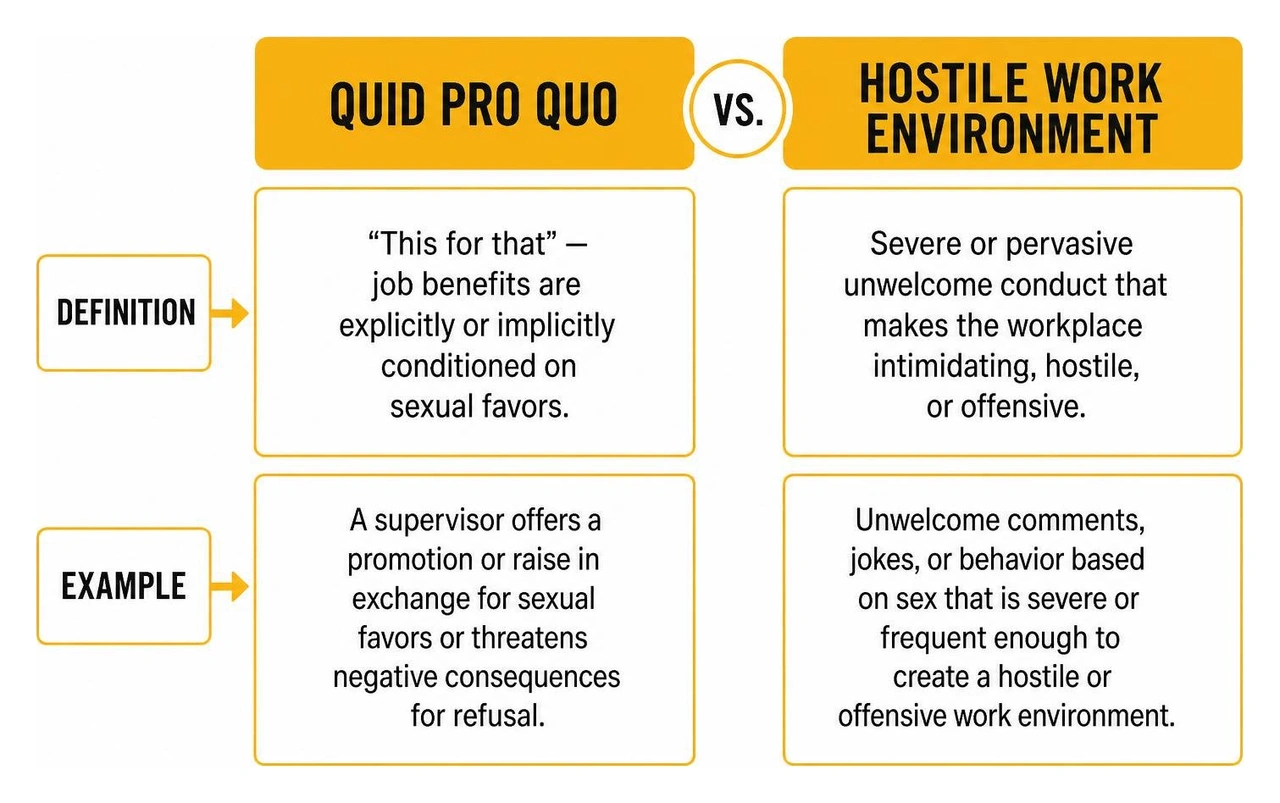
To help make this distinction simple, let's look at how these two legal concepts compare:
| Feature | Quid Pro Quo | Hostile Work Environment |
|---|---|---|
| Definition | "This for that" — job benefits are explicitly or implicitly conditioned on sexual favors. | Severe or pervasive unwelcome conduct that makes the workplace intimidating, hostile, or offensive. |
| Key Actors | Almost always a supervisor, manager, or someone with authority to hire, fire, or promote. | Can be supervisors, coworkers, subordinates, or even third parties like clients or vendors. |
| Key Requirement | A single, clear demand or threat tied to a tangible employment action (e.g., promotion or firing). | A pattern of behavior, or an extraordinarily severe single incident, that alters the terms of employment. |
| Employer Liability | Automatic liability if a supervisor carries out a tangible employment action. | Employer is liable if they knew (or should have known) about the conduct and failed to take prompt corrective action. |
For a more detailed breakdown of these concepts in plain English, you can read our comprehensive Quid Pro Quo vs Hostile Environment guide.
Proving a Hostile Work Environment
A hostile work environment claim does not require a supervisor to demand sexual favors. Instead, it involves a pattern of offensive conduct that poisons your daily work life. To prove this legally, we must satisfy both an objective and subjective standard:
- Subjective Impact: You must personally find the conduct offensive, hostile, or abusive, and it must negatively affect your work performance or mental well-being.
- Objective Standard: A reasonable person in your position must also find the environment hostile or intimidating.
The law looks at the "totality of the circumstances." This means a court will evaluate how often the conduct occurred, how severe it was, whether it was physically threatening or humiliating, and whether it unreasonably interfered with your work performance. A single off-color joke rarely meets this bar, but a continuous stream of racial slurs, sexual comments, or degrading behavior certainly does.
If you are dealing with a workplace that has become unbearable, you should read more about what constitutes this standard from a Hostile Work Environment Lawyer in Michigan.
What to Do If You Experience or Witness Workplace Harassment
If you are currently experiencing or witnessing harassment at work, taking immediate, strategic action is vital to protect your career and your legal rights. Many workers feel isolated and helpless, but you have more power than you think.
If you are witnessing a colleague go through this, you can learn how to stand by them effectively by reading our guide on How to Support a Coworker's Harassment Report.

Documenting and Preserving Evidence the Right Way
We often tell our clients: evidence wins cases. Employers almost never admit to illegal harassment or discrimination. Instead, they will claim you were fired for "performance issues" or that the incident never happened. To defeat these excuses, you must build a bulletproof paper trail.
Here is your documentation checklist:
- Write a detailed timeline: Keep a private log of every incident. Note the date, time, location, who was involved, exactly what was said or done, and any witnesses who were present.
- Save all written proof: Preserve emails, text messages, Slack or Teams chats, and direct messages.
- Keep performance documents: Save copies of your positive performance reviews, sales records, and commendation emails. If your employer suddenly claims your work is subpar after you complain, these documents will prove their excuse is a pretext.
- Keep it off company servers: Never store your personal log or forwarded evidence emails on your work computer or company cloud account. If you are suddenly terminated or locked out of your accounts, that evidence will be lost. Print them out or save them to a personal device immediately.
For a step-by-step breakdown of how to build your file, check out our guide on Documenting Harassment the Right Way.
Navigating Internal HR Reporting and Avoiding Retaliation
Before you can sue an employer for a hostile work environment, you generally must give them a reasonable opportunity to fix the problem. This means you must report the harassment internally using your company’s established complaint procedure (usually found in the employee handbook).
When you report:
- Put it in writing: Send an email so there is a permanent record of your complaint.
- Be explicit: State clearly that you are being harassed based on a protected characteristic (e.g., "I am experiencing a hostile work environment based on my sex"). If you just say "my boss is mean," HR can dismiss it as a personality conflict.
- Keep a copy: Save the sent email and any response you receive.
Many employees fear that reporting will lead directly to getting fired. However, making a good-faith report of harassment is a protected activity. If your employer demotes you, cuts your hours, writes you up, or terminates you shortly after you report, that is illegal retaliation.
To prepare yourself for this step, read our essential advice on Reporting Sexual Harassment at Work in Michigan.
Why You Need a Workplace Harassment Lawyer in Bingham Farms
Taking on an employer by yourself is incredibly difficult. Corporations have HR departments and legal teams whose primary job is to protect the company, not you.
When you hire a dedicated workplace harassment lawyer in Bingham Farms, we level the playing field. We handle the stressful communications, protect you from retaliation, and build a strategic case designed to secure the justice and financial recovery you deserve.

If you want to explore the legal landscape in our surrounding communities, you can review peer-reviewed options on the Best Employment Lawyers in Royal Oak, MI - Justia.
How a Workplace Harassment Lawyer in Bingham Farms Evaluates Your Case
When we sit down for your free consultation, we will perform a comprehensive case assessment. We look closely at the timing of events, the strength of your evidence, and whether your employer followed their own policies.
We also evaluate whether you have a claim for constructive discharge. This occurs when an employer intentionally makes your working conditions so intolerable that a reasonable person would feel forced to quit. Under the law, constructive discharge is treated as a wrongful termination, meaning you do not lose your right to sue just because you handed in your resignation.
If you are working in Southfield or surrounding areas, you can learn more about how we build these specific strategies by speaking with a Hostile Work Environment Lawyer in Southfield MI.
Choosing the Right Workplace Harassment Lawyer in Bingham Farms
You need an attorney who knows the local courts, the local judges, and the tactics commonly used by defense firms in Oakland County.
At Batey Law Firm, PLLC, we have spent nearly 30 years fighting exclusively for employees. We do not represent giant corporations; we represent real people who have been wronged. Our deep litigation experience means we are always prepared to take your case to trial if the employer refuses to offer a fair settlement.
If you want to see how we approach hostile work environments in neighboring areas, you can read more about our advocacy as a Hostile Work Environment Attorney in Royal Oak MI.
Frequently Asked Questions About Michigan Harassment Claims
What are the deadlines for filing a workplace harassment claim in Michigan?
The deadlines (statutes of limitations) depend heavily on the law you are using to sue:
- Michigan ELCRA: You have 3 years from the date of the harassment to file a lawsuit directly in state court.
- EEOC (Federal): You must file an administrative charge within 300 days of the last discriminatory act to preserve your federal claims.
- Michigan Whistleblowers' Protection Act (WPA): If you were retaliated against for reporting a suspected violation of law to a public body, you have an extremely short window of only 90 days to file a lawsuit.
- MIOSHA/OSHA: Safety-related retaliation complaints must often be filed within 30 days.
Because these deadlines are strict and waiting can result in losing your right to sue, you should contact an attorney immediately.
What remedies and damages are available to victims of workplace harassment?
If we successfully prove your workplace harassment claim, you may be entitled to significant financial recovery, including:
- Back Pay: Compensation for lost wages and benefits from the time you were terminated or forced to quit up to the date of trial.
- Front Pay: Future lost earnings if you cannot find a comparable job.
- Emotional Distress Damages: Compensation for the mental anguish, anxiety, depression, and loss of enjoyment of life caused by the harassment.
- Punitive Damages: Available in certain federal cases to punish employers who acted with malice or reckless indifference.
- Attorney’s Fees and Court Costs: The court can order your employer to pay your legal bills.
Can I sue if the harassment happened at an off-site event like a holiday party?
Yes. Your employer's duty to provide a safe, harassment-free workplace does not stop at the office door. If harassment occurs at a company-sponsored holiday party, an off-site conference, a business trip, or even via social media after hours, the employer can still be held liable.
If the conduct is reported and the employer fails to take action, they have allowed the hostile work environment to bleed into your daily work life. You can read more about these specific holiday and off-site scenarios in our guide on Holiday Parties Harassment.
Conclusion
No one should have to endure abuse, degradation, or fear just to earn a living. If you are facing a hostile work environment, sexual harassment, or retaliation, the law is on your side—and we are too.
At Batey Law Firm, PLLC, we bring award-winning, personalized representation backed by nearly 30 years of employee-side advocacy. We understand the emotional toll of workplace disputes, and we are committed to helping you reclaim your career, your dignity, and your peace of mind.
Do not wait for things to get worse. Contact us today by email at sbatey@bateylaw.com to schedule your free, confidential case evaluation.
Protect your rights with a Bingham Farms employment lawyer and let us help you take the first step toward a better future.