.png)
How a Michigan Workplace Retaliation Attorney Fights Back for You

What a Workplace Retaliation Lawyer in Michigan Can Do for You
If you need a workplace retaliation lawyer in Michigan, here is what you should know right away:
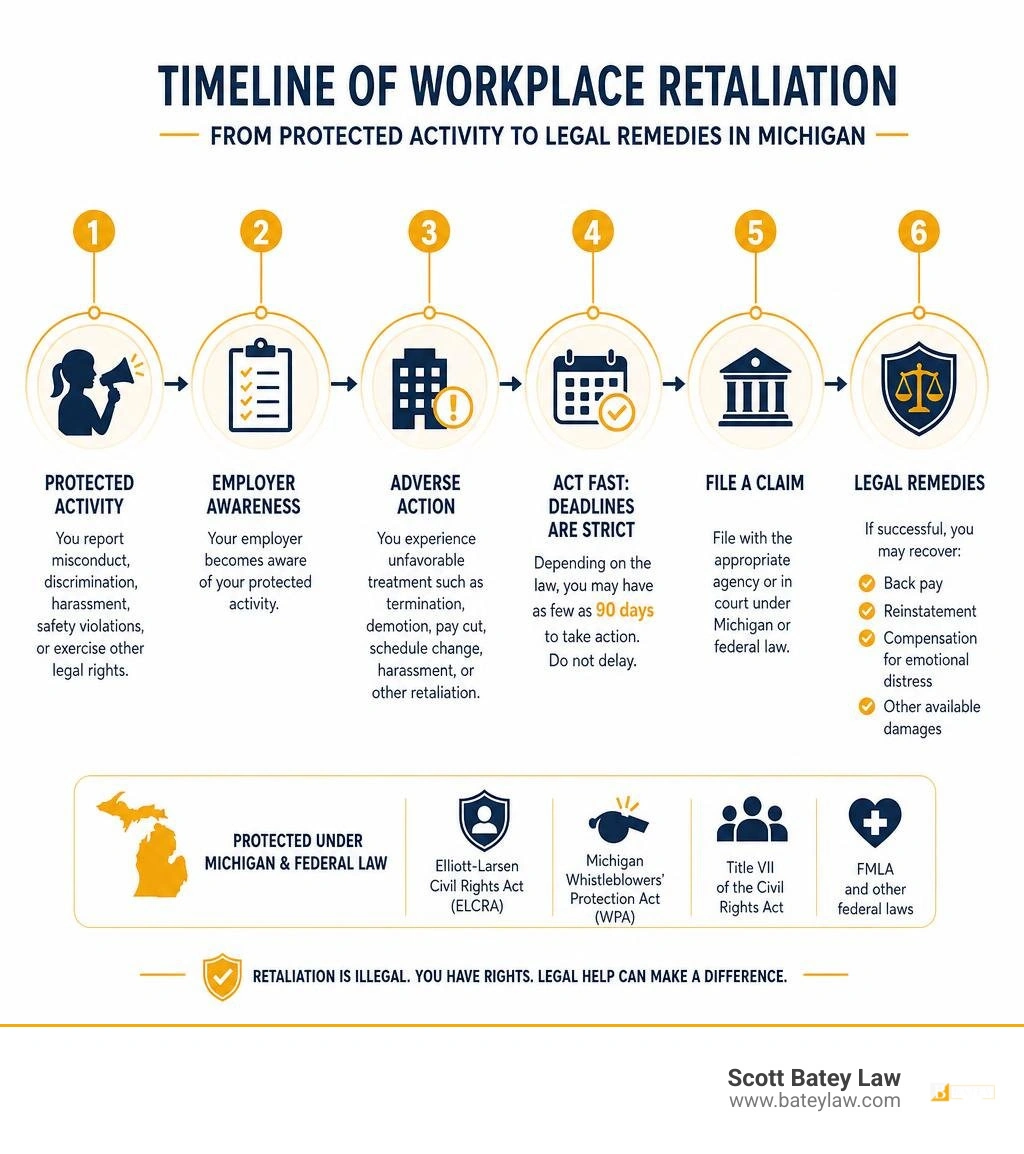
- Retaliation is illegal. Your employer cannot punish you for reporting discrimination, harassment, safety violations, or other misconduct.
- You have rights under both Michigan and federal law. Key protections come from the Elliott-Larsen Civil Rights Act (ELCRA), the Michigan Whistleblowers' Protection Act (WPA), Title VII, the FMLA, and more.
- Deadlines are strict. Depending on which law applies, you may have as few as 90 days to file.
- A retaliation lawyer can help you document your case, file with the right agency, and pursue compensation including back pay, reinstatement, and emotional distress damages.
- Most employment lawyers work on contingency — meaning no fees unless you win.
Doing the right thing at work should not cost you your job. But for many Michigan employees, speaking up about harassment, discrimination, a safety hazard, or fraud leads to exactly that — a sudden demotion, a suspicious performance review, a schedule change, or outright termination. This is workplace retaliation, and it is one of the most common employment law violations in the country. In fact, 49% of all employment claims filed between 1997 and 2018 were retaliation claims — making it the single most frequently reported workplace violation.
Michigan has more than 3.9 million workers entitled to protection from this kind of employer misconduct. Yet many employees stay silent because they fear making things worse. Others do not realize that what happened to them is actually illegal.
I'm Scott Batey, founder of Batey Law Firm, PLLC in Bingham Farms, Michigan, and I have spent nearly three decades representing employees across Michigan as a workplace retaliation lawyer in Michigan — helping workers who have been punished for doing the right thing fight back and protect their livelihoods. If you recognize your situation in any of what follows, this guide will show you exactly what your options are.
Understanding Workplace Retaliation Under Michigan and Federal Law
At its core, workplace retaliation occurs when an employer punishes an employee for exercising their legally protected rights. While Michigan is generally an "at-will" employment state—meaning an employer can fire you for any reason or no reason at all—there is a major catch. They cannot fire or punish you for an illegal reason.
Both state and federal frameworks protect you when you speak out against workplace wrongdoing. At the federal level, statutes like Title VII of the Civil Rights Act, the Americans with Disabilities Act (ADA), and the Age Discrimination in Employment Act (ADEE) contain strict anti-retaliation provisions.
In Michigan, our primary state-level protection is the Elliott-Larsen Civil Rights Act (ELCRA) (specifically MCL 37.2701(a)). Under the ELCRA, it is illegal for an employer to retaliate against you because you opposed a violation of the act, made a charge, or participated in an investigation.
Furthermore, Michigan common law recognizes strong public policy exceptions to at-will employment. An employer cannot terminate you for refusing to break the law, fulfilling a statutory duty (like jury duty), or exercising a right granted by law. When employers ignore these rules, they can be held legally accountable. To dive deeper into this topic, read our guide on retaliation after you speak up how michigan employees can protect themselves.
Sometimes, retaliation creates an environment so toxic that it crosses the line into a hostile work environment. If you are experiencing severe, pervasive pushback, understanding how these claims overlap is critical to protecting your rights and building a strong case.
Protected Activities Under State and Federal Statutes
To have a valid retaliation claim, the action you took must be considered a "protected activity." This means you were exercising a right protected by law. Common protected activities include:
- Reporting Harassment or Discrimination: Filing an internal complaint about sexual harassment, racial discrimination, or bias based on religion, national origin, age, or disability. For a step-by-step breakdown of how to navigate this safely, check out retaliation after reporting harassment the michigan employee playbook.
- Filing Wage and Hour Complaints: Demanding unpaid overtime, reporting minimum wage violations, or challenging worker misclassification. Learn more about your rights regarding a retaliation for wage complaint oakland county mi and discover how you can build leverage after a WHD complaint by reading about wage hour retaliation building leverage after a whd complaint.
- Taking Approved Leave: Requesting or taking leave under the Family and Medical Leave Act (FMLA).
- Filing for Workers' Compensation: Seeking benefits after getting injured on the job.
- Whistleblowing: Reporting suspected illegal activities, fraud, or safety violations to public bodies or regulatory agencies.
Prohibited Employer Actions That Constitute Retaliation
Many people believe retaliation only counts if you are fired. In reality, any "materially adverse" action that would discourage a reasonable worker from speaking up can qualify as illegal retaliation. This includes both obvious and subtle tactics:
| Obvious Retaliation | Subtle (But Still Illegal) Retaliation |
|---|---|
| Wrongful termination or firing | Sudden, undocumented micromanagement |
| Demotion or loss of job title | Exclusion from key team meetings and projects |
| Direct pay cuts or withholding bonuses | Transfer to an inconvenient shift or location |
| Formal written discipline or suspension | Unwarranted, sudden negative performance reviews |
| Denying a well-deserved promotion | Hostile attitude or social isolation from supervisors |
Employers often use subtle tactics to make your work life so miserable that you feel forced to quit. This is known as "constructive discharge," and legally, it is treated the same as being fired. If you believe your employer is trying to push you out, you should review your legal protections immediately to ensure you do not inadvertently waive your rights.
When to Hire a Workplace Retaliation Lawyer Michigan

If you are experiencing sudden, unfair treatment at work after speaking up, you should consult a workplace retaliation lawyer in Michigan as soon as possible. Employers have human resources departments and legal teams designed to protect the company's bottom line. You deserve an advocate whose sole job is to protect you.
Getting an attorney involved early can help you secure critical evidence, ensure your complaints are phrased in a way that maximizes your legal protections, and prevent you from making mistakes that could hurt your claim. Whether you are in Bingham Farms, Southfield, Royal Oak, or elsewhere in Oakland County, our team at Batey Law Firm, PLLC is ready to step in. You can learn more about our local advocacy by visiting our page on retaliation lawyer birmingham mi batey law firm pllc.
Common Examples of Retaliation in Michigan Workplaces
Retaliation happens in every industry, from blue-collar factories to high-level corporate offices. Real-world cases from across Michigan show just how far some employers will go:
- The Warden's Case: A prison warden opposed the sexual harassment of a colleague by an administrator. In response, the employer launched a frivolous internal investigation and demoted the warden. This led to a $438,000 jury verdict against the department.
- The Juvenile Facility Case: Multiple employees at a juvenile detention facility reported sexual abuse and opposed discriminatory practices. They faced intense retaliation, eventually securing a pre-trial settlement exceeding $1,000,000.
- The Healthcare Administrator Case: An administrator at a public health system presented internal research showing racial disparities in how security was called on visitors. Shortly after presenting this sensitive data, the administrator was terminated under the guise of "restructuring," resulting in a significant legal settlement.
- Safety Hazard Reporting: An industrial worker reports a serious machinery safety violation to MIOSHA and is suddenly suspended or given the most dangerous, miserable tasks in the shop. If you find yourself in this situation, read our specialized guide on retaliation after reporting a safety issue in michigan.
These cases demonstrate that retaliation is highly real, and the courts do hold employers financially accountable under both state and federal laws.
Choosing the Right Workplace Retaliation Lawyer Michigan
Choosing an attorney is a highly personal decision. When looking for a workplace retaliation lawyer in Michigan, keep these three criteria in mind:
- Personalized Attention: You are not a case number. You want a firm where you can speak directly with the lead attorney handling your case, not be passed around to assistants.
- Proven Trial Experience: Many employment disputes are resolved through negotiation, but your lawyer must be ready and willing to take your case to a jury if the employer refuses to offer a fair settlement.
- Contingency Fee Structure: You should not have to worry about upfront legal fees while fighting for your job. Look for a firm that operates on a "no win, no fee" basis.
At Batey Law Firm, PLLC, we bring over 25 years of award-winning, personalized representation to workers in Southfield, Royal Oak, Troy, and across the state. If you are in the Southfield area, learn how we protect your rights by visiting retaliation lawyer in southfield mi protect your rights after speaking up.
How to Prove a Retaliation Claim in Michigan
Proving retaliation requires establishing a clear link between your protected activity and the employer's adverse action. Because employers rarely admit to illegal motives, we rely on a combination of direct and circumstantial evidence to build your case.
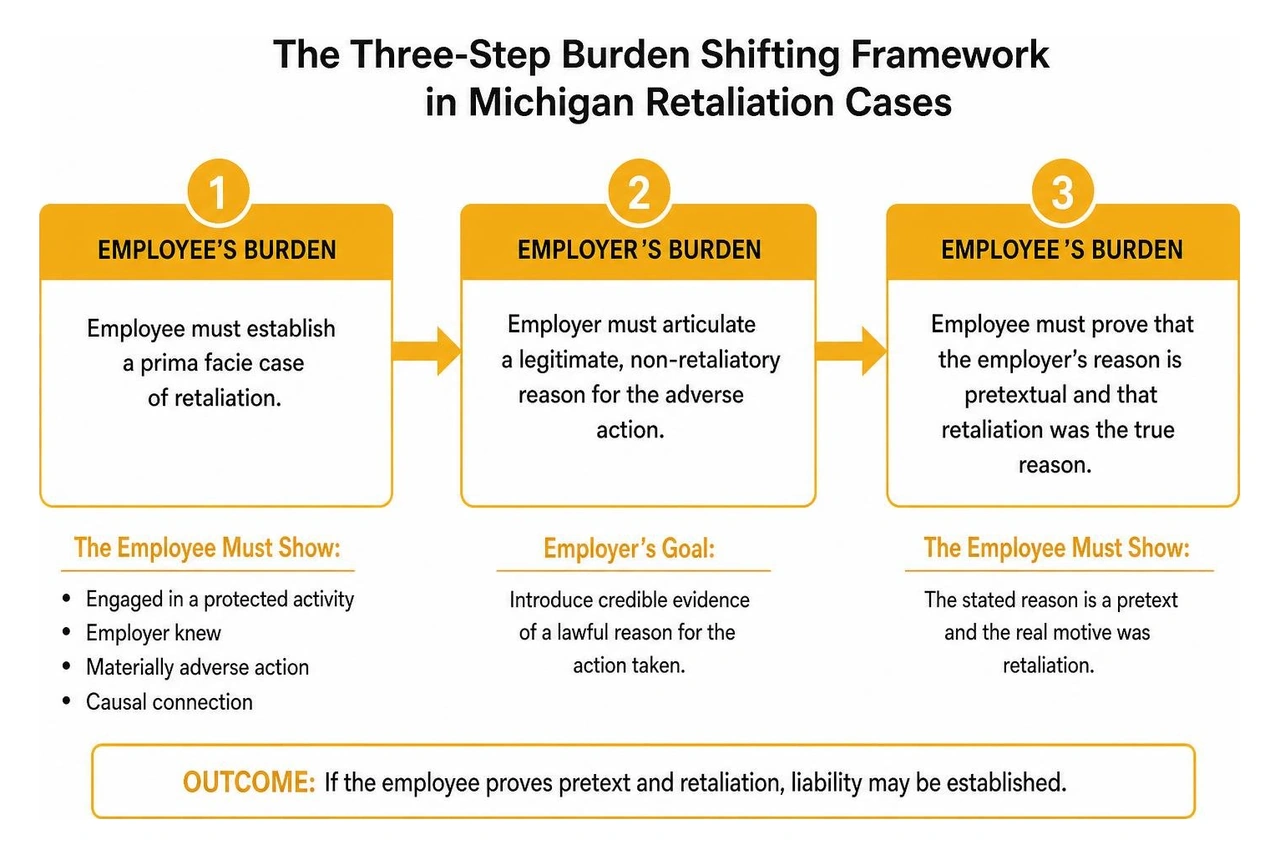
To establish a prima facie (legally sufficient) case of retaliation, we must prove four core elements:
- You engaged in a protected activity (e.g., you reported discrimination or safety issues).
- Your employer knew you engaged in this protected activity.
- Your employer took a materially adverse action against you.
- There is a causal connection between your protected activity and the adverse action.
Temporal proximity—or the timing of the events—is often the strongest circumstantial evidence we have. If you have a clean 10-year record of positive performance reviews, but receive your first-ever written warning two weeks after reporting sexual harassment, the timing strongly suggests a retaliatory motive.
How a Workplace Retaliation Lawyer Michigan Proves Your Case
When you hire us, we immediately begin gathering and preserving evidence to secure your claim. This process includes:
- Securing Digital Evidence: Retrieving emails, Slack messages, text messages, and internal memos that show a shift in management's tone or plans to target you.
- Reviewing Performance Records: Comparing your historical performance reviews and commendations against any sudden negative write-ups.
- Obtaining Witness Statements: Interviewing coworkers who observed the discriminatory behavior or witnessed supervisors treating you differently after you spoke up.
To understand how we turn workplace pushback into a powerful legal claim, read our article on retaliation lawyer in birmingham mi when workplace pushback becomes a legal claim. If you are located near our main office, you can also explore how we assist local professionals as a retaliation whistleblower lawyer in bingham farms michigan.
The Shifting Burden of Proof and Pretext
Retaliation cases that rely on circumstantial evidence are evaluated using a legal framework known as the McDonnell Douglas burden-shifting analysis.
First, we establish your prima facie case. Once we do, the burden shifts to the employer to provide a legitimate, non-retaliatory business reason for their action (such as a company-wide restructuring, budget cuts, or poor performance).
Once they offer this reason, the burden shifts back to us to prove that their stated reason is a pretext—a cover story designed to hide their true retaliatory motive. We prove pretext by showing that the employer's explanation is false, did not actually motivate the decision, or was not applied consistently to other employees in similar situations.
Critical Deadlines and Statutes of Limitations in Michigan
When it comes to employment law, time is of the essence. If you miss a filing deadline, you can lose your right to pursue legal remedies forever. In Michigan, different laws have wildly different statutes of limitations:
- EEOC Charge: To pursue a federal claim under Title VII, the ADA, or the ADEA, you must file a charge with the Equal Employment Opportunity Commission (EEOC) within 300 days of the retaliatory act.
- MDCR Complaint: Under Michigan state law, you have 180 days from the date of the discrimination or retaliation to file a complaint with the Michigan Department of Civil Rights (MDCR) .
- EEOC Lawsuit Window: Once the EEOC completes its investigation and issues a "Notice of Right to Sue," you have exactly 90 days to file a federal lawsuit.
- General State Lawsuit: For general employment and retaliatory discharge claims under the Elliott-Larsen Civil Rights Act, you have 3 years to file a lawsuit in Michigan state court.
To make sure you do not miss these critical windows, read our detailed breakdown of the michigan whistleblowers protection act deadlines remedies proof.
The 90-Day Whistleblower Window and Other Strict Timelines
Some of the most protective laws have the shortest deadlines. Under the Michigan Whistleblowers' Protection Act (WPA), which protects employees who report suspected violations of the law to a public body, you have a highly strict 90-day window to file a lawsuit. If you wait until day 91, your claim is barred. You can read more about avoiding this trap at michigan wpa deadlines remedies dont miss the 90 day window.
Additionally, if you are retaliated against for reporting workplace safety issues to MIOSHA, you have only 30 days to file a complaint with the agency. Learn the fundamentals of these fast-moving cases by reading about retaliation after reporting a safety issue miosha basics for employees. If you need immediate assistance with a whistleblower claim in our home office area, contact a whistleblower attorney bingham farms.
What to Do If You Suspect Workplace Retaliation
If you suspect your employer is starting to retaliate against you, taking the right steps immediately can protect your career and strengthen your future legal claim.

- Do Not Resign Prematurely: Quitting voluntarily makes it much harder to claim lost wages or prove wrongful termination. Unless you are in physical danger or the environment is completely intolerable, consult with an attorney before making any major career decisions.
- Report the Retaliation Internally: If your company has an HR department or an established complaint process, report the retaliatory behavior in writing. This puts the employer on notice and creates a formal paper trail.
- Keep Your Complaints in Good Faith: You do not have to prove that the underlying issue you complained about was actually illegal, but you must have a sincere, good-faith belief that it was.
Step-by-Step Guide to Documenting Misconduct
To build a solid foundation for your case, follow this documentation strategy:
- Keep a Private Journal: Write down the dates, times, locations, and details of every retaliatory incident. Note who was present and what was said.
- Save Your Documents Safely: Keep copies of your performance reviews, emails, and text messages. Do not store these on company-owned servers or devices, as your access can be cut off instantly upon termination. Forward them to a personal email or save them to a personal device (while ensuring you do not violate valid company data privacy policies).
- Create a Chronological Timeline: Map out your employment history, the exact date you engaged in a protected activity, and the exact dates your employer's behavior shifted.
- Consult Legal Counsel Immediately: Let an experienced attorney evaluate your timeline and guide your next steps.
If you are in the Birmingham area, you can learn more about our specialized services at retaliation whistleblower lawyer birmingham mi. For those closer to our main office, check out our guide on working with a retaliation lawyer in bingham farms mi.
Frequently Asked Questions About Workplace Retaliation
Is it still retaliation if my underlying complaint is not upheld?
Yes. As long as you made your original complaint about discrimination, harassment, or illegal activity in good faith, you are legally protected from retaliation. Even if an HR investigator or a government agency ultimately determines that no discrimination occurred, your employer still cannot punish you for speaking up.
Am I protected if I was retaliated against for helping a coworker?
Absolutely. Both Michigan and federal laws protect third parties. Under the ELCRA's "participation clause," you are protected if you assisted, testified, or served as a witness in a colleague's discrimination or harassment claim. Employers cannot legally target you, nor can they retaliate against your close family members or associates who work at the same company.
What damages and remedies can I recover in a retaliation lawsuit?
If you win your retaliation case, you may be entitled to significant financial compensation and equitable remedies, including:
- Back Pay: Compensation for wages, benefits, and bonuses you lost from the date of the retaliation or termination up to the date of your trial.
- Front Pay: Compensation for future lost earnings if reinstatement is not possible or practical.
- Reinstatement: Getting your original job or an equivalent position back.
- Emotional Distress Damages: Compensation for the mental anguish, stress, anxiety, and loss of enjoyment of life caused by the employer's behavior.
- Punitive Damages: Awarded in egregious cases under federal law to punish the employer and deter future misconduct.
- Attorney's Fees and Court Costs: Forcing the employer to pay for your legal representation.
In addition to employment-specific claims, severe workplace accidents can sometimes lead to massive liability settlements. For example, our legal community has seen landmark results like a $2,737,000 industrial accident premiere liability and products settlement. To understand the full scope of remedies available under state whistleblower laws, explore our resource on michigan whistleblowers protection act deadlines remedies proof.
Conclusion
No one should have to choose between keeping their job and doing what is right. If your employer has retaliated against you for speaking up, they have broken the law—and we are here to hold them accountable.
At Scott Batey Law (Batey Law Firm, PLLC), we provide award-winning, personalized representation backed by more than 25 years of experience fighting for Michigan workers. Based in Bingham Farms, we proudly represent clients throughout Southfield, Birmingham, Royal Oak, Detroit, and Oakland County.
Do not let fear silence you, and do not navigate this complex legal landscape alone. Contact us today to schedule a free, confidential consultation to evaluate your case and discuss your options.