
Fighting Back: Your Guide to Michigan Employment Retaliation Laws

What Is Workplace Retaliation in Michigan — and Do You Have a Case?
Workplace retaliation in Michigan occurs when an employer punishes an employee for doing something the law protects — like reporting discrimination, filing a complaint, or cooperating with an investigation.
Here is what you need to know at a glance:
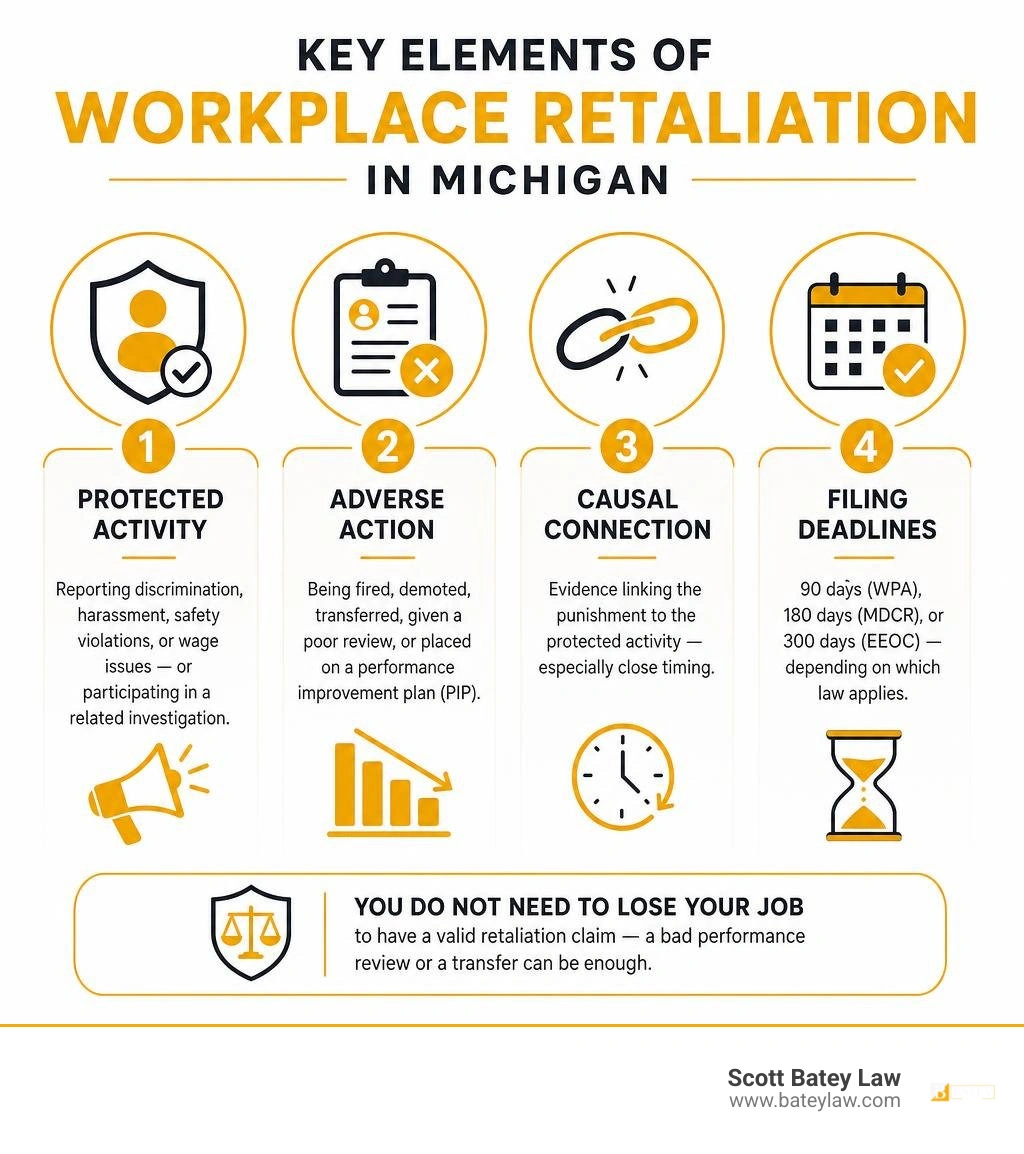
- Protected activity: Reporting discrimination, harassment, safety violations, or wage issues — or participating in a related investigation
- Adverse action: Being fired, demoted, transferred, given a poor review, or placed on a performance improvement plan (PIP)
- Causal connection: Evidence linking the punishment to the protected activity — especially close timing
- Key laws: Michigan's Elliott-Larsen Civil Rights Act (ELCRA), the Whistleblowers' Protection Act (WPA), and federal Title VII
- Filing deadlines: 90 days (WPA), 180 days (MDCR), or 300 days (EEOC) — depending on which law applies
- You do NOT need to lose your job to have a valid retaliation claim — a bad performance review or a transfer can be enough
Retaliation is one of the most common and misunderstood workplace legal claims. Many employees don't realize they're protected until it's too late — or they assume they need to be fired before they can take action. Neither is true.
As long as your complaint was made in good faith, the law protects you from retaliation even if the underlying complaint was not upheld.
I'm Scott Batey, a Michigan employment attorney who has spent nearly 30 years representing employees facing workplace retaliation in Michigan, from wrongful termination to subtle forms of punishment like sudden poor evaluations and unexplained reassignments. This guide walks you through your rights, the law, and exactly what to do if you believe your employer is retaliating against you.
Understanding Workplace Retaliation Michigan Laws vs. Discrimination

To protect yourself in the workplace, it is vital to understand the difference between discrimination and retaliation. Discrimination occurs when an employer treats you poorly because of a protected characteristic — such as your race, sex, age, religion, disability, height, weight, or marital status.
Retaliation, on the other hand, is a completely separate legal claim. It occurs when an employer punishes you specifically because you stood up for your civil rights or reported a violation of the law.
In many cases, an employee might experience discrimination or sexual harassment, file an internal complaint, and then face immediate hostility, a sudden demotion, or termination. Even if a court ultimately finds that the underlying discrimination did not technically violate the law, the employer can still be held fully liable for retaliation. You can learn more about retaliation after reporting harassment to understand how these two legal concepts interact in practice.
In Michigan, your rights are protected by both federal and state laws. Federally, Title VII of the Civil Rights Act of 1964 prohibits retaliation. On the state level, the Elliott-Larsen Civil Rights Act (ELCRA) serves as our primary shield against workplace injustice. ELCRA is often more powerful than federal law because it applies to a broader range of employers and covers additional protected classes.
What Constitutes Workplace Retaliation Michigan Employees Face?
Under Michigan law, proving a retaliation claim requires establishing three core components. If any of these elements are missing, your claim may not hold up in court:
- Protected Activity: You must have engaged in an action protected by law, such as reporting sexual harassment, complaining about unpaid overtime, or cooperating as a witness in an civil rights investigation.
- Adverse Employment Action: Your employer must have taken a negative action against you that would deter a reasonable worker from speaking up.
- Causal Connection: You must show a direct link between your protected activity and the negative action. This is often established through highly suspicious timing or sudden changes in managerial behavior.
For a detailed breakdown of how these three elements function under state law, you can read our guide on How to Prove Workplace Retaliation in Michigan.
Protected Activities Under ELCRA and Federal Law
The law divides protected activities into two main categories:
- The Opposition Clause: This protects you when you oppose discriminatory practices. Examples include submitting a written complaint to HR, verbally protesting sexual harassment, or refusing to carry out an order that you reasonably believe is discriminatory.
- The Participation Clause: This protects you when you take part in formal legal proceedings. This includes filing a charge with the Equal Employment Opportunity Commission (EEOC), testifying in a deposition, or acting as a witness.
Importantly, you do not have to be the victim of the harassment to be protected. If you act as a witness or support a coworker who is being targeted, your participation is fully protected. You can read about how to support a coworker’s harassment report – without risking retaliation to learn how to stand up for your colleagues safely.
Furthermore, these protections apply as long as your complaint was made in good faith. Even if an internal investigation concludes that no harassment occurred, your employer cannot punish you for raising the issue, provided you had a sincere and reasonable belief that a violation took place.
What Employer Actions Are Considered Retaliatory?
Many workers mistakenly believe that an employer must fire them for it to count as retaliation. In reality, the law covers a wide range of retaliatory behaviors. The U.S. Supreme Court set the benchmark in Burlington Northern & Santa Fe Railway Co. v. White, establishing that a retaliatory action is illegal if it is "materially adverse" — meaning it would dissuade a reasonable worker from making or supporting a charge of discrimination.
Retaliation can take many forms, including:
- Demotions or pay cuts
- Involuntary transfers to less desirable shifts or geographic locations
- Exclusion from key team meetings or training opportunities
- Sudden, unjustified negative performance evaluations
- Being placed on a Performance Improvement Plan (PIP)
- Hostile micro-behaviors, such as sudden isolation or verbal abuse by management
These protections also extend to other areas of employment law. For instance, if you take job-protected medical leave and return to find your duties stripped away, you should find out about FMLA retaliation to see how these protections apply to medical leave.
The 'Materially Adverse' Standard and White v. Department of Transportation
For nearly two decades, Michigan workers faced an unfair hurdle in state courts. Under a 2003 ruling (Peña v. Ingham County Road Commission), Michigan courts incorrectly required plaintiffs to show direct economic or monetary loss to establish a retaliation claim. This meant employers could make an employee's life miserable through harassment, terrible schedules, or bad reviews, and the employee had no legal recourse as long as their salary remained the same.
Fortunately, the Michigan Court of Appeals corrected this 17-year legal error in the landmark 2020 case, White v. Department of Transportation. In White, the court officially aligned Michigan's ELCRA standard with the federal "materially adverse" standard.
The court ruled that non-monetary punishments — such as being placed on a PIP, receiving a sudden poor evaluation, or being transferred to a different office — are indeed materially adverse actions that a jury should evaluate. This decision was a massive victory for Michigan workers, ensuring that employers can no longer hide behind "non-economic" punishments to force employees out.
Wage and Safety Complaint Protections
Retaliation protections also cover wage disputes and safety reports. If you complain about unpaid overtime, off-the-clock work, or safety hazards, your employer cannot punish you.
Under Michigan's Prevailing Wages on State Projects Act (Act 10 of 2023), which went into effect on February 13, 2024, workers on state-funded construction projects have powerful protections. According to the MCL 408.1119 Statute, if an employer removes a worker from a project or cuts their hours after they complain about prevailing wages, there is a rebuttable presumption of retaliation. This shifts the burden of proof directly onto the employer to prove they had a legitimate, non-retaliatory reason for their actions. However, workers must act quickly, as complaints under this act must be filed with the commissioner within 90 days of the retaliatory act.
For more information on your rights regarding wage disputes, you can access more info on wage theft retaliation. If you have reported safety issues to management or MIOSHA, you can read more info on safety issue retaliation.
Landmark Expansions: Third-Party and Associational Retaliation
Can an employer punish you to get back at someone else? For example, if your spouse or close friend at work files a discrimination complaint, can your boss fire you as a way to punish them?
This is known as third-party or associational retaliation, and it is one of the fastest-growing areas of Michigan employment law.
How Miller v. Department of Corrections Expanded Protections
In a groundbreaking decision on May 10, 2024, the Michigan Supreme Court officially recognized third-party retaliation claims under the ELCRA in Miller v. Department of Corrections. You can read the MSC Miller v. MDOC Opinion to examine the court's complete reasoning.
In this case, two state corrections officers were terminated following a "sham" internal investigation. They argued they were actually fired because of their close friendship with a supervisor who had supported his wife's racial harassment lawsuit against the department. The Michigan Supreme Court ruled that ELCRA’s anti-retaliation provision (MCL 37.2701(a)) protects close associates and friends from being targeted as indirect punishment. The court recognized that a reasonable worker would easily be deterred from opposing discrimination if they knew their close friends or family members would be fired in response.
This ruling reversed a more restrictive decision by the Court of Appeals. To see the historical context of how this case progressed through the state judiciary, you can read the COA Miller v. MDOC Opinion.
Proving Third-Party Workplace Retaliation Michigan Claims
While the Miller decision opened the door for associational claims, proving them requires meeting specific standards. Under ELCRA, there are two primary pathways for third-party claims:
- MCL 37.2701(a): This protects close associates (such as spouses, fiancés, or very close friends) who are targeted by an employer seeking to punish the primary whistleblower. This aligns Michigan law with the federal standard established by the U.S. Supreme Court in Thompson v. North American Stainless.
- MCL 37.2701(f): This protects individuals who "aided or encouraged" another person in asserting their civil rights. If you actively helped a coworker write their HR complaint or provided advice, you are protected under this specific subsection.
If you are bringing an associational claim based purely on friendship under subsection (a), you must show that your relationship was close enough that your termination would naturally deter the whistleblower from exercising their rights.
How to Prove Retaliation: Timing, Pretext, and Evidence
Proving workplace retaliation in Michigan rarely involves a "smoking gun" admission where a manager says, "I am firing you because you complained." Instead, we build most successful cases using circumstantial evidence.
To help you understand how courts evaluate these claims, you can read about protecting yourself after speaking up.
The Role of Temporal Proximity (Timing)
The time gap between your protected activity and your employer's negative action is often the most critical piece of circumstantial evidence.
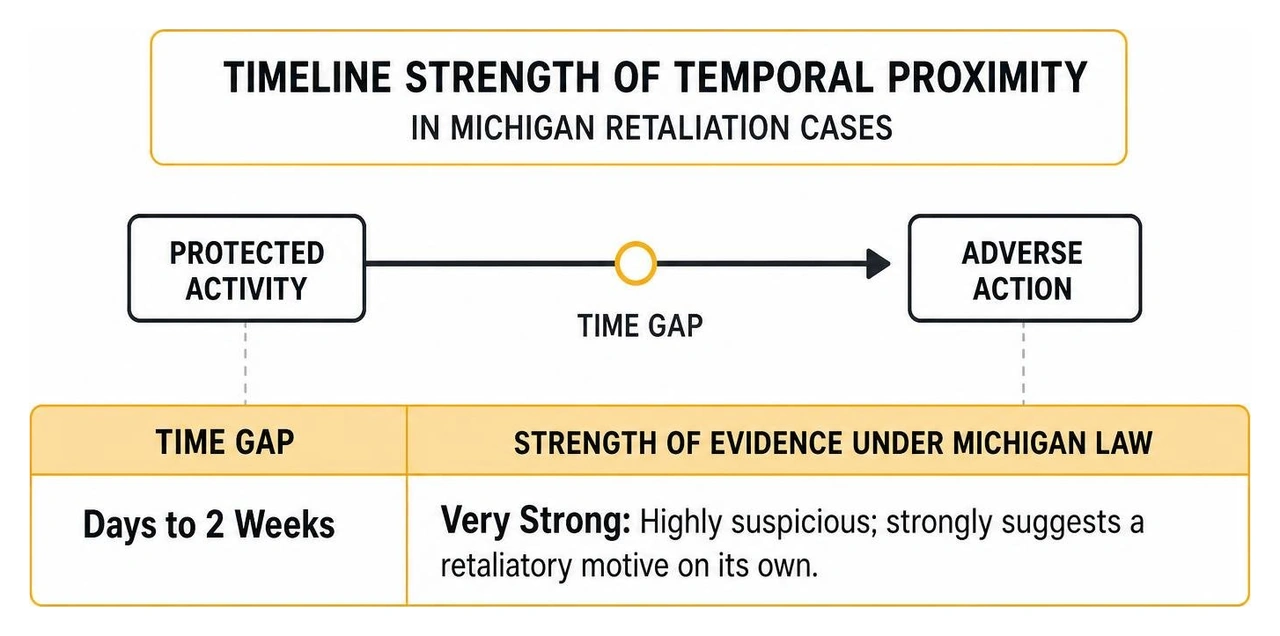
Michigan courts generally evaluate the strength of timing evidence using the following temporal proximity guidelines:
| Time Gap | Strength of Evidence under Michigan Law |
|---|---|
| Days to 2 Weeks | Very Strong: Highly suspicious; strongly suggests a retaliatory motive on its own. |
| 2 Weeks to 1 Month | Strong: Highly supportive, but requires some additional corroborating facts. |
| 1 to 3 Months | Moderate: Helpful to the case, but insufficient on its own without other evidence. |
| 3 to 6 Months | Weak: Rarely enough to prove causation without significant supporting evidence. |
| 6+ Months | Insufficient: Legally weak; requires independent proof of ongoing hostility or pretext. |
Overcoming Employer Defenses and Showing Pretext
Once we establish a basic case of retaliation, your employer will likely try to defend themselves by claiming you were disciplined for a legitimate, non-retaliatory reason — such as poor performance, tardiness, or company restructuring.
To win, we must show that the employer's stated reason is a pretext (a legal term for a lie or cover-up). We can prove pretext by demonstrating that:
- Shifting Explanations: The employer keeps changing their story about why you were disciplined.
- Disparate Treatment: Other employees who did not complain committed the same minor infractions but faced no disciplinary action.
- Departure from Standard Procedures: The company bypassed its own progressive discipline policy (e.g., firing you immediately instead of issuing a standard verbal warning).
- Inconsistent Documentation: You received glowing performance reviews for years, only to receive your first-ever negative review days after filing a complaint.
For insights on building leverage during wage-related disputes, you can access more info on wage and hour retaliation leverage.
Filing Deadlines and Legal Pathways: EEOC vs. MDCR vs. Court
If you have experienced retaliation, you have several legal pathways. However, you must navigate strict deadlines and procedural rules. Missing a deadline can completely bar you from seeking justice.
For a comparison of how different state-level whistleblower protections operate, you can find more info on Whistleblowers' Protection Act deadlines.
EEOC (300 Days) vs. MDCR (180 Days) Deadlines
Before you can file a federal lawsuit under Title VII, you must exhaust your administrative remedies by filing a charge with a government agency:
- EEOC (Federal): You have 300 days from the date of the retaliatory act to file a charge. On average, it takes the EEOC about 10 months to investigate a charge of discrimination or retaliation.
- MDCR (State): You have 180 days from the incident to file a complaint. Unlike the EEOC, the MDCR requires your formal complaint to be physically signed in front of a notary public before they will officially begin their investigation.
Because the EEOC and MDCR maintain a work-sharing agreement, filing a complaint with one agency generally dual-files it with the other, protecting your rights under both state and federal law.
Filing an Agency Complaint vs. Filing a Lawsuit in Court
Under Michigan’s ELCRA, you do not have to go through an administrative agency first; you have the right to file a lawsuit directly in state court. The statutory deadline to file an ELCRA lawsuit in court is 3 years from the date of the retaliatory action.
Warning: Many employers sneak clauses into employee handbooks, job applications, or employment contracts that legally shorten this 3-year filing window to as little as 180 days, or require you to resolve all disputes through mandatory arbitration instead of a jury trial. It is vital to have an experienced attorney review your employment documents immediately to ensure you do not miss a shortened deadline.
Frequently Asked Questions about Michigan Retaliation
Is it still retaliation if my original discrimination complaint is not upheld?
Yes. As long as you made your complaint in good faith and with a reasonable belief that discrimination or harassment was occurring, you are fully protected. The law recognizes that employees should not be afraid to speak up out of fear that they might be punished if an investigator ultimately sides with the employer.
What remedies and damages are available to retaliation victims in Michigan?
If you win a retaliation lawsuit, you may be entitled to significant financial remedies, including:
- Back Pay: Compensation for lost wages and benefits from the date of your termination up to the date of trial.
- Front Pay: Compensation for future lost earnings if reinstatement is not possible.
- Reinstatement: Getting your old job back (though this is rare due to ongoing workplace tension).
- Compensatory Damages: Compensation for emotional distress, anxiety, depression, and damage to your professional reputation.
- Attorney’s Fees and Court Costs: In many civil rights cases, the court can order the employer to pay your legal fees.
What immediate steps should I take if I suspect workplace retaliation?
If you believe your employer is pushing you out or punishing you for speaking up, take these steps immediately:
- Document Everything: Keep a detailed, chronological personal journal of every interaction, meeting, and comment. Note the dates, times, who was present, and exactly what was said.
- Preserve Communications: Save copies of text messages, emails, and voicemails. Do not download proprietary company data, but do preserve personal performance reviews, emails where you raised concerns, and messages showing changes in how you were treated.
- Keep Your Records Off Company Devices: Back up your personal journal and evidence to a secure personal device or personal email. If you are suddenly fired, you will lose access to your work computer and company email accounts instantly.
- Do Not Post on Social Media: Avoid posting anything about your workplace, your boss, or your legal concerns online, as employers will use these posts against you in court.
- Contact an Employment Attorney: Speak with an experienced attorney before signing any severance packages, performance improvement plans, or liability releases.
Conclusion
Facing workplace retaliation is incredibly stressful. You stood up for what was right, only to find your job, your career, and your reputation placed at risk. You do not have to fight this battle alone.
At Scott Batey Law, we provide award-winning, personalized representation backed by nearly 30 years of experience. From our office in Bingham Farms, we represent workers throughout Oakland County, Detroit, Southfield, Royal Oak, and across Michigan. We understand the tactics employers use to cover up retaliation, and we know how to build the strong, evidence-backed cases required to hold them accountable.
If you are facing workplace pushback, unfair treatment, or wrongful termination, Contact a Retaliation Lawyer in Birmingham, MI today to schedule a confidential consultation. Let us help you protect your rights, your livelihood, and your future.