.png)
How a Michigan Workplace Lawyer Protects Your Hard-Earned Rights

What a Workplace Rights Lawyer in Michigan Can Do for You
If you're looking for a workplace rights lawyer in Michigan, here's what you need to know right away:
Quick answers to the most common questions:
| Your Situation | What You Should Know |
|---|---|
| Wrongful termination | Michigan is at-will, but illegal firings still happen — you may have a case |
| Discrimination or harassment | Protected under both Michigan's Elliott-Larsen Civil Rights Act and federal law |
| Unpaid wages or overtime | Michigan minimum wage is $10.10/hr — wage theft is actionable |
| Retaliation for reporting | Nearly 49% of all employment claims involve retaliation — you have strong legal protections |
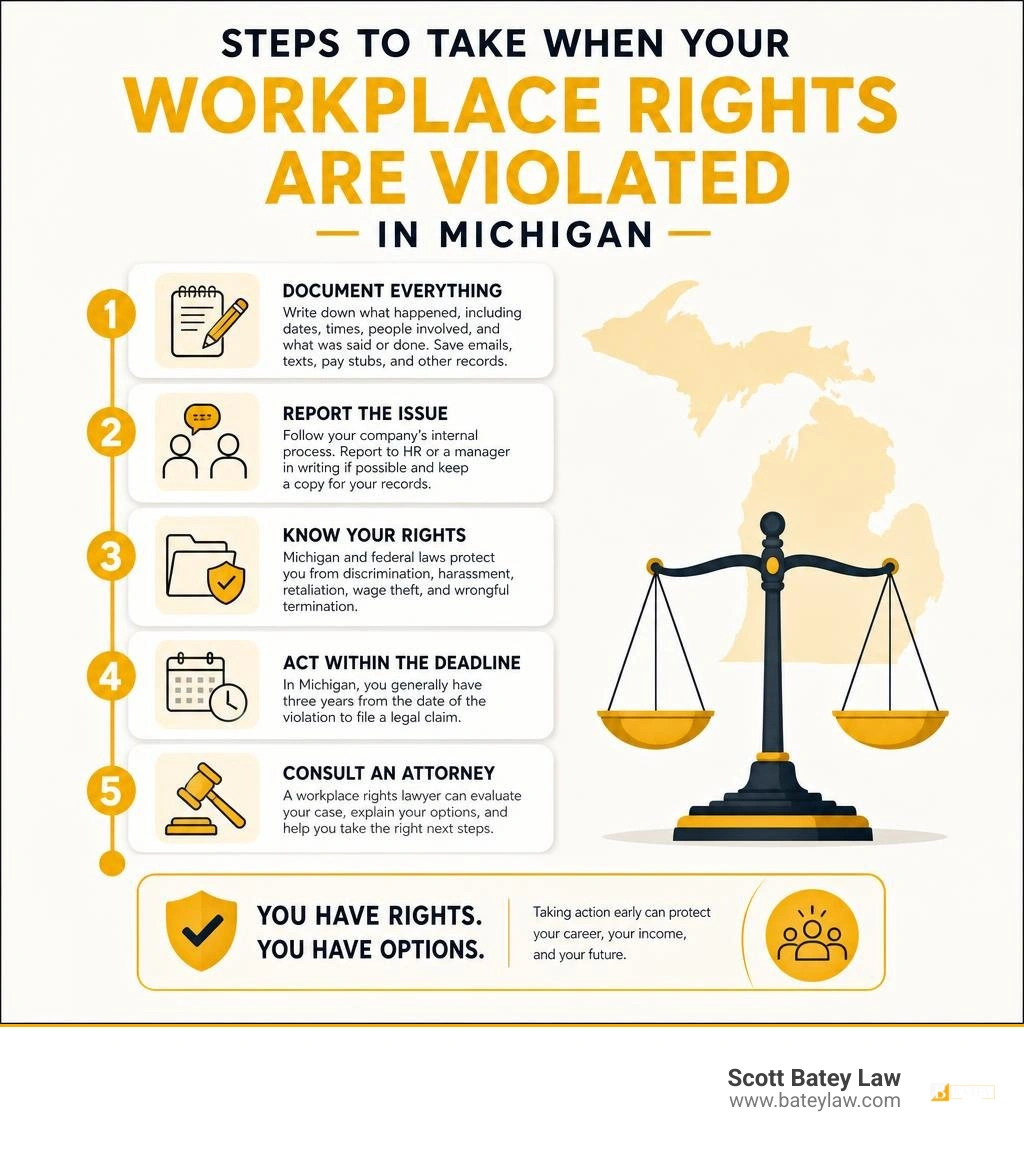
| Deadline to file | You generally have three years from the date of the violation in Michigan |
Michigan has over 3.9 million workers. And every day, some of them face situations that feel impossible: a sudden termination with no explanation, a paycheck that's short, a manager who makes the workplace unbearable, or a demotion that happens right after they complained about something wrong.
Most people don't know whether what happened to them is actually illegal. That uncertainty — combined with fear of making things worse — stops many workers from ever finding out what their rights really are.
The truth is that even though Michigan is an "at-will" employment state, many strong state and federal laws protect workers from discrimination, wage theft, harassment, and retaliation. Knowing those laws — and acting quickly — can make all the difference.
I'm Scott Batey, and as a workplace rights lawyer in Michigan with nearly 30 years of experience representing employees at Batey Law Firm, PLLC in Bingham Farms, I've helped workers across Michigan navigate wrongful termination, discrimination, retaliation, FMLA disputes, and more. This guide walks you through everything you need to know to protect yourself.
Common Workplace Rights Violations in Michigan

Every day, hardworking Michiganders go to work expecting to be treated fairly, paid accurately, and kept safe. Unfortunately, workplace violations are incredibly common. When employers prioritize their bottom line over their workers' well-being, the consequences can be devastating.
If you suspect your employer has crossed the line, partnering with a Michigan Employment Lawyer for Employees is the best way to understand your options and hold them accountable. Below are the most frequent violations we see in our practice.
Employment Discrimination and Harassment
Discrimination and harassment remain persistent issues in modern workplaces. In Michigan, employees are protected by a robust web of state and federal laws. Chief among these is the Elliott-Larsen Civil Rights Act (ELCRA), which works alongside federal protections like Title VII of the Civil Rights Act of 1964.
Under these laws, it is illegal for an employer to make employment decisions—such as hiring, firing, promotions, or pay—based on protected characteristics. These include:
- Race, color, and national origin
- Religion
- Sex, gender identity, and pregnancy
- Age and disability
- Marital status and familial status
Michigan also has several unique protections that go beyond standard federal laws. For example, the ELCRA explicitly prohibits discrimination based on height and weight. Additionally, following a landmark Michigan Supreme Court ruling, discrimination based on sexual orientation is officially prohibited under the ELCRA.
More recently, Michigan passed the CROWN Act, which bans discrimination based on hair texture and protective hairstyles historically associated with race. If you believe you have faced unfair treatment due to any of these protected traits, consulting an ELCRA Discrimination Lawyer in Michigan can help you determine if your employer violated state civil rights laws.
Wage Theft and Employee Misclassification
Wage theft occurs in many forms, and it is not always as obvious as an employer refusing to hand over a paycheck. Often, it happens quietly behind the scenes.
One of the most widespread issues we handle is employee misclassification. With the rise of the modern gig economy, some employers try to shift their tax and expense burdens onto workers by labeling them as "independent contractors" instead of "W-2 employees."
By misclassifying you, an employer avoids paying payroll taxes, providing workers' compensation, offering benefits, and paying overtime. Whether you are an employee or an independent contractor is determined by the actual control the employer has over your job duties, not by the label they put on your contract.
Other common wage violations include:
- Off-the-clock work: Forcing you to perform tasks before clocking in or after clocking out (such as cleaning up, attending meetings, or waiting for security checks).
- Overtime exemptions: Misclassifying hourly workers as "exempt salaried employees" based solely on a fancy job title to avoid paying them time-and-a-half.
- Illegal deductions: Taking money out of your paycheck for business expenses, uniform costs, or cash register shortages.
If you are not receiving the pay you earned, a Wage Overtime Lawyer Metro Detroit can audit your pay stubs, track your actual hours worked, and fight to recover your unpaid wages.
Understanding State and Federal Labor Protections
Navigating the intersection of state and federal labor laws can be confusing. Some regulations overlap, while others offer entirely different levels of protection. In Michigan, employees enjoy the benefits of both federal standards and state-specific laws, with the rule of thumb being that whichever law provides the greater protection to the employee is the one that applies.
| Legal Category | Federal Protections | Michigan State Protections |
|---|---|---|
| Minimum Wage | $7.25 per hour (FLSA) | $10.10 per hour (for most employees) |
| Tipped Minimum Wage | $2.13 per hour | $3.84 per hour (tips must bring total to at least $10.10/hr) |
| Overtime Pay | 1.5x regular rate for hours over 40/week | Follows federal 40-hour threshold (no single-day overtime) |
| Civil Rights | Title VII (Race, Sex, Religion, Age, etc.) | ELCRA (Adds height, weight, marital status, and sexual orientation) |
| Medical Leave | FMLA (Up to 12 weeks unpaid leave for eligible workers) | Paid Medical Leave Act (Requires paid sick time for eligible employers) |
Under federal law, the Fair Labor Standards Act (FLSA) establishes the baseline for minimum wage and overtime, while the Family and Medical Leave Act (FMLA) grants eligible employees up to 12 weeks of unpaid, job-protected leave for specific family and medical reasons.
However, Michigan's state laws often provide stronger safeguards. For instance, the Michigan Supreme Court revived voter-initiated minimum wage and sick leave laws, signaling a continued push for stronger worker protections.
Despite these protections, most employees without a union or individual contract are considered "at-will" employees. This means either you or your employer can terminate the employment relationship at any time, with or without notice, and for any reason—or no reason at all.
However, there are critical limits to this rule. Your employer cannot fire you for an illegal reason, such as discrimination, reporting safety violations to MIOSHA, or refusing to participate in illegal activities. Understanding the At Will Employment Exceptions in Michigan is vital if you suspect your termination was unlawful.
The Three-Year Statute of Limitations in Michigan
When your workplace rights are violated, time is of the essence. You cannot wait indefinitely to take legal action. In Michigan, the statute of limitations for filing most employment law claims—including wage disputes and civil rights violations under the ELCRA—is generally three years from the date of the violation.
While three years might sound like a long time, building a successful case requires extensive preparation. Over time, physical evidence can disappear, digital records like emails can be auto-deleted, and witnesses' memories will inevitably fade.
Furthermore, some administrative claims, such as those filed with the Equal Employment Opportunity Commission (EEOC) or the Michigan Department of Civil Rights (MDCR), have much shorter deadlines—often 180 or 300 days from the date of the discriminatory act.
Additionally, a crucial Michigan Supreme Court ruling limited the ability of employers to contractually shorten these limitations periods in employment contracts. This was a massive win for workers, but you must still act quickly to preserve your rights. If you have been terminated, consulting an attorney about Wrongful Discharge Michigan immediately will ensure you do not miss critical filing deadlines.
When and How to Partner with a Workplace Rights Lawyer in Michigan
Many employees hesitate to contact a lawyer because they believe they can resolve the issue internally through their company’s Human Resources (HR) department. While it is often necessary to report issues internally to trigger certain legal protections, it is vital to remember one basic truth: HR works for the employer, not for you. Their primary goal is to protect the company from legal liability, not to secure your best interests.
In fact, contacting a lawyer before you alert HR or a government agency is often the smartest move. Unscrupulous employers have been known to scrub email servers, delete phone messages, and alter personnel files once they realize they are under investigation.
An experienced attorney can help you quietly gather and preserve electronic records, performance reviews, and witness statements before the company has a chance to cover its tracks. If you are facing a hostile work environment or unfair treatment, finding an Employment Lawyer Near Me - Bingham Farms MI will give you a dedicated advocate who can help you strategize your next steps safely.
Key Qualities of a Top Workplace Rights Lawyer in Michigan
Choosing the right legal advocate is one of the most important decisions you will make for your career and financial security. When evaluating potential attorneys, look for the following key qualities:
- Contingency Fee Structure: The best employment lawyers represent workers on a contingency fee basis. This means you pay no upfront legal fees, and your attorney only gets paid if they successfully recover compensation for you through a settlement or court verdict.
- Deep Trial Experience: Some lawyers prefer to settle every case quickly, even if it means accepting a lower payout. You want an attorney with a proven track record of taking cases to trial and winning. Employers know which law firms are willing to fight in court, and they offer higher settlements to avoid facing them.
- Personalized Attention: Your career and livelihood are highly personal. Avoid "bill mill" law firms where your case is passed down to a paralegal or junior associate. You deserve direct, responsive communication with the lead attorney handling your case.
If you are looking for local representation in Oakland County, reviewing directories of the Best Employment Lawyers in Oak Park, MI can help you identify highly-rated advocates who specialize in protecting employee rights.
How a Workplace Rights Lawyer in Michigan Recovers Your Damages
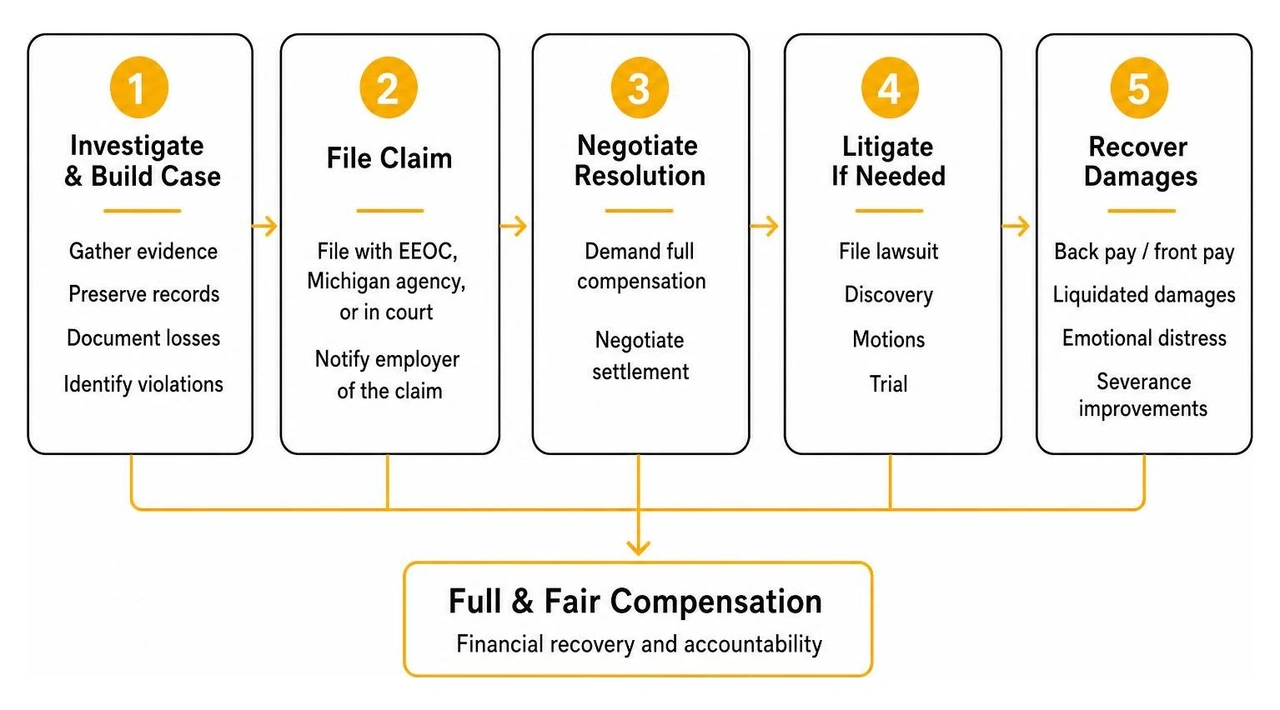
When we take on an employment case, our goal is to restore what you lost and hold your employer accountable for their unlawful actions. A successful claim can recover several types of damages:
- Back Pay and Front Pay: Back pay covers the wages, bonuses, and benefits you lost from the date of your illegal termination up to the date of your trial or settlement. Front pay may be awarded if you cannot easily find a comparable job in your field.
- Liquidated Damages: In wage and hour cases, the court may award double the amount of your unpaid wages as a penalty against the employer for violating the law.
- Emotional Distress Damages: Harassment, discrimination, and sudden job loss can take a massive toll on your mental health and family life. You can recover compensation for the pain, suffering, and humiliation caused by your employer's conduct.
- Severance Negotiations: If your employer offers you a separation package, do not sign it without legal review. An attorney can negotiate better terms, extend your health benefits, and ensure you do not sign away your right to pursue existing legal claims.
Before signing any termination paperwork, consulting an expert in Severance Agreement Review Negotiation Michigan is the best way to ensure you are receiving a fair deal.
Frequently Asked Questions About Michigan Employment Law
What should I do if my employer retaliates against me?
If your employer takes "adverse action" against you—such as firing you, demoting you, cutting your hours, or transferring you to an undesirable shift—after you reported a violation, you are protected by law.
In fact, retaliation is the single most common claim filed in employment law, accounting for roughly 49% of all claims filed over a two-decade period.
Under the Michigan Whistleblowers' Protection Act and federal anti-retaliation provisions, it is strictly illegal to punish employees for asserting their workplace rights, reporting safety hazards, or filing a wage complaint.
If you experience retaliation, write down every incident with dates, times, and names of witnesses. Keep copies of all written communications. Then, immediately contact a Retaliation Lawyer in Southfield MI to protect your career and hold your employer accountable.
How is overtime eligibility determined in Michigan?
Overtime eligibility is determined strictly by your actual job duties and salary level, not by your job title or whether you are paid a salary. Many employers mistakenly (or intentionally) believe that if they pay an employee a flat salary and call them a "manager," they do not have to pay them overtime. This is a common form of wage theft.
To be exempt from overtime under the FLSA, you must meet specific salary thresholds and perform primary duties that are administrative, executive, or professional in nature. If your primary duties involve manual labor, routine clerical work, or direct customer service without managerial authority, you are likely nonexempt and entitled to time-and-a-half for all hours worked over 40 in a single workweek.
If you suspect you are being denied overtime pay, consulting with the Best Employment Lawyers in Troy, MI can help you clarify your status and recover your lost wages.
Can I be fired without warning in Michigan?
Yes, because Michigan is an "at-will" employment state, your employer can legally fire you without any prior warnings, write-ups, or explanations. They do not have to prove "just cause" to let you go.
However, "at-will" is not a license for employers to break the law. You cannot be fired for discriminatory reasons, for taking approved medical leave under the FMLA, or for whistleblowing.
If you were fired without warning and suspect the real reason was illegal, you may have grounds for a wrongful termination lawsuit. To learn more about your options, read our detailed breakdown on Can I Sue for Being Fired Without Warning.
Conclusion
Your job is more than just a paycheck—it represents your hard work, your dignity, and your family's financial security. When an employer violates your rights through discrimination, wage theft, harassment, or retaliation, they are threatening your livelihood. You do not have to navigate these stressful career crises alone.
At Batey Law Firm, PLLC, we have spent over 25 years standing shoulder-to-shoulder with Michigan workers. From our office in Bingham Farms, we provide award-winning, deeply personalized representation to clients throughout Metro Detroit, including Birmingham, Southfield, Royal Oak, and Oakland County. We operate on a contingency fee basis, meaning we don't get paid unless we win your case.
If you believe your workplace rights have been violated, take control of your situation today. Reach out to Batey Law Firm, PLLC for a free, confidential consultation with a trusted Michigan Employment Lawyer for Employees. Let us help you reclaim your wages, your rights, and your dignity.