.png)
Fired in the Farms? What You Need to Know About Wrongful Termination Bingham Farms

When Getting Fired Isn't Legal: Wrongful Termination in Bingham Farms, MI
Wrongful termination in Bingham Farms is more common than most employees realize — and Michigan's "at-will" employment law does not give employers a free pass to fire you for any reason they choose.
Quick answer — here's when a firing may be illegal in Michigan:
- You were fired because of your race, sex, age (40+), religion, disability, pregnancy, or another protected characteristic
- You were let go after requesting or taking FMLA medical leave
- You were terminated after reporting discrimination, harassment, or illegal conduct
- Your employer refused a reasonable disability accommodation and then fired you
- Working conditions became so unbearable after a complaint that you felt forced to quit (constructive discharge)
If any of these apply to your situation, you may have a viable wrongful termination claim under Michigan or federal law.
Michigan is an at-will state. That means your employer can generally fire you at any time, for any reason, or for no reason. But "at-will" has real limits. It does not protect employers who fire someone for an illegal reason — and those illegal reasons are more numerous than most people think.
I'm Scott Batey, founder of Batey Law Firm in Bingham Farms, and I've spent nearly 30 years representing Michigan employees in wrongful termination in Bingham Farms and across the state. If you're wondering whether what happened to you was legal, this guide will walk you through exactly what the law says and what your options are.
Understanding At-Will Employment and Wrongful Termination Bingham Farms
When most people walk into our Bingham Farms office after being let go, they are understandably upset. Many of them say, "They blindsided me. I didn't even get a warning!"
Under Michigan's default employment rules, employers are generally not required to give you a warning, a reason, or a second chance. This is the foundation of the at-will employment doctrine. However, we have spent decades helping clients navigate the complex web of At-Will Employment Exceptions in Michigan.
The law is clear: while you can be fired for a bad reason or no reason, you absolutely cannot be fired for an illegal reason.
To understand how strictly Michigan courts view at-will employment, we can look to the landmark appellate ruling in Burger v. Ford Motor Co. Case Analysis. In that case, the court reaffirmed that an employer does not owe an at-will employee a common-law duty to conduct a "perfect" or even a "non-negligent" workplace investigation before terminating them. In other words, you cannot sue your employer simply because their internal investigation was sloppy or unfair.
However, there is a massive caveat to this rule. If an employer uses a "sloppy" or biased investigation as a deliberate cover-up—what the law calls a pretext—to fire you because of your race, age, gender, disability, or because you blew the whistle on illegal activity, then you do have a case. The issue isn't just that the investigation was bad; it's that the bad investigation was a shield for illegal discrimination or retaliation.
This is why many workers ask, Can I Sue for Being Fired Without Warning? The short answer is: if the lack of warning was part of a sudden, retaliatory shift in how your employer treated you after you exercised your legal rights, the answer is often a resounding yes.
Illegal Reasons to Fire Someone Under Michigan and Federal Law
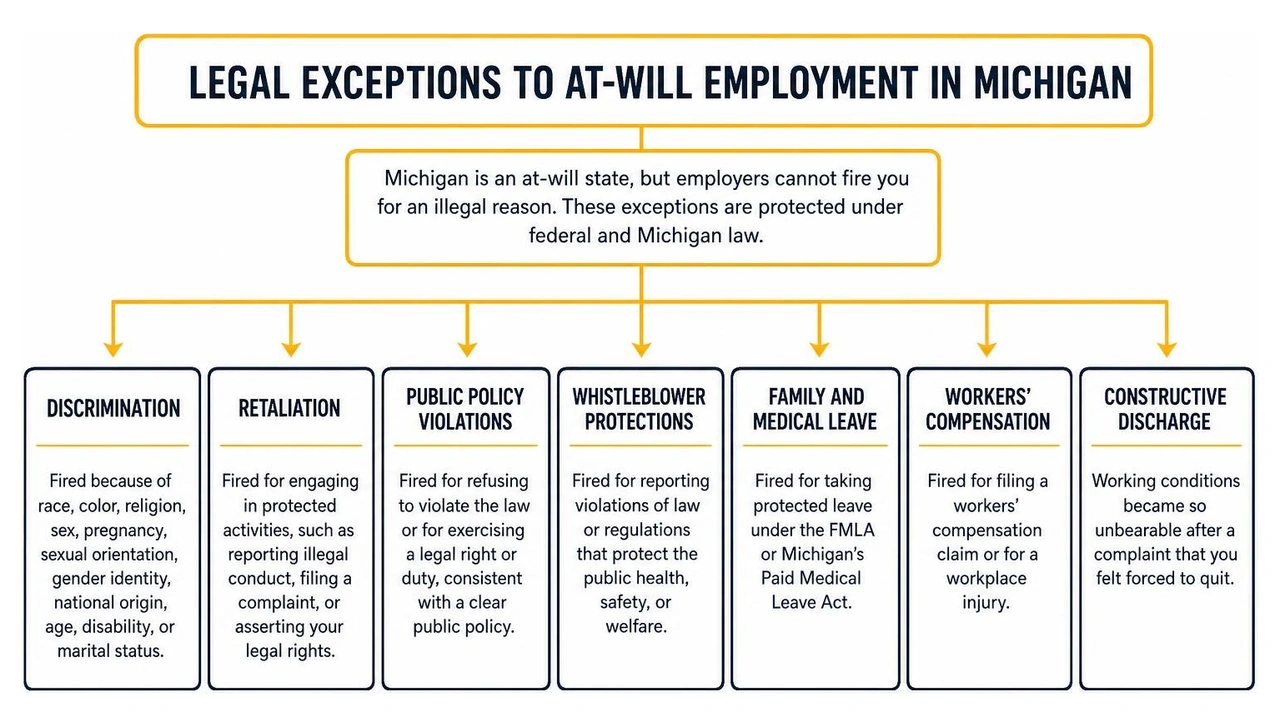
So, what actually makes a firing illegal? Under both federal statutes and Michigan state laws, there are specific protected characteristics and activities that are completely off-limits for employers when making termination decisions.
In Michigan, the primary shield for workers is the Elliott-Larsen Civil Rights Act (ELCRA). ELCRA is incredibly powerful because it applies to almost all Michigan employers with one or more employees. This is a much broader safety net than federal civil rights laws (like Title VII), which often require an employer to have at least 15 employees before you can file a claim.
If you believe you have been targeted, it is vital to understand the Illegal Reasons to Fire Someone. These include:
- Federal Protected Classes: Race, color, national origin, sex, religion, age (40 and over), pregnancy, and physical or mental disability.
- Michigan-Specific Protections: Under ELCRA, Michigan law goes a step further by explicitly outlawing discrimination based on marital status, height, and weight. Yes, you read that correctly—if an employer in Troy, Southfield, or Bingham Farms fires you because they decide you are "too short," "too heavy," or because you recently got married or divorced, they are violating state civil rights laws.
- Retaliation: It is illegal to fire an employee because they complained about discrimination, participated in an investigation, or refused to participate in illegal business activities.
The Reality of Wrongful Termination Bingham Farms and Local Legal Protections
Bingham Farms and the surrounding communities in Oakland County—such as Birmingham, Beverly Hills, and Franklin—serve as a major professional hub in Metro Detroit. Because of this, the local legal landscape is highly specialized.
If you look at the Bingham Farms Wrongful Termination Attorneys Directory, you will find that our small geographic area is home to highly experienced employment lawyers. This density of legal talent exists because Oakland County courts and local federal jurisdictions handle some of the most complex employment litigation in the state.
When you are facing a wrongful termination in the local area, having a legal team that understands the specific tendencies of Oakland County judges and local administrative offices is a distinct advantage. We know how local employers build their defense strategies, and we know how to dismantle them.
Medical Leave and Disability Discrimination: FMLA vs. ADA

One of the most active battlegrounds in employment law involves workers who need time off to care for their health or the health of a family member. Far too often, employers view an employee's medical crisis as an administrative inconvenience and look for ways to "restructure" them out of a job.
Under federal and state laws, you have dual layers of protection: the Family and Medical Leave Act (FMLA) and the Americans with Disabilities Act (ADA), alongside Michigan's Persons with Disabilities Civil Rights Act (PWDCRA).
A common issue we see involves "100% healed" policies. This is when an employer tells an injured or sick worker, "You cannot return to work until you are 100% cleared with zero restrictions."
Under the law, these policies are flatly illegal.
The ADA and PWDCRA require employers to engage in a good-faith "interactive process." This means they must sit down with you and discuss whether you can perform the essential functions of your job with a "reasonable accommodation"—such as light duty, a modified schedule, or specialized equipment. If you are Fired After Medical Leave in MI because your employer refused to accommodate your transition back to work, your civil rights have been violated.
FMLA Interference vs. FMLA Retaliation
If you are eligible for FMLA, you are entitled to up to 12 weeks of unpaid, job-protected leave in a 12-month period for serious health conditions or family care. When employers violate this law, their actions generally fall into one of two legal categories:
- FMLA Interference: This occurs when your employer actively blocks, delays, or discourages you from exercising your rights. Examples include an HR manager failing to provide you with FMLA paperwork, miscalculating your eligibility hours, or calling you repeatedly while you are in the hospital to demand that you complete work projects.
- FMLA Retaliation: This occurs when you successfully take your leave, but your employer punishes you for doing so. This often looks like returning from leave only to find your office packed up, your hours slashed, or your position "eliminated" due to a sudden corporate restructuring.
In retaliation cases, employers almost always claim the termination was part of a planned layoff or a performance-related decision. However, if your job duties were simply rebranded under a different title and handed to a coworker, courts will easily spot the pretext.
Disability Accommodations and PWDCRA Protections
The PWDCRA protects Michigan employees who have physical or mental health conditions that substantially limit one or more major life activities.
To trigger these protections, you must request a reasonable accommodation. This request does not need to be written in formal legal jargon, but it must clearly communicate that you need a workplace adjustment due to a medical condition.
Once you make this request, your employer cannot legally retaliate against you. If you suddenly receive your very first negative performance review or find yourself socially isolated by management immediately after requesting an accommodation, you are likely experiencing unlawful workplace retaliation.
Proving Your Case: Timing, Pretext, and Constructive Discharge
In a courtroom, feelings do not win cases—evidence does. Because employers rarely admit to illegal behavior in writing, we must build your case using circumstantial evidence. We look closely at three critical pillars:
- Temporal Proximity (Timing): If you have a spotless 10-year record and are suddenly fired three days after reporting sexual harassment or disclosing a pregnancy, the timing speaks volumes. While timing alone is rarely enough to win a case, a close temporal link strongly infers a retaliatory motive.
- Comparator Evidence: We look at how your employer treats "similarly situated" coworkers who do not share your protected characteristic. If you were fired for being five minutes late, but coworkers outside your protected class are routinely late without consequence, we have powerful evidence of discrimination.
- Policy Deviations: If your company handbook outlines a strict five-step progressive discipline policy, but management skipped straight to firing you without warning, this deviation suggests they were looking for an excuse to get rid of you.
But what happens if you weren't actually fired, but were forced to quit? This is where the legal concept of Constructive Discharge Michigan comes into play.
Under Michigan law, if your employer intentionally makes your working conditions so intolerable, hostile, or humiliating that a reasonable person would feel they have absolutely no choice but to resign, the law treats your resignation as a forced firing. However, the legal standard for proving constructive discharge is incredibly high. You must show that the environment was truly severe and that you gave the employer a reasonable opportunity to fix the issue before walking out.
Proving Pretext in a Wrongful Termination Bingham Farms Claim
When we file a lawsuit, your employer will almost certainly present a "legitimate, non-discriminatory reason" for your firing. They will claim you had a bad attitude, poor sales numbers, or that your position was cut for budgetary reasons.
Our job is to prove this excuse is a pretext—a legal lie designed to hide their true, unlawful motives. We expose pretext by identifying:
- Sudden PIPs: A Performance Improvement Plan (PIP) that lands on your desk immediately after a protected complaint, containing unrealistic goals designed to make you fail.
- Shifting Explanations: If your manager tells you that you are being laid off due to budget cuts, but HR later tells the unemployment office you were fired for misconduct, their inconsistent stories undermine their credibility.
- The Paper Trail: Internal emails, text messages, or Slack chats where managers drop their professional filters and reveal their true biases.
Key Deadlines and Statutes of Limitations in Michigan
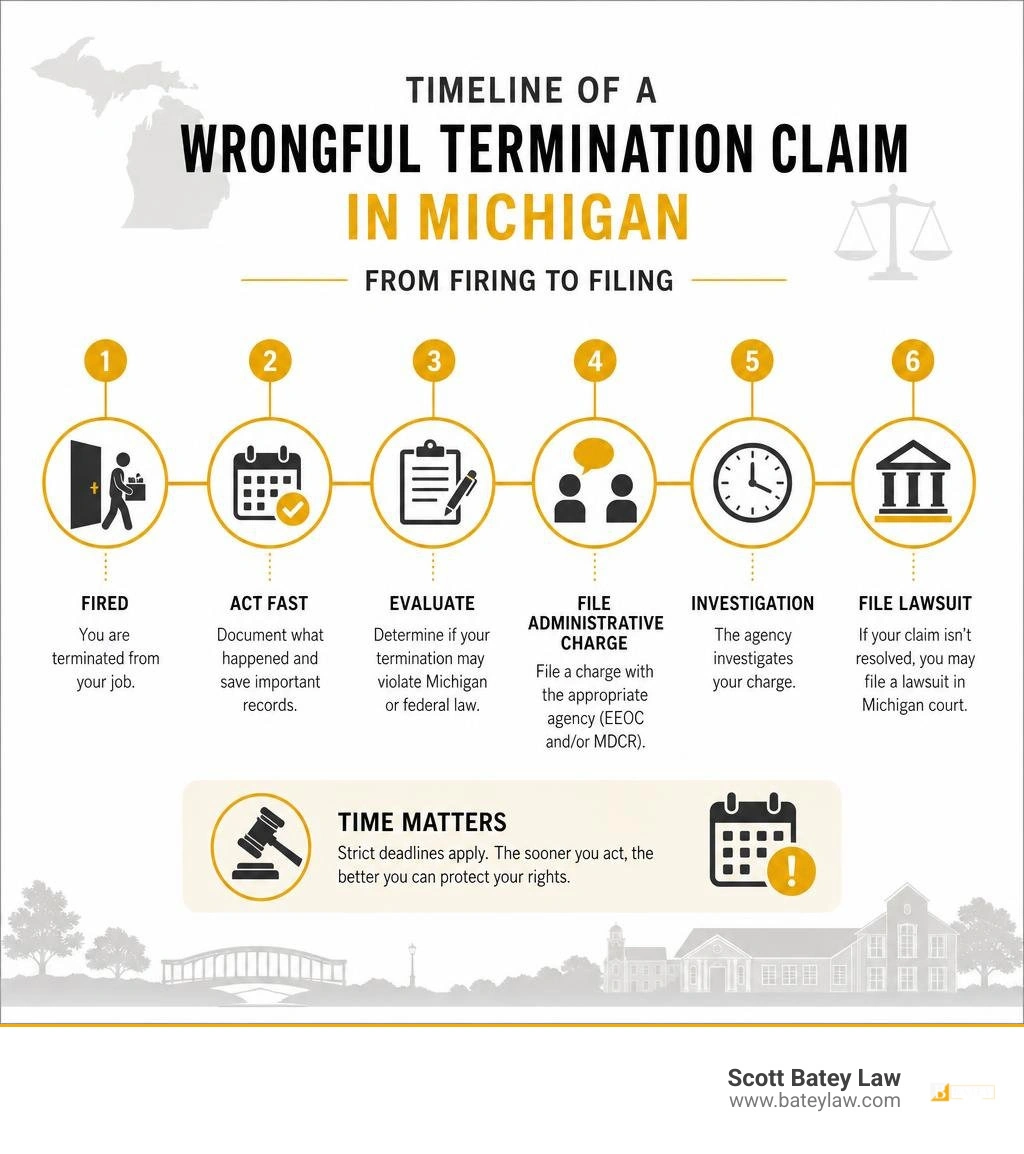
If you suspect you have been wrongfully terminated, you must act quickly. Employment law has some of the strictest and shortest deadlines of any legal field. If you miss a deadline, you lose your right to seek justice forever.
| Claim Type / Governing Law | Filing Window / Statute of Limitations | Filing Venue |
|---|---|---|
| Elliott-Larsen Civil Rights Act (ELCRA) | Up to 3 Years | Michigan State Court |
| Persons with Disabilities Civil Rights Act (PWDCRA) | Up to 3 Years | Michigan State Court |
| EEOC Administrative Charge | 300 Days (from the discriminatory act) | Federal Agency |
| Michigan Whistleblowers' Protection Act (WPA) | Strict 90 Days | Michigan State Court |
It is also critical to understand how the Michigan 180-Day Limitation of Actions Clause can impact your rights. Many employers sneak clauses into employment applications or handbooks that attempt to shorten the standard three-year statute of limitations down to just 180 days (or six months).
Michigan courts have historically upheld these contractually shortened limitation periods. If you signed an application containing this clause, you must file your lawsuit within six months of your termination, or your case may be dismissed. This is why we urge workers to consult a professional about Wrongful Discharge Michigan as soon as possible after being let go.
Frequently Asked Questions About Wrongful Termination
What should I do immediately after being fired?
The moments directly following a termination are critical. Here is your emergency checklist:
- Preserve the Evidence: Do not delete any work-related text messages, emails, or call logs on your personal phone. Take screenshots of relevant communications, performance reviews, and company policies if you still have legal access to them.
- Write Down a Timeline: While your memory is fresh, write down a detailed, day-by-day timeline of events. Include dates, times, names of witnesses, and exact quotes of what was said to you.
- Do Not Send Emotional Messages: It is tempting to fire off an angry email to HR or post a scathing review on social media. Do not do this. These communications will be obtained by your employer's defense attorneys during discovery and can be used to paint you as unprofessional or insubordinate.
- Do Not Sign Anything on the Spot: If your employer hands you a severance agreement, do not sign it immediately. You are legally entitled to take the agreement home to review it.
Before you sign away your right to sue, contact an experienced Wrongful Termination Lawyer in Bingham Farms MI to review the terms and help you negotiate a better package.
Can I sue if I was fired without a written warning?
Generally, yes—if the firing was motivated by discrimination or retaliation. Because Michigan is an at-will state, an employer is not legally required to issue a written warning before firing you.
However, if your company has an established progressive discipline policy in its employee handbook, and they bypassed that policy specifically to target you, we can use that deviation to prove pretext. If you want to explore whether your sudden termination violated your rights, check out our guide on finding a Wrongful Termination Attorney in Oakland County MI.
Is quitting considered wrongful termination if I was forced out?
Yes, if your situation meets the legal criteria for constructive discharge. If your employer intentionally made your daily work life a living nightmare because of your age, sex, race, disability, or because you reported misconduct, your resignation is treated as a wrongful termination in the eyes of the law.
Because these claims are highly complex, it is essential to consult with a Wrongful Termination Attorney in Birmingham MI before you hand in your resignation letter, as we can help you document the intolerable conditions to build a stronger case.
Conclusion
Getting fired is a stressful, disruptive, and often deeply insulting experience. But you do not have to accept unfair and illegal treatment in silence.
At Scott Batey Law, we have spent over 25 years standing up to major corporations and local employers on behalf of Michigan workers. We provide award-winning, deeply personalized representation to clients in Bingham Farms, Southfield, Troy, Royal Oak, and across Oakland County. We understand the games employers play to hide their illegal actions, and we have the resources, experience, and dedication required to hold them accountable.
If you suspect your termination violated state or federal law, do not wait until a critical deadline passes. Contact our office today to speak with a dedicated Employment Lawyer Bingham Farms MI and let us help you protect your career, your reputation, and your future.