.png)
Bingham Farms Employment Lawyer: In-Depth Guide to Workplace Issues

When to Contact a Bingham Farms Employment Lawyer
A bingham farms employment lawyer helps Michigan employees assess workplace problems such as wrongful termination, discrimination, harassment, retaliation, denied medical leave, unpaid wages, and restrictive employment agreements.
- You may have legal rights even though Michigan is an at-will employment state.
- Act quickly if you were fired, demoted, disciplined after speaking up, or asked to sign a severance agreement.
- Save records now, including emails, texts, performance reviews, HR complaints, pay records, and termination documents.
- Do not assume unfair treatment is lawful. Termination or discipline can be illegal when tied to discrimination, protected leave, whistleblowing, or other protected activity.
Workplace disputes can put your income, reputation, and future career at risk. Michigan law and federal law can offer important protections, but the right path depends on the facts, the evidence, and sometimes very short filing deadlines.
I am Scott Batey, a Michigan employment attorney and founder of Scott Batey Law in Bingham Farms. Since 1996, I have represented employees statewide in the types of workplace disputes a bingham farms employment lawyer handles, from discrimination and retaliation claims to leave disputes, severance reviews, and litigation.
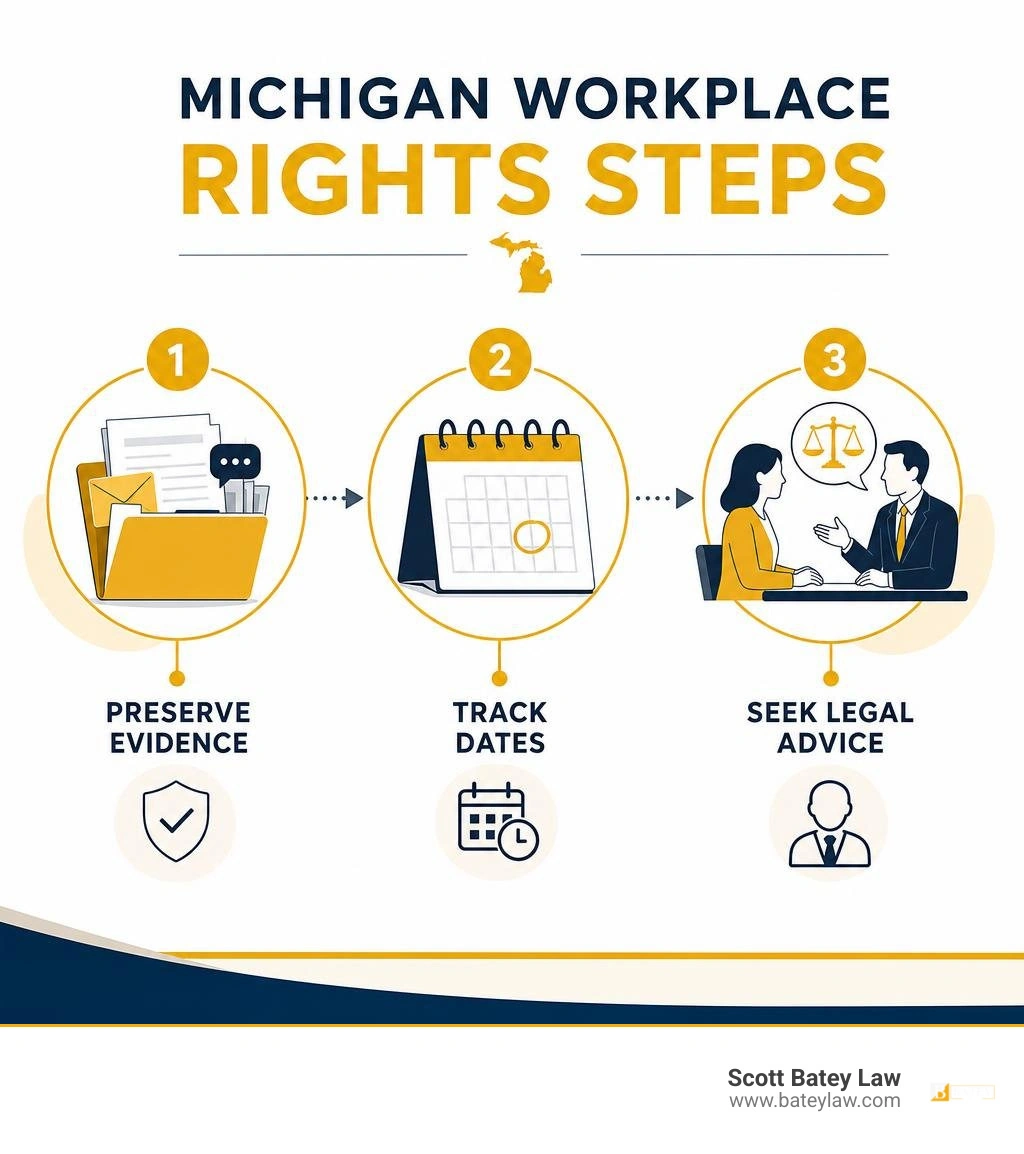
Legal Cases Managed by a Bingham Farms Employment Lawyer

Navigating employment disputes without clear legal guidance often leaves workers feeling overwhelmed and vulnerable. When conflict arises at work, a bingham farms employment lawyer serves as a direct shield and strategic advisor. At Scott Batey Law, we evaluate the unique nuances of your working conditions, gather key evidence, and map out a comprehensive plan to enforce your rights.
Whether you are facing unfair treatment, dealing with medical accommodations, or seeking assistance from a Workplace Discrimination Lawyer in Bingham Farms MI, knowing where the law stands is the first step toward regaining control. Our firm works directly with clients across Metro Detroit—including Birmingham, Troy, Southfield, and Royal Oak—to address unlawful employer conduct head-on.
Cases Handled by Your Bingham Farms Employment Lawyer
Employment law encompasses a wide range of workplace interactions and statutory protections. Our office routinely manages complex matters, ensuring that employees receive dedicated, senior-level counsel across every phase of a dispute.
Key practice areas handled by our firm include:
- Wrongful Termination: If you were fired for an illegal reason, working with a Wrongful Termination Lawyer in Bingham Farms MI helps expose whether your employer violated anti-discrimination statutes, retaliated against you, or breached an employment contract.
- Sexual Harassment and Hostile Work Environment: We represent employees subjected to unwanted sexual advances, quid pro quo demands, or pervasive harassment. Partnering with a dedicated Sexual Harassment Lawyer - Bingham Farms MI ensures that your dignity is protected and that employers are held accountable for toxic environments.
- Retaliation and Whistleblower Claims: Employers cannot legally punish you for reporting illegal acts, safety violations, or workplace discrimination. Seeking assistance from a Retaliation Lawyer in Bingham Farms MI allows you to assert your protections under state and federal law.
- Medical Leave and Disability Rights: We protect employees under the Family and Medical Leave Act (FMLA) and disability protection statutes. Consulting a FMLA Lawyer Bingham Farms MI ensures that your right to protected medical leave or workplace accommodations is fully upheld.
- Wage and Hour Violations: Under the Fair Labor Standards Act (FLSA), non-exempt employees must be paid 1.5 times their regular hourly rate for all hours worked over 40 in a single workweek. We help workers recover unpaid overtime, tackle off-the-clock work demands, and resolve worker misclassifications (such as improper 1099 independent contractor labeling).
Navigating Michigan At-Will Employment and Exceptions
A common misconception among Michigan workers is that being an "at-will" employee means you have no rights if you are fired. Under Michigan's at-will employment doctrine, an employer can generally terminate an employee at any time, for any reason, or for no reason at all. However, at-will employment is not a legal license to commit unlawful acts.
Employers cannot fire or penalize workers for reasons that violate established federal or state statutes. Key statutory and public policy exceptions to Michigan's at-will doctrine include:
- Statutory Discrimination: Firing an employee based on protected characteristics like race, sex, age, religion, national origin, disability, height, weight, or marital status.
- Protected Retaliation: Terminating a worker for exercising a statutory right, such as filing a workers' compensation claim, requesting protected FMLA leave, or demanding wage fairness.
- Whistleblower Protections: Discharging an employee because they reported or were about to report a suspected law violation to a public body.
- Contractual Exceptions: Terminating an employee in violation of an explicit written contract or an implied agreement that establishes an "for-cause" employment relationship.
Anti-Discrimination Laws: ELCRA vs. Federal Statutes
Michigan workers are protected by both state legislation and federal anti-discrimination laws. While these frameworks share common goals, understanding their differences is vital when deciding where and how to pursue a legal claim.
| Provision / Feature | Michigan Elliott-Larsen Civil Rights Act (ELCRA) | Federal Title VII / ADA / ADEA Statutes |
|---|---|---|
| Minimum Employer Size | Applies to employers with 1 or more employees | Applies to employers with 15 or more employees (20+ for ADEA) |
| Unique Protected Traits | Height, weight, marital status, age, race, sex, religion, familial status | Race, color, religion, sex, national origin, disability, age (40+) |
| Filing Deadline | 3 years from the date of the unlawful act | 300 days to file an EEOC charge in Michigan |
| Prerequisites to Lawsuit | Direct court filing allowed; no prior agency charge required | Administrative exhaustion (EEOC charge) required first |
| Damage Caps | No statutory caps on non-economic or compensatory damages | Federal statutory caps exist based on employer size |
State vs. Federal Protections for Michigan Workers
The primary state statute protecting employees in Michigan is the Elliott-Larsen Civil Rights Act (ELCRA). ELCRA is noticeably broader than its federal counterpart, Title VII of the Civil Rights Act of 1964. For example, while Title VII applies only to employers with 15 or more workers, ELCRA protects employees working for businesses with just a single employee.
Furthermore, ELCRA provides explicit protections against workplace discrimination based on height, weight, and marital status—traits that are not explicitly covered under federal non-discrimination statutes. Michigan law also protects workers with physical or mental disabilities through the Persons with Disabilities Civil Rights Act (PWDCRA). Working with an experienced ADA Accommodation Lawyer Bingham Farms helps ensure that your rights under both the ADA and the PWDCRA are asserted effectively during interactive accommodation requests.
Strict Deadlines for Michigan Employment Claims
Missing a legal deadline can permanently erase your right to seek justice and recover compensation. Michigan employment statutes and federal laws impose strict statutes of limitations:
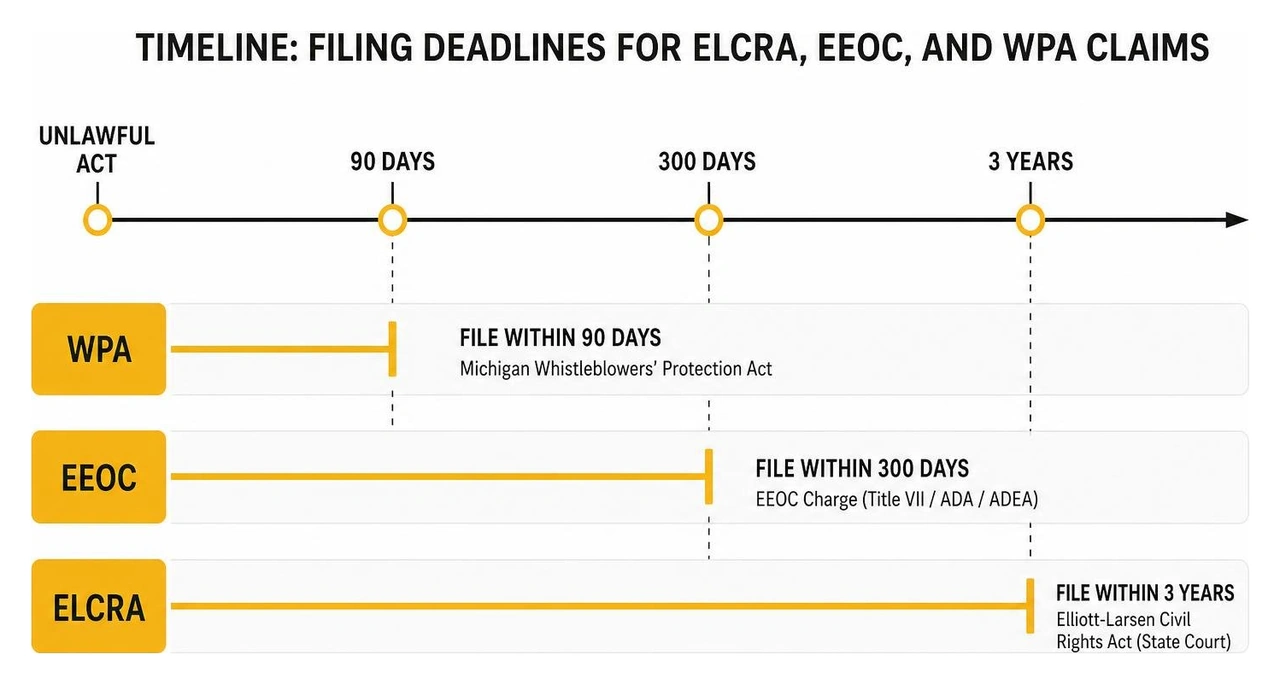
- Michigan Whistleblowers' Protection Act (WPA): Exceptionally strict—claims under the WPA must be formally filed within 90 days of the retaliatory act. Partnering with a skilled Whistleblower Attorney Bingham Farms immediately after an adverse job action is crucial to meet this brief window.
- Federal Administrative Filings (EEOC): Under Title VII, the ADA, and the ADEA, employees must file a charge of discrimination with the Equal Employment Opportunity Commission (EEOC) within 300 days of the unlawful conduct.
- Elliott-Larsen Civil Rights Act (ELCRA): Employees generally have 3 years from the date of the discriminatory or retaliatory action to file a lawsuit directly in state court.
Proving Workplace Harassment and Retaliation Claims

Winning a discrimination, harassment, or retaliation claim rarely depends on finding a "smoking gun" email where a manager openly admits to illegal intent. More often, successful cases are built through meticulous documentation, establishing patterns of conduct, and exposing inconsistent employer explanations. You can learn more about our local approach by reading Employment Lawyer in Bingham Farms How We Tackle Cases Locally.
Proving Retaliation and Workplace Misconduct
To establish a illegal retaliation or harassment claim under Michigan law, we focus on establishing key categories of circumstantial evidence:
- Timing and Temporal Proximity: A sudden drop in performance reviews, unexpected disciplinary write-ups, or termination occurring shortly after an employee engages in protected activity (such as filing an HR complaint or requesting leave) strongly suggests retaliatory motive.
- Comparator Evidence: Demonstrating that non-protected employees who engaged in similar workplace conduct were treated far more leniently than you were.
- Deviations from Policy: Showing that management bypassed standard progressive discipline steps or ignored established company policies specifically to target you.
- Pretext: Proving that the employer's stated reason for discipline or termination is factually false, inconsistent, or shifted over time.
Evidence Preservation to Protect Your Legal Rights
If you suspect your rights are being violated, preserving clear evidence outside of company-controlled systems is essential. Once you lose access to work emails, internal servers, or messaging apps, recovering key proof becomes vastly more difficult.
To protect your potential claim:
- Keep a Personal Record: Write a detailed, chronological journal documenting incident dates, times, locations, witnesses, and exact statements made.
- Save Physical and Electronic Copies: Forward non-confidential, relevant emails, text messages, performance evaluations, award certificates, and written HR complaints to a personal email address or personal device.
- Preserve Paperwork: Gather copies of employment contracts, company handbooks, commission plans, and pay stubs.
- Prepare for Legal Review: Review our resource on Wrongful Termination Lawyer Bingham Farms What to Bring to Your Consult to ensure you arrive fully prepared for an initial case assessment.
Negotiating Severance and Restrictive Covenants in Michigan
When an employment relationship ends—or when entering a new role—you may be asked to sign complex agreements that can severely impact your future income and career growth. Reaching out to a specialized Severance Agreement Lawyer in Bingham Farms MI helps ensure that you do not sign away vital statutory rights without fair compensation.
Evaluating Noncompete and Nonsolicitation Agreements
Restrictive covenants are designed to protect employer business interests, but overly broad agreements can unfairly trap workers.
- Noncompete Agreements: Restrict where, for whom, and in what industry you can work after leaving an employer. Courts review noncompetes for reasonableness regarding duration, geographic scope, and the specific line of work prohibited.
- Nonsolicitation Agreements: Limit your ability to contact former clients, customers, or co-workers after departure. Nonsolicitation covenants are frequently easier for employers to enforce than noncompetes, but subtle phrasing can mean the difference between maintaining your professional network and facing a lawsuit.
Maximizing Severance Package Terms and Benefits
Employers often present severance packages as non-negotiable "take-it-or-leave-it" offers. In practice, severance terms are frequently negotiable. Beyond monetary compensation, a thorough review of a severance agreement should address critical non-financial provisions:
- Broad Release of Claims: Severance agreements require you to waive legal claims against the employer. We evaluate whether the financial payout fairly reflects the value of any legal claims you are giving up.
- Neutral References and Verification: Ensuring the employer agrees in writing to provide a neutral job reference and confirm dates of employment to prospective employers.
- Non-Disparagement Clauses: Restricting what both parties can publicly say about the separation, ensuring the language is mutual rather than one-sided.
- Benefit Continuation: Clarifying health insurance coverage details under COBRA and preserving accrued bonus payments or equity options.
Administrative Filings and Courtroom Litigation Procedures
When informal dispute negotiations fail to resolve a workplace dispute, pursuing formal administrative remedies or courtroom litigation becomes necessary. Retaining experienced local representation through Batey Law Local Employee-Side Counsel ensures your legal strategy is built on deep familiarity with local judges, local filing rules, and regional employer defense tactics.
Working with a Bingham Farms Employment Lawyer for EEOC and MDCR Filings
Before filing a federal lawsuit under laws like Title VII or the ADA, employees must exhaust administrative remedies by filing a dual charge with the EEOC or the Michigan Department of Civil Rights (MDCR).
Our office assists clients through each stage of administrative proceedings, including drafting precise position statements, participating in agency mediation, and obtaining the "Right-to-Sue" letter required to initiate formal court proceedings. You can research verified legal practitioners in Oakland County through directory resources like Best Employment Lawyers in Troy, MI - Justia .
Consultation Preparation and When to Hire Legal Counsel
Contacting an employment lawyer early in the process—ideally before signing separation agreements, attending disciplinary hearings, or resigning—gives you the best opportunity to safeguard your rights. During an initial consultation, we conduct a fast, straightforward review of your situation.
To maximize your initial consultation, bring the following items:
- Employment Records: Offer letters, employment agreements, restrictive covenants, or severance proposals.
- Performance Documentation: Recent performance reviews, written warnings, commendations, or disciplinary notices.
- Communication History: Key emails, text messages, and written HR complaint tickets.
- Financial and Personal Details: Recent pay stubs, W-2 forms, a detailed timeline of events, and notes regarding any personal bankruptcy history (which can impact legal standing in active litigation).
Frequently Asked Questions About Employment Law in Michigan
What should I bring to my initial employment law consultation?
You should bring a detailed timeline of workplace events, employment contracts, offer letters, disciplinary notices, written performance reviews, relevant emails or text messages, HR complaint receipts, recent pay stubs, and any severance drafts presented by your employer.
Can I be fired while on medical leave under FMLA or ADA?
An employer cannot fire you because you requested or took approved FMLA leave or requested a reasonable disability accommodation. However, limited exceptions exist if an employer can prove a legitimate, non-discriminatory reason—such as a nationwide corporate layoff planned prior to your leave.
If you were Fired After Medical Leave Bingham Farms MI, our firm evaluates whether your employer engaged in illegal FMLA interference or retaliation. Additionally, employer policies requiring workers to be "100% healed" before returning from leave are generally illegal under federal and state disability laws, as employers are legally obligated to engage in an interactive process to explore reasonable accommodations.
What is the deadline to file a whistleblower claim under Michigan law?
Under the Michigan Whistleblowers' Protection Act (WPA), you have only 90 days from the date of the retaliatory action (such as termination, demotion, or suspension) to file a lawsuit in court. Because this deadline is exceptionally short compared to other civil claims, contacting legal counsel immediately after experiencing retaliation for reporting an alleged law violation is critical.
Conclusion
Facing unfair treatment, harassment, or unlawful termination at work can derail your career and threaten your financial well-being. However, you do not have to confront an employer alone. Scott Batey brings over 25 years of trial-tested legal experience representing employees across Michigan, earning recognition from Michigan Super Lawyers every year since 2014.
Our client-focused firm prioritizes strong, legitimate claims, offering direct, personalized legal representation from start to finish. From negotiating executive severance agreements to winning a $1 million jury verdict for workplace racial harassment, our track record demonstrates our passion for protecting worker rights in Oakland County courts and across Michigan.
If your job, career, or professional reputation is at risk, take action today. Contact Scott Batey Law by visiting our Employment Lawyer Bingham Farms MI page to schedule your free, confidential consultation.