
What Every Employer Needs to Know About Hourly Exempt Roles

Understanding When Exempt Is Hourly Under Federal Wage Law
Under the Fair Labor Standards Act (FLSA), an hourly employee is exempt from overtime only in narrow statutory situations. The primary example is the computer professional exemption, which requires payment of at least $27.63 per hour and primary duties involving high-level systems analysis, software engineering, programming, or similar complex technical work. Specific industry carve-outs also exist for motor carrier drivers, agricultural laborers, movie theater staff, and certain small-market broadcast personnel. Outside those exceptions, hourly workers remain non-exempt and must receive overtime compensation at one and one-half times their regular pay rate for every hour worked beyond 40 hours in a single workweek.
Many business owners and payroll managers assume that no worker who is exempt is hourly, believing that the line between exempt and non-exempt employees is identical to the line between salaried and hourly compensation. That assumption creates significant legal risk. Employee classification is governed by federal statutes rather than internal payroll labels. Congress established these foundational guardrails under 29 U.S. Code § 213 exemptions, outlining specifically which workers can be carved out of minimum wage and overtime mandates.
The default rule under federal law is straightforward: every employee is non-exempt unless the employer can prove they qualify for a specific statutory exemption. While most white-collar exemptions outlined in Section 13(a)(1) of the FLSA demand that workers receive a predetermined, fixed salary, there are narrow statutory exceptions where an employee who is paid an hourly wage remains exempt from premium overtime pay.
How the FLSA Governs Exempt Is Hourly Classifications
The most widely applied scenario where an hourly worker qualifies for a white-collar exemption involves skilled technology personnel. Under federal law, the computer professional exemption allows employers to pay qualified technical specialists either on a standard salary basis or on an hourly basis. To maintain exempt status while paying an hourly wage, the employer must meet two strict criteria:
- The Compensation Level: The employee must be paid an hourly rate of not less than $27.63 per hour.
- The Primary Duty Requirement: The worker's day-to-day responsibilities must primarily involve high-level computer systems analysis, software engineering, programming, or similar complex system architecture tasks.
If an IT professional is paid $30.00 per hour to design and write complex database code, they may legally be classified as exempt from overtime. Conversely, if that same worker is paid $25.00 per hour, the exemption automatically fails regardless of how sophisticated their coding skills are. Similarly, basic technical support, hardware repair, and routine helpdesk administration do not qualify for this exemption, even if the worker makes well above $27.63 per hour.
Specific Industry Exemptions for Hourly Workers
Beyond computer professionals, federal wage law carves out narrow industry-specific exemptions where employees paid on an hourly or piece-rate basis do not receive traditional FLSA overtime. These exemptions exist because separate regulatory frameworks or distinct working conditions govern those fields:
- Motor Carrier Drivers: Certain interstate commercial truck drivers and driver helpers subject to the Secretary of Transportation's safety jurisdiction under the Motor Carrier Act are exempt from FLSA overtime rules.
- Agricultural Laborers: Farmhands and agricultural workers who plant, cultivate, or harvest crops are generally exempt from statutory overtime mandates, though they remain protected by minimum wage requirements unless specific small-farm labor limits (such as the 500 man-day test) apply.
- Movie Theater Staff: Employees of motion picture theaters have historically been excluded from federal overtime requirements under Section 213(b)(27).
- Broadcast Engineers and News Staff: Under narrow provisions, certain announcers, news editors, and chief engineers at small-market radio or television stations are exempt from statutory overtime.
Outside of these specific statutory carve-outs, an hourly compensation structure almost always requires paying time-and-a-half for hours worked past 40.
Core Exemption Tests: Salary Basis vs. Duties Test
To establish that an employee is legally exempt from overtime, an employer must satisfy a multi-part legal analysis. For the classic "white-collar" exemptions, paying an employee an hourly wage is generally prohibited because the regulations mandate a guaranteed salary.
The standard salary level required for white-collar exemptions is $684 per week, which equals $35,568 annually. Under the salary basis rule, the employee must receive their full predetermined salary for any week in which they perform work, regardless of the quality or quantity of the hours worked. An employer cannot reduce a salaried exempt worker's pay simply because business was slow or they left two hours early on a Friday. Employers may utilize nondiscretionary bonuses and incentive payments (including commissions) paid on an annual or more frequent basis to satisfy up to 10 percent of this standard salary level.
Beyond salary requirements, the employee must also satisfy the duties test. Job titles alone mean nothing under the law. Regulators evaluate the actual tasks an employee performs every day, referencing guidelines like the DOL professional exemption guidelines to establish whether an exemption applies.
| Exemption Category | Minimum Pay Requirement | Key Primary Duties Required |
|---|---|---|
| Executive | $684 per week (salary) | Managing an enterprise or recognized subdivision; regularly supervising 2+ full-time employees; authority to hire/fire or carry significant weight in personnel decisions. |
| Administrative | $684 per week (salary) | Office or non-manual work directly related to business management/operations; regular exercise of discretion and independent judgment on significant business matters. |
| Learned Professional | $684 per week (salary or fee) | Work requiring advanced intellectual knowledge in a specialized field of science or learning, customarily acquired through prolonged, specialized intellectual instruction. |
| Creative Professional | $684 per week (salary or fee) | Work requiring invention, imagination, originality, or talent in a recognized artistic or creative field (e.g., writers, composers, graphic artists). |
| Computer Professional | $684 per week (salary) OR $27.63 per hour | Systems analysis, software design, program development, or testing of operating systems and application code. |
| Outside Sales | No salary threshold | Primary duty of making sales or obtaining orders outside the employer’s physical place of business; regularly away from the office. |
White-Collar Duties Breakdown: Executive, Administrative, and Professional
Each standard white-collar category targets specific forms of organizational responsibility:
- Executive Exemption: The worker must actively manage the business, department, or team. They must direct the work of at least two full-time employees (or the equivalent in part-time workers) and possess meaningful authority over hiring, firing, promotions, or assignments. A shift leader who primarily works the cash register and occasionally delegates tasks does not qualify.
- Administrative Exemption: The role must involve non-manual work supporting business operations (such as finance, human resources, legal, or quality control) that involves the continuous exercise of independent judgment on matters of significance. Routine clerical tasks, data entry, and adherence to rigid manuals do not meet this standard.
- Professional Exemption: Learned professionals must apply advanced knowledge acquired through a specialized higher education degree (such as certified accountants, engineers, physicians, and attorneys). Creative professionals must rely on personal invention and artistic interpretation rather than standard operational processes.
Highly Compensated Employees and Ineligible Roles
Under federal law, the Highly Compensated Employee (HCE) rule creates a simplified exemption pathway. If an employee earns total annual compensation of at least $107,432 (which must include at least $684 per week paid on a salary or fee basis), the employer only needs to show that the worker customarily and regularly performs at least one of the exempt duties of an executive, administrative, or professional employee. However, because the HCE rule mandates a weekly salary baseline, an hourly compensation structure cannot be used for this shortcut.
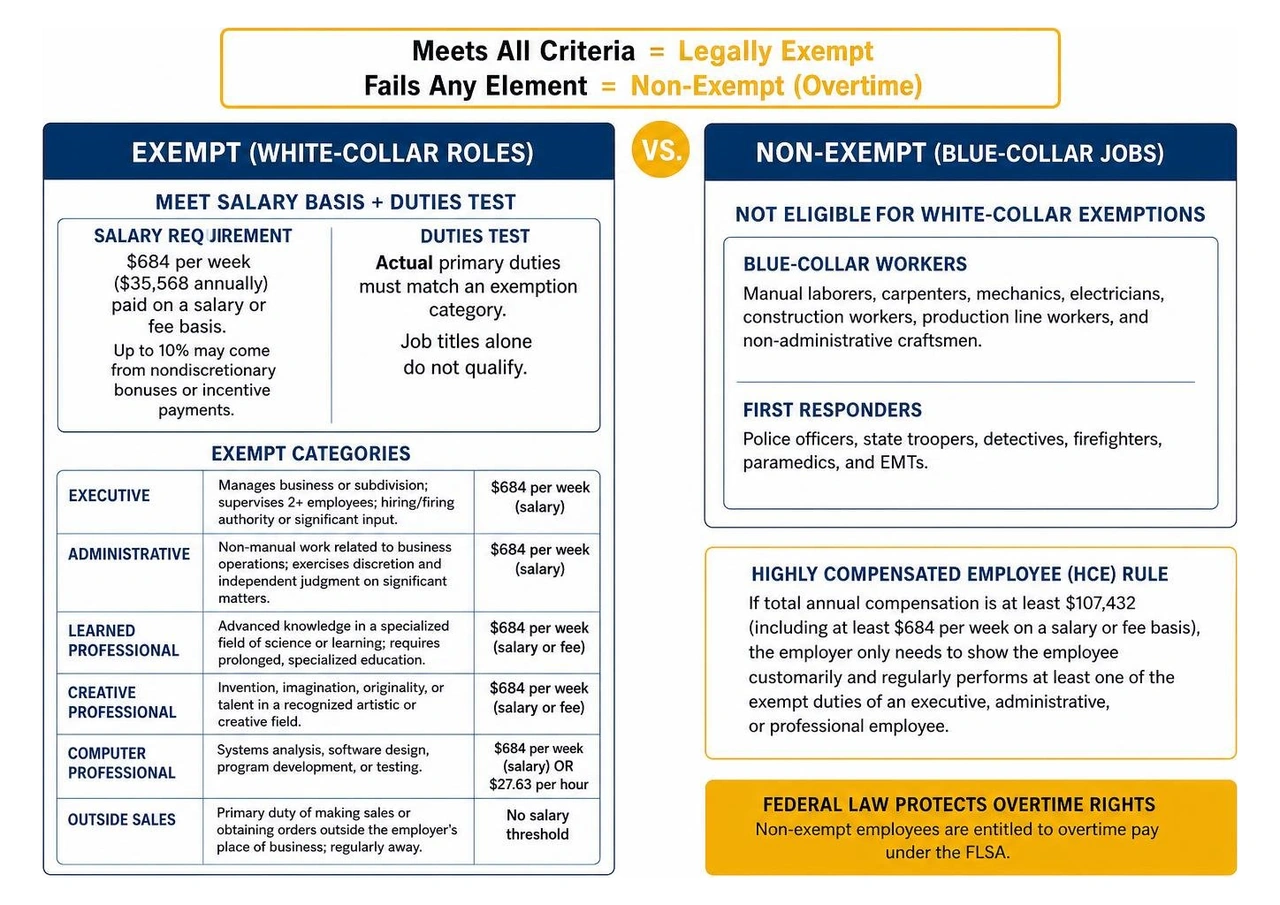
Federal regulations make it unequivocally clear that certain occupations can never be classified as exempt under the standard white-collar rules, regardless of how much they earn:
- Blue-Collar Workers: Manual laborers, carpenters, mechanics, electricians, construction workers, production line workers, and non-administrative craftsmen are entitled to overtime pay under the FLSA.
- First Responders: Police officers, state troopers, detectives, firefighters, paramedics, and emergency medical technicians are protected non-exempt employees entitled to overtime pay, recognizing the hazardous, operational, and non-discretionary nature of emergency frontline work.
Legal Risks and Penalties of Worker Misclassification
When an employer treats an hourly worker as exempt from overtime without a valid statutory basis, the financial and legal exposure can mount quickly. Misclassification denies employees compensation guaranteed by federal and state law, often leading to claims involving wage theft and off-the-clock violations.

If an investigation or private lawsuit reveals that an employer failed to pay required overtime premiums, the employer can be held liable for:
- Back Overtime Wages: Full restitution of all unpaid overtime for up to two years, or up to three years if the court finds the violation was willful.
- Liquidated Damages: An additional mandatory statutory penalty equal to 100% of the back wages owed, effectively doubling the payout.
- Attorneys' Fees and Costs: Payment of the employee's reasonable legal fees and litigation costs.
- Civil Money Penalties: Regulatory fines assessed by the U.S. Department of Labor for repeat or willful violations.
Understanding the direct financial exposure of employee misclassification risks allows companies to correct flawed wage structures before litigation arises.
State Law Nuances: Where Exempt Is Hourly Classification Varies
While the FLSA establishes a federal baseline, states are legally permitted to enforce stricter overtime rules and higher salary floors. For businesses operating across state lines, compliance with federal law alone is not enough.
In some states, wage orders and statutory thresholds are significantly more protective than the federal standard. For example, state frameworks like the California IWC overtime exemptions establish distinct hourly pay thresholds for exempt computer software employees that far exceed the federal $27.63 benchmark. They also enforce daily overtime requirements (requiring overtime after 8 hours of work in a single day), which federal law does not mandate.
In our home state, employees are protected by both federal regulations and the Michigan Improved Workforce Opportunity Wage Act. Workers who are denied earned compensation can pursue formal remedies through Michigan wage and hour claims. When federal and state laws conflict, employers must always adhere to the standard that provides the greatest protection and compensation to the employee.
Auditing Payroll and Preventing Overtime Disputes
To maintain full compliance and prevent unexpected back-wage liabilities, employers should conduct structured wage-and-hour reviews. Proactive steps include:
- Conducting Job Duty Audits: Evaluate actual daily work assignments rather than outdated job descriptions. Verify that any worker marked as exempt genuinely exercises discretionary authority or satisfies specialized technical standards.
- Reviewing Pay Structures: Ensure all exempt employees (outside of qualifying computer professionals and specific statutory industries) receive a guaranteed salary meeting or exceeding $684 per week without unauthorized deductions.
- Maintaining Accurate Time Records: Require non-exempt hourly employees to track all hours worked, including remote tasks, off-hours communications, and travel time.
- Seeking Legal Counsel: When handling complex pay adjustments, consult seasoned Metro Detroit wage and overtime legal counsel to verify that job classifications withstand regulatory scrutiny.
Frequently Asked Questions About Hourly Exempt Status
Can any hourly worker be classified as exempt if they make enough money?
No. Under federal wage law, high hourly earnings do not eliminate the legal requirement for overtime pay. Unless an hourly employee fits into a specific statutory exemption—such as the computer professional exemption paying at least $27.63 per hour, or a designated industry exclusion like motor carriers—hourly workers must receive time-and-a-half for all hours worked over 40 in a workweek. A skilled tradesperson earning $60.00 per hour remains non-exempt and must receive overtime compensation.
Are first responders or blue-collar workers ever exempt when paid hourly?
No. Federal labor regulations explicitly state that first responders (including police officers, firefighters, and paramedics) and blue-collar manual workers are non-exempt employees entitled to overtime compensation. Their compensation level does not change this status, and employers cannot use white-collar exemptions to avoid paying overtime to frontline workers.
What should an employer do if an hourly employee was improperly classified as exempt?
If an internal audit reveals an employee was improperly treated as exempt while working hourly, the employer should promptly:
- Reclassify the position as non-exempt on payroll.
- Review historical time records to calculate unpaid overtime hours over the relevant period.
- Issue retroactive back pay for all earned overtime compensation.
- Update timekeeping procedures to ensure all future hours are accurately logged and paid.
Conclusion
Understanding employee classification is a vital legal duty for any employer. Misinterpreting how wage laws apply to hourly workers can lead to costly audits, liquidated damages, and disruptive litigation. While federal law permits narrow hourly exemptions for specific technical roles and regulated industries, the vast majority of hourly employees remain fully entitled to statutory overtime compensation.
At Scott Batey Law, we bring over 25 years of experience to evaluating employment disputes, wage claims, and classification issues across Michigan. We help workers secure the compensation they have earned and advise on workplace rights. For more insights on evolving labor standards, review our comprehensive guide to 2026 pay changes and exempt reclassification to protect your workplace rights and maintain legal compliance.