.png)
Unpaid Wages? Step-by-Step Guide to Filing a Michigan Wage Claim

Understanding Violations Covered by a Michigan Wage and Hour Claim
When you spend your time and energy working for an employer in Michigan, you expect to be paid every cent you have earned. Unfortunately, wage theft happens far more often than it should across Metro Detroit and throughout Michigan. A Michigan wage and hour claim covers several distinct types of pay and benefit violations under state law.
If your employer is improperly withholding pay, understanding what constitutes a legal violation is your first line of defense. Our guide on wage theft in Michigan, overtime, off-the-clock work, and retaliation explores these issues in depth, but generally, state claims fall into three core categories: unpaid base wages, improper deductions, and denied fringe benefits.
Under Michigan law, specifically the Payment of Wages and Fringe Benefits Act (Act 390 of 1978), employers are strictly required to pay agreed-upon wages on scheduled paydays. Common wage violations reported to the Michigan Wage and Hour Division include:
- Failure to pay earned hourly wages or agreed salaried amounts.
- Unpaid earned sales commissions or performance bonuses.
- Bounced payroll checks or delayed wage payments.
- Illegal payroll deductions for register shortages, broken equipment, or uniform costs.
- Failure to pay accrued fringe benefits like vacation or PTO upon separation (when required by written contract or policy).
- Denying earned sick leave under Michigan's Earned Sick Time Act.
- Minimum wage and overtime violations.
Unpaid Overtime, Minimum Wage, and Misclassification
Under state and federal law, non-exempt employees must receive overtime pay—calculated at 1.5 times their regular hourly rate—for all hours worked in excess of 40 within a single 7-day workweek. Yet employers frequently attempt to bypass overtime rules through off-the-clock work demands or misclassification schemes.
As covered in our legal analysis of 2026 pay changes, overtime bonuses, and exempt reclassification, simply paying an employee a salary does not automatically make them "exempt" from overtime. If your job duties do not meet strict administrative, executive, or professional criteria under the law, you are entitled to overtime pay regardless of your job title.
Another common tactic is misclassifying employees as 1099 independent contractors. If your supervisor controls your work hours, dictates your equipment, and directs your daily tasks, you are likely a W-2 employee entitled to minimum wage and overtime protection. Take a moment to review our guide on misclassification checks in Michigan to evaluate your current working relationship.
Sick Leave and Fringe Benefit Disputes
Fringe benefits—such as paid vacation days, holiday pay, personal time off (PTO), and bonuses—are governed strictly by contract under Michigan law. If your employer maintains a written policy or contract promising to pay out accrued unused vacation time when you leave the company, that promise is legally enforceable under Act 390. If no written policy exists, state law does not automatically force employers to pay out unused vacation upon separation.
Paid sick leave operates under a different rule. Michigan's Earned Sick Time Act establishes clear statutory entitlements for sick leave accrual and usage. If you have faced pushback or non-payment while using medical leave, consulting a Michigan Earned Sick Time Act lawyer can help clarify your rights.
Employers are legally prohibited from denying earned sick time or penalizing workers for using it properly. To ensure compliance on your end, check our walkthrough on using Michigan earned sick time without risking retaliation.
Deadlines and Evidence Required for Your Complaint
Filing a Michigan wage and hour claim requires strict attention to statutory deadlines (known as statutes of limitations) and thorough documentation. Missing a filing deadline can permanently bar you from recovering the money you worked hard to earn.
| Claim Type | Applicable Statute / Law | Statutory Filing Deadline |
|---|---|---|
| Unpaid Wages, Commissions, Fringe Benefits | Payment of Wages and Fringe Benefits Act (Act 390) | 12 months from date of violation |
| Illegal Wage Deductions | Payment of Wages and Fringe Benefits Act | 12 months from date of violation |
| Minimum Wage & Overtime Violations | Improved Workforce Opportunity Wage Act | 3 years from date of violation |
| Earned Sick Time Act (ESTA) Violations | Earned Sick Time Act | 3 years from date of violation |
| Retaliation / Disciplinary Action / Discharge | Act 390 Section 13(2) | 30 days from retaliatory action |
You can submit your dispute directly through the official State of Michigan Online Wage and Benefit Complaint Form or by submitting a paper form to the Department of Labor and Economic Opportunity (LEO).
Time Limits for a Michigan Wage and Hour Claim
As outlined in the chart above, different violations carry drastically different timeframes:
- 12 Months for General Wage Claims: If your employer owes you standard unpaid wages, commissions, or promised vacation pay, you must file your claim within 12 months of the date the wages were due.
- 3 Years for Minimum Wage & Overtime: Claims asserting that you were paid below state minimum wage or denied proper overtime premiums carry a generous 3-year statutory window.
- 3 Years for ESTA Violations: Complaints alleging sick leave withholding or non-monetary violations under the Earned Sick Time Act must be initiated within 3 years.
- 30 Days for Retaliation Claims: This is the most dangerous trap for workers. If you were fired, demoted, or suffered a pay cut because you asked for your unpaid wages or filed a complaint, you have only 30 calendar days from the date of the retaliatory action to file a formal retaliation complaint.
Evidence Needed to Support Your Complaint
When state investigators review a Michigan wage and hour claim, they rely heavily on physical and electronic evidence. While employers are legally required to maintain detailed payroll records, providing your own documentation drastically accelerates the investigation.

Before filing, gather non-original copies of the following documents:
- Pay Stubs and Earnings Statements: Showing pay rates, pay periods, and any authorized or unauthorized deductions.
- Time and Attendance Records: Personal time logs, calendar entries, text messages showing arrival/departure times, or electronic punch records.
- Written Agreements: Employment contracts, offer letters, commission schedules, or bonus plans signed by you and the employer.
- Company Handbooks and Policies: Written policies governing vacation rollover, PTO payouts, and sick time accrual.
- Tax Records: W-2 or 1099 statements showing total reported earnings.
- Communication Logs: Emails, text messages, or written notes regarding wage disputes or requests for missing pay.
Never mail original copies of your evidence to the state—always send clean photocopies or upload digital files through the state's filing portal.
The State Investigation Process and Special Rules
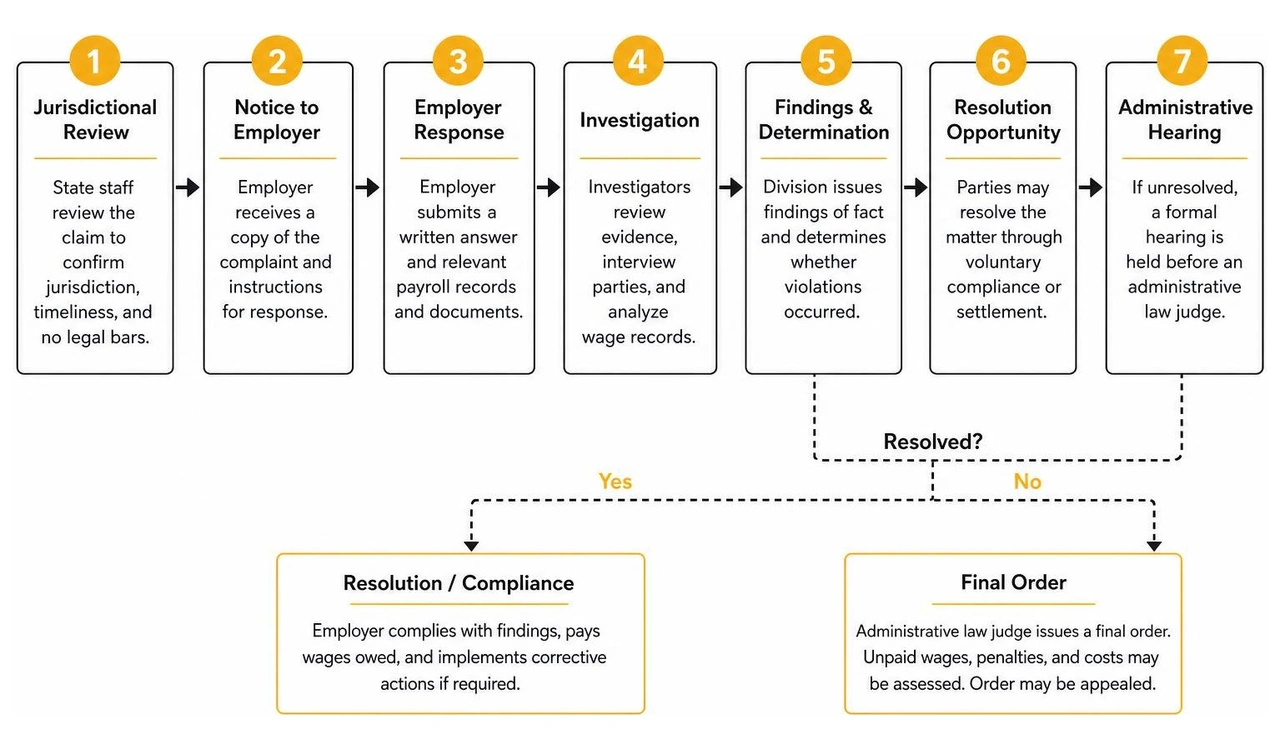
Once you submit your complaint form, the Michigan Wage and Hour Division initiates a structured administrative workflow governed by statutory guidelines in MCL Section 408.481.
Informal Resolution and Administrative Hearings
The administrative investigation follows a step-by-step sequence:
- Jurisdictional Review: State staff review your claim to confirm the work was performed in Michigan, the claim meets filing deadlines, and no active lawsuits or bankruptcy stays exist.
- Employer Notification & Investigation: The agency notifies your employer of the complaint and requests complete payroll and time records. Investigators process incoming cases on a first-in, first-out rotation.
- Informal Resolution: The division attempts to resolve the dispute informally through mediation or negotiation within a 90-day window.
- Written Determination: If an informal agreement cannot be reached within 90 days, the department issues an official written Determination detailing violations, back wages owed, and administrative penalties assessed.
- 14-Day Appeal Window: Either party (you or your employer) has exactly 14 calendar days from the date the Determination is issued to request an administrative review. If no appeal is filed, the determination becomes a final agency order.
- Administrative Hearing: If appealed, an independent Hearings Officer conducts a formal hearing, taking testimony and reviewing evidence under oath.
- Circuit Court Appeal: Final decisions issued by a Hearings Officer can be appealed to the appropriate Michigan Circuit Court (such as Oakland County, Wayne County, or Macomb County).
How Damages Are Calculated in a Michigan Wage and Hour Claim
When state investigators find a wage violation, remedies focus on making the employee whole. Recoverable damages can include:
- Back Pay: The exact monetary difference between what you were paid and what you were legally owed.
- 100% Liquidated Damages: Under certain statutory provisions (and under federal FLSA claims), employees may recover double back pay if the employer's wage violation was willful or lacked good faith.
- 5% Penalty Interest: State law allows assessing statutory interest on unpaid wages owed under Act 390.
- Civil Penalties: Employers who repeatedly violate wage laws face administrative fines payable to the state.
Important Insolvency Disclaimer: While the state agency can order your employer to pay, the Wage and Hour Division does not guarantee actual cash recovery. If an employer goes out of business, dissolves assets, or enters bankruptcy, collecting awarded wages can become challenging without secondary legal action.
Retaliation Protections and Legal Options
Many workers suffer in silence because they fear losing their job if they report unpaid wages. Michigan law explicitly prohibits employers from taking adverse actions against employees who assert their wage rights.

Under Section 13 of Act 390, an employer cannot discharge, discipline, demote, dock pay, or discriminate against an employee because the worker filed a complaint, voiced concerns about unpaid wages, or participated in an investigation. If you are dealing with employer pushback in Metro Detroit, our legal team provides specialized assistance for retaliation for wage complaints in Oakland County and surrounding areas.
Reporting Employer Retaliation
If your boss fires you or slashes your hours after you ask for your missing paycheck, you must act fast. You have a narrow 30-day window from the date of the retaliatory action to file a formal retaliation complaint with the Michigan Wage and Hour Division.
Filing an administrative retaliation claim creates crucial legal leverage. As discussed in our article on building leverage after a wage and hour complaint, proving retaliatory discharge can open the door to recovering lost future wages, reinstatement, emotional distress damages, and attorney fees.
You can also read our detailed analysis on using Michigan ESTA leave without fear of illegal termination.
State Claims vs. Federal FLSA Lawsuits
When recovering unpaid compensation, filing an administrative claim with the Michigan Wage and Hour Division is not your only option. You can also evaluate federal options under the Fair Labor Standards Act (FLSA) or file a private civil lawsuit in court.
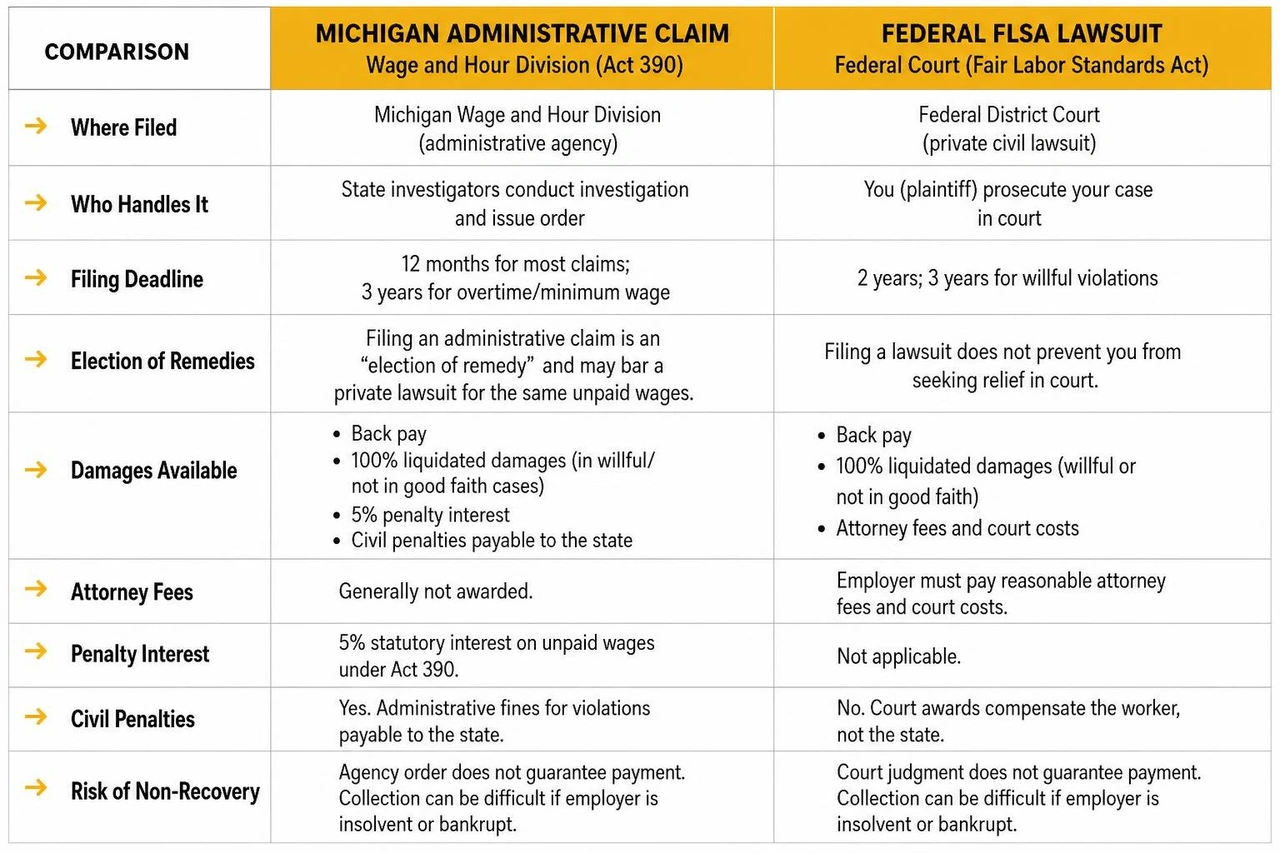
Understanding the distinctions between these paths is critical:
- Filing Deadlines: Michigan state wage claims carry a 12-month limit (3 years for overtime/minimum wage), whereas federal FLSA claims have a 2-year statute of limitations (extended to 3 years for willful violations).
- Election of Remedies: Under Michigan law, filing a formal administrative claim under Act 390 is considered an "election of remedy." This means if you submit a claim through the state agency, you may be legally precluded from filing a separate private lawsuit in court for the exact same unpaid wages.
- Damages Available: Private court lawsuits under the FLSA or state law often allow workers to pursue mandatory double damages (100% liquidated damages) and demand that the employer pay all legal fees and court costs.
Before picking a path, speaking with an experienced attorney ensures you select the forum that maximizes your financial recovery.
Frequently Asked Questions
What happens if my employer files for bankruptcy or if I already sued them?
The Michigan Wage and Hour Division loses administrative jurisdiction over your claim if your employer files for bankruptcy or if you have already filed a civil lawsuit in court for the same unpaid wages. Bankruptcy triggers an automatic legal stay, meaning wage claims must be submitted through federal bankruptcy court proceedings. Similarly, if you have already filed a lawsuit or obtained a court judgment, state administrative investigators cannot take on your case.
Can my employer deduct money for broken equipment or cash register shortages?
Under Michigan law, employers are strictly prohibited from deducting money from your paycheck for cash register shortages, customer walkouts, damaged inventory, or broken tools without your full, free, and voluntary written consent obtained at the time of the deduction. An employer cannot force you to sign a blank deduction agreement upon hire.
Even with written consent, deductions for overpayments or errors cannot exceed 15% of your gross pay per pay period, nor can any deduction drop your effective pay rate below the state minimum wage.
Does the state guarantee I will receive my money if my claim is successful?
No. The State of Michigan investigates complaints and orders non-compliant employers to pay, but it does not guarantee actual financial recovery. If an employer hides assets, operates under an dissolved LLC, or lacks financial solvency, collecting the owed funds requires post-judgment collection efforts, garnishments, or legal enforcement.
Conclusion
Navigating a Michigan wage and hour claim can feel daunting, but you do not have to fight wage theft alone. State law provides strong protections for workers who are denied earned compensation, but strict statutory deadlines mean that waiting too long can cost you everything you are owed.
If you are looking for an employment attorney in Bingham Farms, MI or searching across Metro Detroit—including Birmingham, Southfield, Royal Oak, Farmington Hills, Troy, or Detroit—Scott Batey Law is ready to stand by your side. With over 25 years of dedicated experience representing workers in wage theft, overtime disputes, and illegal retaliation, our firm delivers personalized, aggressive legal representation.
Whether you need assistance evaluating an administrative wage complaint or want to pursue a direct wage recovery lawsuit, contact a Metro Detroit wage and overtime attorney at Scott Batey Law today to protect your paycheck and enforce your rights under the law.