
Sick and Tired of Retaliation: Your Guide to Michigan FMLA Protections

FMLA Retaliation in Michigan: What to Do First
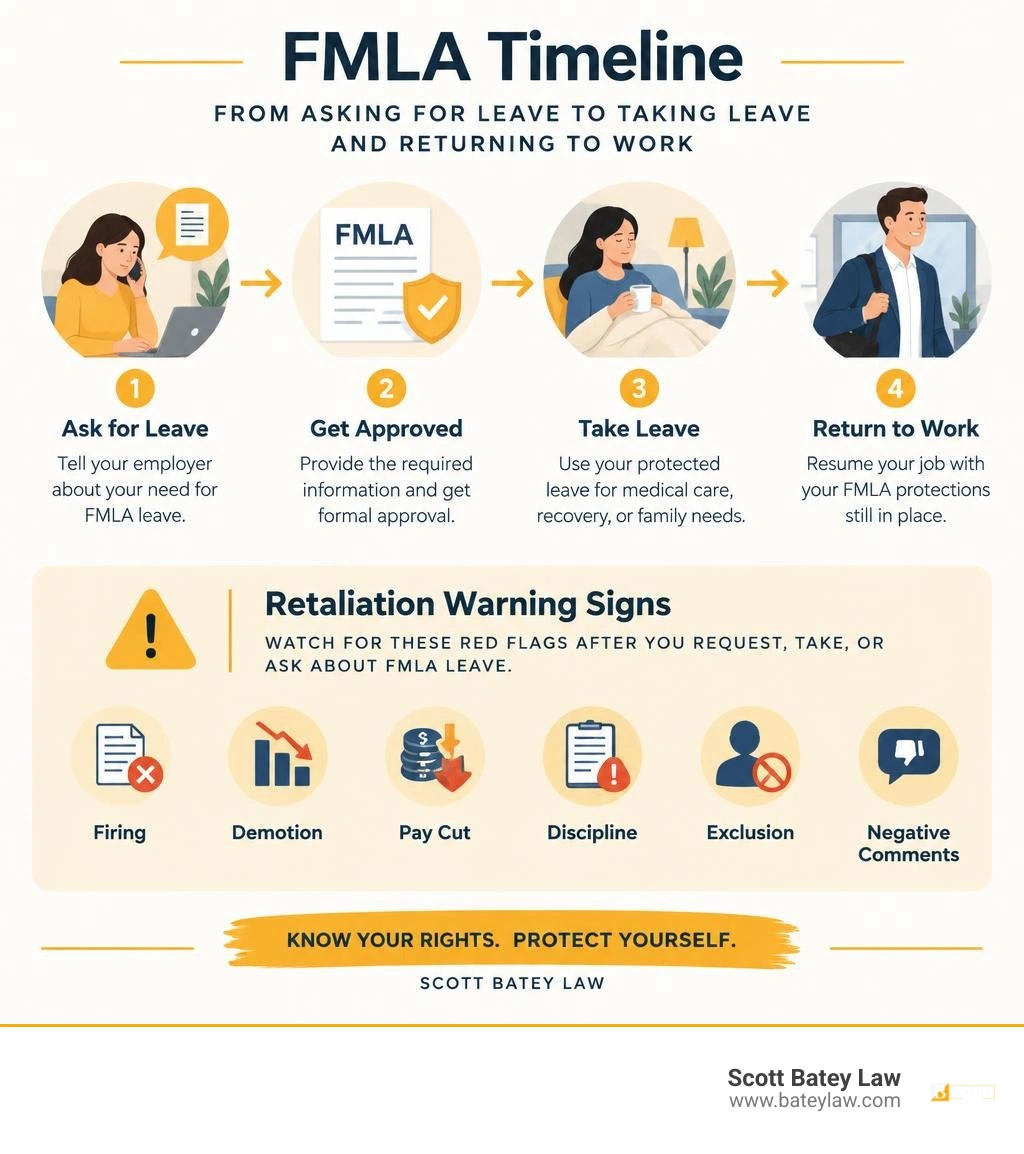
FMLA retaliation in Michigan can happen when an employer punishes you for asking about, requesting, or taking protected medical or family leave. Firing, demotion, a pay cut, or discipline tied to your leave may be retaliation. Save your leave requests, HR messages, performance reviews, and a dated record of what changed. Most FMLA lawsuits must be filed within two years; the deadline may extend to three years for a willful violation.
You do not have to wait until you return from leave to have protection. Under a 2026 Sixth Circuit ruling, even asking HR for FMLA paperwork can be protected activity. This guide explains how to spot retaliation, distinguish it from interference with your leave rights, and protect your claim.
I'm Scott Batey, and I've represented workers facing FMLA retaliation in Michigan and other employment disputes since 1996. Let's start with the difference between retaliation and interference.
Discover more about fmla retaliation michigan:
Understanding FMLA Retaliation in Michigan vs. Interference
When an employer reacts poorly to a medical crisis, workers often assume any unfair treatment falls under one broad legal violation. Under the Family and Medical Leave Act (FMLA), however, federal law creates two distinct legal claims: interference and retaliation. Knowing which theory applies to your situation is essential for building a winning case.
| Legal Claim | Governing Statute | Core Legal Question | Is Employer Intent Required? | Key Proof Elements |
|---|---|---|---|---|
| FMLA Interference | 29 U.S.C. § 2615(a)(1) | Did the employer deny, obstruct, or interfere with a benefit the worker was entitled to receive? | No (Strict Liability standard) | 1. Eligible employee 2. Covered employer 3. Right to leave 4. Notice given 5. Benefit denied/burdened |
| FMLA Retaliation | 29 U.S.C. § 2615(a)(2) | Did the employer take an adverse action against the worker because they exercised FMLA rights? | Yes (Discriminatory / Retaliatory Motive) | 1. Protected activity 2. Employer knowledge 3. Adverse employment action 4. Causal connection |
Understanding FMLA interference vs retaliation in Michigan helps preserve your rights and focus on the correct evidence from day one.
FMLA Interference vs. Retaliation: The Critical Legal Distinction
The statutory divide lies between 29 U.S.C. § 2615(a)(1) and § 2615(a)(2).
- FMLA Interference (§ 2615(a)(1)): Makes it unlawful for any employer to interfere with, restrain, or deny the exercise of (or attempt to exercise) any FMLA right. In interference claims, the employer’s intent is irrelevant. If you were eligible, provided sufficient notice, and your employer miscalculated your hours, refused to reinstate you to an equivalent position, or pressured you to perform work tasks while on leave, they violated the statute.
- FMLA Retaliation (§ 2615(a)(2)): Prohibits employers from discharging or discriminating against employees for opposing unlawful practices or exercising their statutory leave rights. Retaliation turns entirely on motive. We must demonstrate that the employer’s adverse decision was driven by an intent to punish you for asserting your leave rights.
Common Employer Actions That Qualify as FMLA Retaliation in Michigan
Retaliation rarely arrives with an explicit admission from human resources. Instead, it surfaces through targeted workplace actions after you make your request or return to work. Common retaliatory behaviors include:
- Wrongful Termination: Firing an employee immediately before, during, or shortly after their medical leave.
- Retaliatory Demotion: Stripping supervisory duties, demoting job titles, or assigning undesirable tasks under the guise of "restructuring."
- Sudden Negative Evaluations: Issuing poor performance ratings or disciplinary write-ups to an employee with a spotless prior record.
- Salary and Compensation Reductions: Cutting hourly wages, eliminating guaranteed pay draws, or stripping commission opportunities.
- Unfavorable Shift Reassignments: Moving a worker from a standard day shift to an undesirable overnight or weekend rotation.
- Hostile Work Environment: Subjecting an employee to targeted micro-management, ostracization, or negative remarks about taking leave.
Recognizing these FMLA retaliation in Michigan red flags is critical if you were fired after medical leave in Michigan and suspect management used your health as an excuse to let you go.
Proving FMLA Retaliation Under Sixth Circuit Precedent

Federal employment lawsuits in Michigan fall under the jurisdiction of the U.S. Court of Appeals for the Sixth Circuit. The Sixth Circuit maintains specific evidentiary standards for employees asserting retaliation claims based on circumstantial evidence.
What Constitutes Protected Activity Under Recent Rulings
To establish a retaliation claim, you must first prove that you engaged in an FMLA-protected activity. Historically, employers argued that an employee had not engaged in protected activity until they formally submitted completed medical certifications signed by a physician.
The legal landscape offers broader protections for workers. As highlighted in a major Sixth Circuit ruling on FMLA paperwork requests, simply asking human resources or your manager for FMLA paperwork qualifies as protected activity.
Under this precedent:
- You do not have to be currently eligible for leave on the exact day you ask.
- You do not have to return the completed form immediately to trigger statutory protection.
- You do not have to provide an immediate medical diagnosis during that initial inquiry.
The court recognized that allowing employers to fire employees the moment they inquire about leave forms would create a loophole that undermines the entire statute.
The McDonnell Douglas Burden-Shifting Framework and Causal Evidence
Because employers rarely admit they fired someone over medical leave, courts evaluate circumstantial evidence using the McDonnell Douglas burden-shifting framework:
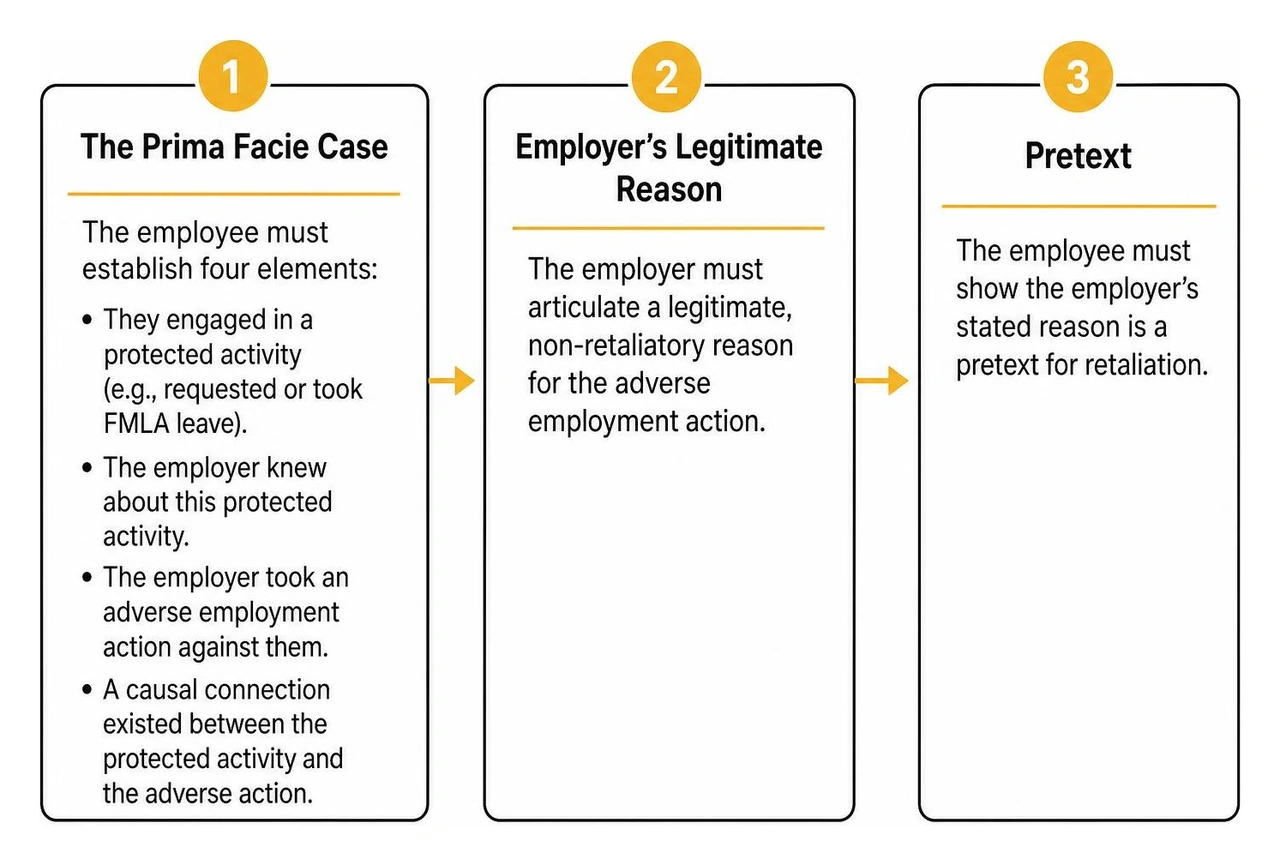
- The Prima Facie Case: The employee must establish four elements:
- They engaged in a protected activity (e.g., requested or took FMLA leave).
- The employer knew about this protected activity.
- The employer took an adverse employment action against them.
- A causal connection existed between the protected activity and the adverse action.
- Legitimate, Non-Discriminatory Reason: If the worker establishes a prima facie case, the burden shifts to the employer to articulate a lawful business justification for the adverse action (such as performance issues, company-wide layoffs, or policy violations).
- Pretext for Discrimination: The burden shifts back to the employee to prove the employer's stated rationale is a pretext—a cover-up for unlawful retaliation.
In Michigan federal courts, demonstrating temporal proximity—how closely the adverse action followed the protected request—serves as crucial circumstantial proof. As analyzed in Groening v. Glen Lake Community Schools, courts scrutinize employer timelines, shifting justifications, and sudden disciplinary escalations when evaluating pretext. Knowing these red flags for being fired after medical leave can help you identify when an employer's stated reason does not match the facts.
Constructive Discharge in FMLA Retaliation in Michigan Cases
An employer does not have to hand you an official pink slip to commit retaliation. In some cases, management intentionally creates intolerable working conditions to force an employee to quit. This is known as constructive discharge.
To prove constructive discharge in Michigan, an employee must demonstrate that:
- The employer deliberately created working conditions so intolerable that a reasonable person in the employee’s shoes would feel compelled to resign.
- The employer acted with the intent of forcing the worker out, or could reasonably foresee that the employee would resign.
A primary example of this principle within the Sixth Circuit is Hurtt v. International Services, Inc.. In that case, an employee experiencing severe depression and sleep disorders requested a reasonable schedule accommodation and FMLA leave. In response, the employer abruptly terminated his guaranteed $70,000 annual salary draw, placing him on a commission-only structure that immediately plunged him into a $22,751.93 pay deficit.
The Sixth Circuit reversed the district court's dismissal, ruling that slashing an employee’s compensation structure and refusing accommodations after a medical leave request creates conditions sufficient to support a constructive discharge claim.
Interplay Between FMLA, ADA, PWDCRA, and Michigan Civil Rights Laws
FMLA retaliation rarely occurs in a vacuum. When an employee takes leave for a serious health condition, their underlying medical diagnosis often qualifies as a disability under state and federal anti-discrimination laws.
When we evaluate cases at Scott Batey Law, we analyze how multiple statutes work together:
- The Americans with Disabilities Act (ADA): While the FMLA provides 12 weeks of job-protected leave, the ADA requires employers to provide "reasonable accommodations" to qualified individuals with disabilities, which can include extended medical leave or modified schedules beyond the standard 12-week FMLA allotment.
- Persons with Disabilities Civil Rights Act (PWDCRA): Michigan’s state-level disability statute (MCL 37.1101 et seq.) mirrors federal ADA protections and protects workers against disability discrimination across our state, including in Oakland County, Wayne County, and surrounding communities.
- Elliott-Larsen Civil Rights Act (ELCRA): Michigan's ELCRA (MCL 37.2101 et seq.) covers discrimination based on sex, pregnancy, familial status, and other protected classes.
Employers must navigate these overlapping statutes carefully. For instance, in Tanner v. Stryker Corporation of Michigan, the court examined how attendance policies and leave categories apply to pre-birth absences. Navigating these interactions requires an experienced FMLA and ADA lawyer in Bingham Farms who can identify every applicable claim.
Damages, Willfulness, and Statutes of Limitations in Michigan
When an employer violates federal leave laws, the financial remedies available to workers are designed to make them whole while penalizing bad-faith behavior:
- Back Pay: Compensation for all lost wages, salary, overtime, and employment benefits from the date of wrongful termination or demotion up to the date of settlement or trial judgment.
- Front Pay: Future lost wages awarded when reinstatement to your old position is not feasible due to workplace hostility.
- Liquidated Damages: Under the FMLA, a prevailing employee is statutorily entitled to liquidated damages equal to double the amount of back pay plus interest, unless the employer can prove it acted in good faith with reasonable grounds for believing its actions complied with the law.
- Attorneys’ Fees and Court Costs: The FMLA mandates that an employer found liable must pay the employee’s reasonable attorney fees and litigation expenses.
Because retaliation requires showing intentional, retaliatory motive, building your case around retaliation naturally strengthens your claim for statutory liquidated damages.
The general statute of limitations for filing an FMLA claim is two years from the date of the unlawful conduct. If we prove the employer acted willfully—meaning management knew its conduct violated federal law or showed reckless disregard for your statutory rights—the filing deadline extends to three years. Contacting an experienced Michigan FMLA attorney as soon as adverse action occurs protects your claim from expiring.
Actionable Steps to Take If You Experience Medical Leave Retaliation

If you suspect management is penalizing you for taking medical leave, take these steps to protect your rights:
- Preserve All Written Communications: Save copies of leave requests, medical certifications, FMLA notices, approval letters, and email or text exchanges with HR or supervisors. Forward these records to a secure personal email or print physical copies.
- Secure Your Performance History: Gather prior annual evaluations, written commendations, client reviews, and pay stubs showing your track record before you requested leave.
- Keep a Contemporaneous Log: Maintain a detailed, dated journal of every retaliatory incident, negative comment, shift change, or meeting with management.
- Follow Company Complaint Procedures: If safe to do so, file a written complaint with HR detailing the retaliatory treatment you are facing. This creates an official paper trail establishing that the company was notified.
- Do Not Sign Severance Agreements Immediately: Employers often offer departing workers release agreements that waive all federal and state FMLA claims in exchange for modest severance pay. Never sign without having an attorney review the agreement first.
For personalized guidance across Southeast Michigan, working with an FMLA lawyer in Oakland County, MI helps ensure your evidence is properly gathered and preserved.
Frequently Asked Questions About Medical Leave Rights
Is asking for FMLA paperwork alone considered protected activity?
Yes. Under Sixth Circuit law, simply asking human resources or your supervisor for FMLA paperwork constitutes protected activity. You do not need to be currently eligible for leave or have an immediate medical certification in hand at the moment of your request to be protected from retaliation.
How long do I have to file an FMLA retaliation lawsuit in Michigan?
Under federal law, you have two years from the date of the retaliatory action to file a lawsuit in court. If your employer acted willfully, the statute of limitations extends to three years.
Can an employer use a no-fault attendance policy against FMLA leave?
No. Federal regulations explicitly prohibit employers from counting protected FMLA absences as points or occurrences under "no-fault" attendance systems. Learn more about how attendance point systems violating FMLA protections breach federal leave laws.
Conclusion
Facing workplace retaliation while managing a serious health condition or caring for an ailing family member is exhausting. Federal and Michigan laws protect you from being penalized for asserting your medical leave rights.
At Scott Batey Law, we bring more than 25 years of focused employment litigation experience to workers across Bingham Farms, Birmingham, Troy, Southfield, Royal Oak, and throughout Oakland County and Metro Detroit. If you believe your employer punished you for taking medical leave, contact a dedicated retaliation lawyer in Birmingham, MI today for a confidential evaluation of your case.