.png)
Navigating a Hostile Work Environment Law Firm Without Losing Your Mind

When Your Employer Is Also Your Harasser: Recognizing a Hostile Work Environment Law Firm
If you work at a hostile work environment law firm, you already know that something is deeply wrong — but you may not know whether what you're experiencing is illegal.
Here's a quick answer to help you decide:
Signs you may be in a legally actionable hostile work environment at a law firm:
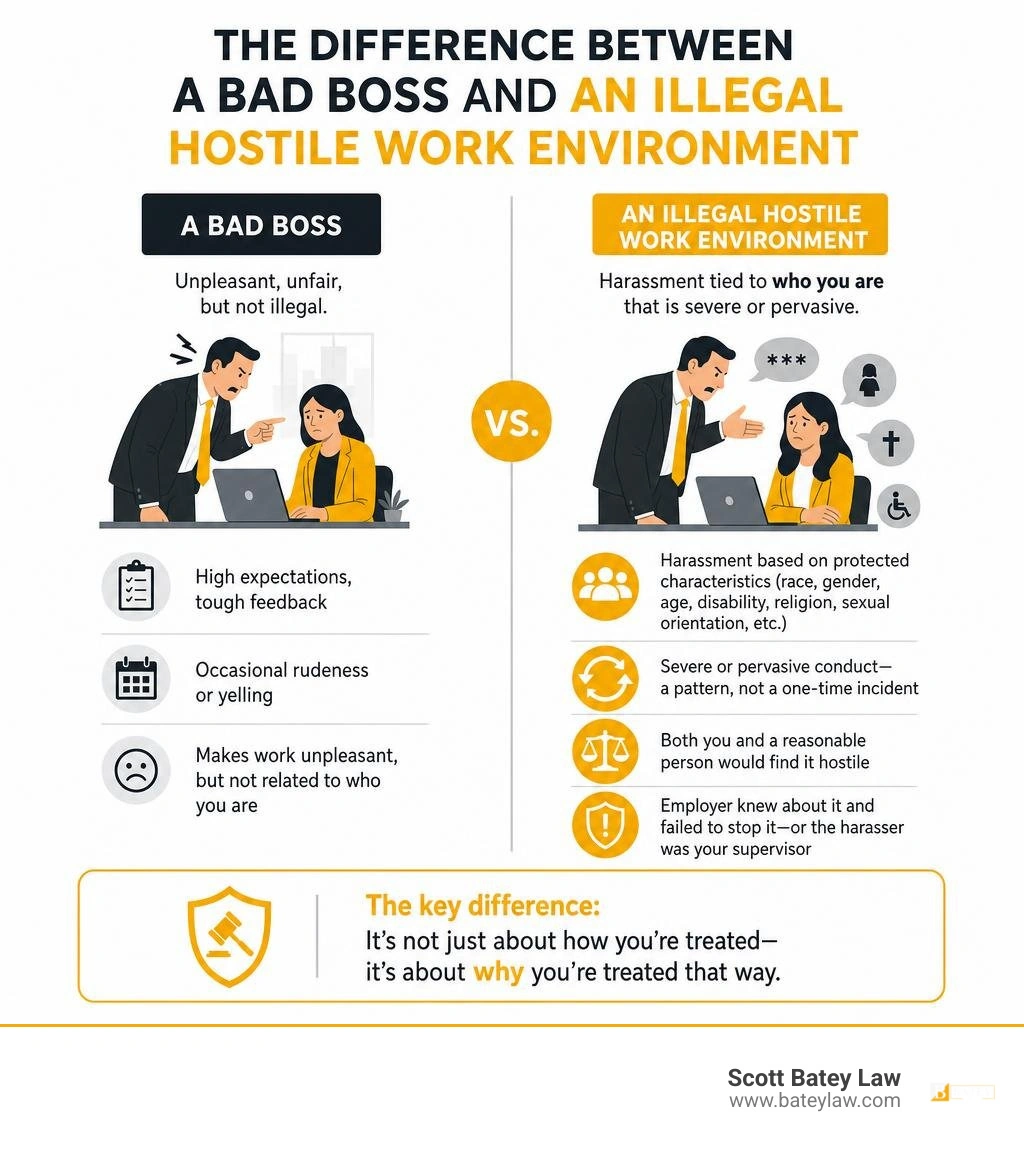
- Harassment is tied to a protected characteristic — such as your race, gender, age, disability, religion, or sexual orientation
- The conduct is severe or pervasive — not just a bad day or a rude partner, but a pattern that alters your ability to do your job
- Both you and a reasonable person would find it hostile — courts apply both a subjective and an objective standard
- Your employer knew about it and failed to stop it — or the harasser was your supervisor
A difficult boss is not automatically illegal. Mistreatment tied to who you are under the law is a different matter entirely.
Law firms present a unique challenge. The power imbalance between partners and associates is steep. Retaliation can feel career-ending. And the very people who should protect you often protect the institution instead. These dynamics make it harder to speak up — but they don't change your legal rights.
I'm Scott Batey, a Michigan employment lawyer who has spent nearly three decades representing employees facing workplace discrimination, harassment, and retaliation — including those working inside law firms and professional service environments. I understand the specific pressures that come with a hostile work environment law firm situation, and I'm here to help you make sense of your options before the situation gets worse.
What Legally Constitutes a Hostile Work Environment?
To successfully hold a hostile work environment law firm accountable, we must look past office politics and focus on the strict legal definitions. Under federal law, such as Title VII of the Civil Rights Act of 1964, and Michigan state law, specifically the Elliott-Larsen Civil Rights Act (ELCRA), a hostile work environment is not merely a place where people are rude, demanding, or yell about billable hours.
Instead, the hostility must be directly linked to a protected class. Furthermore, the offensive behavior must cross a specific legal threshold: it must be so "severe or pervasive" that it alters the terms and conditions of your employment.
The table below highlights the crucial distinctions between a challenging workplace and an illegal one:
| Feature | A "Bad Boss" / Demanding Firm | Illegal Hostile Work Environment |
|---|---|---|
| Primary Driver | High standards, bad temper, or poor management skills. | Discrimination based on a legally protected characteristic. |
| Targeting | Equal-opportunity jerk; yells at everyone regardless of identity. | Targeted harassment aimed at specific protected groups. |
| Legal Status | Legal (though highly unpleasant and counterproductive). | Illegal under federal (Title VII) and Michigan state (ELCRA) laws. |
| Impact on Work | Stressful, but you can still technically complete your tasks. | Severe enough that a reasonable person would find it abusive. |
When courts analyze these cases, they look at both federal precedents and local statutes. For instance, in the landmark case Fitzgerald v. FORD MARRIN ESPOSITO WITMEYER, 153 F. Supp. 2d 219 (S.D.N.Y. 2001), the court examined how overheard sexual banter and offensive nicknames among law firm associates affected the workplace. While the court in that specific case ultimately set aside a jury verdict because the conduct did not meet the high threshold of severity, it highlighted how closely courts dissect the social context and frequency of the behavior.
More recently, in Gurley v. David H. Berg & Associates, No. 1:2020cv09998 (S.D.N.Y. 2022), a legal assistant alleged systemic discrimination, including selective policy enforcement and derogatory comments about her natural hair. The court's analysis demonstrated that while federal "severe or pervasive" standards are demanding, state and city laws often offer broader pathways to prove that an employee was treated "less well" due to discriminatory intent.
To dig deeper into these legal boundaries, you can read our detailed breakdown on Hostile Work Environment vs Bad Boss: Where the Law Draws the Line.
The Legal Threshold: Severe or Pervasive Conduct
To win a lawsuit against a hostile work environment law firm, you must prove the conduct was either severe or pervasive.
- Severe: A single, highly egregious incident can sometimes be enough to establish a claim. This includes physical assaults, direct threats of violence, or high-level discriminatory slurs used by a supervisor.
- Pervasive: This refers to a continuous, ongoing pattern of behavior. It is the cumulative effect of constant jokes, slurs, exclusionary behavior, and daily humiliation that makes the environment intolerable.
Courts evaluate the "totality of the circumstances" to decide if the behavior meets this threshold. They consider the frequency of the discriminatory conduct, its severity, whether it is physically threatening or humiliating, and whether it unreasonably interferes with your work performance. You can read more about how Michigan courts interpret these elements in our article on Hostile Work Environment in Michigan: What Actually Makes It Illegal.
Protected Characteristics and Discriminatory Harassment
For workplace harassment to be illegal, it must be motivated by bias against a protected characteristic. Under Michigan’s ELCRA and federal civil rights laws, these protected categories include:
- Race and National Origin: Derogatory comments, selective enforcement of rules, or allocating administrative burdens solely to minority employees. Statistics show this remains a massive issue: 48% of Black male workers and 36% of Black female workers have reported experiencing race-based discrimination or harassment at work.
- Gender and Sex: Including sexual harassment, pregnancy discrimination, and gender-based double standards.
- Age: Roughly 66% of workers over the age of 50 report witnessing or experiencing age discrimination in the workplace.
- Disability: Failing to accommodate or mocking physical or mental health conditions.
- Sexual Orientation and Gender Identity: Transgender employees face extreme vulnerability, being 6x more likely to experience workplace harassment than cisgender employees.
If the hostility you experience is not tied to one of these characteristics, it may be bullying, but it is likely not illegal discrimination. For a complete look at how these elements function together under state law, check out Hostile Work Environment in Michigan: Elements, Evidence, and Deadlines.
Spotting the Signs: Is Your Hostile Work Environment Law Firm Toxic?

Law firms are notorious pressure cookers, but some cross the line from demanding to toxic. The intense focus on billable hours, partner track competition, and rigid hierarchies can create a breeding ground for abuse.
Common Behaviors in a Hostile Work Environment Law Firm
In a toxic law firm, harassment often manifests in distinct ways:
- Verbal Abuse disguised as "Feedback": Partners screaming at associates, using personal insults, or humiliating them in front of clients and colleagues.
- Sexual Harassment: Inappropriate comments, unwanted advances, or a "boys' club" culture. While women file 78% of workplace sexual harassment claims, a staggering 72% of victims never report the abuse due to fear of devastating career damage.
- Systemic Exclusion: Purposely leaving certain associates out of key client meetings, trials, or professional development opportunities based on their protected characteristics.
- Weaponized Billing Metrics: Using performance standards selectively to punish or push out employees who have complained about mistreatment.
If you are facing sexual harassment or a deeply inappropriate culture, it is vital to know your rights and options before taking formal steps. Read our guide on Reporting Sexual Harassment at Work in Michigan: What to Do Before HR Calls You In.
How a Hostile Work Environment Law Firm Evades Accountability
Law firms are staffed by lawyers, meaning they know exactly how to protect themselves. They often employ sophisticated tactics to suppress complaints:
- HR as a Shield: Human Resources in a law firm is there to protect the partnership, not you. When you report harassment, they may quietly build a file of performance issues against you to justify a termination.
- Retaliation: This is the most common response to a complaint. In fact, retaliation accounted for 52% of all charges filed with the EEOC in 2024. This can include demotions, sudden negative performance reviews, or being stripped of cases.
- Constructive Discharge: Making your work life so miserable that you feel you have no choice but to quit.
Law firms also use complex organizational structures to escape federal liability. In Devine v. Stone, Leyton & Gershman, P.C., 100 F.3d 78 (8th Cir. 1996), the court examined whether attorney shareholder-directors counted as "employees" to meet the 15-employee threshold required for Title VII coverage. This case highlights how firms try to use corporate technicalities to avoid federal anti-discrimination laws.
Fortunately, Michigan's ELCRA covers employers with even a single employee, ensuring you have state-level protections regardless of the firm's size. If you suspect your firm is preparing to retaliate against you, prepare yourself by reading Retaliation After Reporting Harassment: The Michigan Employee Playbook.
Proving Your Case: Evidence, Liability, and Timelines
To successfully sue a hostile work environment law firm, you must meet a strict burden of proof. You must prove that the harassment occurred, that it was based on a protected characteristic, and that the employer is legally liable.
Under the law, employer liability depends on who did the harassing:
- Supervisor Harassment: If a partner or supervisor with direct authority over you creates the hostile environment, the employer is often held strictly liable. The employer can only escape liability if they can prove the Faragher-Ellerth defense: that they had a robust, working anti-harassment policy, and that you unreasonably failed to use it.
- Co-Worker or Third-Party Harassment: If the harasser is a fellow associate, paralegal, or client, the firm is liable only if they knew (or should have known) about the behavior and failed to take prompt, corrective action.
Documenting the Harassment Effectively
Your personal testimony is powerful, but objective, contemporaneous evidence is what wins cases.
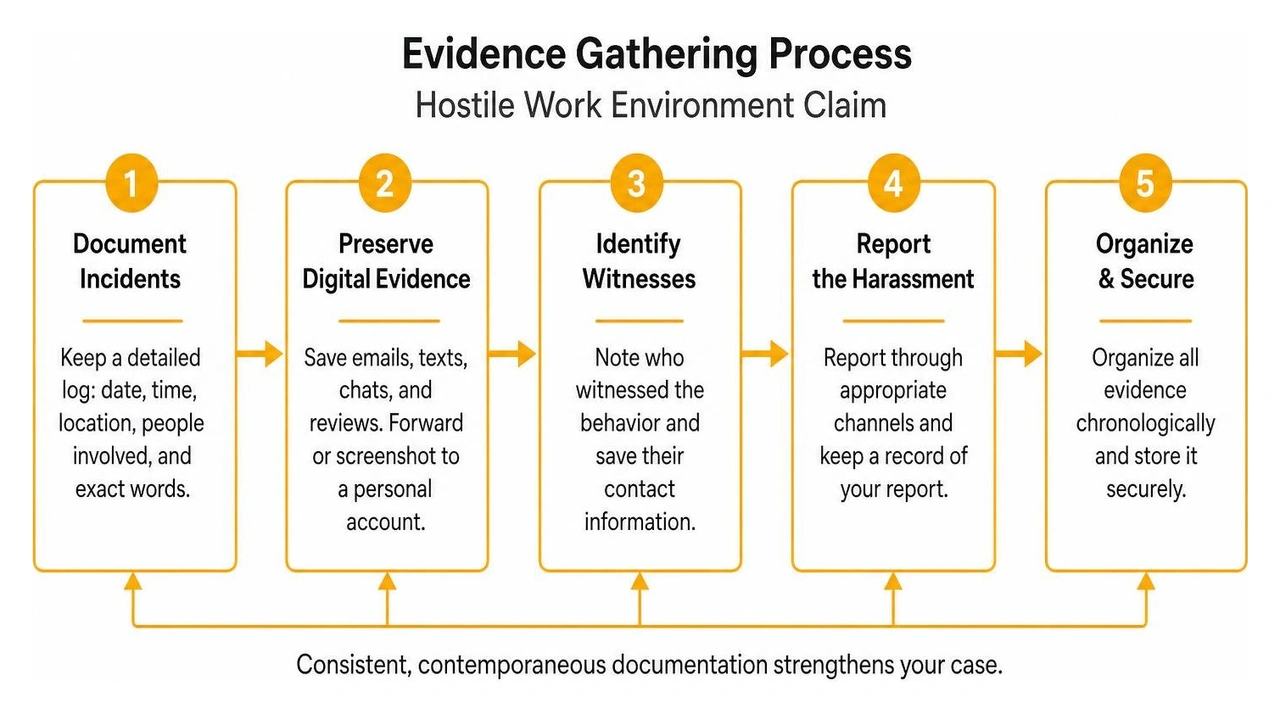
To build a strong case, we recommend following these steps:
- Keep a Private Log: Write down the date, time, location, individuals involved, and exact words spoken during every hostile incident. Keep this log on a personal device or notebook—never on your work computer.
- Preserve Digital Evidence: Save emails, text messages, Slack chats, and performance reviews. Forward these to a personal email address or take screenshots.
- Identify Witnesses: Note which colleagues witnessed the behavior and keep their personal contact information.
For a comprehensive checklist on how to gather this proof without violating firm policies, read Documenting Harassment the Right Way: Notes, Emails, and Screenshots MI.
Understanding Statutes of Limitations and Filing Deadlines
You cannot wait indefinitely to file a claim. If you choose to file an administrative complaint with the Equal Employment Opportunity Commission (EEOC), the standard federal deadline is 180 days from the date of the last discriminatory act. In Michigan, because we have a state agency (the Michigan Department of Civil Rights), this deadline is extended to 300 days.
Under Michigan's ELCRA, you have a much more generous window of three years to file a lawsuit directly in state court. However, waiting is never advisable, as evidence can disappear and memories fade.
If you are located in the metro Detroit area, consulting with a local specialist is critical to meeting these strict procedural deadlines. For representation in Southfield and surrounding areas, you can connect with a Hostile Work Environment Lawyer in Southfield MI to ensure your rights are fully protected.
Frequently Asked Questions About Toxic Workplaces
What is the difference between a bad boss and an illegal hostile work environment?
A bad boss is rude, makes unreasonable demands, or yells at everyone equally. While this creates a miserable office, it is not illegal. An illegal hostile work environment requires that the hostility be motivated by discriminatory animus toward a protected class (like race, gender, or age) and be severe or pervasive enough to alter your working conditions. Learn more by reading Hostile Work Environment vs Bad Boss: Drawing the Line in Michigan.
Can I sue for constructive discharge if I am forced to quit?
Yes. If the harassment and abuse at your firm are so severe that any reasonable person would feel compelled to resign, the law treats your resignation as a wrongful termination. This is known as constructive discharge. However, the legal bar for proving constructive discharge is incredibly high, which is why you should always consult an attorney before handing in your resignation. For residents in the Royal Oak area, we discuss these strategies in detail here: Hostile Work Environment Attorney in Royal Oak MI.
What damages can I recover in a hostile work environment lawsuit?
If you win your case, you may be entitled to several types of financial compensation:
- Back Pay and Front Pay: Lost wages and benefits from the time you were terminated or forced to quit.
- Compensatory Damages: Compensation for emotional distress, mental anguish, and loss of professional reputation.
- Punitive Damages: Awarded in federal cases to punish the employer if they acted with malice or reckless indifference. Under federal law, combined compensatory and punitive damages are subject to statutory caps ranging from $50,000 to $300,000 depending on the size of the firm.
- Attorney's Fees: The court may order the law firm to pay your legal fees.
Conclusion

Working at a hostile work environment law firm can make you feel isolated, stressed, and powerless. But remember: just because your employers are lawyers does not mean they are above the law. You have rights, and you do not have to endure discrimination or harassment to preserve your career.
At Scott Batey Law, we have spent over 25 years providing award-winning, personalized representation to workers across Michigan. Based in Bingham Farms, MI, we proudly serve clients in Birmingham, Southfield, Royal Oak, Troy, Detroit, and throughout Oakland County. We know the tactics toxic employers use, and we know how to beat them.
If you are ready to stand up for your rights and regain your peace of mind, contact us today. Let’s discuss your situation and outline a clear path forward. Read more about how we can support you: Hostile Work Environment Lawyer in Michigan: When Workplace Harassment Becomes Illegal.