
Navigating Justice with a Michigan Civil Rights Attorney
Finding the Right Michigan Civil Rights Attorney
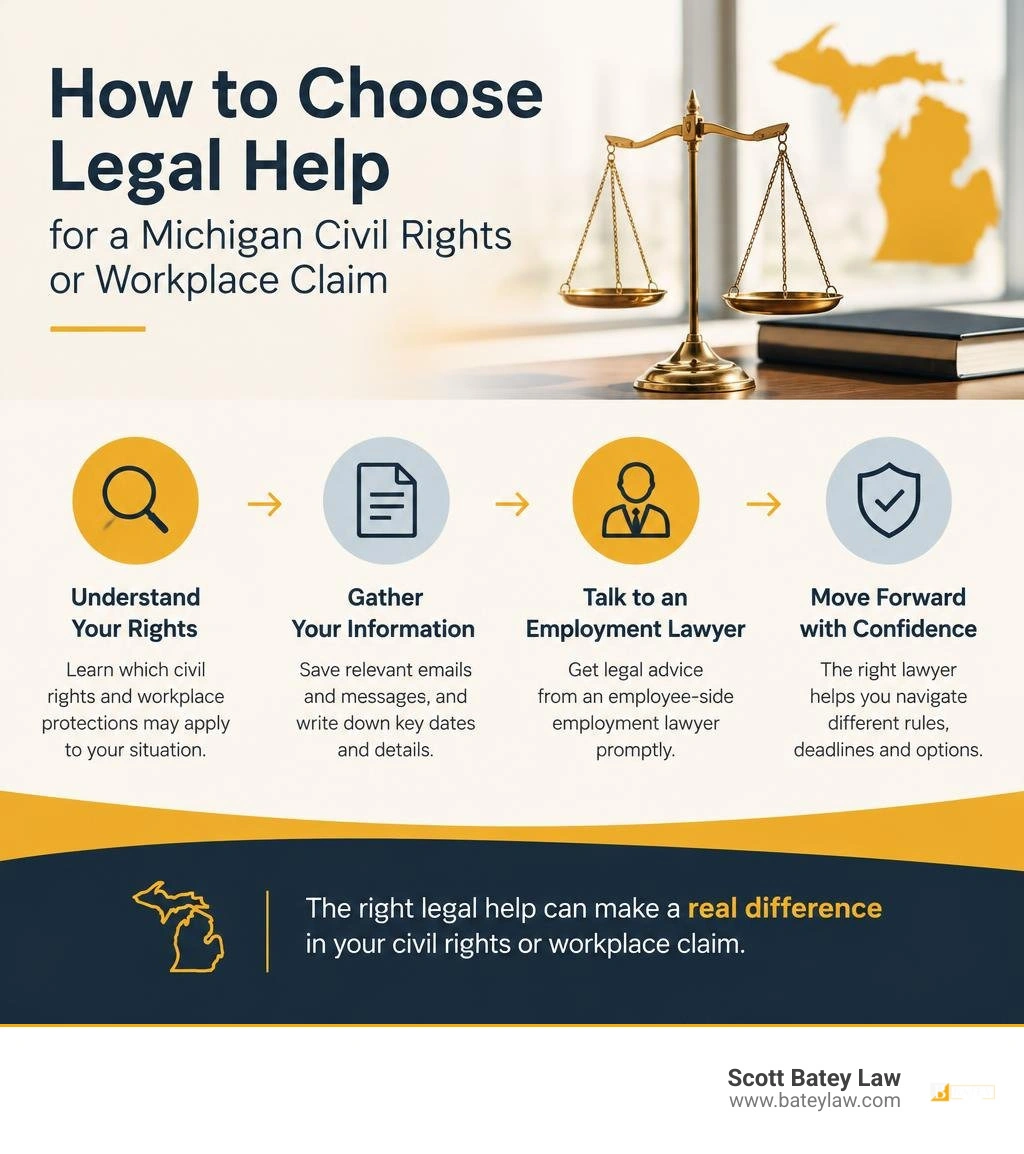
A Michigan civil rights attorney can help you assess a rights violation, but the right lawyer depends on what happened. If the problem is at work, save relevant emails and messages, write down key dates, and speak with an employee-side employment lawyer promptly. Discrimination, harassment, retaliation, and wrongful termination claims can have different rules and deadlines.
I'm Scott Batey, an employment lawyer who has represented Michigan workers since 1996. If your search for a "michigan civil rights attorney" began with a workplace problem, the sections below will help you understand which protections may apply.
Michigan civil rights attorney further reading:
What Does a Michigan Civil Rights Attorney Do?
When people hear the term "civil rights," they often picture grand historical movements or intense courtroom battles. In everyday practice across Michigan—from Detroit to Oakland County communities like Birmingham, Southfield, and Troy—civil rights law focuses on holding powerful institutions accountable when they abuse their authority or violate basic legal guarantees.
At its core, civil rights law breaks down into two distinct avenues: constitutional enforcement against government actors and statutory protections against private discrimination. When government officials violate your rights under the color of law, federal law provides a specific remedy under 42 U.S.C. § 1983. This statute allows individuals to bring lawsuits against police officers, prison staff, state officials, and municipalities for constitutional infringements like excessive force, unlawful search and seizure, or due process violations.
In contrast, statutory civil rights laws protect individuals against wrongful treatment by private entities, such as private employers or landlords. Understanding which framework governs your dispute is the first step toward seeking justice.
| Feature | Federal Section 1983 Claims | Michigan State Civil Rights Claims (ELCRA) |
|---|---|---|
| Primary Focus | Constitutional rights violations by government officials | Unlawful discrimination and harassment |
| Who Can Be Sued? | State actors, police, municipalities, agencies | Private employers, business entities, labor unions |
| Legal Basis | U.S. Constitution (4th, 8th, 14th Amendments) via § 1983 | Elliott-Larsen Civil Rights Act |
| Key Hurdles | Qualified immunity, municipal custom standards (Monell) | Proving disparate treatment, pretext, and causation |
| Common Relief | Compensatory damages, injunctive relief, punitive damages | Back pay, front pay, emotional distress damages, attorney fees |
Defending First Amendment Freedoms and Protester Rights
The right to assemble peacefully and speak out against government policy sits at the heart of our democracy. Yet activists, organizers, and everyday citizens frequently face unlawful arrests, excessive force, or retaliatory charges while exercising these freedoms on public streets.
Civil rights advocates step into these moments to defend political activists who engage in civil disobedience. Securing preliminary injunctions against police departments and pursuing damages for unconstitutional arrests ensures that law enforcement cannot arbitrarily suppress public dissent. Whether addressing unconstitutional curfews in Detroit or wrongful detentions during community protests, holding state actors accountable preserves free expression for everyone. In many situations, individuals arrested during peaceful protests also face retaliatory fallout at their jobs, requiring guidance from a skilled civil rights employment attorney to protect their livelihoods.
Challenging Government Entities and Official Misconduct
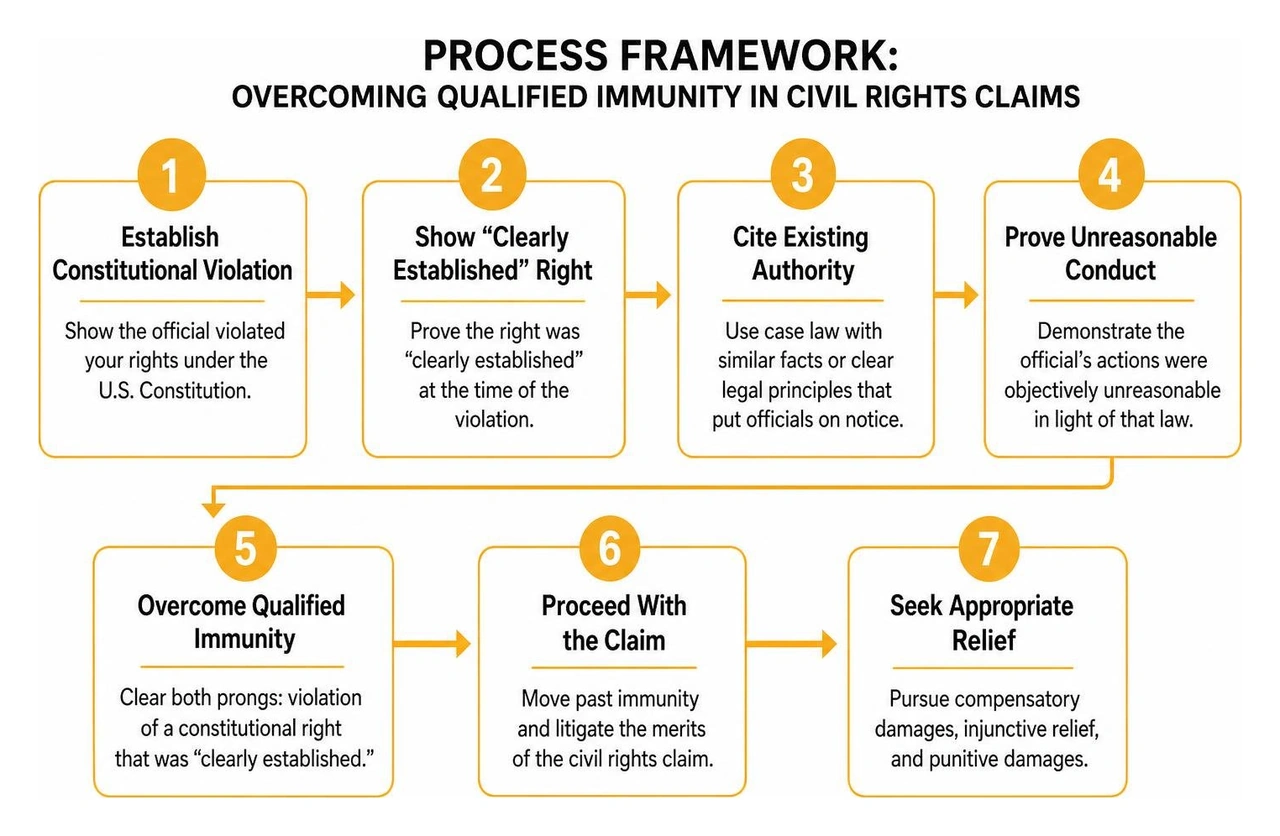
Taking on government agencies requires navigating complex legal hurdles, chief among them the doctrine of qualified immunity. This doctrine shields public officials from civil liability unless a plaintiff can prove that the official violated a "clearly established" statutory or constitutional right. Overcoming this defense demands deep constitutional knowledge and precise litigation strategies.
Civil rights litigators tackle egregious forms of state misconduct, including:
- Malicious Prosecution: Pursuing state actors who initiate criminal proceedings without probable cause and with malicious intent.
- Wrongful Convictions: Exposing coerced confessions, withheld exculpatory evidence, and procedural misconduct that rob innocent people of their freedom.
- Prisoner Rights and Failure to Protect: Holding correctional facilities accountable for cruel and unusual punishment, inadequate medical care, or catastrophic administrative neglect.
Case Study: Landmark Civil Rights Litigation in Michigan
To understand the transformative power of constitutional advocacy in Michigan, one can examine landmark legal battles across the state. As highlighted in constitutional scholarship and legal studies at Wayne Law, dedicated civil rights litigation has played a vital role in championing constitutional rights, environmental justice, and institutional accountability.
Michigan legal history demonstrates how strategic legal advocacy can shatter traditional barriers in constitutional law, establishing precedents that protect citizens against government overreach and systemic neglect.

Flint Water Crisis and Constitutional Precedents
Among the most significant legal battles in modern Michigan history is the Flint water crisis litigation. When government officials switched the city's water source to the corrosive Flint River without proper corrosion control, thousands of residents were exposed to toxic levels of lead and other contaminants.
Litigating against the state presented massive sovereign immunity defenses. However, civil rights advocates achieved a historic victory before the Michigan Supreme Court. The court ruled that the State of Michigan could be held directly liable for damages under the substantive due process clause of the Michigan Constitution. This groundbreaking precedent affirmed that citizens possess a constitutional right to bodily integrity that the state cannot violate with deliberate indifference. In addition to state constitutional claims, litigators pursued federal accountability against the Environmental Protection Agency (EPA) under the Federal Tort Claims Act for its failure to intervene, setting a standard for environmental justice litigation nationwide.
How Civil Rights Litigation Challenges Systemic Injustice
Throughout Michigan's legal history, landmark civil rights cases have demonstrated how tenacity and meticulous trial preparation translate into systemic reform and accountability:
- Substantive Due Process Precedents: Establishing direct state liability when government actions endanger public health and fundamental bodily integrity.
- Injunctions and Policy Reform: Securing court-ordered preliminary injunctions that restrict unlawful crowd-control tactics and protect constitutional rights.
- Strategic Discovery: Uncovering internal communications and government memos to dismantle official narratives and defeat immunity defenses.
- Community Impact: Reinforcing that courtroom victories must align with broader community advocacy to ensure long-term protections for the public.
Civil Rights in the Workplace: Protecting Employees Under State Law
While high-profile police misconduct and constitutional cases dominate headlines, civil rights violations occur just as frequently inside office buildings, retail centers, and manufacturing plants across Oakland County and Southeast Michigan.
When an employer treats an employee unfairly because of who they are, that is not merely bad management—it is a direct violation of civil rights law. Navigating ELCRA discrimination claims in Michigan requires proving that an adverse employment decision was motivated by unlawful bias rather than legitimate business reasons.
At Scott Batey Law, we have spent more than 25 years fighting for Michigan employees facing workplace bias, harassment, and retaliation. Workplace civil rights protections ensure that your livelihood is never contingent upon enduring discrimination.
When to Consult a Michigan Civil Rights Attorney for Workplace Injustice
Workers often hesitate to call an attorney because they aren't sure if their mistreatment crosses the legal threshold. Consulting an experienced workplace discrimination lawyer in Bingham Farms, Michigan is crucial the moment you suspect your employment status is in jeopardy due to discrimination or reporting misconduct.
You should seek legal counsel immediately if you experience:
- Wrongful Termination: Being fired, laid off, or demoted under pretextual reasons when the real motivator is race, sex, age, disability, or religion.
- Hostile Work Environment: Enduring severe or pervasive harassment that management knows about but refuses to correct.
- Retaliation for Whistleblowing: Facing pay cuts, disciplinary write-ups, or termination after reporting illegal corporate conduct or health violations, as protected by the Michigan Whistleblowers' Protection Act.
- Failure to Accommodate: When an employer arbitrarily denies reasonable adjustments for physical limitations or sincere religious practices.
Protections Under the Elliott-Larsen Civil Rights Act and ADA
Michigan workers enjoy robust protections under state and federal statutes designed to eliminate employment bias:
- The Elliott-Larsen Civil Rights Act (ELCRA): Prohibits discrimination in employment, housing, and public accommodations based on race, color, religion, national origin, sex, age, marital status, height, weight, sexual orientation, and gender identity or expression.
- The Americans with Disabilities Act (ADA) & Persons with Disabilities Civil Rights Act (PWDCRA): Requires employers to provide reasonable accommodations to qualified individuals with disabilities unless doing so creates an undue hardship. Consulting a qualified Michigan disability discrimination lawyer helps ensure your medical needs are respected without risking your career.
By holding employers accountable under these state and federal frameworks, we ensure that workplace civil rights are vigorously defended throughout Bingham Farms, Royal Oak, Ferndale, Southfield, and surrounding communities.
Frequently Asked Questions About Civil Rights Claims in Michigan
What is the primary difference between a Section 1983 claim and an ELCRA claim?
The primary difference lies in who committed the violation and the legal basis of the claim. A Section 1983 claim applies to government actors (such as police officers, public school officials, or municipal agencies) who violate your constitutional rights under the color of law. In contrast, the Elliott-Larsen Civil Rights Act (ELCRA) applies broadly to private employers, businesses, and institutions, prohibiting discrimination based on protected characteristics regardless of state action.
What legal precedent was established in the Flint water crisis litigation?
The Michigan Supreme Court established that state government entities and officials can be held directly liable for monetary damages under the substantive due process clause of the Michigan Constitution. The court recognized that the constitutional right to bodily integrity protects citizens against state-created dangers when officials act with deliberate indifference to public health and safety.
What should individuals document if their civil rights have been violated?
To build an effective civil rights or employment claim, gather and preserve the following evidence immediately:
- A detailed chronological timeline of all relevant events, meetings, and incidents.
- Copies of relevant emails, text messages, voicemails, performance reviews, or written disciplinary warnings.
- Contact information for witnesses, including coworkers, bystanders, or third parties who observed the misconduct.
- Documentation of complaints submitted to HR, management, or internal oversight bodies, along with the employer's response.
Conclusion
Whether challenging government overreach in constitutional litigation or defending workers against illegal workplace bias, civil rights laws exist to ensure dignity, equality, and accountability. As landmark litigation across Michigan has proven, courageous plaintiffs and dedicated attorneys can reshape legal standards and hold even the most powerful entities responsible.
If you are facing discrimination, retaliation, or wrongful termination in the workplace, you do not have to fight alone. With over 25 years of dedicated advocacy across Bingham Farms, Detroit, and the greater Oakland County area, our team is ready to stand by your side. Contact Scott Batey Law today for experienced workplace discrimination legal representation under ELCRA and take the first step toward securing the justice you deserve.