.png)
FMLA in Michigan: What You Need to Know About Job-Protected Leave

What Michigan Employees Need to Know About Family Medical Leave
Michigan family medical leave is protected under two separate laws — and knowing which one applies to you can make the difference between keeping your job and losing it.
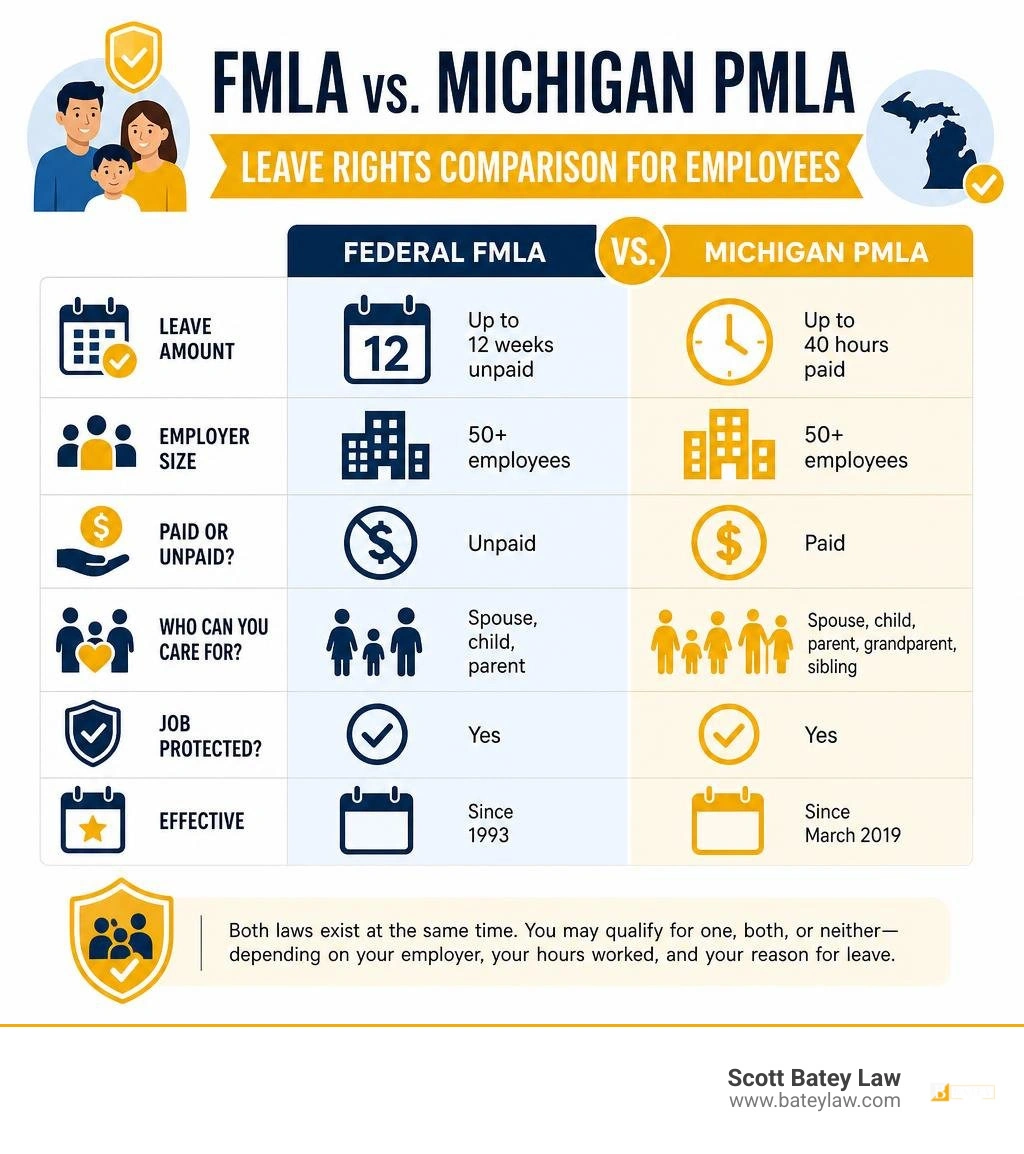
Here is a quick overview:
| Federal FMLA | Michigan PMLA | |
|---|---|---|
| Leave amount | Up to 12 weeks unpaid | Up to 40 hours paid |
| Employer size | 50+ employees | 50+ employees |
| Paid or unpaid? | Unpaid | Paid |
| Who can you care for? | Spouse, child, parent | Spouse, child, parent, grandparent, sibling |
| Job protected? | Yes | Yes |
| Effective | Since 1993 | Since March 2019 |
Both laws exist at the same time. You may qualify for one, both, or neither — depending on your employer, your hours worked, and your reason for leave.
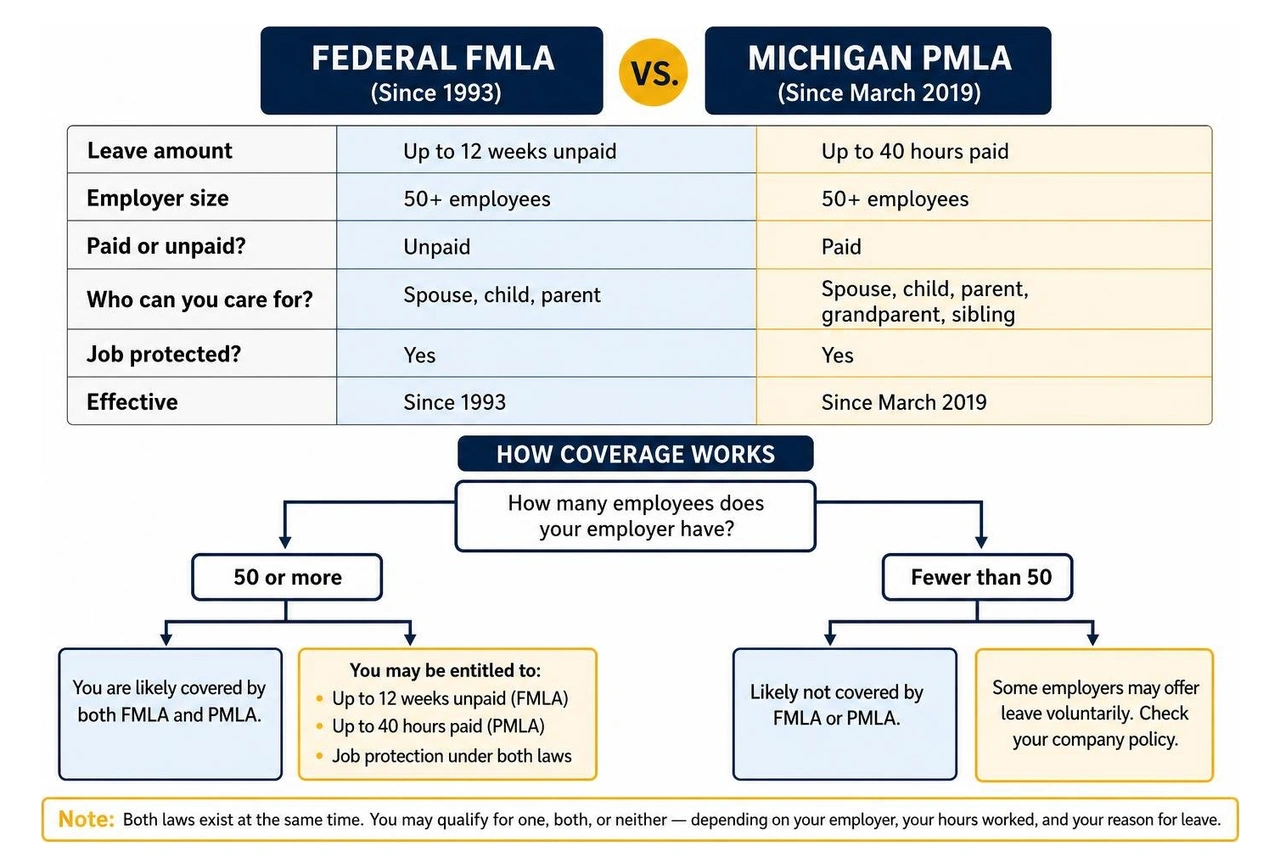
If your employer has 50 or more employees, you are likely covered by both the federal Family and Medical Leave Act (FMLA) and Michigan's Paid Medical Leave Act (PMLA). That means you may be entitled to:
- Up to 12 weeks of unpaid, job-protected leave per year under FMLA
- Up to 40 hours of paid leave per year under the PMLA
- Continued group health insurance during your leave
- The right to return to the same or an equivalent position
Many Michigan workers don't realize these protections exist — or don't know what to do when an employer ignores them.
I'm Scott Batey, a Michigan employment lawyer based in Bingham Farms. For nearly 30 years, I have represented employees across Michigan in michigan family medical leave disputes, including wrongful denial of FMLA, retaliation for taking leave, and termination while on protected leave. This guide will walk you through exactly how these laws work and what to do if your rights have been violated.
Federal FMLA vs. Michigan Paid Medical Leave Act (PMLA)
Understanding how federal and state laws interact is the first step in navigating your leave. The federal Family and Medical Leave Act (FMLA), enacted in 1993, is a nationwide law providing up to 12 weeks of unpaid, job-protected leave for specific medical and family milestones.
In contrast, Michigan’s Paid Medical Leave Act (PMLA), which took effect on March 29, 2019, addresses shorter-term needs by requiring covered employers to provide paid sick time. While FMLA is designed for major life events—like recovering from surgery, undergoing cancer treatments, or bonding with a newborn—the state PMLA covers routine illnesses, preventative care, and even non-medical emergencies like school closures or domestic violence assistance.
Covered Employers Under Federal and State Rules
Not every employer is legally required to offer these leave options.
- Federal FMLA Coverage: Applies to all public agencies (including state, county, and local government employers) and public or private schools, regardless of size. For private-sector employers, FMLA only applies if they employ 50 or more employees during 20 or more workweeks in the current or preceding calendar year. Additionally, the employee must work at a site that has 50 or more employees within a 75-mile radius.
- Michigan PMLA Coverage: Applies to any business, corporation, nonprofit, or government entity that employs 50 or more individuals across the United States. Unlike FMLA, there is no geographic "75-mile radius" restriction for state-mandated paid leave, meaning even if your specific local branch has only a few workers, you are covered if the parent company meets the 50-employee threshold.
Eligible Family Members: Who Can You Care For?
When you need to take time off to care for a loved one, the definition of "family member" varies dramatically between the two statutes.
Under the federal FMLA, your caregiving leave is restricted to:
- Your spouse
- Your biological, adoptive, step, or foster child under the age of 18 (or an adult child who is incapable of self-care due to a physical or mental disability)
- Your biological, adoptive, step, or foster parent, or an individual who stood in loco parentis (acting as a parent) to you when you were a child
Michigan’s PMLA is far more inclusive. It allows you to take paid leave to care for:
- Your spouse
- Your children (including biological, adopted, foster, step, legal wards, or children to whom you stand in loco parentis, regardless of age)
- Your parents (including step-parents, foster parents, or legal guardians)
- Your grandparents
- Your grandchildren
- Your biological, foster, adoptive, or step-siblings
This means if you need to take three hours off to drive your grandmother to a preventative care appointment, you are legally protected under Michigan's PMLA, even though federal FMLA would not cover this relationship.
Eligibility Requirements for Michigan Family Medical Leave
To secure job-protected leave under the federal FMLA in Michigan, you must meet three strict personal eligibility criteria:
- 12 Months of Service: You must have worked for your employer for at least 12 months. These months do not need to be consecutive. For instance, seasonal workers can combine separate periods of employment, provided any break in service does not exceed 7 years (unless the break was due to military service covered by USERRA or a collective bargaining agreement).
- 1,250 Hours Worked: You must have physically worked at least 1,250 hours during the 12-month period immediately preceding the start of your leave. This is actual hours worked; paid time off, sick days, and vacation time do not count toward this total. FLSA-exempt salaried employees are legally presumed to have met this requirement unless the employer can prove otherwise.
- 50/75 Mile Rule: You must work at a location where your employer has at least 50 employees within a 75-mile radius.
If you are facing challenges with your employer recognizing your eligibility, consulting an experienced FMLA Lawyer in Oakland County, MI can help protect your employment status.
Who Qualifies for Michigan Family Medical Leave under PMLA?
While the PMLA applies to employers with 50 or more workers, the state law carves out 12 specific exemptions. To be an "eligible employee" under the PMLA, you must not fall into any of these excluded categories:
- Employees who worked fewer than 25 hours per week on average during the preceding calendar year.
- Seasonal employees who work 25 weeks or fewer in a calendar year.
- FLSA-exempt professional, executive, or administrative employees.
- Employees covered by a collective bargaining agreement.
- Certain youth or temporary workers.
Under MCL Section 408.963, eligible employees begin accruing paid leave on their first day of work but may be required by their employer to wait up to 90 calendar days before actually using their accrued hours.
How the Earned Sick Time Act Impacts Michigan Family Medical Leave
The legal landscape surrounding sick leave in Michigan has undergone dramatic shifts. In 2018, an initiative petition led to the creation of the Earned Sick Time Act. However, the Michigan Legislature used an "adopt-and-amend" strategy to scale back the law, resulting in the weaker Paid Medical Leave Act (PMLA).
Following years of intense litigation, the Michigan Supreme Court ruled in Mothering Justice v. Attorney General that the legislature's amendatory tactics were unconstitutional. As a result, the original, far more robust Earned Sick Time Act was revived, becoming effective on February 21, 2025.
Under this revived law:
- All employers (not just those with 50+ employees) must provide sick leave.
- Employees accrue 1 hour of sick time for every 30 hours worked (compared to the PMLA's 1-to-35 ratio).
- Employees of small businesses (fewer than 10 employees) can accrue and use up to 40 hours of paid sick leave per year.
- Employees of larger businesses (10 or more employees) can accrue and use up to 72 hours of paid sick leave per year.
Small businesses were granted a temporary transition period until October 1, 2025, to fully implement the tracking and administrative requirements of this updated law.
How Much Leave Can You Take (And Is It Paid?)

The duration and financial structure of your leave depend entirely on the law you are utilizing:
- Federal FMLA Leave Limits: Eligible employees can take up to 12 workweeks of unpaid, job-protected leave in any 12-month period. Under the military caregiver provisions, you may take up to 26 workweeks of unpaid leave in a single 12-month period to care for a covered service member with a serious injury or illness.
- Michigan Paid Leave Accrual: Under the original PMLA, employees accrue 1 hour of paid leave for every 35 hours worked, capped at 40 hours per year. Under the revived Earned Sick Time Act, the accrual rate increases to 1 hour for every 30 hours worked, with annual limits expanding up to 72 hours for larger employers.
Employers can choose to use the accrual method or "frontload" the full statutory amount of leave (40 or 72 hours) at the start of the benefit year. If your employer frontloads your leave, they are not legally required to allow you to carry over unused hours to the next benefit year. However, if they use the accrual method, you are entitled to carry over unused hours up to the statutory cap.
Intermittent Leave and Short-Term Absences
You do not always have to take your FMLA leave in one continuous block of time. If medically necessary—such as for chemotherapy, physical therapy, or managing chronic conditions like asthma or migraines—you can take intermittent leave or work on a reduced schedule.
When utilizing intermittent leave, your employer must track your absences in the smallest increments their payroll system allows for other forms of leave, down to less than an hour if applicable.
Unfortunately, some employers attempt to penalize workers for these short-term absences by applying "points" under internal attendance policies. Under federal law, utilizing protected FMLA leave cannot be counted against you. If you are facing unfair disciplinary actions, we encourage you to read our analysis on Attendance Point Systems vs. FMLA.
The Application Process and Returning to Work
Securing your leave requires following specific administrative steps to ensure your job remains protected:
- Provide Notice: If your need for leave is foreseeable (such as a scheduled surgery or childbirth), you must notify your employer at least 30 days in advance. If the emergency is sudden, you must notify them as soon as practicable, typically following your company's standard call-in procedures.
- Submit Medical Certification: Your employer has the right to request medical certification from a healthcare provider. They must allow you at least 15 calendar days to return the completed FMLA certification form. Under Michigan's paid leave laws, if your employer requests documentation, you must be given at least 3 days to provide it.
- Follow Agency Procedures: For state employees, this involves utilizing specific timekeeping systems (such as SIGMA, where you might enter time as "Pending FMLA Approval" or use specific codes like FMSL or FMAL). You can read more about state-level administrative procedures in the Family Care Leave Guidelines.
Health Insurance and Benefits During Leave
One of the most critical protections offered by the FMLA is the continuation of your group health insurance. While you are on leave, your employer must maintain your health coverage under the same terms and conditions as if you had continued working.
- If your leave is paid (using accrued sick or annual leave), your portion of the premium will be deducted from your paycheck as usual.
- If your leave is unpaid, you must make arrangements with your employer to pay your share of the health insurance premiums to prevent coverage gaps.
- Failure to return: If you choose not to return to work after your FMLA leave ends for reasons within your control, your employer may legally seek to recoup the premiums they paid on your behalf during your unpaid leave.
Job Protection and Returning to Work
When you return from FMLA leave, you are entitled to be reinstated to your original position or to an equivalent position with equivalent pay, benefits, and other employment terms.
- Medical Releases: If you took leave for your own serious health condition, your employer can require a "fitness-for-duty" certification (a medical release) from your doctor before you return. However, if you took leave to care for a family member, no return-to-work medical documentation can be required.
- Work Restrictions: If you return with temporary medical restrictions, your employer must evaluate whether these can be accommodated. If you face unfair treatment or termination upon attempting to return, consult our guide on being Fired After Medical Leave in Michigan.
Protecting Your Rights: Violations, Retaliation, and Legal Remedies
Despite clear legal mandates, many employers in Southeast Michigan—from Detroit to Troy and Oakland County—violate these laws. These violations typically fall into two categories:
- FMLA Interference: This occurs when an employer discourages, delays, or denies your right to take protected leave. Examples include refusing to provide FMLA forms, miscalculating your hours to deny eligibility, or counting protected sick days against you.
- FMLA Retaliation: This occurs when an employer punishes you for exercising your rights. Examples include demoting you, reducing your hours, giving you poor performance reviews, or terminating your employment because you took leave.
Understanding the distinction between these violations is critical to building a strong case. For a deeper look, see our article on FMLA Interference vs. Retaliation in Michigan.
Additionally, if you are terminated or discriminated against due to a chronic medical condition, your case may involve both FMLA violations and disability discrimination under the Americans with Disabilities Act (ADA). You can learn more about how these laws interact in our detailed post on Fired After Medical Leave in Michigan: FMLA and ADA Overlap.
If your state-level PMLA or Earned Sick Time rights are violated, you have the right to file an administrative complaint with the Michigan Department of Licensing and Regulatory Affairs (LARA) or the Wage and Hour Division. You must file these statutory claims within 6 months of the alleged violation.
Frequently Asked Questions About Michigan Family Medical Leave
Can my employer force me to find a replacement worker if I take sick leave?
No. Under both the Paid Medical Leave Act and the revived Earned Sick Time Act (specifically MCL 408.963(9)), an employer is strictly prohibited from requiring you to search for or secure a replacement worker as a condition for using your accrued sick leave. Doing so is a form of illegal employer retaliation.
What happens to my unused paid medical leave if I quit or get fired?
Under Michigan law, employers are not required to pay out unused accrued paid medical leave or sick time upon your termination, resignation, or retirement. However, if you are rehired by the same employer within a specific timeframe (typically 6 to 12 months depending on the governing statute), your previously accumulated, unused leave must be reinstated.
Can I combine FMLA with Michigan's Paid Parental Leave?
If you are a State of Michigan employee, you may be eligible for paid parental leave to bond with a newborn or newly placed adoptive child. However, if your leave qualifies for both federal FMLA and state-level paid parental leave, you cannot stack them consecutively to take double the time off. Instead, the leaves must be taken concurrently, meaning they run at the same time.
Conclusion
Navigating michigan family medical leave laws can be incredibly stressful, especially when you are already dealing with a serious medical diagnosis or caring for a sick parent or child. You should never have to choose between your health, your family, and your livelihood.
If your employer has denied your leave request, threatened your job security, or terminated your employment after you requested time off, we are here to help. At Scott Batey Law, we provide award-winning, personalized representation backed by over 25 years of experience fighting for workers' rights in Bingham Farms, Southfield, Royal Oak, Troy, and throughout Oakland County.
We can help you identify violations, navigate At-Will Employment Exceptions in Michigan, and hold unlawful employers accountable. Contact an experienced FMLA Lawyer in Bingham Farms, MI today to schedule a personalized consultation.