.png)
The Employee Guide to Handling Workplace Harassment in Michigan

When Does Workplace Harassment Become Illegal in Michigan?
Michigan workplace harassment is one of the most misunderstood areas of employment law — and missing the difference between a difficult boss and illegal conduct can cost you your case.
Here is a quick overview of what you need to know:
- It must be based on a protected trait. Harassment is only illegal if it targets you because of your race, sex, age, disability, religion, height, weight, sexual orientation, gender identity, or another characteristic protected under Michigan law.
- It must be severe or pervasive. Rude, unfair, or demeaning treatment does not automatically cross the legal line. The conduct must be serious enough that a reasonable person would find it hostile or abusive.
- Michigan law is broader than federal law. The Elliott-Larsen Civil Rights Act (ELCRA) covers employers with as few as 1 employee and protects more classes than federal law does.
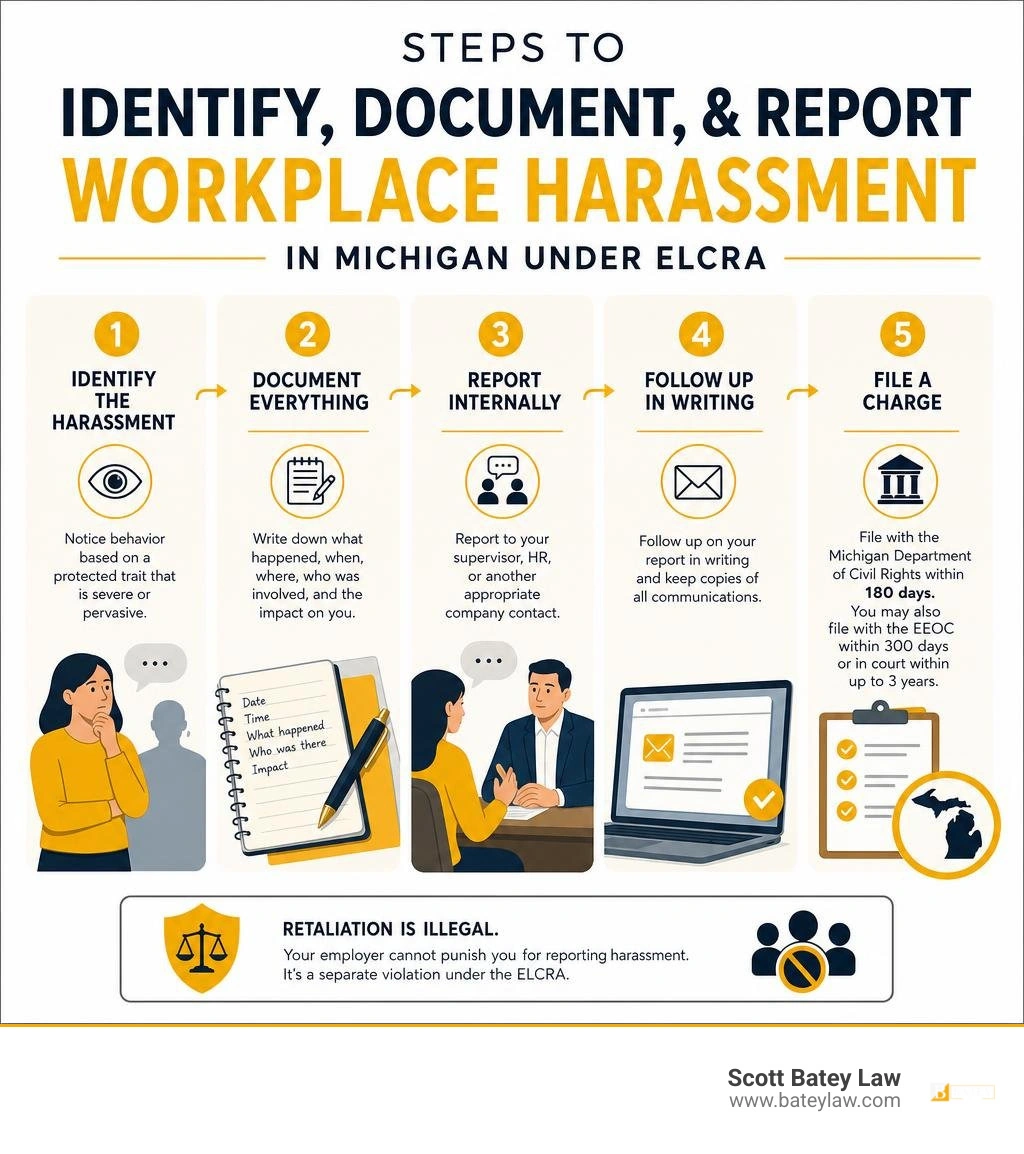
- Deadlines are strict. You have 180 days to file with the Michigan Department of Civil Rights (MDCR), 300 days to file with the EEOC, or up to 3 years to file directly in court.
- Retaliation is also illegal. If your employer punishes you for reporting harassment, that is a separate legal violation.
Almost everyone has worked for a difficult boss. The micromanager who questions every decision. The supervisor who takes credit for your work or publicly humiliates you in team meetings. It feels awful — but feeling awful at work is not the same as having a legal claim. The law does not protect employees from bad management. It protects them from harassment rooted in bias against who they are.
I'm Scott Batey, founder of Batey Law Firm, PLLC in Bingham Farms, Michigan. For nearly three decades, I have focused exclusively on employee-side employment law — including michigan workplace harassment claims under the ELCRA, wrongful termination, retaliation, and discrimination. This guide gives you the practical, plain-English information you need to understand your rights, protect your evidence, and make smart decisions before it is too late.
Understanding Michigan Workplace Harassment Under the ELCRA
To understand your rights as a worker in Michigan, you must first understand the primary state law that protects you: the Elliott-Larsen Civil Rights Act (ELCRA). Originally enacted in 1976 and continuously updated, the ELCRA is Michigan's primary legal shield against workplace discrimination and harassment. It applies to both public and private employers across the state, from corporate offices in Detroit to local businesses in Royal Oak or Southfield.
You can read the official statutory language in the Elliott-Larsen Civil Rights Act (EXCERPT).
Under the ELCRA, Michigan workers enjoy some of the strongest civil rights protections in the nation. The law explicitly outlaws discrimination and harassment based on a wide range of protected characteristics. These include:
- Race and Color: This explicitly includes traits historically associated with race, such as hair texture and protective hairstyles like braids, locks, and twists.
- Sex, Sexual Orientation, and Gender Identity or Expression: Following critical amendments, Michigan law explicitly protects LGBTQ+ employees from discrimination and harassment based on how they identify, express themselves, or who they love.
- Religion: Protection from harassment based on your religious beliefs, practices, or lack thereof.
- Age: Protection for older workers who are mocked, excluded, or targeted because of their age.
- Disability: Protecting employees from harassment or adverse actions related to physical or mental impairments.
- Marital Status and Familial Status: Protections based on whether you are married, single, divorced, or have children.
- Height and Weight: Unlike federal law, Michigan is one of the few states that explicitly lists height and weight as protected classes. If you are targeted, mocked, or denied promotions due to your physical stature or weight, you have direct recourse under state law.
Protected Characteristics Under State vs. Federal Law
Many employees assume that state and federal laws are identical, but in Michigan, state law often provides much broader protections than federal law (Title VII of the Civil Rights Act of 1964).
One of the most significant differences is employer coverage. Under federal Title VII, an employer must have at least 15 or more employees (or 20 or more for federal age discrimination) to be subject to the law. This leaves millions of small-business employees across the United States unprotected.
In contrast, Michigan's ELCRA covers employers with as few as 1 employee. Whether you work for a massive automotive supplier in Troy or a small family-owned boutique in Birmingham, your employer is legally bound to provide a workplace free from discriminatory harassment.
Another crucial difference lies in the damages available. Federal law imposes strict statutory caps on compensatory damages (such as emotional distress) based on the size of the employer. Under the ELCRA, there are no caps on compensatory damages for emotional distress, making state-level filings highly favorable for victims of severe workplace abuse.
| Protection Feature | Michigan ELCRA | Federal Title VII |
|---|---|---|
| Minimum Employer Size | 1 employee | 15 employees (20 for age discrimination) |
| Height & Weight Protection | Yes (Explicitly protected) | No |
| Protective Hairstyles | Yes (Explicitly included under race) | No (Varies by federal court interpretation) |
| Damages Caps | Uncapped compensatory damages | Capped between $50,000 and $300,000 |
| Statute of Limitations (Court) | 3 years | Generally requires administrative exhaustion first |
Hostile Work Environment vs. Bad Boss: Where the Law Draws the Line
We hear it all the time: "My boss is incredibly mean, micromanages my every move, and screams at our team. Is this a hostile work environment?"
Under the law, the short answer is usually no.
There is a massive legal distinction between a "bad boss" and an illegal hostile work environment. A boss who is demanding, disorganized, rude, or just an overall unpleasant person is completely legal in Michigan. Employers are allowed to run highly stressful, toxic, and unpleasant workplaces, provided they do not cross the line into discriminatory behavior.
To learn more about where the courts draw this line, read our detailed comparison: Hostile work environment vs. bad boss: where the law draws the line.
Under Michigan law, a hostile work environment only exists when the offensive conduct is directly tied to a protected characteristic (like your race, sex, age, or disability) and is so severe or pervasive that it alters the conditions of your employment.
To evaluate these claims, Michigan courts use a two-part test:
- The Objective Test: Would a reasonable person in the employee’s shoes find the work environment hostile, intimidating, or abusive?
- The Subjective Test: Did the employee personally perceive the environment to be hostile and abusive?
For a deeper dive into these legal standards, see the guide on Hostile Work Environment Michigan: ELCRA Rights & Legal Standards (2026).
What Qualifies as Illegal Harassment?
Illegal harassment under the ELCRA generally falls into two categories: Quid Pro Quo (primarily in sexual harassment cases, where job benefits are conditioned on sexual favors) and Hostile Work Environment (where ongoing discriminatory behavior makes it impossible to do your job).
For a plain-English breakdown of these two types, read Quid pro quo vs. hostile environment: plain English guide for Michigan workers.
Illegal harassment can manifest in several ways:
- Verbal Conduct: Slurs, epithets, offensive jokes, repeated unwanted requests for dates, or demeaning comments about a person's protected traits (e.g., mocking an older worker's memory or making derogatory remarks about someone's weight).
- Visual Conduct: Displaying offensive posters, signs, calendars, cartoons, or physical objects that degrade a protected class in common areas.
- Physical Conduct: Unwanted physical contact, hugging, kissing, brushing against the body, or blocking an employee's physical path.
- Digital Conduct: Unwanted sexual or discriminatory messages, explicit images, or harassing social media posts sent via email, text message, or communication platforms like Slack or Teams.
The official state guidelines on these behaviors are detailed in the Michigan policy on DISCRIMINATORY HARASSMENT.
What Does Not Constitute Illegal Harassment?
It is vital to understand what does not cross the legal threshold into actionable harassment:
- General Rudeness and Incivility: A coworker who ignores you, speaks sharply, or refuses to help you is rude, but not acting illegally unless their behavior is motivated by bias against a protected class.
- Micromanagement: A supervisor who monitors your bathroom breaks, demands hourly updates, or criticizes your work performance is a poor manager, but this is not illegal harassment.
- Fair Performance Reviews: Getting a negative performance evaluation or constructive feedback is not harassment, even if you strongly disagree with the feedback.
- The "Equal Opportunity Offender": If a supervisor yells at, insults, and humiliates everyone in the office equally, regardless of their race, gender, or age, they are simply a toxic boss, not a discriminatory harasser under the law.
How to Protect Your Rights and Build a Strong Case
If you are experiencing genuine michigan workplace harassment, you cannot rely on HR to simply "do the right thing." You must take active, strategic steps to protect your career, your reputation, and your legal rights. Building a strong case requires clear evidence, strategic internal reporting, and a solid understanding of how employers defend themselves.
How to Document Michigan Workplace Harassment
Evidence is the lifeblood of any employment law case. In court, it is rarely a matter of "he said, she said"—it is a matter of what you can prove.
To build a bulletproof record of the harassment, you should follow these essential documentation rules:
- Keep a Detailed Personal Log: Write down every single incident of harassment immediately after it occurs. Record the date, time, exact location, who was involved, what was said or done, and the names of any coworkers who witnessed the event.
- Keep it Private: Store your personal log, notes, and evidence on a personal device (like your personal cell phone or laptop) or in a physical notebook at home. Never keep your only copy of these records on a company-owned computer, work email account, or company cloud drive. If you are suddenly terminated or locked out of your systems, you will lose access to your evidence instantly.
- Preserve Digital Evidence: Take screenshots of offensive text messages, emails, Slack chats, or social media posts. Ensure these screenshots show the sender’s name, the phone number or email address, and the timestamp.
- Document the Impact: Keep records of any medical or professional help you seek to manage stress, anxiety, or depression caused by the hostile work environment.
For a comprehensive guide on preserving your evidence safely, read Documenting harassment the right way: notes, emails, and screenshots (MI).
Reporting Harassment Internally Before Filing a Claim
Before you can file a lawsuit or an administrative claim against your employer for a hostile work environment, you must generally give them a fair opportunity to fix the problem. This is where the Faragher-Ellerth defense comes into play.
Under this legal doctrine, an employer can escape liability for supervisor-led harassment if they can prove:
- They had an effective anti-harassment policy and reporting procedure in place; and
- The employee unreasonably failed to take advantage of those reporting procedures.
To defeat this defense, you must report the harassment internally. Here is how to do it the right way:
- Consult the Employee Handbook: Locate your company's official anti-harassment policy. Follow the exact reporting procedures outlined in the handbook.
- Submit Your Complaint in Writing: Never make a harassment complaint purely over the phone or in a casual face-to-face chat. Write a formal email or letter to HR or the designated company representative. Use clear language stating that you are experiencing harassment based on a protected trait (e.g., "I am writing to formally report ongoing sexual harassment by my supervisor...").
- Demand Prompt Corrective Action: Once notified, your employer has a legal obligation to conduct a prompt, thorough, and objective investigation, and to take immediate corrective measures to stop the harassment.
For critical advice on preparing for this process, read Reporting sexual harassment at work in Michigan: what to do before HR calls you in.
To understand how employer liability is triggered and evaluated, see Employer Liability for Sexual Harassment in Michigan: ELCRA Standards (2026).
Filing Deadlines and Legal Pathways in Michigan
If your employer ignores your written complaint, conducts a sham investigation, or fails to stop the harassment, you have several legal pathways to pursue justice. However, you must act quickly. Employment law is governed by strict, unforgiving deadlines known as statutes of limitations.
For an overview of how elements, evidence, and deadlines interact, read Hostile work environment in Michigan: elements, evidence, and deadlines.
You have three primary options for filing a claim:
- The Michigan Department of Civil Rights (MDCR): The state agency responsible for investigating civil rights violations under the ELCRA.
- The Equal Employment Opportunity Commission (EEOC): The federal agency that investigates violations of federal law (Title VII).
- Direct Court Filing: Under Michigan's ELCRA, you can bypass the administrative agency process entirely and file a civil lawsuit directly in Michigan circuit court.
To understand all of your options, consult Michigan Sexual Harassment Statute of Limitations: Deadlines & Filing Options (2026).
Filing Deadlines for Michigan Workplace Harassment Claims

Missing a filing deadline will permanently bar your claim, regardless of how strong your evidence is. It is crucial to understand these three critical timelines:
- 180 Days (MDCR): You have exactly 180 calendar days from the date of the last discriminatory incident to file an administrative complaint with the MDCR.
- 300 Days (EEOC): Because Michigan is a "deferral state" with its own civil rights agency, the federal deadline to file a charge of discrimination with the EEOC is extended to 300 calendar days from the last incident.
- 3 Years (Direct Court Filing under ELCRA): This is Michigan's most generous timeline. You have up to 3 years from the date of the last incident of harassment to file a direct lawsuit in state court under the ELCRA.
If you choose to go through the EEOC or MDCR, and the agency dismisses your claim or issues a "Notice of Right to Sue," you face a incredibly tight 90-day deadline from the date you receive that notice to file a lawsuit in court.
Learn more about enforcing your rights through state and federal channels on the Workplace Discrimination | Michigan Legal Help page.
Frequently Asked Questions About Michigan Workplace Harassment
What should I do if I experience retaliation after reporting harassment?
Retaliation is one of the most common—and legally serious—mistakes employers make. Under both state and federal law, it is strictly illegal for an employer to take an adverse employment action against you because you engaged in a protected activity, such as reporting workplace harassment in good faith or participating as a witness in an investigation.
Adverse actions include termination, demotion, salary cuts, shift transfers to less desirable hours, or sudden exclusion from key meetings. If you experience retaliation, you should document the timing of the adverse action (which often occurs immediately following your report) and contact an attorney. You can file a separate, independent retaliation claim that is often easier to prove than the underlying harassment claim itself.
Read our step-by-step strategy: Retaliation after reporting harassment: the Michigan employee playbook.
Can a single incident create a hostile work environment under Michigan law?
Yes. While a hostile work environment is typically built over time through a pattern of ongoing behavior, Michigan courts have ruled that a single, severe incident can be sufficient to establish a hostile work environment.
Examples of a single incident that crosses this high legal threshold include a physical or sexual assault in the workplace, or a supervisor using an egregious racial slur directly against an employee.
How can I support a coworker who is experiencing harassment?
If you witness a coworker being harassed, you can play a critical role in helping them achieve justice while protecting yourself. You can provide a written witness statement detailing what you saw and heard, or agree to testify in an internal investigation or court deposition.
Under the ELCRA, you are legally protected from employer retaliation for assisting, testifying, or participating in a harassment investigation, even if you were not the direct target of the harassment.
For tips on how to safely stand up for your colleagues, read How to support a coworker's harassment report without risking retaliation.
Conclusion
Navigating michigan workplace harassment is emotionally draining and legally complex. When your career, your financial stability, and your mental health are on the line, you should not have to fight this battle alone.
At Scott Batey Law, we provide award-winning, personalized representation backed by over 25 years of experience fighting for workers across Michigan. Whether you are in Bingham Farms, Southfield, Royal Oak, Troy, or anywhere in the Detroit metro area, we are here to help you stand up to abusive employers, protect your rights, and secure the compensation you deserve.
If you want to understand how Michigan's employment laws apply to your specific situation, read about At-Will Employment Exceptions in Michigan.
Is your job, career, or reputation at risk? Don't wait until a strict legal deadline passes. Contact Batey Law Firm today or visit www.bateylaw.com to schedule a free, confidential consultation. Let us help you take back control of your career.