.png)
How to Protect Your Bakery or Boutique Without Illegal Non-Competes

Protect Your Bakery or Boutique Without an Illegal Non-Compete
A small business non compete agreement is not the safest default way to protect a bakery's recipes or a boutique's customer relationships. In Michigan, a restriction must protect a real business interest and be reasonable in its time, geographic reach, and the work it bars. A broad clause that stops a cashier, baker, or sales associate from finding similar work can create legal risk instead of protection.
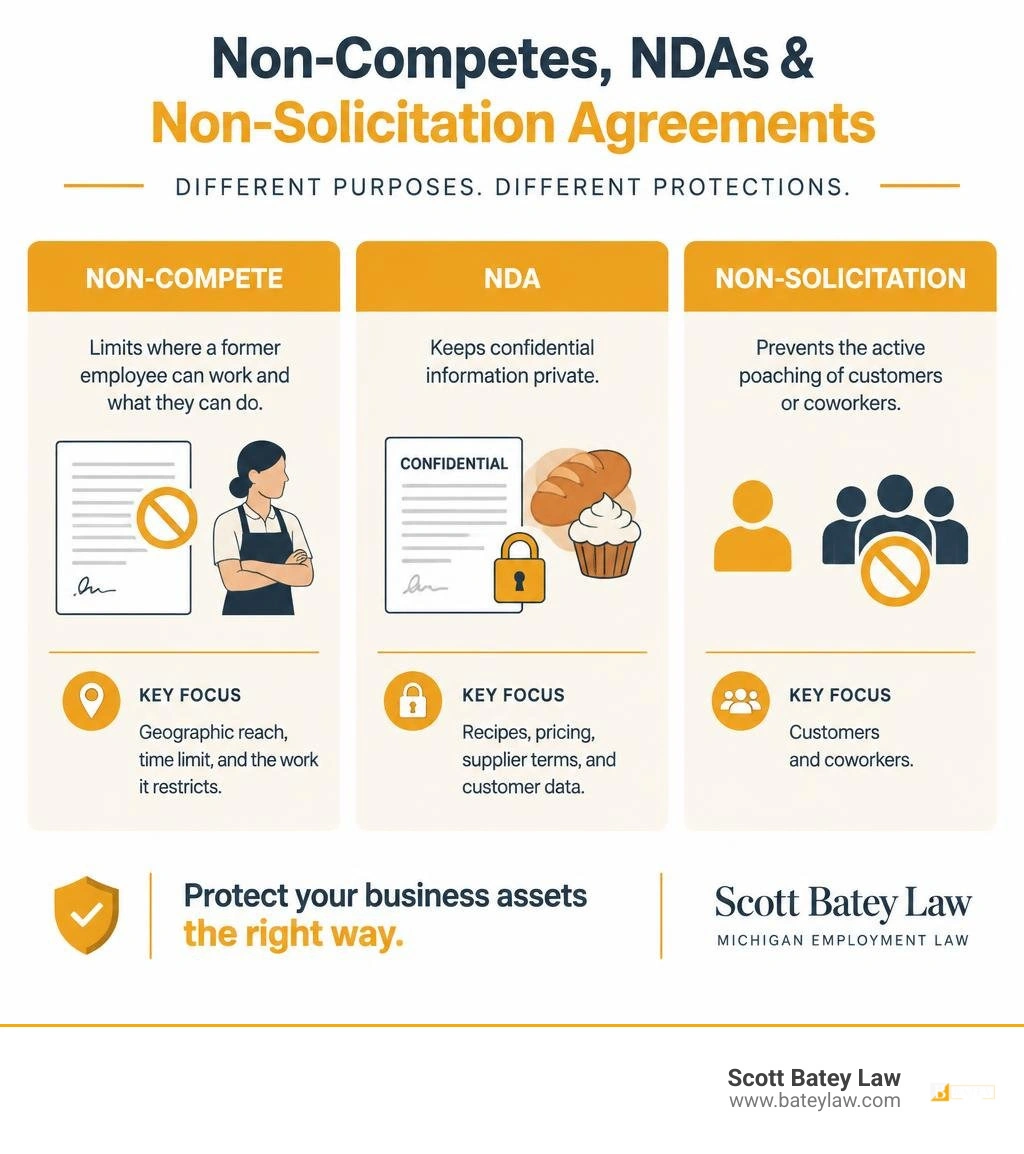
Start with the asset you actually need to protect:
- Use a clear non-disclosure agreement for confidential recipes, pricing, supplier terms, and customer data.
- Use a narrow non-solicitation clause, where appropriate, to address active poaching of customers or coworkers.
- Limit any non-compete to workers with genuine access to sensitive information, and tailor it to their real role.
- Have an attorney review the agreement before asking an employee to sign it.
The goal is not to control where a former employee can earn a living. It is to protect confidential information and established business relationships without using restrictions that may be too broad to enforce. For background on how courts evaluate these limits, the non-compete clause overview explains the general legal framework.
I am Scott Batey, a Michigan employment lawyer who has represented employees since 1996 and regularly reviews restrictive covenants, including small business non compete agreement terms, non-solicits, and confidentiality clauses. In the sections ahead, I will explain how Michigan businesses can protect legitimate assets while employees can spot contract terms that may unfairly limit their next job.
Discover more about small business non compete agreement:
Understanding the Legal Pitfalls of a Small Business Non Compete Agreement

Running a boutique in Birmingham or a specialty bakery in Royal Oak takes immense dedication, creativity, and financial investment. When you invest time training staff on your signature pastry techniques or introducing them to your top clothing wholesale contacts, it is completely natural to want to protect those assets. However, reaching for a broad, blanket contract often backfires.
In Michigan, restrictive covenants are strictly scrutinized. Under state law, an employer cannot simply prevent an individual from earning a living or practicing their trade. Any restriction must protect a legitimate business interest, such as genuine trade secrets, specialized proprietary methods, or close customer goodwill that the worker developed directly at the company's expense. When small business owners try to restrict line-level staff, retail clerks, or junior bakers from working down the street, courts frequently push back.
The regulatory climate in 2026 demands even greater caution. While federal challenges surrounding agency rules continue to evolve, state courts across Michigan remain steadfast in evaluating whether restrictions impose an undue hardship on employees. If you are drafting or reviewing these agreements, consulting an experienced Michigan non-compete lawyer helps ensure you do not rely on language that a judge will strike down.
Why a Generic Small Business Non Compete Agreement Often Fails in Court
One of the biggest mistakes we see independent shop owners make is downloading a free, standard restrictive covenant template from the internet. These boilerplate contracts are usually written with broad, sweeping terms intended to cover every scenario imaginable. In the legal world, overly broad often means entirely unenforceable.
Generic templates frequently fail for three major reasons:
- Imposing restrictions on line-level staff: Attempting to bar a boutique retail associate earning an hourly wage from working at another clothing store in Oakland County is almost always considered an unreasonable restraint of trade.
- Creating undue hardship: If a contract prohibits a cake decorator from working anywhere within a 50-mile radius for three years, a court will likely find that the restriction deprives the worker of their primary livelihood without sufficient justification.
- Lacking adequate legal consideration: For a contract to be valid, both parties must receive something of value. While offering an initial job can serve as consideration for new hires in Michigan, imposing a restrictive covenant on an existing employee without providing an accompanying raise, promotion, or bonus can render the agreement vulnerable to legal challenge.
Key Enforceability Tests for a Small Business Non Compete Agreement in Michigan
Michigan courts apply a multi-factor reasonableness test to evaluate restrictive covenants. When examining a covenant, judges assess whether the agreement:
- Protects a reasonable and legitimate business interest of the employer.
- Is reasonable in geographic scope (limiting the restriction strictly to the area where the employer actually conducts business).
- Is reasonable in duration (typically 6 to 12 months for small retail and food businesses; anything beyond 12 to 24 months faces high skepticism).
- Restricts only the specific type of employment or line of business that directly threatens the protected asset.
- Avoids causing harm to the public interest by suppressing fair market competition.
Michigan operates under the "blue-pencil" doctrine, meaning a court has the discretion to rewrite or strike down unreasonable terms while enforcing the remainder of the contract. However, relying on a judge to fix an overreaching contract is an expensive gamble. Furthermore, business-to-business agreements (such as covenants made during the sale of a bakery) are judged under a far more lenient standard than direct employer-employee contracts.
How to Identify and Classify Your Proprietary Business Assets

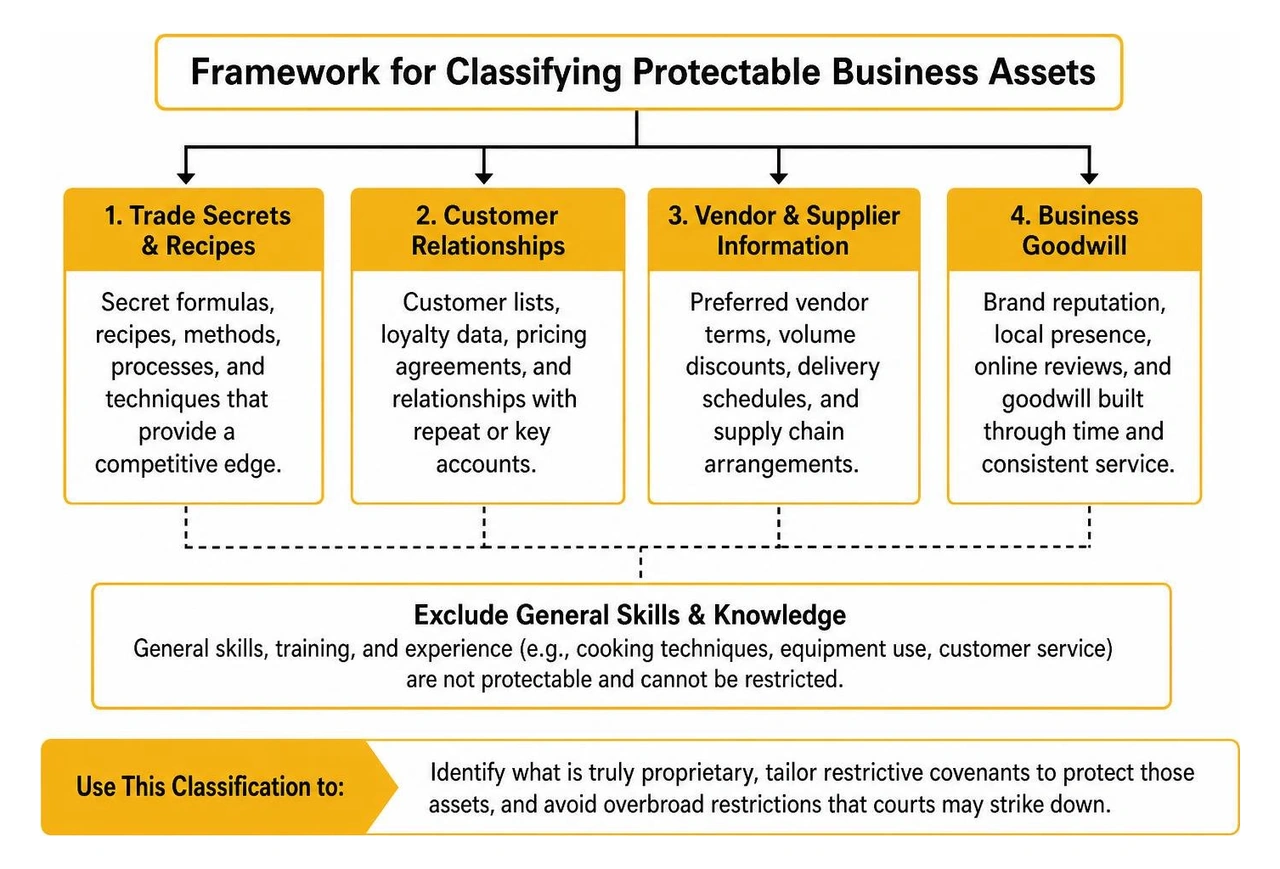
Before drafting any legal agreement, step back and ask: What am I actually trying to protect? In most small retail and culinary businesses, the true value lies in specific intellectual property and relationships—not in locking down an employee's general labor.
Differentiating Secret Recipes from General Culinary Skills
A fundamental distinction in employment law is the difference between an employee’s general skill set and an employer's proprietary trade secrets.
- General Culinary Skills: Knowing how to temper chocolate, calibrate a commercial convection oven, knead sourdough, or manage kitchen ticket flow are general skills. Even if an employee honed those abilities while working in your kitchen, you cannot prevent them from using their trade elsewhere.
- Proprietary Recipes and Formulas: A precise, unique spice blend for a signature pastry, an engineered batter formulation with specific chemical ratios, or a custom operational production guide developed over years can qualify as protectable proprietary information.
To claim trade secret protection in Michigan, you must take reasonable affirmative steps to keep the information secret, such as storing formulas in password-protected files or keeping physical recipe logs in a secure office.
Protecting Customer Lists and Supplier Relationships
In a local boutique in Southfield or Ferndale, customer goodwill is everything. But not all customer data qualifies as a protected asset.
- Public Information: A list of walk-in retail shoppers or names publicly visible on your boutique’s social media followers is generally not protectable.
- Confidential Client Databases: A curated database containing specific client sizing, VIP purchasing histories, custom tailoring preferences, private contact details, and personalized styling notes is proprietary.
- Vendor and Pricing Agreements: Exclusive wholesale discount tiers, negotiated distributor margins, and specialized vendor contracts represent proprietary business knowledge that you can legally safeguard.
Step-by-Step Alternatives to Restrictive Covenants for Retail and Food Businesses
Rather than risking an invalid non-compete, small business owners achieve stronger, more reliable protection by using targeted alternatives.
| Agreement Type | Primary Purpose | Enforceability in Michigan | Impact on Hiring & Retention |
|---|---|---|---|
| Non-Compete Agreement (NCA) | Bars working for any competitor | Strictly scrutinized; disfavored for line staff | High friction; deters top candidates |
| Non-Disclosure Agreement (NDA) | Protects secret recipes, vendor terms, and data | High, when terms are clearly defined | Minimal; standard industry practice |
| Non-Solicitation Agreement | Stops former staff from poaching clients/peers | High, provided time and scope are reasonable | Low; targets harmful interference |
Implementing Enforceable Non-Disclosure Agreements (NDAs)
A well-crafted Non-Disclosure Agreement (NDA) is the cornerstone of asset protection for any food or retail establishment. Unlike a non-compete, an NDA does not stop a former employee from working down the road; it simply prohibits them from sharing or utilizing your confidential files, formulas, and operational data.
To make an NDA ironclad:
- Explicitly define what constitutes "Confidential Information" (e.g., specific batch ratios, unreleased seasonal collections, internal profit margins).
- Require the immediate return of all physical binders, keys, digital logins, and recipe cards upon separation.
- Avoid overbroad definitions that claim standard industry knowledge as proprietary secrets. Overreaching language can invalidate terms or create costly disputes, as explored in our guide on severance and restrictive covenant red flags.
Using Tailored Non-Solicitation Agreements for Staff and Clients
If you are concerned that a departing store manager might open a new shop and recruit your entire sales floor or take your top custom-apparel clients, a non-solicitation covenant is the appropriate legal tool.
A non-solicit allows the employee to practice their profession freely while placing narrow guardrails on specific actions:
- Customer Non-Solicitation: Prohibits the former worker from directly contacting and soliciting business from your established client list for a set period (typically 6 to 12 months).
- Employee Non-Solicitation: Prohibits departing staff from poaching their former colleagues to join a competing venture.
Understanding the legal boundaries between these agreements is crucial. You can learn more about how courts evaluate these differences in our article on noncompete vs nonsolicitation differences.
Best Practices for Onboarding and Offboarding Staff Safely
Legal contracts are only as effective as the daily workplace procedures that support them. Having clear onboarding and offboarding workflows protects your business assets far better than a vague contract clause.
Creating Clean Separation Protocols and Exit Interviews
When an employee decides to move on, handling their departure with clarity and professionalism prevents misunderstandings before they turn into lawsuits.
- Conduct a Structured Exit Interview: Discuss the employee's future plans in a constructive manner. Remind them gently of their continuing obligations under their signed NDA or non-solicitation agreement.
- Secure Written Acknowledgments: Have the departing staff member sign a simple separation checklist confirming they have returned all company property, recipe books, customer records, and vendor files.
- Immediate Access Revocation: Promptly shut off access to point-of-sale systems, social media accounts, cloud drives, and customer management tools.
- Consider Paid Garden Leave for Key Roles: For high-level positions like a head chef or general manager, offering a brief period of paid leave upon separation can provide an amicable bridge while protecting sensitive transitions.
Frequently Asked Questions About Restrictive Covenants in Small Businesses
Can a local bakery legally prevent a pastry chef from working nearby?
Generally, no. Michigan courts disfavor geographic non-compete restrictions that prevent skilled workers from using their general culinary talents, especially if the restriction causes financial hardship. Unless the pastry chef possesses extraordinary, proprietary formulas that cannot be protected via an NDA, a blanket ban on working at a nearby kitchen is difficult to enforce.
What consideration is legally required to make a covenant enforceable?
For new hires, the offer of employment itself generally serves as sufficient consideration in Michigan. However, if you ask an existing employee to sign a new restrictive agreement months or years into their tenure, you must provide fresh consideration—such as a merit increase, cash bonus, promotion, or specialized paid training.
How do courts handle overbroad restrictive covenants?
Under Michigan's blue-pencil rule, judges have the authority to narrow an overbroad restriction (such as reducing a two-year ban down to six months or shrinking a 50-mile radius to 5 miles). However, if an agreement is egregiously overreaching, a court may choose to declare the entire covenant void and unenforceable, leaving the employer with zero protection.
Conclusion
Protecting your boutique or bakery does not require heavy-handed contracts that alienate talented staff or invite costly legal disputes. By focusing on well-drafted Non-Disclosure Agreements, sensible non-solicitation clauses, and disciplined internal security procedures, you can safeguard your recipes, customer goodwill, and vendor relationships effectively.
At Scott Batey Law, we have over 25 years of experience evaluating employment agreements and protecting workers and small business owners throughout Bingham Farms, Birmingham, Southfield, Royal Oak, and across Oakland County. If you need clarity on your employment contracts or wish to review restrictive terms, connect with our knowledgeable team or consult a noncompete agreement attorney in Southfield to ensure your business rights are thoroughly protected.