.png)
Finding the Right Southfield Wrongful Termination Lawyer for Your Case

Finding a Southfield Wrongful Termination Lawyer: Where to Start
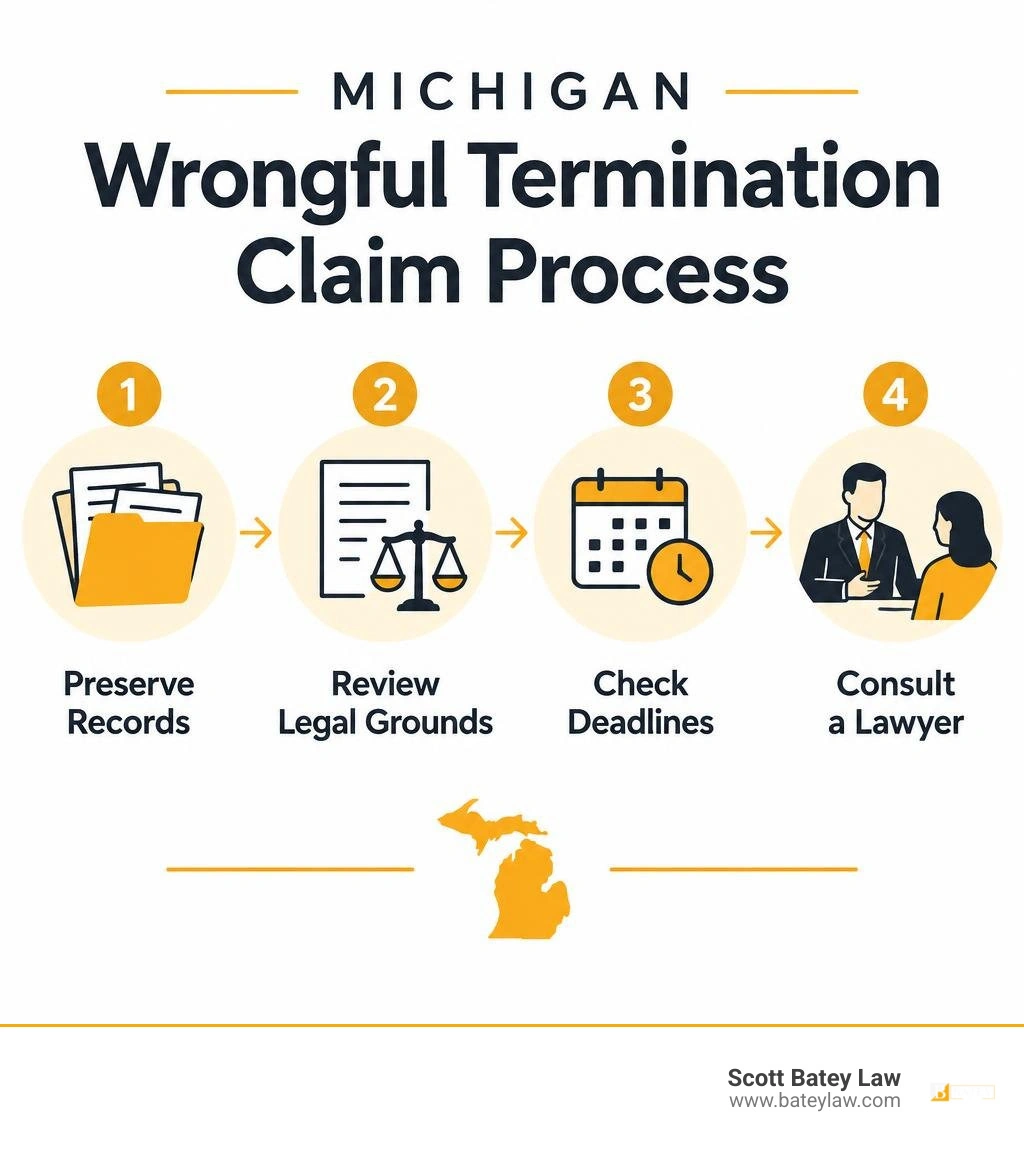
If you were fired after reporting discrimination, requesting an accommodation, or taking protected leave, speak with an employee-side lawyer promptly. Michigan employers can generally fire at-will employees, but not for an illegal reason. Save your termination notice, past reviews, relevant messages, and a timeline of what happened. Ask about filing deadlines before signing a severance agreement.
When choosing a lawyer, look for someone who handles Michigan employment claims and will explain the evidence, likely costs, and possible outcomes in plain language. The U.S. Equal Employment Opportunity Commission provides a useful overview of federal protections for workers who believe they were discharged unlawfully.
I'm Scott Batey, a Southfield wrongful termination lawyer who has represented Michigan employees in workplace disputes since 1996. The first step is understanding when an at-will firing may cross the legal line.
Essential southfield wrongful termination lawyer terms:
Understanding Wrongful Termination vs. At-Will Employment in Michigan
Michigan operates under the at-will employment doctrine. In general terms, this means an employer can terminate an employee at any time, with or without cause, and with or without advance warning. Similarly, employees are free to resign whenever they choose.
However, "at-will" does not give an employer free rein to break state or federal law. A firing becomes an unlawful discharge when the motivating factor violates statutory protections, breaches an explicit or implied employment contract, or infringes upon established public policy. Exploring at-will exceptions in Michigan when a firing crosses the line helps clarify where an employer's legal discretion ends and unlawful termination begins.
Protected Characteristics Under ELCRA and Federal Anti-Discrimination Laws
Under Michigan’s Elliott-Larsen Civil Rights Act (ELCRA) and federal statutes such as Title VII of the Civil Rights Act of 1964, the Americans with Disabilities Act (ADA), and the Age Discrimination in Employment Act (ADEA), employers cannot make adverse employment decisions based on protected personal characteristics.
These protected categories include:
- Race, color, and national origin
- Sex, gender identity, sexual orientation, and pregnancy
- Age (protecting individuals 40 and older under both federal and state law)
- Disability and genetic information
- Religion
- Marital status
- Height and weight (a protection explicitly codified under Michigan's ELCRA)
When an employer discharges an employee due to any of these traits, they have engaged in illegal discrimination. Working alongside a dedicated workplace discrimination attorney in Southfield, MI allows you to assert your rights under both state and federal frameworks.
At-Will Exceptions: When Does an Abrupt Firing Cross the Line?
An unexpected termination often raises the question: can I sue for being fired without warning? While abrupt dismissals can be harsh or unfair, they are only actionable if they violate legal boundaries.
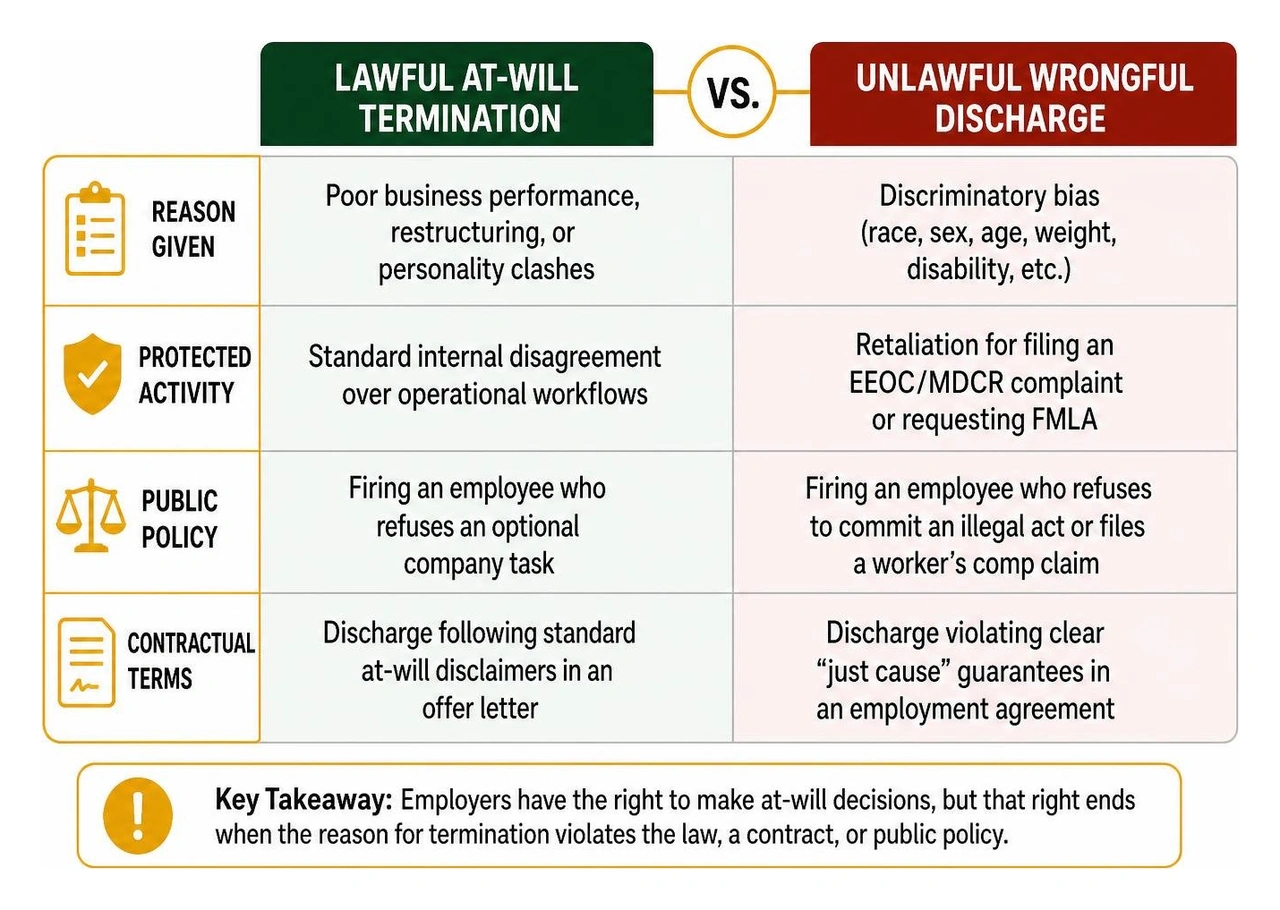
The table below outlines common differences between lawful at-will terminations and unlawful wrongful discharges:
| Factor | Lawful At-Will Action | Unlawful Wrongful Discharge |
|---|---|---|
| Reason Given | Poor business performance, restructuring, or personality clashes | Discriminatory bias (race, sex, age, weight, disability, etc.) |
| Protected Activity | Standard internal disagreement over operational workflows | Retaliation for filing an EEOC/MDCR complaint or requesting FMLA |
| Public Policy | Firing an employee who refuses an optional company task | Firing an employee who refuses to commit an illegal act or files a worker's comp claim |
| Contractual Terms | Discharge following standard at-will disclaimers in an offer letter | Discharge violating clear "just cause" guarantees in an employment agreement |
Common Unlawful Firing and Retaliation Tactics in Southfield Workplaces
Workplace discrimination and retaliation rarely arrive with an open admission of guilt. Companies understand that stating an illegal reason creates instant liability. As a result, employers often employ subtle, indirect tactics designed to manufacture a paper trail before executing a termination. A seasoned retaliation lawyer in Southfield, MI knows how to recognize these patterns and expose the underlying motives.
Retaliation Following Harassment Complaints or Medical Leave Requests
Retaliation occurs when an employer subjects a worker to negative employment actions because they exercised a legally protected right. Statistically and practically, retaliation claims are often easier to prove than the underlying discrimination claim because the timeline of events provides clear evidence of motive.
Common protected activities that trigger unlawful employer retaliation include:
- Reporting sexual harassment or racial discrimination to management or Human Resources.
- Filing formal complaints with the Equal Employment Opportunity Commission (EEOC) or the Michigan Department of Civil Rights (MDCR).
- Requesting medical accommodations under the ADA or taking job-protected leave under the Family and Medical Leave Act (FMLA). Knowing your rights after being fired following medical leave in Michigan is vital if your discharge coincided with health-related absences.
- Objecting to unsafe workplace conditions or wage theft.
When an employee is fired after reporting harassment, the close timing between the report and the discharge—known as temporal proximity—often serves as key evidence of retaliatory intent.
Identifying Pretextual Performance Reviews and Disciplinary Write-Ups

To mask an illegal termination, employers frequently rely on "pretext"—a fabricated, seemingly neutral business reason designed to hide unlawful discrimination or retaliation.
Pretextual tactics often manifest in several recognizable ways:
- Sudden Negative Reviews: An employee with years of stellar evaluations suddenly receives poor marks right after making a protected complaint.
- Hyper-Scrutiny: Minor infractions that were previously ignored—such as arriving two minutes late or taking a slightly extended lunch—become grounds for formal disciplinary write-ups.
- Biased Scheduling and Shift Reductions: Cutting an employee's hours or assigning unfavorable shifts to force them to quit or underperform.
- Exclusion: Leaving the employee off critical project emails, meetings, or client communications to create artificial performance failures.
How a Southfield Wrongful Termination Lawyer Builds a Winning Case
Building a strong employment case requires proving that the employer's stated reason for firing was not the real reason, and that unlawful discrimination or retaliation was the true factor. Understanding what a strong wrongful termination case looks like helps employees see how separate pieces of evidence form a cohesive narrative.
Why You Need a Southfield Wrongful Termination Lawyer to Analyze Comparators and Records
One of the most effective ways to establish pretext is through comparator analysis. An experienced employment attorney in Michigan investigates how the employer treated similarly situated coworkers outside your protected class who engaged in similar conduct or held similar job responsibilities.
For example, if an employer claims you were fired for minor tardiness, your legal team will seek company attendance logs during discovery. If other employees outside your protected group had worse attendance records but faced no discipline, that disparity serves as compelling evidence of disparate treatment.
In addition to comparator evidence, an attorney gathers:
- Internal emails, Slack messages, and internal notes discussing your employment.
- Deposition testimony from supervisors, HR personnel, and coworkers.
- Historical employment data showing patterns of discriminatory terminations within the organization.
Calculating Comprehensive Damages: Lost Wages, Emotional Distress, and Statutory Remedies
Wrongful termination can disrupt your career and create substantial financial and emotional strain. The law provides multiple avenues of compensation to make injured workers whole again:
| Damage Category | Purpose | Included Items |
|---|---|---|
| Back Pay | Restores lost income from date of termination to date of settlement or trial | Base salary, lost bonuses, health insurance benefits, retirement contributions |
| Front Pay | Compensates for future earnings lost if reinstatement is not possible | Projected future salary differential while searching for comparable employment |
| Compensatory Damages | Addresses the human and psychological impact of the illegal firing | Emotional distress, anxiety, depression, damage to professional reputation |
| Punitive Damages | Punishes egregious or malicious employer misconduct (available under select federal statutes) | Monetary penalties designed to deter future illegal conduct |
| Attorney Fees & Costs | Shifts the cost of litigation to the non-compliant employer | Reasonable attorney fees and statutory court costs permitted by law |
Immediate Steps to Take if You Suspect an Illegal Firing
Taking prompt, methodical steps following a termination can significantly improve the strength of your case. Being mindful of the common mistakes employees make before calling an employment lawyer can prevent accidental damage to your potential claims.
Critical Documentation and Evidence Preservation Checklist

Preserving records is one of the most critical responsibilities you have as an employee. Do not rely on your employer to maintain or willingly provide records later.
Before you lose access to company systems, or immediately thereafter, make sure to collect:
- Copies of all written performance evaluations, awards, and commendations.
- The official termination notice and any severance documentation offered.
- Relevant emails, text messages, and chat transcripts demonstrating mistreatment, protected complaints, or shifting explanations from management.
- Your employee handbook, code of conduct, and disciplinary policies.
- A private, detailed timeline of events, including exact dates, times, locations, and names of witnesses.
- Pay stubs, benefits summaries, and bonus statements to establish your baseline compensation.
When to Consult a Southfield Wrongful Termination Lawyer Before Contacting HR
Human Resources professionals are employed to protect the organization from legal liability, not to advocate for individual workers. Consulting an attorney early can help you understand when to call an employment attorney before HR gets involved.
Securing counsel beforehand ensures your internal communications are clearly framed as legally protected activities. It also protects you from inadvertently signing away your rights in an ambiguous severance agreement or broad liability release. Reviewing a checklist of what to bring to an employment lawyer consultation will help ensure your initial case assessment is focused and productive.
Frequently Asked Questions About Michigan Wrongful Termination Claims
What qualifies as illegal wrongful termination under Michigan law?
Illegal wrongful termination occurs when an employer fires an employee for an unlawful reason. This includes violations of state anti-discrimination statutes (such as ELCRA), federal statutes (such as Title VII, ADA, or ADEA), retaliation for exercising a statutory right (such as filing a workers' compensation claim or requesting medical leave), or breaching an express or implied employment contract.
How long do employees have to file a wrongful discharge claim in Michigan?
Deadlines depend strictly on the type of claim you are filing. Under Michigan’s Elliott-Larsen Civil Rights Act, you generally have three years from the date of termination to file a lawsuit in state court. However, federal claims under Title VII, the ADA, or the ADEA require you to file a charge of discrimination with the EEOC or MDCR within 300 days of the discriminatory act. Missing these statutory deadlines can permanently bar your claim.
Can an employer fire a worker without warning or disciplinary notice?
Yes, under Michigan’s at-will employment doctrine, an employer can terminate an employee without notice or progressive discipline, provided the motivation is not illegal. However, if company policy or an implied contract mandates progressive discipline, or if the lack of warning is used to conceal an unlawful, discriminatory motive, the abrupt firing can serve as evidence supporting a wrongful termination claim.
Conclusion
Losing your job under questionable circumstances can feel overwhelming, but you do not have to navigate the complex legal system alone. At Scott Batey Law, we bring over 25 years of focused employee-side advocacy to every case, fighting to hold employers accountable across Southfield, Oakland County, and the broader Metro Detroit area. If you believe your firing crossed the line into unlawful discrimination or retaliation, explore your rights under the workplace discrimination and wrongful discharge protections of ELCRA and take the first step toward reclaiming your career and financial security.