.png)
How to Spot and Stop Workplace Harassment in Michigan

When Work Becomes Unbearable: What Michigan Employees Need to Know About Workplace Harassment
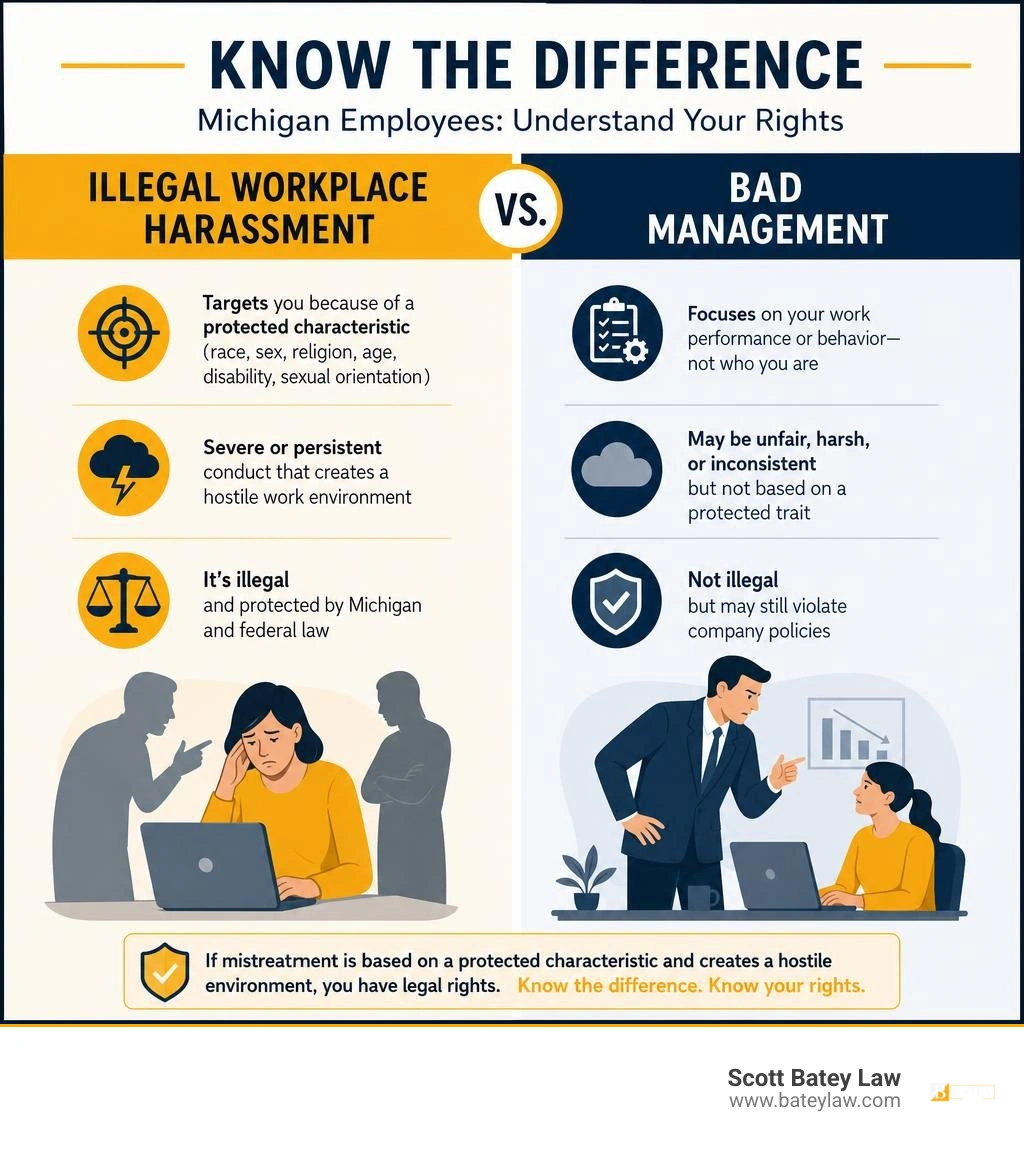
Workplace harassment in Michigan is illegal when it targets an employee based on a protected characteristic — such as race, sex, religion, age, disability, or sexual orientation — and is severe or persistent enough to create a hostile work environment.
Here is a quick summary of what you need to know:
- What it is: Unwelcome conduct based on a protected characteristic that interferes with your ability to work
- Key laws: The Elliott-Larsen Civil Rights Act (ELCRA), Title VII, and the ADA
- Who is covered: Most Michigan employees at companies with 15 or more employees (federal) or any size employer (ELCRA)
- Filing deadlines: 180 days to file with the Michigan Department of Civil Rights (MDCR); 300 days to file with the EEOC
- Retaliation is also illegal: Reporting harassment in good faith protects you, even if the complaint is not upheld
Every day, Michigan workers show up and face intimidation, humiliation, or constant mistreatment on the job. Nearly half of American workers have been affected by workplace bullying in some form. But not all of that mistreatment is the same — and not all of it is illegal.
The law does not protect you from every rude boss or difficult coworker. It does protect you when that mistreatment is tied to who you are — your race, gender, disability, religion, or other protected traits.
Understanding the difference between a bad work situation and an illegal one is the first step toward protecting yourself.
I'm Scott Batey, a Michigan employment lawyer with nearly 30 years of experience representing employees in workplace harassment Michigan cases, including hostile work environment claims, sexual harassment, and retaliation. This guide will walk you through exactly what the law covers, what steps to take, and how to protect your rights.
Understanding Workplace Harassment Michigan: Bullying vs. Illegal Conduct
Many people who contact our offices in Bingham Farms or Detroit are dealing with immense stress at work. They describe a toxic atmosphere where they feel constantly targeted. However, from a legal perspective, we must establish a clear distinction between general workplace bullying and illegal harassment under Michigan law.
While both cause serious emotional distress, only one of them gives you the right to file a lawsuit or administrative complaint. As the resource guide on Workplace Discrimination | Michigan Legal Help points out, legal protection relies heavily on whether the bad behavior is directly tied to a protected class.
What is Workplace Harassment Michigan Under the Law?
Under both state and federal frameworks, illegal workplace harassment is a form of discrimination. It is defined as unwelcome verbal, physical, or visual conduct directed at an employee because of a protected characteristic.
For harassment to cross the line into illegal territory, the conduct must:
- Be motivated by bias against a protected class (such as race, sex, age, or disability).
- Create an intimidating, hostile, or offensive work environment, or result in a tangible employment action (like being fired, demoted, or passed over for a promotion).
If a supervisor screams at you simply because they have a terrible temper and they scream at everyone equally, it is bad management, but it is generally not illegal. However, if they target you with slurs, make offensive jokes about your age, or treat you worse than others because of your gender, that constitutes illegal Hostile Work Environment in Michigan What Actually Makes It Illegal.
Workplace Bullying vs. Illegal Harassment
Workplace bullying is defined as unwanted, recurring aggressiveness that causes psychological or physical harm and creates a power imbalance. On average, workplace bullying happens at least once a week for a period of six months and can last for two to five years.
Despite how destructive it is, bullying itself is not explicitly prohibited by federal or Michigan employment statutes. It exists in a legal gray area. However, that does not mean employers have a free pass to ignore it. Under the Michigan Occupational Safety and Health Administration (MIOSHA), employers have a general duty to provide a safe work environment. Unchecked bullying that escalates to threats or physical safety hazards can lead to MIOSHA violations, workers' compensation claims, or tort liability. In fact, unchecked workplace bullying has led to jury verdicts against employers exceeding $7,000,000 for breach of the duty of care.
When does bullying become illegal harassment? It happens the moment the bully's behavior targets a protected characteristic. To understand where the legal boundaries lie, you can read our detailed breakdown of Hostile Work Environment vs Bad Boss Where the Law Draws the Line.
Federal and State Laws Protecting Michigan Workers
When we represent workers in Oakland County, Wayne County, and across Michigan, we utilize a powerful combination of state and federal civil rights laws to build strong cases.
The Elliott-Larsen Civil Rights Act (ELCRA)
The Elliott-Larsen Civil Rights Act (ELCRA) is Michigan’s primary anti-discrimination law, and it is one of the strongest state civil rights statutes in the nation. It applies to all Michigan employers, regardless of size.
Under the ELLIOTT-LARSEN CIVIL RIGHTS ACT (EXCERPT), workers are protected from discrimination and harassment based on:
- Race, color, and national origin
- Religion
- Sex (which explicitly includes pregnancy, childbirth, and related medical conditions)
- Age
- Height and weight
- Marital status and familial status
Furthermore, thanks to landmark legislative updates, the ELCRA explicitly protects workers against discrimination and harassment based on sexual orientation and gender identity or expression. This ensures comprehensive protection for LGBTQ+ workers throughout Michigan, from Southfield to Troy and beyond.
Federal Protections: Title VII and the ADA
In addition to state laws, several federal statutes protect Michigan employees:
- Title VII of the Civil Rights Act of 1964: Prohibits harassment based on race, color, religion, sex, and national origin. It applies to employers with 15 or more employees.
- The Americans with Disabilities Act (ADA): Protects individuals with physical or mental disabilities from harassment and requires employers to provide reasonable accommodations. It also applies to employers with 15 or more employees.
- The Age Discrimination in Employment Act (ADEA): Protects workers aged 40 and older, applying to employers with 20 or more employees.
These federal laws are enforced by the U.S. Equal Employment Opportunity Commission (EEOC). Because Michigan state law (ELCRA) covers employers of all sizes and includes unique protected classes like height and weight, state law often provides broader pathways to justice, though we frequently file claims under both federal and state jurisdictions.
What Constitutes a Hostile Work Environment in Michigan?
A "hostile work environment" is a term that is frequently misunderstood. Many employees believe that having an aggressive, micro-managing, or rude boss automatically means they are enduring a hostile work environment. In the legal world, however, the standard is much higher and more specific.
To learn more about the exact boundaries of these claims, you can read our guide on Hostile Work Environment Lawyer in Michigan When Workplace Harassment Becomes Illegal.
The "Severe or Pervasive" Legal Standard
For harassment to rise to the level of an illegal hostile work environment, the conduct must be severe or pervasive. This means that the offensive behavior cannot be isolated, minor, or trivial. Instead, it must be continuous enough to alter the terms and conditions of your employment and create an abusive working atmosphere.
Michigan courts evaluate these cases using an objective reasonableness standard. Established in the landmark Michigan Supreme Court case Radtke v. Everett :: 1993 :: Michigan Supreme Court Decisions :: Michigan Case Law :: Michigan Law :: U.S. Law :: Justia, the court asks: Would a reasonable person in the plaintiff’s position perceive the conduct as substantially interfering with their employment or creating an intimidating, hostile, or offensive environment?
While a single, isolated off-color joke or minor disagreement rarely meets this standard, a single extremely severe incident—such as physical restraint, sexual assault, or an explicit physical threat by a supervisor—can be sufficient to establish a hostile work environment.
Examples of Illegal Harassment vs. Bad Management
To help you identify whether your situation crosses the legal line, we have compiled a comparison of common workplace scenarios. You can also explore our article on Hostile Work Environment vs Bad Boss Drawing the Line in Michigan for deeper context.
| Illegal Harassment (Actionable) | Lawful but Unpleasant Management (Not Actionable) |
|---|---|
| Quid Pro Quo: A supervisor conditions a promotion or raise on sexual favors or dates. | A supervisor is demanding, sets aggressive sales goals, and closely monitors your daily output. |
| Discriminatory Hostility: Coworkers repeatedly use racial slurs, post offensive memes, or mock an employee’s religious attire. | A coworker is rude, ignores you in the breakroom, or gossips about general office politics. |
| Targeted Abuse: A manager routinely assigns the worst shifts or demotes an employee because of their age or physical disability. | A manager has poor communication skills, yells at everyone equally, or plays favorites without targeting a protected class. |
| Gender Bias: An employee is constantly subjected to degrading comments regarding gender roles, sexual orientation, or identity. | A boss gives you a negative performance review that you believe is unfair but is based on work metrics. |
How to Document and Report Workplace Harassment in Michigan
If you believe you are experiencing workplace harassment michigan, you must take active steps to protect yourself. You cannot rely on your company's Human Resources department to build your case for you. HR represents the employer's interests; your goal should be to create an unassailable paper trail.
Step-by-Step Guide to Documenting Incidents
Effective documentation is often the difference between winning and losing an employment law case. For a comprehensive strategy, read Documenting Harassment the Right Way Notes Emails and Screenshots MI.
When documenting harassment, follow these essential steps:
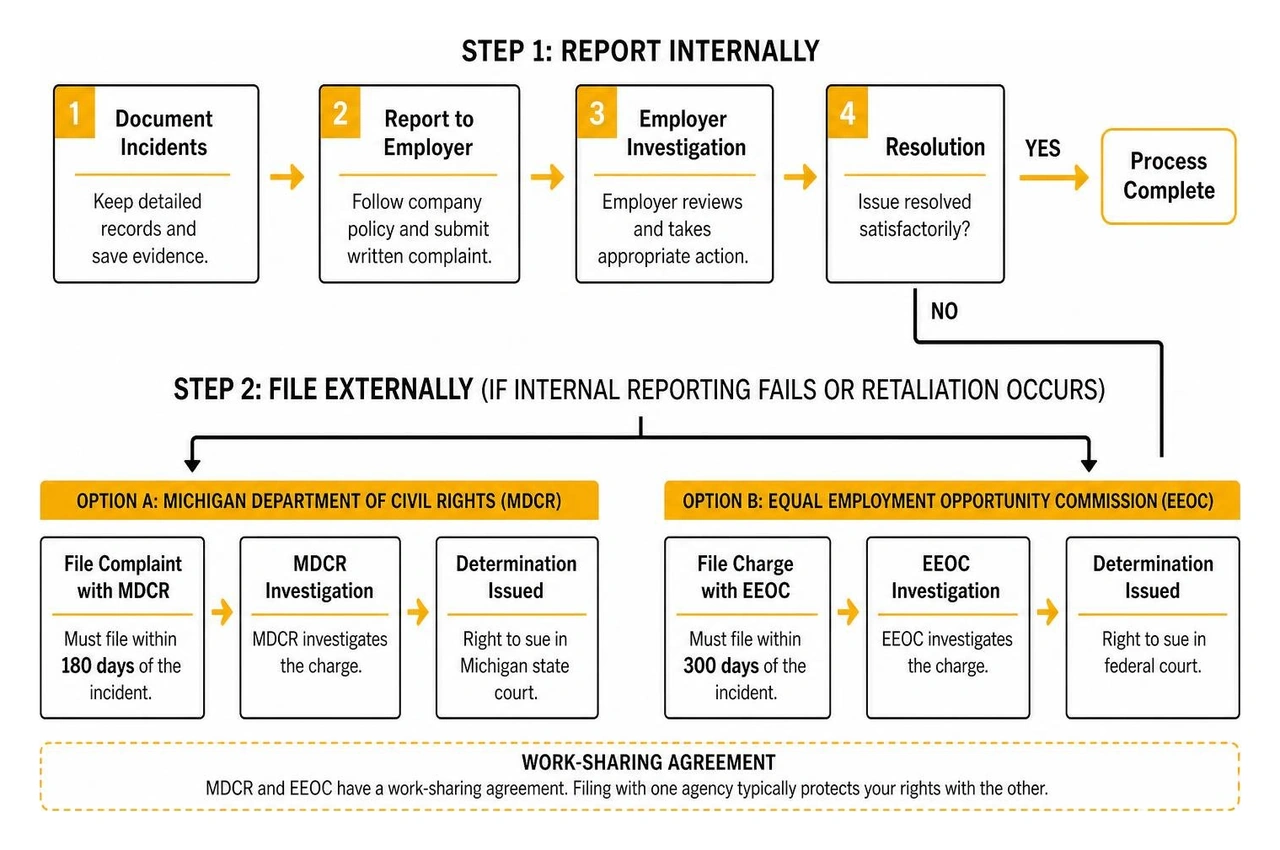
- Keep a detailed log: Write down every single incident immediately. Include the date, exact time, location, who was involved, what was said or done, and the names of any witnesses.
- Save physical and digital evidence: Preserve emails, text messages, Slack or Teams chats, and voicemail messages.
- Use personal devices: Never store your documentation or evidence solely on your work computer, work phone, or company cloud account. If you are suddenly fired or locked out of your accounts, you will lose access to your evidence. Forward emails or take screenshots and save them on your personal phone or personal computer.
- Document the impact: Keep notes on how the harassment is affecting your health, sleep, and performance. If you seek medical treatment or therapy, keep records of those visits.
Reporting Internally vs. Filing with the EEOC and MDCR
Before taking external legal action, you must generally give your employer an opportunity to fix the problem by reporting the harassment internally. Review your employee handbook for the company’s specific reporting procedures and follow them exactly. Submit your complaint in writing, clearly stating that you are experiencing harassment based on your protected characteristic (e.g., "discriminatory harassment based on my disability"). To prepare yourself for this step, read Reporting Sexual Harassment at Work in Michigan What to Do Before HR Calls You In.
If internal reporting fails, or if your employer retaliates against you, you have two primary government agencies with which you can file an administrative charge:
- Michigan Department of Civil Rights (MDCR): You must file a complaint within 180 days of the discriminatory incident.
- Equal Employment Opportunity Commission (EEOC): You must file a charge within 300 days of the incident.
Because the EEOC and MDCR have a work-sharing agreement, filing with one agency typically protects your rights with the other.
Retaliation Protections and Legal Remedies for Victims
Fear of losing a job keeps many victims of harassment silent. It is vital to know that the law provides strong protections for employees who stand up for their rights.
Your Rights Against Retaliation After Reporting Workplace Harassment Michigan
Retaliation occurs when an employer takes an "adverse employment action" against you because you engaged in a protected activity. Protected activities include filing a harassment complaint with HR, cooperating with an internal investigation, or filing a charge with the EEOC or MDCR.
Adverse employment actions include:
- Termination or demotion
- Salary cuts or shifts to less desirable hours
- Undeserved negative performance reviews
- Exclusion from key meetings or team projects
Under Michigan law, you are protected from retaliation as long as you made your complaint in good faith. This means that even if an investigation ultimately concludes that no illegal harassment occurred, your employer still cannot punish you for speaking up. If you are facing backlash, consult Retaliation After Reporting Harassment The Michigan Employee Playbook to understand your rights and next steps.
Available Remedies and Damages
If we successfully prove that you were subjected to illegal workplace harassment or retaliation, several forms of compensation and legal remedies may be available to you:
- Back Pay: Compensation for lost wages and benefits from the time of the unlawful action (such as wrongful termination) up to the date of trial.
- Front Pay: Compensation for future lost wages if you cannot return to your position or find equivalent employment.
- Compensatory Damages: Compensation for emotional distress, mental anguish, loss of professional reputation, and out-of-pocket medical expenses.
- Punitive Damages: Available under federal law (Title VII and ADA) to punish employers who acted with malice or reckless indifference to your rights.
- Attorney’s Fees and Court Costs: The court may order your employer to pay your legal fees.
Frequently Asked Questions About Michigan Workplace Harassment
How long do I have to file a harassment complaint in Michigan?
To pursue administrative remedies, you have 180 days from the date of the harassment to file a complaint with the MDCR, and 300 days to file with the EEOC. If you intend to file a lawsuit directly under the Elliott-Larsen Civil Rights Act (ELCRA) without going through an administrative agency, the statute of limitations is generally three years from the date of the incident. However, check your employment contract or handbook carefully, as some employers include clauses that attempt to shorten these filing deadlines.
Can I sue for a hostile work environment if only one incident occurred?
Yes, but the incident must be exceptionally severe. Under the standard established in Radtke v. Everett, a single incident of physical restraint, sexual assault, or an explicit threat of violence by an employer or supervisor in a close working environment can be sufficient to create a hostile work environment.
What if HR ignores my harassment complaint?
If HR ignores your complaint, fails to conduct a thorough investigation, or sweeps the issue under the rug, they have failed in their legal duty to take prompt corrective action. This significantly increases your employer's liability. Your next steps should be to preserve all of your documentation, file an administrative complaint with the EEOC or MDCR, and contact an experienced employment attorney immediately to discuss filing a lawsuit.
Conclusion: Stand Up for Your Rights with Scott Batey Law
No one should have to endure an abusive, discriminatory environment just to earn a living. If you are facing workplace harassment michigan, you do not have to navigate this stressful and complex process alone.
At Scott Batey Law, we have spent over 25 years providing personalized, award-winning representation to workers in Bingham Farms, Southfield, Royal Oak, Troy, Detroit, and across Oakland County. We understand the tactics employers use to avoid liability, and we are committed to helping you hold them accountable.
Protect your rights with an experienced Bingham Farms employment lawyer at Scott Batey Law. Contact us today to schedule a confidential consultation and take the first step toward reclaiming your career and peace of mind.