.png)
A Comprehensive Guide to Wrongful Termination (2025)

Wrongful Termination: When a Firing Breaks the Law
Wrongful termination means being fired for a reason that breaks the law or a binding employment agreement. In Michigan, an employer can usually fire an at-will worker without warning. But it cannot fire someone because of discrimination, retaliation for a protected complaint, or another legally protected action. A firing can feel unfair without being illegal; the reason behind it is what matters.
If you suspect your firing was unlawful, write down what happened, save records you can legally keep, and check filing deadlines promptly. Do not rush to sign a severance agreement that may release your claims.
I'm Scott Batey, a Michigan employment lawyer who has represented workers in wrongful termination and related workplace disputes since 1996. I help employees sort out which facts matter, what options they have, and what to do next.
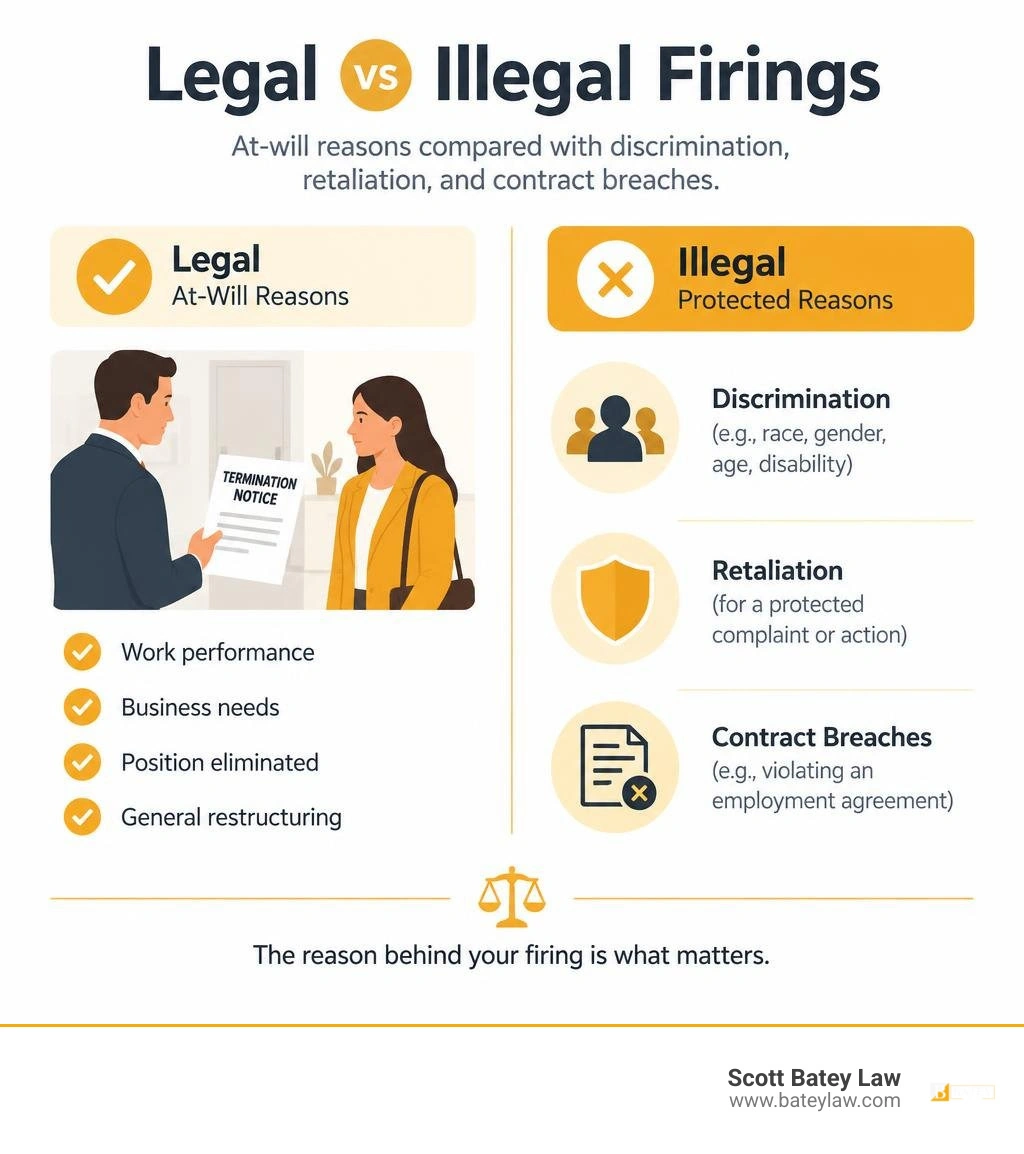
Know your wrongful termination terms:
What Legally Constitutes Wrongful Termination?
Under American employment law, the baseline rule across Michigan—from Detroit and Southfield to Troy and Royal Oak—is the doctrine of at-will employment. This standard means that an employer can generally terminate an employee at any time, for any reason, or for no reason at all. However, "any reason" is not an absolute free pass. It cannot be an illegal reason.
As outlined in the legal definition of wrongful termination, an unlawful dismissal occurs whenever an employer discharges an employee in a manner that breaches a contractual agreement, violates statutory protections, or infringes upon established public policy. More than 2.7 million American workers separate from their jobs each month, and while many departures are routine, thousands cross the threshold into actionable legal violations.
| Factor | Unfair Termination (Legal) | Illegal Termination (Actionable) |
|---|---|---|
| Core Motive | Personality clashes, arbitrary boss decisions, or poor management judgment | Discrimination based on protected status, retaliation, or public policy violations |
| Contractual Status | Standard at-will employment with no written promises or disciplinary procedures | Breach of an express written contract or enforceable implied handbook promises |
| Legal Protection | No violation of federal, Michigan state, or local civil rights laws | Violates civil rights statutes (Title VII, ELCRA, ADA, ADEA, FMLA) |
| Available Remedy | Generally limited to state unemployment compensation | Back pay, front pay, emotional distress damages, punitive damages, and legal fees |
Unlawful Firing vs. Unfair Firing
One of the hardest realities we explain to workers is that an unfair firing is not automatically an illegal firing. Employers have broad managerial discretion. A manager can fire someone because of a petty disagreement, favoritism, or a baseless assumption, and under a strict application of the at-will rule, that firing is legally permissible.
However, employers frequently mask unlawful motives behind arbitrary explanations or sudden performance criticisms. This is known as a pretextual firing. When reviewing whether a dismissal crosses into illegal territory, understanding the at-will doctrine helps workers differentiate between managerial unfairness and unlawful misconduct.
Federal and State Protected Classes
Both federal and state statutes explicitly prohibit employers from making employment decisions—especially discharges—based on specific protected characteristics. Key federal statutes include:
- Title VII of the Civil Rights Act of 1964: Prohibits discrimination based on race, color, national origin, religion, and sex (including pregnancy, sexual orientation, and gender identity).
- Age Discrimination in Employment Act (ADEA): Protects workers aged 40 and older from age-biased hiring, firing, and demotions.
- Americans with Disabilities Act (ADA): Shields qualified individuals with physical or mental disabilities and requires reasonable accommodations.
- Family and Medical Leave Act (FMLA): Protects workers taking qualified medical leave from adverse employment actions.
Michigan workers are also protected by comprehensive state legislation, including the Elliott-Larsen Civil Rights Act (ELCRA) and the Persons with Disabilities Civil Rights Act (PWDCRA), which provide expansive protections. You can review standard administrative procedures and guidelines from federal agencies to see how administrative charges are routed.
Major Legal Exceptions to At-Will Employment
While at-will employment remains standard, the law establishes strict boundaries. When an employer violates statutory rights or breaches an agreement, the at-will defense fails. Reviewing established at-will employment exceptions shows that workers possess substantial legal shields against unlawful employer misconduct.
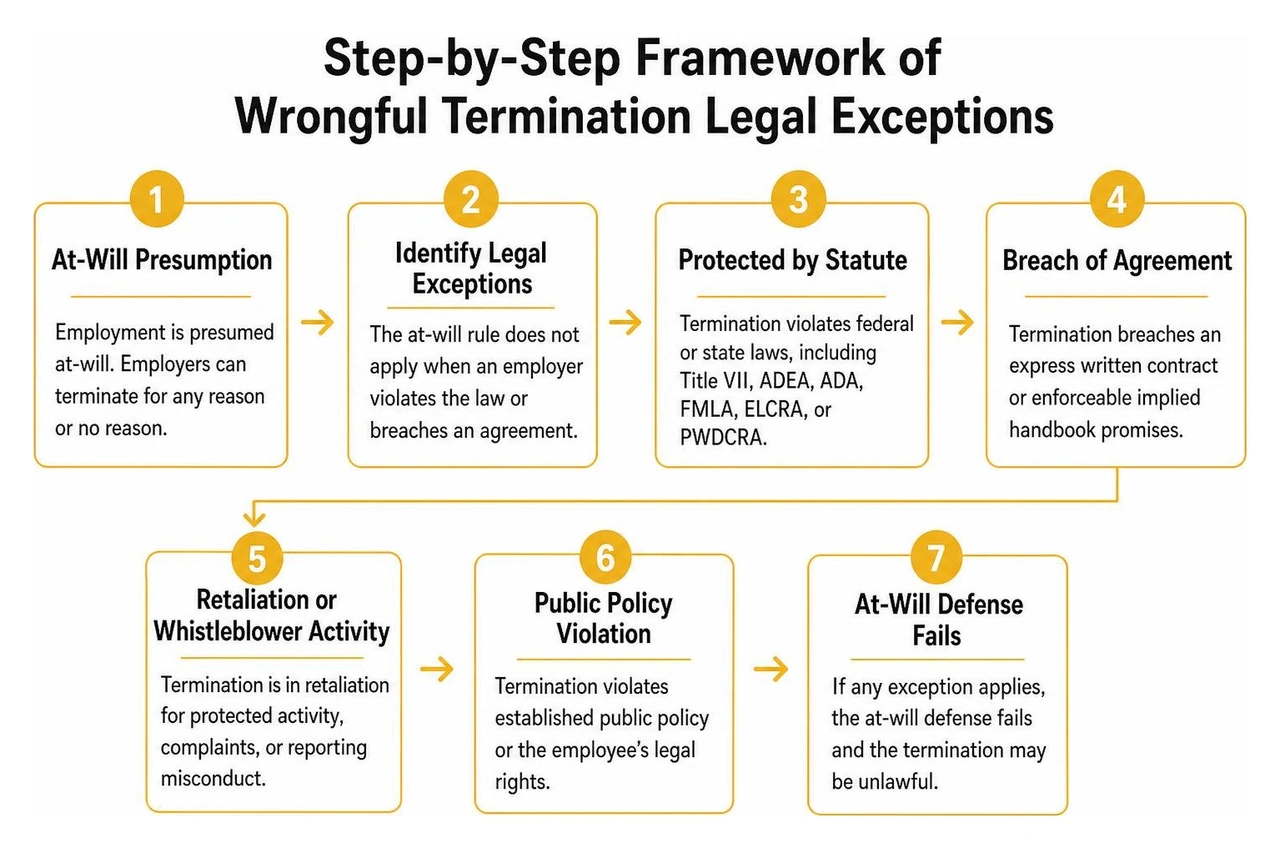
Retaliation and Whistleblower Rights
Retaliation is the single most common basis for workplace claims. Retaliation accounted for over 55 percent of all charges received by the EEOC in recent years, making up over 56% of charges filed in fiscal year 2023.
Retaliation occurs when an employer penalizes an employee for engaging in a protected activity, such as:
- Reporting sexual harassment or racial discrimination internally or to the EEOC.
- Filing an OSHA complaint regarding hazardous workplace conditions.
- Requesting reasonable accommodations under the ADA or taking approved FMLA leave.
- Cooperating as a witness in an active workplace investigation.
- Exercising statutory rights, such as filing for workers' compensation.
When an employee is suddenly discharged after raising legal or safety concerns, suing for firing without warning can hold the employer accountable for retaliatory conduct.
Implied Contracts and Policy Manual Guarantees
While most employment is at-will, written employment contracts, offer letters, and even employee handbooks can alter this relationship. If an employer distributes a handbook that guarantees progressive discipline (e.g., verbal warning, written reprimand, suspension, then termination) without an unambiguous at-will disclaimer, it may establish an enforceable implied contract.
When an organization promises to terminate staff only for "just cause" and then disregards its own mandatory procedures, affected workers may pursue wrongful discharge claims grounded in contract law.
Public Policy Violations and Constructive Discharge
An employer cannot force a worker to choose between keeping their job and breaking the law. The public policy exception makes it unlawful to dismiss an employee for:
- Refusing to engage in illegal activities, such as falsifying financial reports or violating environmental regulations.
- Exercising a statutory right, such as filing a wage claim.
- Fulfilling an obligatory civic duty, such as attending jury duty.
Additionally, an employer cannot escape liability by making the workplace so intolerable that an employee feels compelled to quit. This situation is known as constructive discharge. When assessing protections when fired abruptly or forced out under hostile conditions, courts evaluate whether a reasonable person in the employee's position would have felt forced to resign.
Building Evidence and Filing a Claim

Because employers rarely admit to unlawful motives, the vast majority of cases rely on circumstantial evidence. Establishing a valid claim requires proactive documentation and a clear timeline of events. Taking swift evidence moves to make after termination can protect crucial records before they are altered or erased.
Critical Steps to Take Immediately Following a Wrongful Termination
If you suspect you were dismissed unlawfully, taking disciplined steps will help protect your case:
- Preserve Documentation: Secure personal copies of performance reviews, offer letters, disciplinary memos, emails, and text messages that you have lawful access to keep.
- Request Your Personnel File: Under Michigan law (the Bullard-Plawecki Employee Right to Know Act), employees have the legal right to inspect and obtain copies of their personnel records.
- Create a Factual Timeline: Build an organized, chronological record detailing every relevant interaction, meeting, performance evaluation, and complaint. Focus on building an evidence timeline that highlights shifts in managerial behavior following protected activities.
- Secure Contact Info for Witnesses: Gather personal email addresses and phone numbers for former coworkers who witnessed your performance or the discriminatory behavior.
- Avoid Social Media Pitfalls: Never vent about your termination, your employer, or your legal strategy on public forums, as defense attorneys routinely scrutinize social media for statements to use against you.
Filing Deadlines and Agency Procedures
Timing is critical. About 150,000 wrongful termination and discrimination charges are filed with the Equal Employment Opportunity Commission (EEOC) each year. Under federal guidelines, you typically have 180 calendar days from the date of the unlawful act to file a charge, which is extended to 300 days in Michigan because state laws enforce comparable protections.
Once the EEOC resolves its inquiry—having processed more than 75,000 charges last fiscal year—it may issue a "Right-to-Sue" notice, granting you 90 days to initiate a federal lawsuit. Furthermore, an estimated 60 million American workers are subject to mandatory pre-dispute arbitration agreements. These agreements require claims to proceed before a private arbitrator rather than a public jury, though statutory exceptions exist for certain claims like sexual assault and harassment.
Potential Remedies, Damages, and Severance Pitfalls

When pursuing legal action, the goal is to make the employee whole. In the most recent complete fiscal year, the EEOC obtained more than $500 million in monetary relief for workers through its administrative enforcement activities alone, excluding private court litigation. When evaluating a claim, consulting local Oakland County employment law insights helps clarify potential financial recovery.
Calculating Back Pay, Front Pay, and Emotional Distress
Damages in employment cases fall into several key categories:
- Back Pay: Total wages, overtime, commissions, and lost fringe benefits (health insurance, 401(k) matches) calculated from the termination date up to settlement or trial.
- Front Pay: Anticipated future lost earnings awarded when workplace reinstatement is impractical.
- Compensatory Damages: Compensation for emotional distress, anxiety, reputational harm, and medical expenses caused by the firing.
- Punitive Damages: Financial penalties assessed to punish malicious employer actions. Under federal Title VII, combined compensatory and punitive damages are capped based on employer size: $50,000 for employers with 15–100 workers, scaling up to $300,000 for employers with 500 or more employees. Michigan's state statutes (such as ELCRA) do not impose these same federal damage caps.
- Attorneys' Fees and Costs: Prevailing employees can often recover reasonable legal fees directly from the employer.
Workers must remember that plaintiffs have an affirmative duty to mitigate damages by actively seeking comparable replacement employment. Settlement allocations also have tax consequences: wage components (back/front pay) are subject to standard W-2 payroll withholding, whereas emotional distress damages are generally reported on a 1099 form.
Severance Agreements and Release Waivers
When terminating an employee, companies routinely offer severance pay in exchange for signing a broad release of all legal claims. You should never sign a severance document immediately.
Under the Older Workers Benefit Protection Act (OWBPA), workers aged 40 and older must be given at least 21 days to review a severance offer (or 45 days in group layoffs) and a mandatory 7-day post-signing revocation window. If you sign away your rights, you permanently extinguish your ability to sue for illegal dismissal. Having an attorney review these agreements can uncover potential legal claims and provide leverage to negotiate higher severance packages.
Frequently Asked Questions About Workplace Dismissals
Can I File a Wrongful Termination Lawsuit if I Was an At-Will Worker?
Yes. At-will employment allows dismissal for many reasons, but not an illegal reason. If your firing was motivated by race, sex, age, disability, or retaliation for a protected activity, your at-will status offers no shield to the employer. A successful claim demonstrates that the company's stated reason was merely a pretext to conceal an unlawful motive.
What is the Difference Between Being Fired and Constructive Discharge?
A standard firing is an involuntary dismissal initiated directly by the employer. Constructive discharge occurs when an employer creates, allows, or refuses to correct working conditions that are so intolerable that a reasonable employee would feel compelled to resign. In the eyes of the law, an established constructive discharge is treated the same as an involuntary termination.
How Long Do I Have to Take Legal Action After Being Terminated?
Deadlines depend heavily on the legal nature of your claim. Federal discrimination and retaliation claims require an EEOC filing within 180 to 300 days of termination. State statutory claims in Michigan, such as those brought under the Elliott-Larsen Civil Rights Act, carry a three-year statute of limitations, while breach of written contract claims can extend up to six years. Because missing an administrative deadline permanently bars your recovery, you should seek legal advice as soon as possible after being dismissed.
Conclusion
Experiencing a sudden firing disrupts your livelihood, your professional confidence, and your career stability. While Michigan employers possess broad latitude under at-will employment, they must operate within the boundaries of state and federal civil rights laws. Recognizing the clear distinction between an unfair workplace experience and an actionable unlawful dismissal is the essential first step toward obtaining justice and compensation.
At Scott Batey Law, we have dedicated over 25 years to fighting for workers across Bingham Farms, Birmingham, Beverly Hills, Farmington Hills, Oak Park, Ferndale, Berkley, Madison Heights, and throughout greater Oakland County and Detroit. We offer award-winning, personalized representation on a contingency fee basis, ensuring that everyday employees have access to experienced advocacy against well-funded employers.
If you suspect your dismissal was motivated by discrimination, retaliation, or a breach of contract, do not navigate the legal process alone. Contact our team to schedule an initial case review with a dedicated Wrongful Termination Attorney Birmingham MI and protect your legal rights today.