.png)
The Ultimate Guide to the Covenant Not to Compete

What a Covenant Not to Compete Means for Your Next Job
A covenant not to compete, often called a noncompete agreement, is a contract term that may limit where, for whom, or in what role you can work after leaving an employer. It may also restrict you from starting a competing business for a set time.
Whether it is enforceable depends heavily on state law and the contract's details. Courts often look at whether the restriction protects a real business interest and is reasonable in its duration, geographic reach, and the work it prohibits. A clause that blocks you from working in an entire industry, in any role, or for too long may be vulnerable to challenge.
For Michigan employees, the key is not to assume a signed agreement controls your future. Read the exact language, preserve a copy, avoid sharing confidential information, and get legal advice before accepting a job that could trigger a dispute. Federal efforts to ban most worker noncompetes remain tied up in litigation as of September 2026, so state law and the facts of your agreement still matter.
I am Scott Batey, a Michigan employment lawyer who has represented employees since 1996 in workplace and contract disputes. I help workers evaluate a covenant not to compete, negotiate safer terms, and respond strategically when an employer threatens to enforce one.
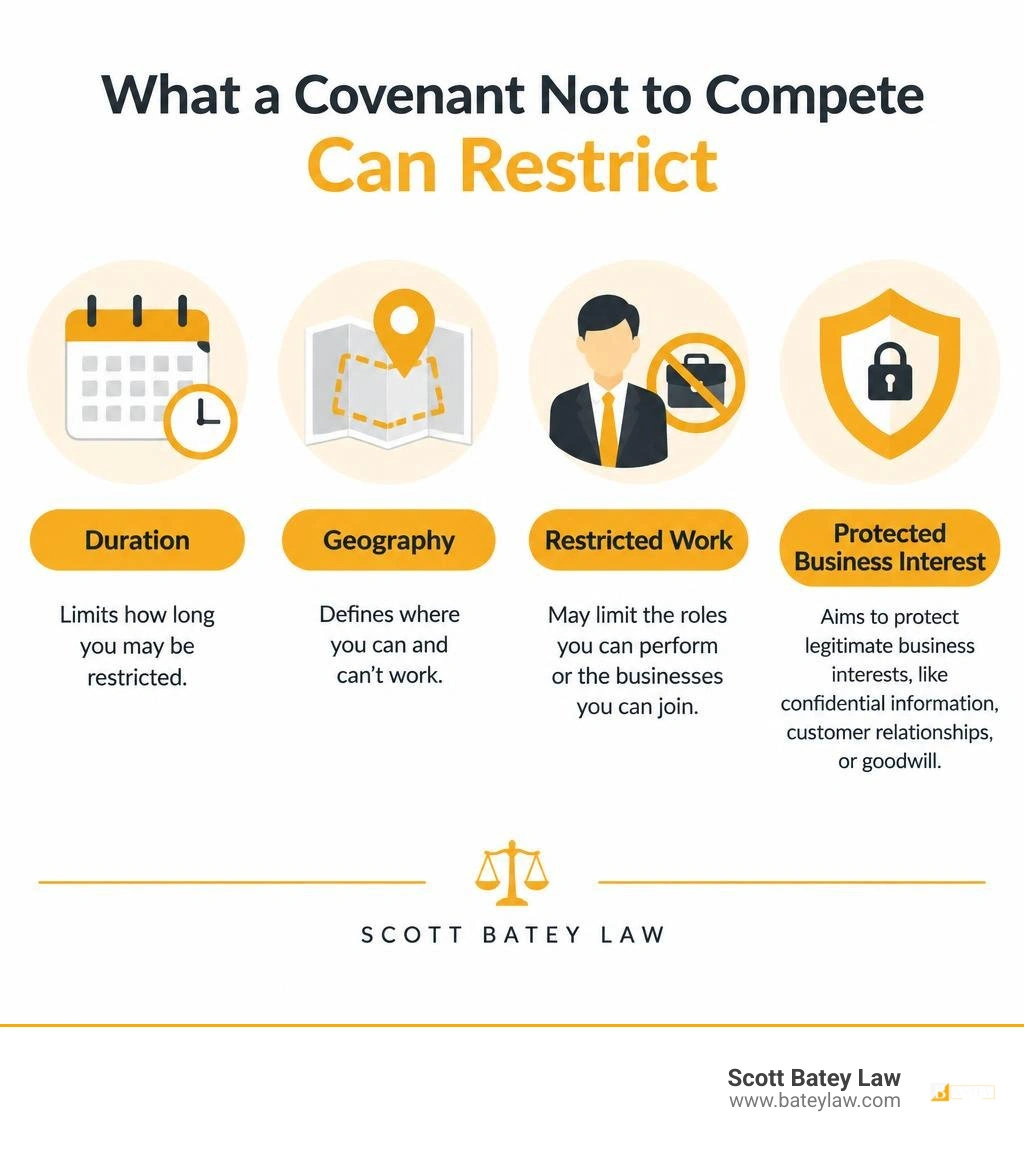
Covenant not to compete terms explained:
- Michigan Non Compete Lawyer
- Non Compete Agreement Between Business Partners
- Small Business Non Compete Agreement
What Is a Covenant Not to Compete and How Does It Work?
At its core, a covenant not to compete is an agreement designed to prevent an individual from engaging in commercial activities that directly rival their former employer. Across the country, an estimated 30 million workers—nearly one in five Americans—are bound by restrictive covenants. In corporate corridors and local businesses alike, these clauses are pitched as shields to protect proprietary trade secrets, customer goodwill, and substantial investments in specialized training.

However, there is a fine line between safeguarding legitimate assets and imposing an unlawful restraint on trade. When an employer asks you to sign a noncompete, they are asking you to surrender a portion of your post-employment mobility. If you eventually depart, the agreement dictates what jobs you can take, which geographical territories are off-limits, and how long you must wait before re-entering your chosen field.
Legal Definition and Essential Elements of a Covenant Not to Compete
Under contract law, a covenant not to compete is a restrictive covenant executed between an employer and an employee (or between the buyer and seller of a business). To be legally binding, it must contain specific core elements:
- Legitimate Business Interest: The restraint cannot exist purely to stifle competition. It must protect proprietary information, specialized customer lists, or commercial goodwill.
- Adequate Consideration: There must be a tangible benefit given in exchange for signing. For new hires, this is typically the job offer itself. For existing employees, continued employment, a raise, a promotion, or a bonus may serve as consideration depending on state rules.
- Reasonable Temporal Duration: The ban must last only as long as necessary to protect the interest—often ranging from 6 to 12 months, and rarely justified beyond 24 months.
- Defined Geographic Territory: The geographic scope must be tied directly to the specific market where the employer operates and where you actually performed services.
- Narrowly Defined Restricted Activities: The agreement should only prohibit work in direct competition with what you did, rather than banning you from working in any capacity for a competitor.
In the context of corporate acquisitions, covenants not to compete are treated with greater deference by judges. A buyer paying millions of dollars for an established enterprise has an equitable right to protect that purchase by preventing the former owner from immediately opening a rival shop next door. You can read our detailed guide on the non-compete agreement buying a business dynamic to understand how corporate transactions differ from standard employment relationships. For rank-and-file employees, however, courts apply rigorous scrutiny. Before signing or walking away from an opportunity, consulting a Michigan non-compete lawyer can clarify whether the contract meets necessary legal standards.
Noncompete vs Nonsolicitation and NDA Differences
Employers often combine multiple restrictive covenants into a single contract. Understanding the functional difference between noncompetes and nonsolicitation agreements is critical to knowing what you can and cannot do when switching jobs.
Researchers estimate that over 95% of workers subject to a noncompete have also signed a nondisclosure agreement (NDA). While an NDA prevents you from leaking confidential data, a noncompete prevents you from working altogether in your field within a set area.
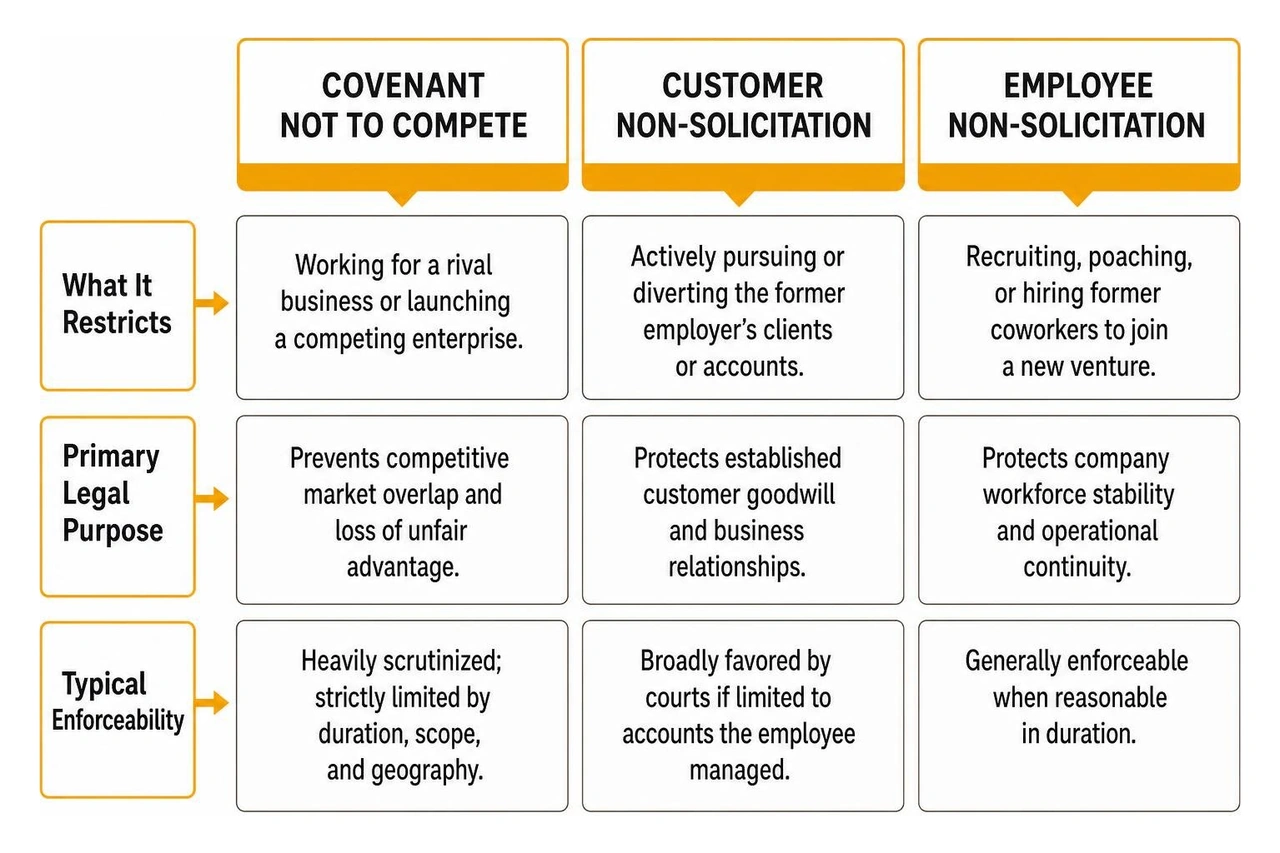
| Provision Type | What It Restricts | Primary Legal Purpose | Typical Enforceability |
|---|---|---|---|
| Covenant Not to Compete | Working for a rival business or launching a competing enterprise. | Prevents competitive market overlap and loss of unfair advantage. | Heavily scrutinized; strictly limited by duration, scope, and geography. |
| Customer Non-Solicitation | Actively pursuing or diverting the former employer's clients or accounts. | Protects established customer goodwill and business relationships. | Broadly favored by courts if limited to accounts the employee managed. |
| Employee Non-Solicitation | Recruiting, poaching, or hiring former coworkers to join a new venture. | Protects company workforce stability and operational continuity. | Generally enforceable when reasonable in duration. |
| Non-Disclosure Agreement (NDA) | Disclosing or utilizing proprietary trade secrets, pricing, and internal data. | Safeguards intellectual property and confidential business assets. | Highly enforceable, often lasting indefinitely for genuine trade secrets. |
If you are evaluating post-employment duties, reviewing confidentiality agreements and NDAs alongside non-solicitation language will reveal whether your primary exposure lies in where you work or how you communicate with past contacts. We also address specialized career paths in our overview for physicians navigating noncompete agreements.
Legal Enforceability and Reasonableness Standards
Courts do not enforce covenants not to compete automatically. Because these clauses restrict an individual's ability to earn a living, judges evaluate them through the lens of public policy and equity. An employer cannot simply enforce an agreement out of spite or to suppress employee wages.

The Three-Prong Reasonableness Test
In jurisdictions that enforce restrictive covenants, including Michigan, courts apply a three-prong reasonableness framework:
- Is the restriction necessary to protect a legitimate business interest? The employer must establish an actual risk to trade secrets, specialized training, or client relationships. Mere fear of ordinary competition does not suffice.
- Is the scope reasonable in duration, geographic footprint, and type of work? A restriction covering regions where the company has no clients, or prohibiting roles entirely unrelated to what you performed, will fail this prong.
- Does the clause impose an undue hardship on the employee or harm the public interest? A court will weigh whether enforcing the noncompete effectively denies you the ability to support yourself or restricts the public's access to vital local services.
When a clause is overly broad, courts in many states may exercise the "blue-pencil doctrine" or judicial reformation powers to narrow the offensive terms while enforcing the remainder. However, if the underlying premise of the restriction is oppressive, the entire covenant can be declared void.
What Makes a Covenant Not to Compete Unenforceable or Overbroad?
Agreements frequently cross the line into illegality when employers overreach. Common fatal flaws include:
- "Any Capacity" Restrictions: Barring a software developer from working as an administrative assistant, janitor, or product manager at a competing technology firm. Courts routinely strike down clauses that ban working in "any capacity."
- Overreaching Geography: Imposing a nationwide or worldwide ban when the employer’s actual market is confined to Southeast Michigan.
- Lack of Consideration: Forcing a long-tenured worker to sign a restrictive covenant without providing any corresponding benefit, promotion, bonus, or job protection.
- Application to Rank-and-File Staff: Attempting to enforce noncompetes against low-wage or entry-level personnel who have no access to trade secrets, pricing formulas, or high-level strategic decisions.
When reviewing contract terms, our team regularly examines severance red flags to ensure departing employees do not mistakenly surrender their legal mobility.
The Regulatory Landscape: Federal Rules and State Laws in 2026
The legal landscape surrounding restrictive covenants is evolving rapidly. Currently, four states ban the use of noncompetes entirely, while 34 states plus the District of Columbia place statutory limits on their scope, enforceability, or applicable wage thresholds.
The FTC Non-Compete Rule and Ongoing Legal Challenges
In early 2024, the Federal Trade Commission issued its landmark FTC Non-Compete Clause Rule, classifying worker noncompetes as an unfair method of competition under Section 5 of the FTC Act. The FTC received more than 26,000 public comments during rulemaking, with over 25,000 expressing direct support for an outright ban.
The economic data underpinning the FTC's position highlights significant market impacts:
- The rule was projected to stimulate over 8,500 new business formations each year.
- Average worker earnings were estimated to increase by $524 annually.
- Healthcare expenditures were modeled to drop by up to $194 billion over a decade.
- Innovation was expected to rise, yielding 17,000 to 29,000 additional patents annually.
The FTC rule established that existing noncompetes for senior executives—defined as workers earning above $151,164 annually in policy-making positions, representing less than 0.75% of the workforce—could remain enforceable, while all other worker noncompetes would be rendered void.
However, as of September 2026, the FTC rule remains subject to ongoing federal appellate litigation. Because its nationwide enforcement is stayed pending ultimate judicial resolution, workers cannot rely solely on federal administrative actions to nullify their agreements. State law remains the governing authority for analyzing enforceability.
State-by-State Differences: Bans, Thresholds, and Garden Leave
State legislatures across the country have created a complex patchwork of enforcement rules:
- Complete Bans: States such as California (under Business and Professions Code Section 16600), Minnesota, Oklahoma, and North Dakota prohibit post-employment noncompetes almost entirely, with narrow carveouts for business sales.
- Income Thresholds: States including Illinois, Colorado, Washington, and Maryland prohibit noncompetes for workers earning below established salary thresholds (often indexing between $75,000 and $100,000+).
- Mandatory Garden Leave and Statutory Notice: Under the Massachusetts Noncompetition Agreement Act, noncompetes are capped at 12 months, require 10 days advance written notice with explicit advice to seek legal counsel, and require employers to provide "garden leave" payments—paying at least 50% of the employee’s annualized base salary during the restriction period.
In Michigan, noncompetes remain enforceable under the Michigan Antitrust Reform Act (MCL 445.774a), provided they protect reasonable business interests and remain narrow in geographic scope, line of work, and duration.
How to Negotiate, Challenge, or Exit a Restrictive Covenant
Being handed a restrictive covenant does not mean you have to sign it as written, nor does having signed one mean you are permanently barred from career advancement.
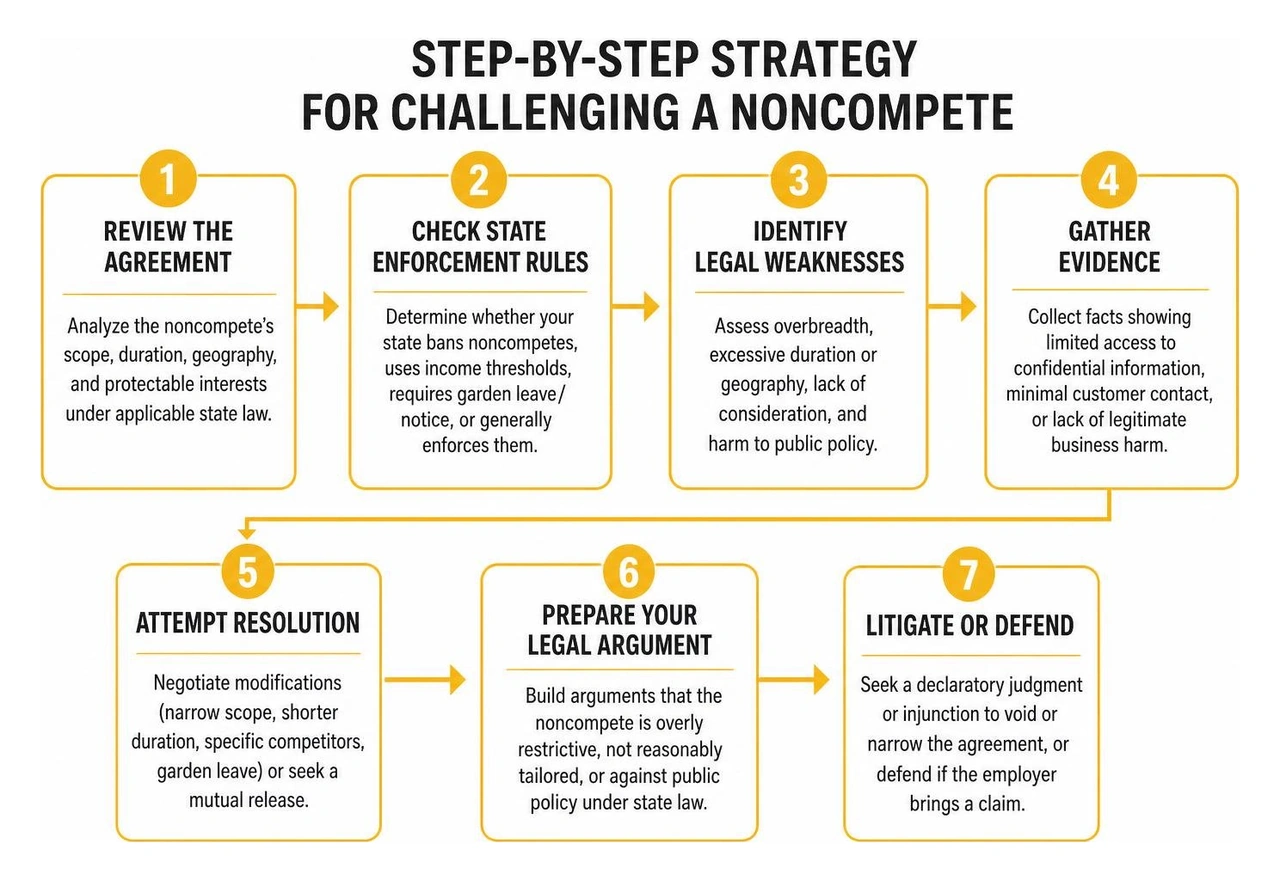
Strategic Redlines and Scope Limitations
If you are negotiating a new job offer or revising an existing contract, you can push for common-sense redlines:
- Name Specific Competitors: Replace vague language like "any direct or indirect competitor" with a concrete list of 3 to 5 direct market rivals.
- Shrink the Timeline: Negotiate a 24-month restriction down to 6 or 12 months.
- Limit the Geographic Radius: Tie the geographical boundaries strictly to the specific office, county, or client territory where you directly generated revenue.
- Carve Out Pre-Existing Relationships: Ensure that clients or professional relationships you brought to the company before your hire date are explicitly exempt.
- Incorporate Layoff Protections: Include explicit contract terms stating that if you are let go without cause or laid off, the noncompete automatically becomes void.
Severance Red Flags and Post-Employment Injunctions
When employment ends, employers frequently embed renewed restrictive covenants inside exit packages. Before signing away your rights, securing a comprehensive severance agreement review ensures you do not inadvertently accept severe work bans in exchange for a modest severance payment.
If an employer believes you are violating a covenant, their typical legal progression involves:
- Sending a formal cease-and-desist letter to you and your new employer.
- Filing a lawsuit seeking emergency injunctive relief (such as a Temporary Restraining Order or Preliminary Injunction) to force you out of your new position.
- Pursuing monetary damages or attempting to claim tortious interference with business relationships.
Responding effectively requires immediate legal analysis of the contract's enforceability before positions harden in court.
Frequently Asked Questions About Covenants Not to Compete
Can my employer enforce a noncompete if I am laid off or fired without cause?
In many instances, an employer's decision to terminate an employee without cause weakens their ability to enforce a restrictive covenant in court. Judges sitting in equity often view it as unfair for a company to discharge a worker involuntarily and simultaneously prevent that individual from earning a living in their specialized trade.
If your termination involved improper employer conduct, reviewing your rights after being fired without cause in Michigan can help establish defenses against post-employment restrictions.
How long does a typical restrictive covenant last before it expires?
In standard commercial employment relationships, reasonable durations typically range from 6 to 12 months. Restrictions extending to 18 or 24 months face heightened judicial scrutiny and usually require unique justifications, such as high-level executive access to long-term trade secrets or specialized product development cycles. Restrictions exceeding two years in standard employment contracts are routinely struck down or reformed by courts.
What happens if I violate a signed restrictive covenant?
If you violate an enforceable covenant not to compete, your former employer can file a lawsuit against you and potentially your new employer. The court may issue a preliminary injunction ordering you to immediately cease working for the competitor. Additionally, you could be held liable for proven actual damages, lost profits, and, where provided for in the contract, the former employer’s reasonable attorney fees.
Conclusion
A covenant not to compete should never be treated as standard, harmless boilerplate. Signing an overly broad agreement can stall your career, limit your earning potential, and expose your next employer to litigation threats. Whether you are reviewing a new employment agreement, navigating a company restructuring, or facing threats from a former employer, you have the right to challenge unreasonable restraints on your professional livelihood.
At Scott Batey Law, we bring more than 25 years of dedicated employee-side advocacy to every case. We provide award-winning, personalized counsel to help you protect your career mobility and assert your workplace rights. If you need strategic guidance on a restrictive covenant, speak with an experienced noncompete agreement attorney today to discuss your legal options.