.png)
A Practical Guide to Firing Legality and Rights in Michigan

What Firing in Michigan Really Means for Your Rights
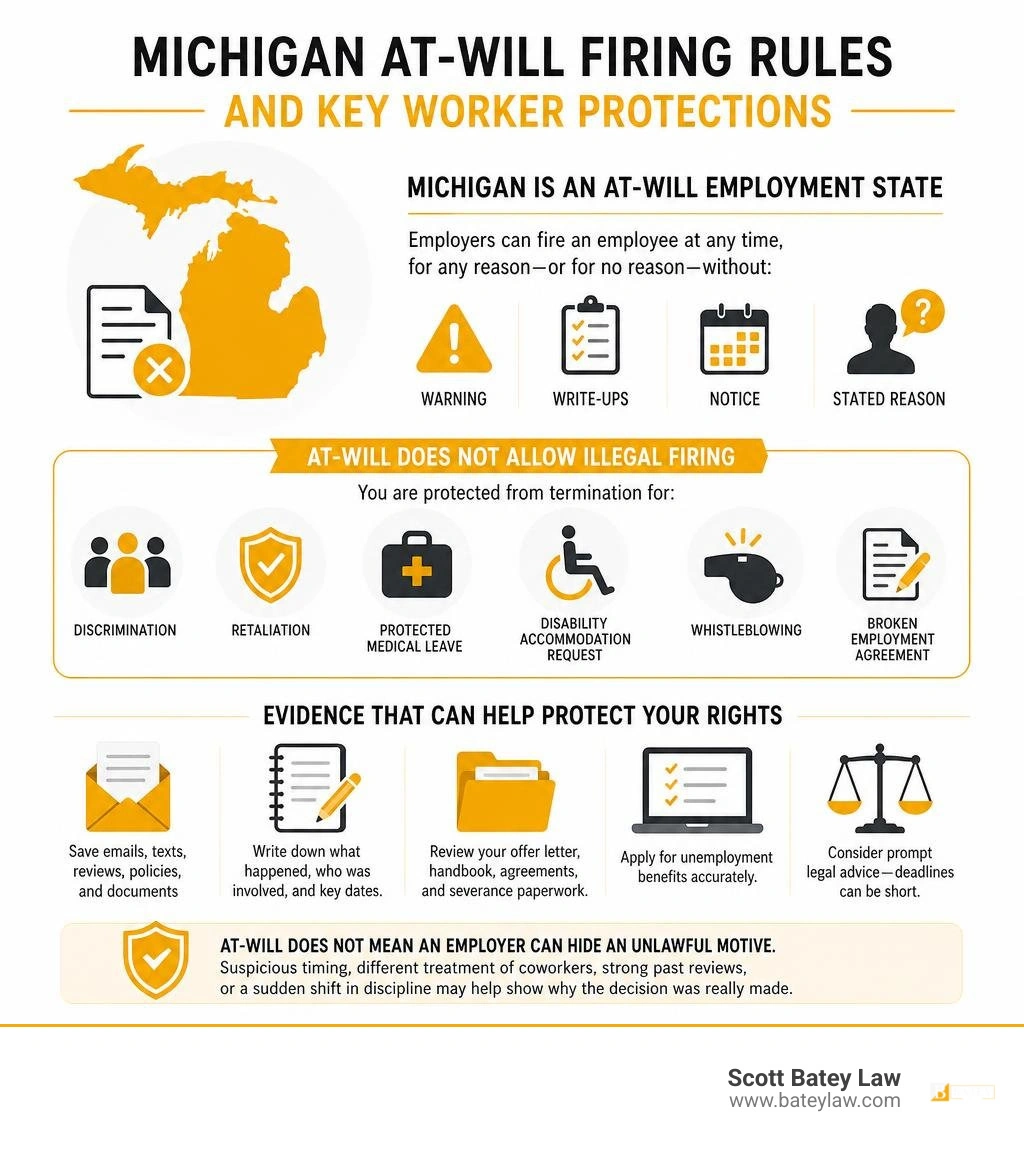
Michigan is an at-will employment state. That usually means an employer can fire an employee without warning, write-ups, notice, or even a stated reason. But firing in Michigan is still illegal when the real reason is discrimination, retaliation, protected medical leave, a disability accommodation request, whistleblowing, or a broken employment agreement.
If you were fired suddenly, take these steps right away:
- Save emails, texts, performance reviews, policies, and termination documents.
- Write down what happened, who was involved, and any recent complaint, leave request, or report you made.
- Review your offer letter, handbook, union agreement, and any severance paperwork before signing.
- Apply for unemployment benefits accurately and consider prompt legal advice because deadlines can be short.
At-will does not mean an employer can hide an unlawful motive by saying nothing. Suspicious timing, different treatment of coworkers, strong past reviews, or a sudden shift in discipline may help show why the decision was really made.
I am Scott Batey, a Michigan employment lawyer who has represented employees since 1996 in disputes involving firing in Michigan, discrimination, retaliation, leave, accommodations, and employment contracts. The sections below explain where at-will rules stop and what evidence can help protect your rights.
Relevant articles related to firing in michigan:
Legal Limits and Rules Governing Firing in Michigan
Understanding Michigan employment law starts with understanding the At-Will Doctrine. In our state, employment is presumed to be at-will. This establishes a bilateral relationship: just as you are free to walk away from your job at any time for any reason (or no reason at all), your employer can terminate your employment relationship without cause and without giving advance notice.
However, "at-will" does not mean "free from the law." Employers often assume the at-will rule gives them total immunity to fire workers arbitrarily. That is simply not true. Statutory protections enacted by Michigan and the federal government draw firm boundaries around management decisions.
| Termination Category | Lawful At-Will Discharge | Unlawful Wrongful Discharge |
|---|---|---|
| Reason Given | Poor business performance, personality clash, company restructuring, or no reason at all. | Termination motivated by race, sex, age, disability, pregnancy, religion, or other protected classes. |
| Notice Provided | Sudden termination with zero prior warnings or corrective write-ups. | Firing immediately following a request for FMLA leave or a disability accommodation. |
| Safety & Reporting | Discharging an employee for standard, non-retaliatory operational adjustments. | Firing a worker for reporting safety violations to MIOSHA or law enforcement. |
| Public Policy | Discharging an employee who refuses to follow lawful corporate business orders. | Firing an employee for refusing to commit perjury or perform an illegal act. |
| Agreements | Terminating an employee whose documentation explicitly maintains at-will status. | Violating express employment contracts, union agreements, or clear "for cause" promises. |
Common Misconceptions About Firing in Michigan
A widespread workplace myth is that a company must place an employee on a Performance Improvement Plan (PIP) or provide three progressive disciplinary write-ups before pulling the trigger on a termination. In reality, state law imposes no progressive discipline requirement on private employers.
Another frequent point of confusion involves employee handbooks. Many workers assume that if they signed an acknowledgment recognizing at-will status, they surrendered their right to challenge an unlawful termination. That is false. As we detail in our analysis of what happens when you are Fired Without Warning in Michigan: What At-Will Really Means, an employer handbook or signed form cannot strip away your statutory workplace protections.
Contractual Exceptions and Implied Agreements
While at-will is the default legal baseline, it can be modified. When an employer enters into an express employment contract promising employment for a set duration, or requiring "just cause" for termination, the employer must abide by those terms. Similarly, collective bargaining agreements negotiated by labor unions provide contractual grievance procedures that replace standard at-will discharge rules.
In certain circumstances, an implied contract may override standard at-will employment. If an employer's policy manuals, onboarding materials, or written guidelines explicitly guarantee progressive discipline or state that employees will only be let go for just cause, those promises can create enforceable contractual obligations under Michigan law. Clear verbal assurances of permanent job security from executives or supervisors can also alter the legal relationship.
Major Unlawful Reasons for Workplace Termination
When an employer discharges a worker based on illegal factors, the at-will doctrine provides zero defense. There are specific Illegal Reasons to Fire Someone established under Michigan and federal statutes that give rise to actionable legal claims.
Protected Classes Under ELCRA and Federal Law
The Elliott-Larsen Civil Rights Act (ELCRA) is one of the most robust state civil rights statutes in the nation. Working in tandem with federal laws like Title VII of the Civil Rights Act and the Age Discrimination in Employment Act (ADEA), ELCRA shields workers across Detroit, Southfield, Troy, and throughout the state.
Under ELCRA and federal statutes, an employer cannot make firing decisions based on:
- Race, color, or national origin
- Sex, gender identity, gender expression, or sexual orientation
- Pregnancy and related medical conditions
- Age (protecting individuals aged 40 and older)
- Religion
- Marital status
- Height and weight (a unique, crucial protection under Michigan's ELCRA that is absent from federal Title VII)
When employers terminate workers because of these protected traits, it constitutes actionable Wrongful Discharge Michigan workers can challenge in court.
Retaliation, Whistleblowing, and Public Policy Violations
Under the Michigan Whistleblowers' Protection Act (WPA), employers are barred from firing or retaliating against an employee who reports—or is about to report—a suspected violation of local, state, or federal law to a public body. Crucially, the employee does not have to prove the employer was ultimately convicted of a crime; they only need a reasonable, good-faith belief that a legal violation occurred.
Workplace safety is another vital area where retaliation is forbidden. When conditions turn dangerous, workers have the absolute legal right to raise concerns or contact safety regulators. Serious industrial and commercial hazards remain a grave concern across our state; for example, Michigan reports two new worker deaths as maintenance technician caught in scrap chute, business owner electrocuted, highlighting the high stakes surrounding workplace safety compliance. Reporting hazards to MIOSHA is a protected activity, and terminating a worker for raising safety flags is illegal.
Furthermore, Michigan courts recognize the public policy exception to at-will employment. An employer cannot discharge an employee because the worker:
- Refused to violate a law or commit an illegal act on behalf of the company
- Exercised a statutory right, such as filing a legitimate workers' compensation claim
- Fulfilled a mandatory civic duty, such as responding to a jury duty summons or complying with a subpoena
Medical Leave and Disability Rights Violations
Federal and state statutes strictly protect employees dealing with health conditions or family medical emergencies. The Family and Medical Leave Act (FMLA) grants eligible employees up to 12 weeks of job-protected, unpaid leave for qualifying medical and family needs. Firing an employee for requesting or taking FMLA leave constitutes unlawful interference and retaliation.
Simultaneously, the Americans with Disabilities Act (ADA) and Michigan's Persons with Disabilities Civil Rights Act (PWDCRA) require employers to provide reasonable accommodations to qualified employees with physical or mental disabilities, provided it does not impose an undue hardship on operations. You do not need to cite specific statutes or legal jargon when making a request; simply communicating your medical need puts the employer on notice. If you find yourself Fired After Medical Leave Bingham Farms MI or penalized after asking for an ergonomic adjustment, modified shift, or medical leave, the termination is subject to legal challenge.
Critical Steps to Take Immediately After Being Terminated
Being terminated without warning creates immediate stress, but the steps you take in the first 48 hours can determine the outcome of a legal claim.

If you are dealing with Employment Law Termination Without Notice, implement this strategic plan:
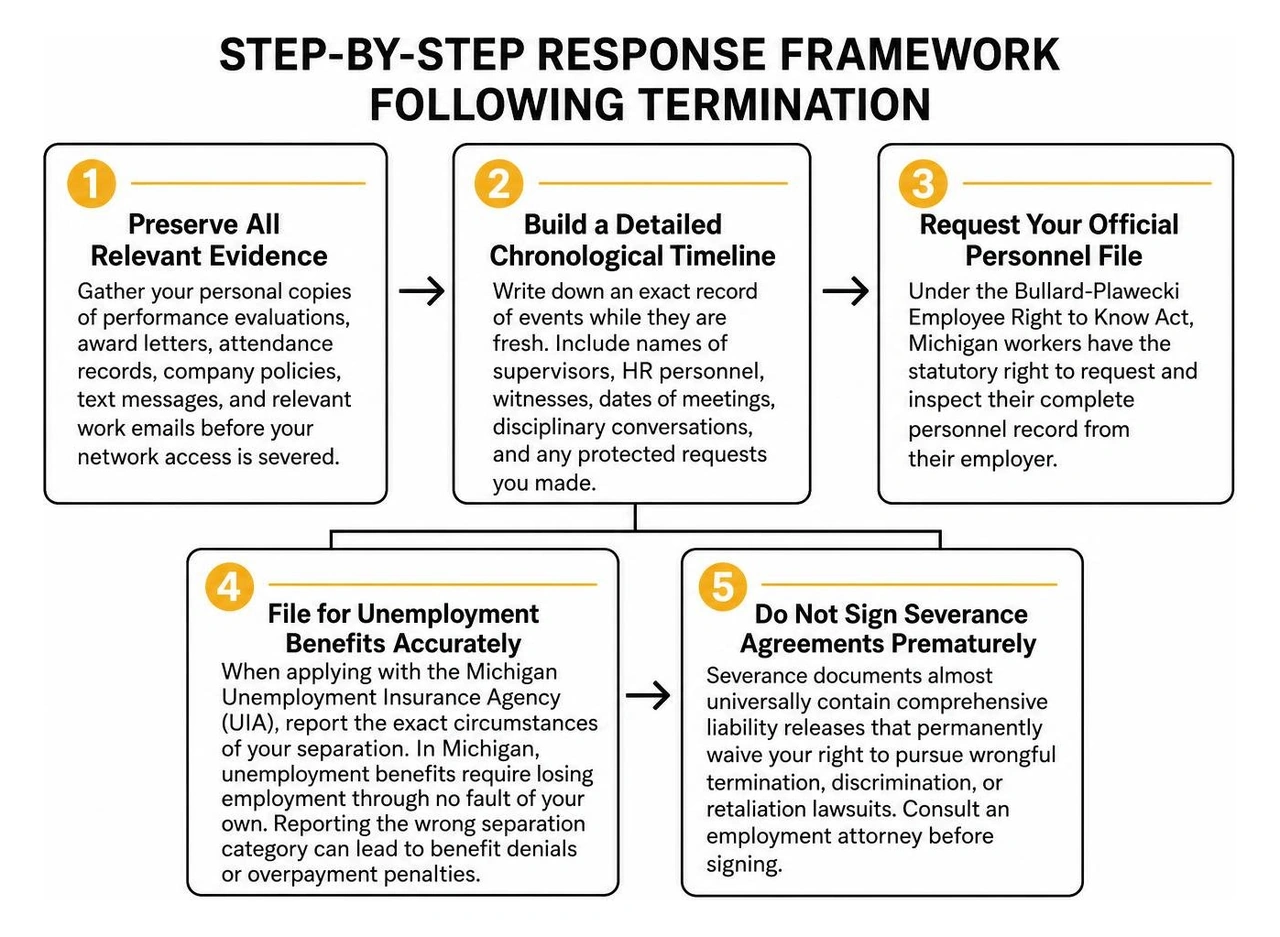
- Preserve All Relevant Evidence: Gather your personal copies of performance evaluations, award letters, attendance records, company policies, text messages, and relevant work emails before your network access is severed.
- Build a Detailed Chronological Timeline: Write down an exact record of events while they are fresh. Include names of supervisors, human resources personnel, witnesses, dates of meetings, disciplinary conversations, and any protected requests you made.
- Request Your Official Personnel File: Under the Bullard-Plawecki Employee Right to Know Act, Michigan workers have the statutory right to request and inspect their complete personnel record from their employer.
- File for Unemployment Benefits Accurately: When applying with the Michigan Unemployment Insurance Agency (UIA), report the exact circumstances of your separation. In Michigan, unemployment benefits require losing employment through no fault of your own. Reporting the wrong separation category can lead to benefit denials or overpayment penalties.
- Do Not Sign Severance Agreements Prematurely: Severance documents almost universally contain comprehensive liability releases that permanently waive your right to pursue wrongful termination, discrimination, or retaliation lawsuits. Consult an employment attorney before signing.
How to Prove Unlawful Firing in Michigan When No Reason Is Given
Employers rarely state illegal motives openly. They do not hand you a letter saying you are being fired because of your age or because you requested medical leave. Instead, proving an unlawful firing relies heavily on circumstantial evidence and establishing legal "pretext."
When wondering, "Can I Sue for Being Fired Without Warning?", we evaluate key evidentiary pillars:
- Suspicious Timing (Temporal Proximity): Being fired days or weeks after requesting an accommodation, filing a harassment grievance, or reporting misconduct.
- Pretextual Rationales: An employer claiming a firing was due to "poor performance" despite years of glowing written evaluations, bonuses, and recent raises.
- Disparate Treatment: Demonstrating that younger, non-disabled, or similarly situated coworkers who engaged in the exact same conduct were not disciplined or fired.
- Shifting Explanations: Management offering conflicting, evolving justifications for your discharge over time.
Recognizing Constructive Discharge and Hostility
Sometimes an employer does not formally fire you. Instead, they make your daily work environment so toxic, hostile, or intolerable that any reasonable person would feel compelled to resign.
In the eyes of Michigan law, this is known as constructive discharge. If your employer cuts your pay drastically, strips your core duties without justification, or subjects you to ongoing harassment to force you out, courts may treat your resignation as a formal firing. Learn to spot the primary Constructive Discharge Signs so you do not accidentally compromise your legal position before consulting legal counsel.
Remedies and Legal Recourse for Wrongful Termination
When a wrongful discharge case is successfully established against an employer, Michigan and federal employment statutes provide comprehensive remedies to make the injured worker whole.
Potential legal remedies include:
- Back Pay: Recovery of all lost wages, bonuses, benefits, and retirement contributions from the date of wrongful termination up to the date of resolution or trial.
- Front Pay: Projected future compensation awarded when workplace hostility makes reinstatement impracticable.
- Compensatory Damages: Financial compensation for emotional distress, mental anguish, reputational harm, and anxiety caused by the unlawful firing.
- Punitive Damages: Under specific federal statutes (such as Title VII or the ADA), damages assessed to punish intentional, malicious employer misconduct.
- Attorneys' Fees and Costs: Statutory provisions that require the offending employer to cover your reasonable legal representation expenses and litigation costs.
Navigating these claims requires focused experience in local court systems. Partnering with a dedicated Wrongful Termination Attorney Oakland County MI ensures your case is positioned to seek maximum recovery under the law. For a complete breakdown of what to expect during this process, review our comprehensive Wrongful Termination Bingham Farms Guide.
Frequently Asked Questions About Firing in Michigan
Can an employer fire you without warning or write-ups in Michigan?
Yes. Under Michigan's at-will employment doctrine, an employer has the general legal authority to discharge an employee on the spot without progressive discipline, formal write-ups, or advance notice. However, this absence of warning is unlawful if the true, underlying motive is rooted in discrimination, retaliation, or violations of public policy.
What should you do if fired after requesting medical leave or disability accommodations?
Document the exact timeline of your medical disclosures and requests. Gather any written emails, doctor's notes, and submission confirmations. Requesting reasonable accommodations under the PWDCRA/ADA or taking leave under the FMLA are federally and state-protected activities, and an abrupt termination following such requests strongly suggests unlawful retaliation.
How does the Michigan Whistleblowers' Protection Act shield employees from retaliatory firing?
The WPA protects employees who report or are about to report a suspected violation of law, regulation, or rule to a public body. You are legally protected as long as you possessed a good-faith, reasonable belief that wrongdoing occurred. If your employer fires, demotes, or disciplines you for making that report, you have the right to file a civil lawsuit under the WPA.
Conclusion
Being fired without warning is a jarring, disruptive experience, but at-will employment is not a blank check for employer misconduct. Michigan workers have clear, enforceable rights under civil rights legislation, whistleblower protections, and public policy doctrines.
If you suspect your termination crossed the line from standard at-will management into unlawful wrongful discharge across Bingham Farms, Birmingham, Royal Oak, Southfield, Beverly Hills, Farmington Hills, Troy, or anywhere in Oakland County, our team at Scott Batey Law is here to stand up for your rights. With over 25 years of courtroom experience representing Michigan workers, we provide the aggressive, personalized advocacy needed to hold employers accountable.
To understand how the law applies to your specific situation, review our guide to At-Will Employment Exceptions in Michigan or reach out to us directly for a confidential evaluation.