
FMLA Continuous Leave: A Practical Guide for Employees

What FMLA Continuous Leave Means for Your Job
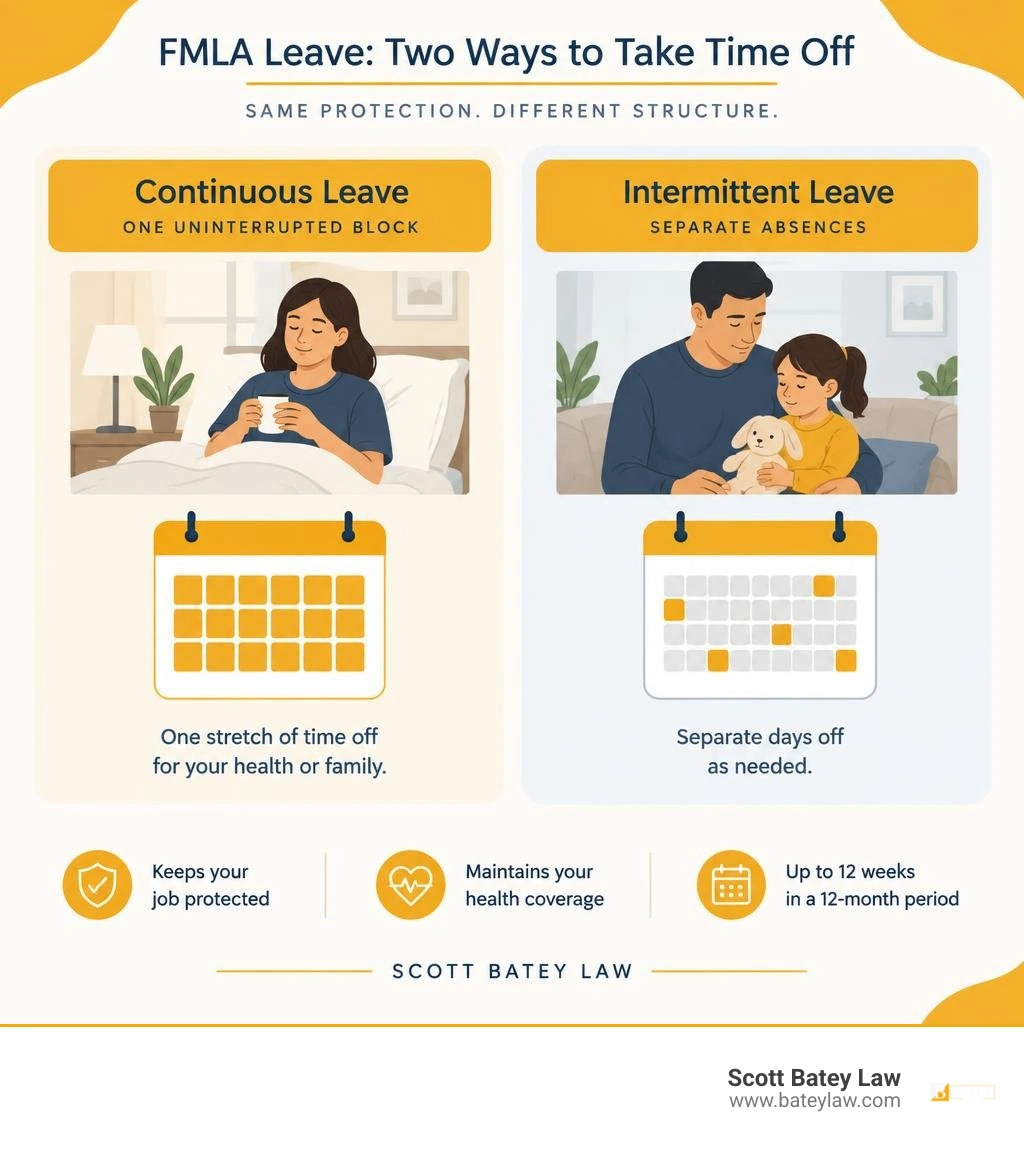
FMLA continuous leave is time off taken in one unbroken stretch for a qualifying health or family reason. Eligible employees can take up to 12 workweeks in a 12-month period. The leave is generally unpaid, but it protects your job and keeps your group health coverage in place under the same terms, as long as you pay your share of the premiums. Unlike intermittent leave, which covers separate absences, continuous leave fits a sustained need, such as recovery from surgery or bonding with a new child.
If you need leave, tell your employer as soon as you can and ask how it will track your time off. Keep copies of your request and any paperwork you submit.
I’m Scott Batey, a Michigan employment lawyer who has represented workers in family and medical leave disputes since 1996. I help employees understand their FMLA continuous leave rights and respond when an employer puts their job at risk.
Understanding FMLA Continuous Leave vs. Intermittent Absences
When life throws a major medical event your way, balancing your health and your livelihood can feel overwhelming. Under the federal Family and Medical Leave Act guidance, eligible employees are guaranteed the right to step away from work to handle significant health and family situations without the fear of losing their jobs. However, how that time off is structured depends entirely on your medical necessity and life circumstances.
Continuous leave represents an extended, uninterrupted block of time away from the workplace. Whether you need three consecutive weeks to recover from spinal surgery or the full 12 weeks to care for a premature newborn, continuous leave provides a stable, predictable period where you are completely relieved of your professional duties. You do not clock in, you do not check work emails, and you focus entirely on recovery or family care.
Continuous vs. Intermittent Leave Comparison
Employees frequently ask us how continuous leave differs from other protected leave structures. While continuous leave involves a single, unbroken absence, intermittent leave is taken in separate blocks of time for a single qualifying condition (such as periodic chemotherapy infusions or episodic migraine flare-ups). A reduced schedule leave allows you to decrease your daily or weekly working hours over an extended period.
The table below outlines the core differences between these three FMLA leave formats:
| Feature | Continuous FMLA Leave | Intermittent FMLA Leave | Reduced Schedule Leave |
|---|---|---|---|
| Absence Structure | One single, unbroken block of time away from work | Sporadic, recurring absences or medical appointments | Scheduled reduction in daily or weekly working hours |
| Common Use Cases | Major inpatient surgery, full maternity recovery, severe depression treatment | Flare-ups of chronic conditions (e.g., asthma, MS), ongoing dialysis | Transitioning back to full-time work, partial-day therapy schedules |
| Notice Requirements | 30 days advance notice when foreseeable; as soon as practicable for emergencies | 30 days advance notice or routine employer call-in procedures per episode | 30 days advance notice; mutually planned with employer |
| Tracking Method | Measured in full workweeks or consecutive business days | Tracked in smallest payroll increments (hours or fractions of hours) | Tracked by total reduced hours compared to standard workweek |
| Return to Work | Often requires a formal fitness-for-duty certification before resumption | Typically does not require fitness certification unless safety issues arise | May require medical documentation confirming hour limitations |
Qualifying Reasons for Taking FMLA Continuous Leave
Continuous FMLA leave is available for specific qualifying events established under federal statutes and coordinated state programs like the State of Michigan Medical Leave Provisions. You can take a continuous block of leave for:
- Your Own Serious Health Condition: Any illness, injury, impairment, or physical or mental condition that involves inpatient hospital care or continuing treatment by a healthcare provider requiring sustained incapacitation.
- Birth, Adoption, or Foster Care Placement: Welcoming a child into your family entitles parents—both mothers and fathers—to continuous bonding leave within the first 12 months following birth or placement.
- Caring for an Immediate Family Member: Providing physical or psychological care for a spouse, child, or parent who is experiencing a serious medical condition.
- Military Family Exigencies and Caregiver Leave: Managing qualifying exigencies arising from a family member's active military duty, or taking up to 26 workweeks of continuous military caregiver leave in a single 12-month period to care for a covered servicemember with a serious illness or injury.
Eligibility Requirements and Leave Entitlement Calculations
Not every worker or business is automatically subject to federal leave protections. To access continuous leave, both your employer and your employment history must satisfy specific statutory thresholds.

Federal FMLA Eligibility Criteria
According to federal standards detailed in Fact Sheet #28: The Family and Medical Leave Act, you are eligible for continuous leave if you meet three specific requirements:
- Employer Coverage: You work for a private-sector employer that employs 50 or more employees within a 75-mile radius of your worksite for at least 20 workweeks in the current or preceding calendar year, or you work for a public agency or school system regardless of size.
- Service Tenure: You have been employed by your company for at least 12 months (these 12 months do not need to be consecutive, provided any gap in service does not exceed seven years, unless covered by military service).
- Hours Worked: You have logged at least 1,250 actual hours of service for your employer during the 12-month period immediately preceding the first day of your requested leave. Paid time off, vacation days, and previous sick leave do not count toward this 1,250-hour threshold.
Calculating Leave for Part-Time and Variable Work Schedules
FMLA provides up to 12 workweeks of leave per 12-month period. For a standard 40-hour-per-week employee, 12 workweeks equates to 480 hours or 60 business days. However, calculating continuous leave becomes nuanced when employees work part-time, variable, or alternating shifts.
The Department of Labor's DOL FMLA Compliance Guidance establishes that FMLA entitlement is always calculated as a fraction of the employee's normal workweek rather than a rigid calendar template:
- Fixed Part-Time Schedules: If you normally work 25 hours per week over 4 days, taking 12 workweeks of continuous leave provides you with 12 weeks of complete absence (a total of 300 hours off).
- Alternating or Variable Shifts: If your work schedule changes from week to week (for example, alternating between 36 hours one week and 48 hours the next), your employer must calculate your weekly baseline using the weekly average of hours worked over the 12-week period directly preceding your leave.
- Permanent Schedule Adjustments: If your regular schedule was permanently reduced from 40 hours to 30 hours prior to your leave request, your 12-week entitlement is calculated using your new 30-hour weekly baseline.
Employers may calculate the 12-month period using a calendar year, a fixed fiscal year, a 12-month period measured forward from your first leave date, or a rolling 12-month period measured backward from the date leave is used. Most employers use the rolling backward method to prevent leave stacking.
The Application Process: Notice, Medical Certification, and Timelines
Securing continuous FMLA leave requires following specific administrative procedures. Missteps or missed deadlines can compromise your job protections.
How to Request FMLA Continuous Leave and Submit Certifications
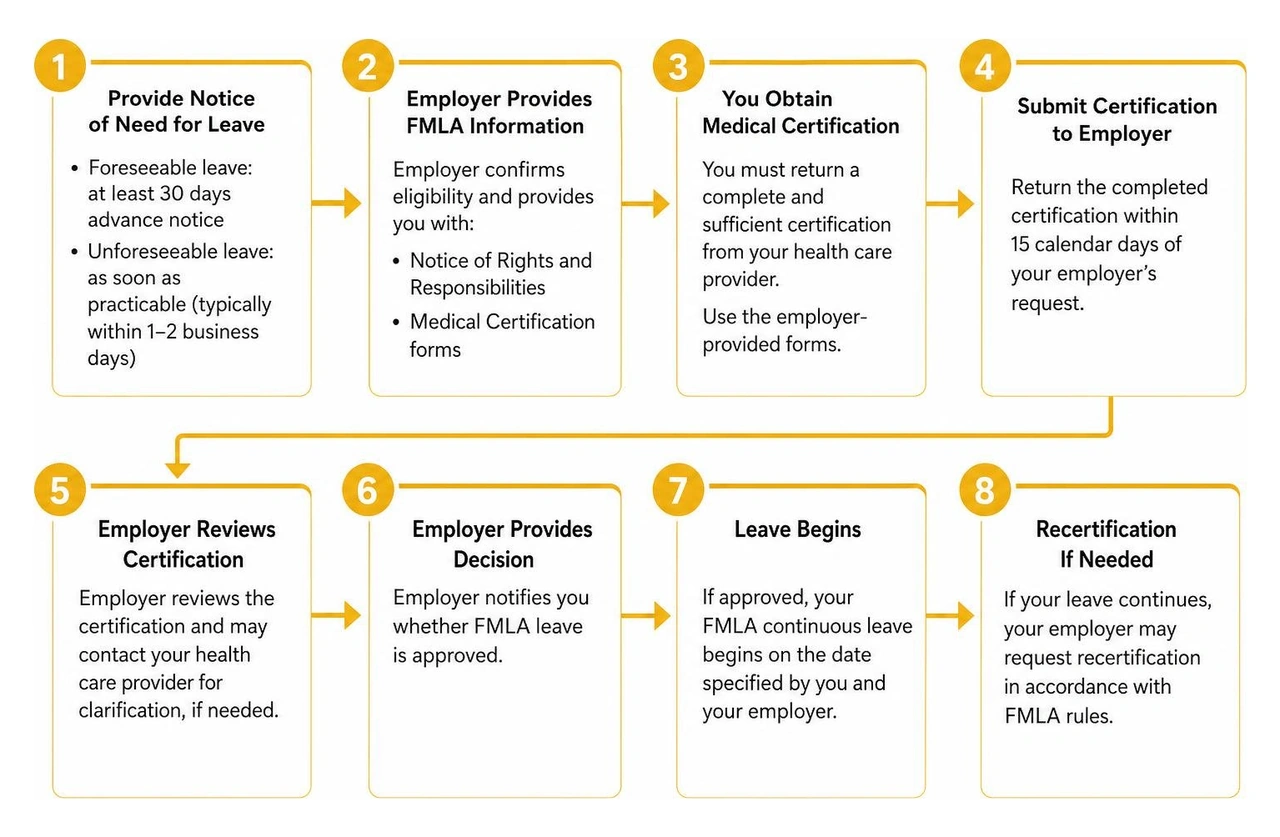
When the need for leave is foreseeable—such as a scheduled orthopedic surgery or expected childbirth—you must provide your employer with at least 30 days advance notice. If your need arises unexpectedly due to a sudden illness or accident, you must give notice as soon as practicable, typically within one or two business days, following your employer's standard call-in procedures.
Once you request leave, the process moves through clear statutory stages:
- Eligibility and Rights Notice: Within 5 business days of learning about your need for leave, your employer must provide you with a Notice of Eligibility and Rights & Responsibilities (Form WH-381).
- Medical Certification Request: Your employer may require a completed Department of Labor medical certification form (such as Form WH-380-E for your own health or WH-380-F for a family member) signed by your healthcare provider.
- The 15-Day Submission Deadline: You must return the completed medical certification within 15 calendar days of your employer's formal request.
- Cure Period: If your employer finds the certification incomplete, vague, or insufficient, they must notify you in writing and grant you at least 7 calendar days to cure the deficiencies. You can read more about resolving these technical defects in our detailed guide on medical certification and cure periods.
- Designation Notice: Within 5 business days of receiving sufficient certification, your employer must provide written confirmation designating the absence as approved FMLA leave (Form WH-382).
Under federal law, medical certifications are strictly confidential. Your employer has no right to demand your entire medical file, and your supervisor cannot contact your doctor directly; any necessary clarification must be conducted by HR professionals, leave administrators, or healthcare personnel.
Coordinating with Paid Leave and Short-Term Disability
FMLA grants guaranteed time off, but it does not require your employer to pay your salary. However, your time away does not necessarily have to be completely unpaid:
- Paid Time Off Substitution: Your employer may require—or you may elect—to substitute accrued paid leave (vacation time, sick days, PTO) to cover your continuous leave period. When paid leave is substituted, it runs concurrently with your 12-week FMLA bank.
- Short-Term Disability (STD): Many employees receive wage replacement through employer-sponsored or private short-term disability policies. STD benefits generally pay a percentage of your regular earnings (often 60% to 70%) during medical incapacitation. When you receive STD benefits, your employer cannot force you to use paid vacation time, though you may choose to supplement STD payments if company policies allow.
- Managing Transition Periods: Understanding what happens with short-term disability after exhausting FMLA is critical if your serious health condition prevents you from returning to full capacity after the 12-week statutory limit expires.
Job Protections, Benefits Continuation, and Return-to-Work Rights
The core purpose of the FMLA is to ensure that taking necessary medical time off does not destroy your career trajectory.

Health Insurance Maintenance and Job Restoration
While you are away on continuous leave, your employer is legally obligated to maintain your group health insurance coverage under the exact same terms and conditions as if you had continued working. If you pay a portion of your monthly premium through payroll deductions, you must arrange a method with HR to continue paying your regular share during unpaid leave.
Upon completing your continuous leave, you have an absolute statutory right to be reinstated to:
- The exact same position you held before taking leave, or
- An equivalent position with identical pay, benefits, working conditions, shifts, geographic location, and promotional opportunities.
Your employer cannot penalize you for your absence, deduct performance scores, or subject you to unlawful attendance point penalties simply because you utilized your protected continuous leave entitlement.
Fitness-for-Duty Certifications and Workplace Accommodations
If your continuous leave was taken for your own serious health condition, your employer may require you to submit a fitness-for-duty certification (a formal medical release from your physician) before permitting you to resume work.
To enforce this requirement lawfully:
- Your employer must notify you of the fitness-for-duty requirement in the initial Designation Notice.
- If your employer wants your doctor to certify that you can perform specific essential job duties, they must attach an accurate, objective job description to that notice.
If your doctor clears you to return with temporary physical restrictions (such as a 15-pound lifting limit or the need for periodic seated rest), your employer cannot automatically refuse your return under the false belief that you must be entirely healed. You can learn more about overcoming this unlawful barrier by exploring return-to-work fitness-for-duty requirements under combined FMLA and Americans with Disabilities Act (ADA) frameworks.
Employer Non-Compliance: Common Pitfalls, Interference, and Retaliation
Despite clear statutory rules, employers in Michigan and across the country regularly mismanage continuous leave. Employer violations generally fall into two legal categories:
- FMLA Interference: Any employer action that hinders, discourages, delays, or denies an employee's lawful exercise of FMLA rights. Examples include refusing to accept a valid medical certification, demanding excessive medical records, repeatedly calling or emailing an employee on leave with work demands, or falsely claiming an employee is ineligible.
- FMLA Retaliation: Taking adverse employment action against an employee for requesting or taking protected leave. Retaliation often manifests as unexpected poor performance evaluations immediately following a leave request, sudden job reassignments to undesirable shifts, stripped supervisory responsibilities, demotions, or termination.
When disputes arise, understanding the distinctions between FMLA interference and retaliation claims is critical for holding non-compliant employers accountable for back pay, front pay, liquidated damages, and attorney fees.
Frequently Asked Questions about Continuous FMLA Leave
Can my employer force me to take continuous leave instead of intermittent leave?
No. An employer cannot force you into taking continuous leave if your medical condition only requires intermittent absences or a reduced schedule, provided your healthcare provider has certified that intermittent leave is medically necessary. Forcing an employee onto continuous leave against medical orders constitutes unlawful FMLA interference. The only exception involves bonding leave following birth or adoption, where employers have legal discretion to require that bonding time be taken in a single continuous block rather than intermittent days unless local policies dictate otherwise.
What happens if I exhaust all 12 weeks of continuous leave and still cannot return?
If your 12 weeks of continuous FMLA leave expire and your medical condition still prevents you from resuming your standard duties, you may still be protected under the Americans with Disabilities Act (ADA) or Michigan's Persons with Disabilities Civil Rights Act (PWDCRA). Under the ADA, an extended leave of absence or modified schedule can serve as a reasonable accommodation, provided it does not impose an undue operational hardship on the employer. Your employer is legally required to engage in a timely, good-faith interactive dialogue with you rather than terminating you automatically upon day 85 of your absence.
Does continuous FMLA leave protect my health insurance benefits?
Yes. Your employer is legally required to maintain your existing group health insurance plan on the same terms throughout your entire continuous leave period. If your employer normally pays 80% of your premium and you pay 20%, that exact cost-sharing structure remains in effect. You must continue paying your standard 20% contribution during unpaid leave. If you fail to pay your premium within 30 days of the due date, your employer may drop coverage after providing at least 15 days written warning, or pay your portion on your behalf and recover those funds upon your return.
Conclusion
Taking continuous FMLA leave allows you to step away from the demands of work to handle severe medical treatments, family crises, or the arrival of a new child. Knowing your rights regarding eligibility, medical certifications, job restoration, and benefits continuation ensures that you can take the necessary time to heal without compromising your economic stability.
If your employer has denied your valid leave request, disciplined you for taking protected time off, or refused to reinstate you to an equivalent position, you do not have to navigate the legal landscape alone. Recognizing the immediate red flags for wrongful termination after medical leave can help you protect your career. At Scott Batey Law, we have spent more than 25 years fighting for workers across Bingham Farms, Southfield, Troy, Detroit, and throughout Oakland County and Michigan. Contact our team today for dedicated, personalized guidance to safeguard your rights and secure the justice you deserve.