.png)
Eavesdropping and Video Laws in the Michigan Workplace
Michigan Workplace Surveillance: What Employees Need to Know
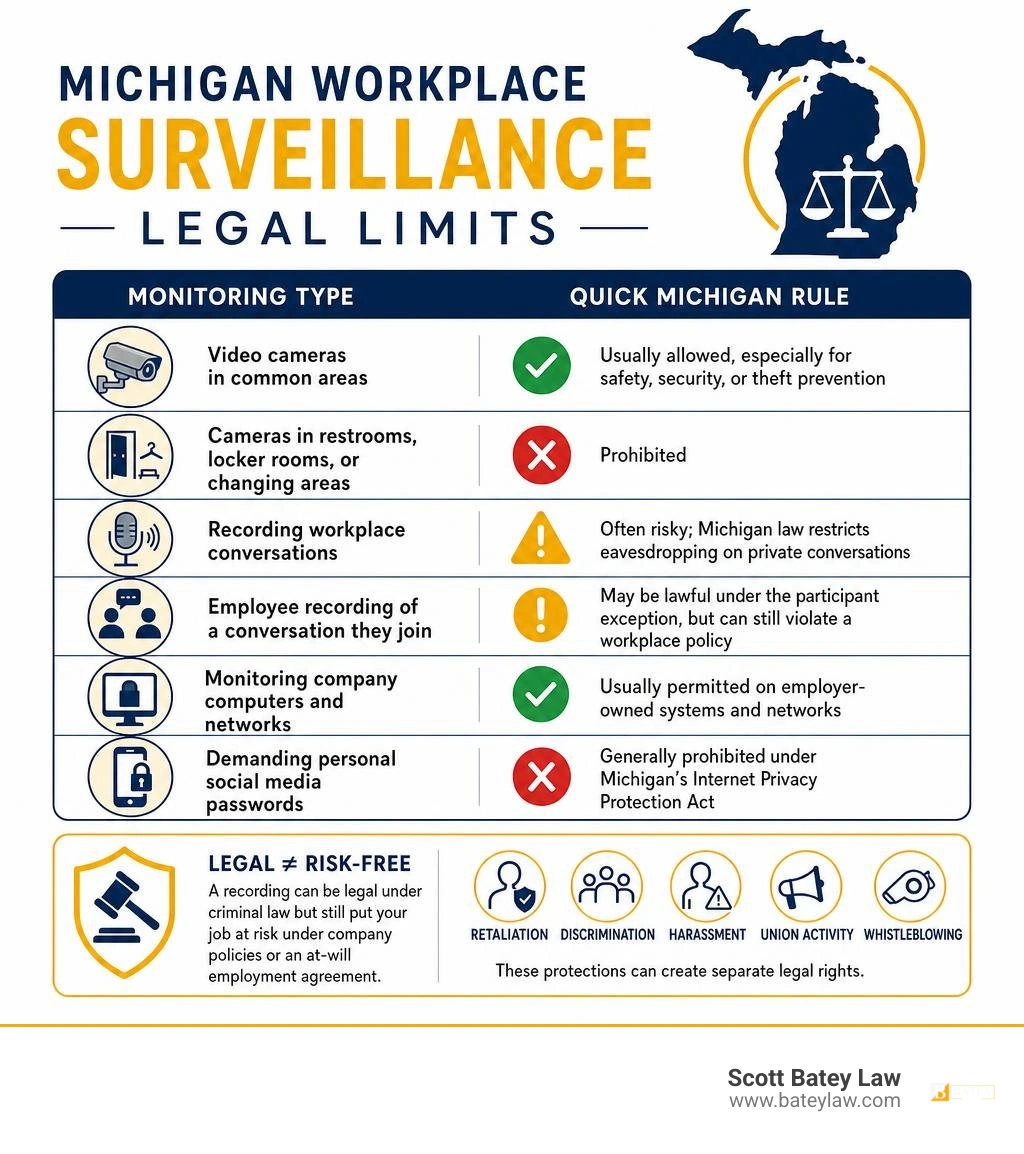
Michigan workplace surveillance is generally legal when an employer monitors common work areas, company devices, email, internet use, or business systems for a real business reason. But important limits apply: employers cannot use cameras in private spaces such as restrooms or locker rooms, and audio recording can create serious legal risk under Michigan's eavesdropping laws.
| Monitoring type | Quick Michigan rule |
|---|---|
| Video cameras in common areas | Usually allowed, especially for safety, security, or theft prevention |
| Cameras in restrooms, locker rooms, or changing areas | Prohibited |
| Recording workplace conversations | Often risky; Michigan law restricts eavesdropping on private conversations |
| Employee recording of a conversation they join | May be lawful under the participant exception, but can still violate a workplace policy |
| Monitoring company computers and networks | Usually permitted on employer-owned systems and networks |
| Demanding personal social media passwords | Generally prohibited under Michigan's Internet Privacy Protection Act |
The hard part is that a recording can be legal under criminal law but still put an employee's job at risk. An at-will employer may enforce a no-recording policy, while retaliation, discrimination, harassment, union activity, and whistleblowing can create separate legal protections.
I am Scott Batey, a Michigan employment lawyer who has represented employees since 1996 in wrongful termination, harassment, discrimination, retaliation, and whistleblower disputes. In Michigan workplace surveillance cases, the details matter: what was recorded, who participated, where it happened, why it was used, and what happened after an employee raised concerns.
Michigan workplace surveillance basics:
Michigan Workplace Surveillance and Audio Eavesdropping Laws
When companies set up security feeds or listening devices, they often assume they have absolute authority on their own property. However, audio recording in Michigan is strictly governed by state criminal statutes. Under Michigan Penal Code section MCL 750.539c, it is illegal for any third party to willfully use a device to eavesdrop upon or record a private conversation without the consent of all participating parties.
A violation of Michigan’s eavesdropping statute is classified as a Class E felony. A conviction carries severe criminal penalties, including up to two years in state prison, fines up to $2,000, or both. In addition to criminal exposure, non-compliant employers and supervisors face substantial civil liability under MCL 750.539e. Injured workers can sue to recover actual monetary damages, attorney fees, court costs, and punitive damages capped at up to $5,000 per statutory violation.
Employers frequently attempt to defend audio recording by pointing to the "business extension exception" under federal wiretap laws. This federal exception allows companies to monitor phone calls made on business phone systems in the ordinary course of business. However, relying on this exception in Michigan creates huge legal risks. Once an employer recognizes that a phone call or conversation is purely personal, live monitoring must cease immediately. Furthermore, the business extension exception generally allows live call auditing—it does not automatically validate non-consensual permanent audio recordings under Michigan's strict eavesdropping penal code.
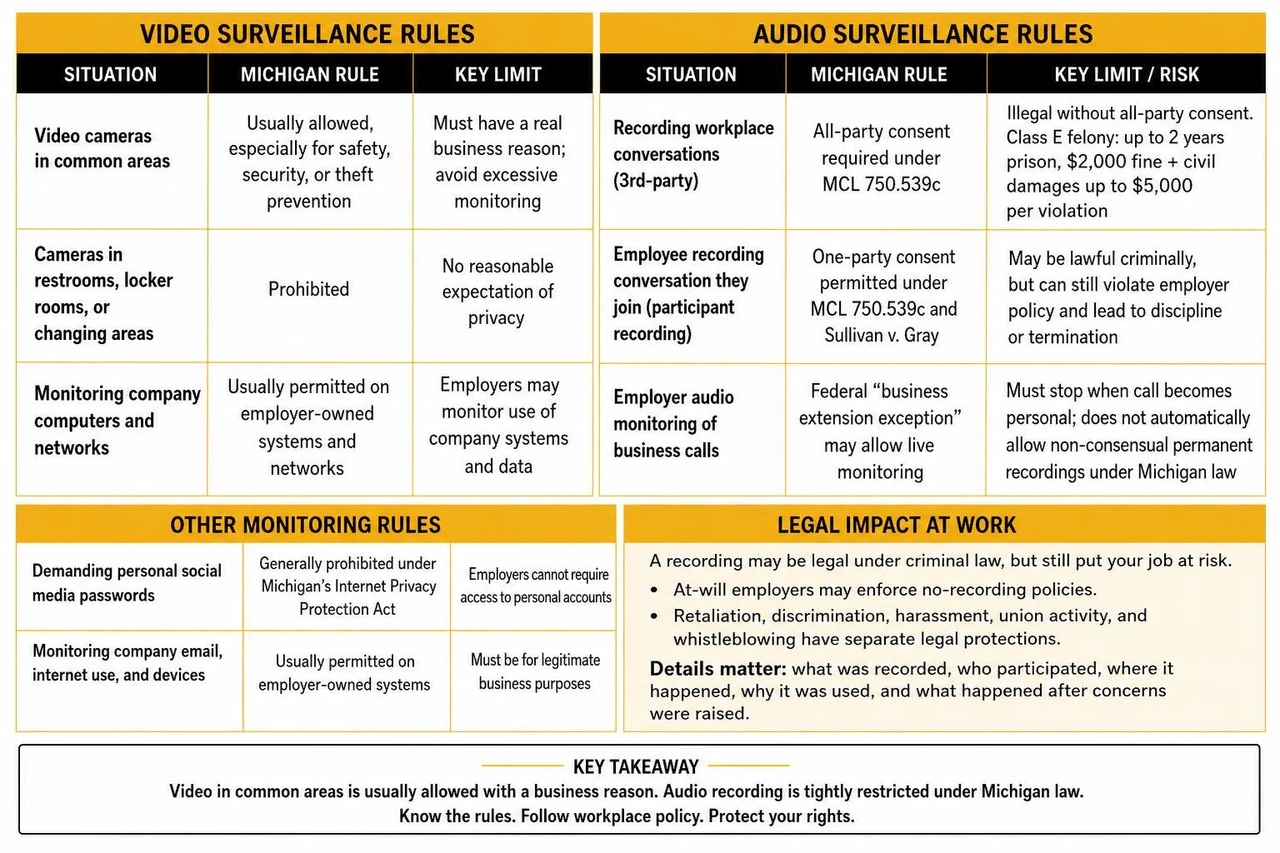
| Surveillance Category | Primary Legal Statute | Consent Requirement | Legal Consequences for Violations |
|---|---|---|---|
| Audio Recording (Third-Party) | MCL 750.539c | All-Party Consent required if recorded by a non-participant | Class E Felony (up to 2 years prison, $2,000 fine) + Civil damages up to $5,000 per violation |
| Audio Recording (Participant) | MCL 750.539c / Sullivan v. Gray | One-Party Consent (participant records own conversation) | Legally permissible criminally, but may violate employer internal handbooks |
| Video Surveillance (Common Areas) | Common Law Privacy / ECPA | No specific statutory consent required if visible | Civil liability for invasion of privacy if no business rationale exists |
| Video Surveillance (Private Areas) | MCL 750.539d | Prohibited entirely | Felony charges (2 to 5 years prison, fines up to $5,000) |
Participant Exception in Michigan Workplace Surveillance
One of the most misunderstood areas of michigan workplace surveillance is whether an employee can secretly record a boss or co-worker. Michigan’s recording laws are often described as operating under a "one-party consent" rule due to the seminal Michigan Court of Appeals decision in Sullivan v. Gray.
In Sullivan v. Gray, the court established the "participant exception." Under this judicial interpretation of MCL 750.539c, a person who is an active, open participant in a conversation is not considered an "eavesdropper." Therefore, if you record a performance evaluation, a disciplinary meeting, or a phone call that you are personally involved in, you are not committing a crime—even if you do not tell the other people present that you are recording them.
However, employees must understand the distinction between criminal legality and employment status. Just because secret recording is not a felony under Sullivan v. Gray does not mean your company cannot discipline or fire you for doing it. If your employer has a clear, written employee handbook policy banning recording devices on company grounds, violating that rule can lead to lawful termination under Michigan's at-will employment framework. To learn more about worker protections, review our Workplace Rights Lawyer Guide 2026.
Video Recording Limits Under Michigan Workplace Surveillance Rules
While audio monitoring faces strict statutory consent requirements, video-only surveillance operates under different parameters. Employers are generally free to install visible security cameras in open, public, or operational work zones such as retail sales floors, warehouses, loading docks, office hallways, customer lobbies, and parking lots. The legal threshold for video monitoring centers on whether an employee maintains a legal "reasonable expectation of privacy" in that specific location.
Under MCL 750.539d, installing, placing, or using any optical or electronic device to observe, record, photograph, or transmit visual images in a private place without the consent of the individuals involved is strictly illegal. In workplace environments, prohibited areas include:
- Employee restrooms and lavatories
- Locker rooms, changing areas, and dressing rooms
- Employee breakrooms or designated relaxation areas where privacy is expected
- Lactation rooms or private medical evaluation quarters
A first offense for illegal visual surveillance in a private place under MCL 750.539d carries a Class E felony charge punishable by up to two years in prison and a fine of up to $2,000. Furthermore, distributing or transmitting illegally recorded visual footage escalates the charge to a felony punishable by up to five years in prison and fines up to $5,000. Legal guidance routinely warns companies that placing hidden cameras in employee rest areas creates massive criminal and civil liability.

Employer Computer, Internet, and AI Monitoring Rights
In modern work environments, employee monitoring extends far beyond hallway cameras. Modern employers frequently deploy automated tracking software, keystroke loggers, web camera capture, and network inspection tools. According to a 2025 study from MIT, approximately 80% of companies now actively monitor remote or hybrid workers.
Federal statutes, including the Electronic Communications Privacy Act (ECPA) and the Stored Communications Act (SCA), provide employers with wide latitude to monitor communications occurring on company-owned infrastructure. On employer-issued laptops, smartphones, and corporate email servers, workers have virtually no expectation of privacy.
Under Michigan’s Internet Privacy Protection Act (Act 478 of 2012), codified at MCL 37.275, employers maintain full statutory rights to inspect, access, and audit any electronic data traveling through corporate networks or stored on employer-paid devices. However, Act 478 explicitly restricts employers from demanding login credentials, social media passwords, or access to an employee's personal accounts. If an employer violates this statute by demanding private passwords, workers must issue a formal 60-day written demand for up to $1,000 in statutory damages before initiating a civil lawsuit under MCL 37.278.
State lawmakers are actively introducing updated legislation to establish stronger worker privacy standards. Proposed legislative measures like House Bill 4456 of 2025 - Michigan Legislature aim to prohibit undisclosed employee communication monitoring by requiring employers to issue written surveillance policies before implementing electronic tracking tools.
Concurrently, artificial intelligence tools have changed how managers track employee output. As reported in ‘Invasive, unnecessary and unethical:’ Lawmaker wants limits on AI surveillance at work - mlive.com, an ExpressVPN survey revealed that 61% of companies use AI software to evaluate employee performance. In response to invasive practices—such as AI tracking facial expressions, measuring bathroom break durations, or evaluating call center voice tones—Michigan lawmakers introduced House Bill 5579 (the RAISE Act). The RAISE Act seeks to:
- Require employers to perform necessity impact assessments before deploying AI monitoring systems.
- Mandate explicit written worker consent prior to AI biometric tracking.
- Prohibit AI algorithms from making automated, unreviewed firing or pay-docking decisions.
- Ban AI-driven tracking in breakrooms, restrooms, and personal spaces.
Federal Wiretap Laws and Email Surveillance
Federal wiretap rules differentiate between real-time communication interceptions and accessing stored communications. When an employee sends an email using a company domain or browses the web on a company network, employer automated firewalls constantly scan network traffic. Under federal law and MCL 37.275, employers can legally monitor, archive, and retrieve these electronic communications without triggering illegal wiretap claims.
Complications arise when employees bring their own devices to work under Bring Your Own Device (BYOD) policies. If an employee logs into a personal personal webmail account while connected to corporate Wi-Fi, the employer cannot legally log into that personal account or demand its password. However, if the employer has specific, articulable evidence that an employee is transferring confidential trade secrets or proprietary financial records to a personal webmail account, MCL 37.275 permits a targeted internal investigation. For a detailed discussion on trade secrets and corporate non-disclosure agreements, read our guide on Confidentiality Agreements in Michigan: When an NDA Goes Too Far.
Can You Be Fired for Recording at Work in Michigan?
The short answer is yes. Michigan is an at-will employment state, meaning an employer can terminate an employment relationship at any time, with or without cause, as long as the reason is not unlawful (such as illegal discrimination or unlawful retaliation).
Even if an audio or video recording is completely legal under Michigan’s criminal eavesdropping statutes (for instance, a recording made under the participant exception), your employer can legally fire you for violating an internal company policy that prohibits recording devices. Courts across Michigan routinely uphold terminations where an employee secretly recorded a boss or staff meeting in direct violation of a clear employee handbook policy. To explore statutory exceptions to the at-will rule, see At-Will Exceptions in Michigan: When a Firing Crosses the Line.
However, an employer’s right to enforce no-recording policies is not absolute. If an employee makes a recording as part of legally protected activity—such as documenting illegal discrimination under the Elliott-Larsen Civil Rights Act (ELCRA), gathering evidence of safety violations under MIOSHA, or reporting criminal fraud under whistleblower statutes—firing that worker may constitute illegal retaliation.
Whistleblower Protections and Documenting Harassment
When workers face illegal harassment or corporate fraud, securing clear documentation is crucial. The Michigan Whistleblowers' Protection Act (WPA), codified at MCL 15.362, protects employees who report—or are about to report—a violation of federal, state, or local laws to a public body.
If an employee secretly records audio or video demonstrating that a supervisor is committing corporate embezzlement, dumping toxic waste, or violating public safety standards, and provides that recording in good faith to law enforcement or regulatory inspectors, the WPA protects that worker from retaliatory firing. However, whistleblower cases carry strict procedural timelines: employees must file a civil lawsuit under MCL 15.363 within 90 days of the adverse employment action.
Similarly, when employees record evidence of severe workplace harassment or racial discrimination to substantiate a formal internal complaint, firing the employee for making the recording can trigger complex retaliation claims under ELCRA or Title VII. For step-by-step instructions on gathering evidence safely without violating privacy statutes, review our analysis on Michigan Whistleblowers' Protection Act: Deadlines, Remedies, Proof and Documenting Harassment the Right Way: Notes, Emails, and Screenshots (MI).
NLRA Section 7 Protections for Workplace Recording
Federal labor law provides another key exception to employer no-recording rules. Section 7 of the National Labor Relations Act (NLRA) protects the rights of both union and non-union employees to engage in "concerted activities for the purpose of collective bargaining or other mutual aid or protection."
Under the National Labor Relations Board's (NLRB) landmark Stericycle framework, overly broad employer policies that blanketly prohibit workplace recordings can be held illegal if they discourage workers from exercising their statutory Section 7 rights. For example, employees are generally protected when recording:
- Unsafe working conditions or hazardous equipment to show fellow workers or government regulators.
- Open discussions regarding employee compensation, benefits, or working conditions.
- Management coercion, intimidation, or unfair labor practices during union organizing drives.
If an employer disciplines or fires a worker for making a recording during protected concerted activity, the employee can file an unfair labor practice charge with the NLRB or pursue a retaliation claim. For further insights on defending against improper employer terminations, consult our resource on Workplace Retaliation Lawyer Michigan.
Frequently Asked Questions About Workplace Surveillance in Michigan
Is Michigan a one-party or all-party consent state for recording audio at work?
Michigan is effectively a one-party consent state for active participants in a conversation, but an all-party consent state for third parties. Under the judicial precedent set in Sullivan v. Gray, if you are an active speaker or listener in a private conversation, you can record that conversation without notifying the other participants. However, if a third party (such as a boss placing a hidden bug in a conference room) records a private conversation between other employees without participating, that act constitutes a Class E felony under MCL 750.539c.
Can an employer place hidden cameras or record phone calls without notice?
An employer can place hidden video-only security cameras in open, non-private workplace locations (such as warehouse floors or retail counters) if there is a legitimate business rationale like theft prevention. However, hidden cameras are strictly prohibited in private areas like restrooms, changing rooms, and locker rooms under MCL 750.539d. Regarding phone calls, employers monitoring business lines can listen to calls under the federal business extension exception, but live auditing must stop immediately if the call is personal. Recording phone calls without informing external callers or obtaining employee consent violates Michigan eavesdropping statutes.
How do Michigan's workplace monitoring laws compare to states like California or New York?
Michigan’s surveillance laws differ significantly from states like California or New York. California enforces strict all-party consent laws for all audio recordings under Penal Code Section 632 and recently enacted Senate Bill 238 to impose annual reporting and $500 penalties on corporate surveillance tools. New York requires employers to provide explicit written notice and obtain signed acknowledgments before conducting any electronic or computer monitoring. Michigan currently does not have a standalone advance electronic monitoring notice law, though proposed bills like HB 4456 and HB 5579 aim to close these regulatory gaps.
Conclusion: Protecting Your Workplace Rights in Michigan
Understanding the boundaries of michigan workplace surveillance requires balancing criminal statutes, federal wiretapping laws, labor regulations, and at-will employment principles. While employers maintain legal rights to safeguard physical property and inspect company computers, they cannot cross statutory lines by conducting non-consensual audio eavesdropping, invading private rest areas, or retaliating against workers who expose illegal activity.
If you suspect your employer has engaged in illegal workplace surveillance, or if you were fired after recording evidence of discrimination, harassment, or corporate wrongdoing, we are ready to stand up for you. At Scott Batey Law, we have spent over 25 years fighting for worker rights across Metro Detroit—including Bingham Farms, Birmingham, Southfield, Royal Oak, Farmington Hills, Troy, and Detroit.
To evaluate your legal options, explore our guide on At-Will Employment Exceptions in Michigan or reach out directly through our Contact Batey Law Firm page to schedule a confidential consultation.