.png)
A Complete Guide to Non-Solicitation Covenants in Employment

What a Non-Solicitation Covenant Means for Your Next Job
A non-solicitation covenant is a contract term that may limit your ability to seek business from former clients or recruit former coworkers after you leave a job. Unlike a non-compete, it does not usually stop you from working for a competitor. Whether it can be enforced depends on its wording, your role, and state law.
If you are planning to leave a Michigan job, check who the clause covers, what contact it bans, and how long it lasts before reaching out to anyone. Even a short message to a former client could lead to a dispute if it asks them to move their business.
I’m Scott Batey, a Michigan employment lawyer who has advised employees on restrictive covenants since 1996. I help people understand how a non solicitation covenant may affect their next job and what options they have before a dispute starts.
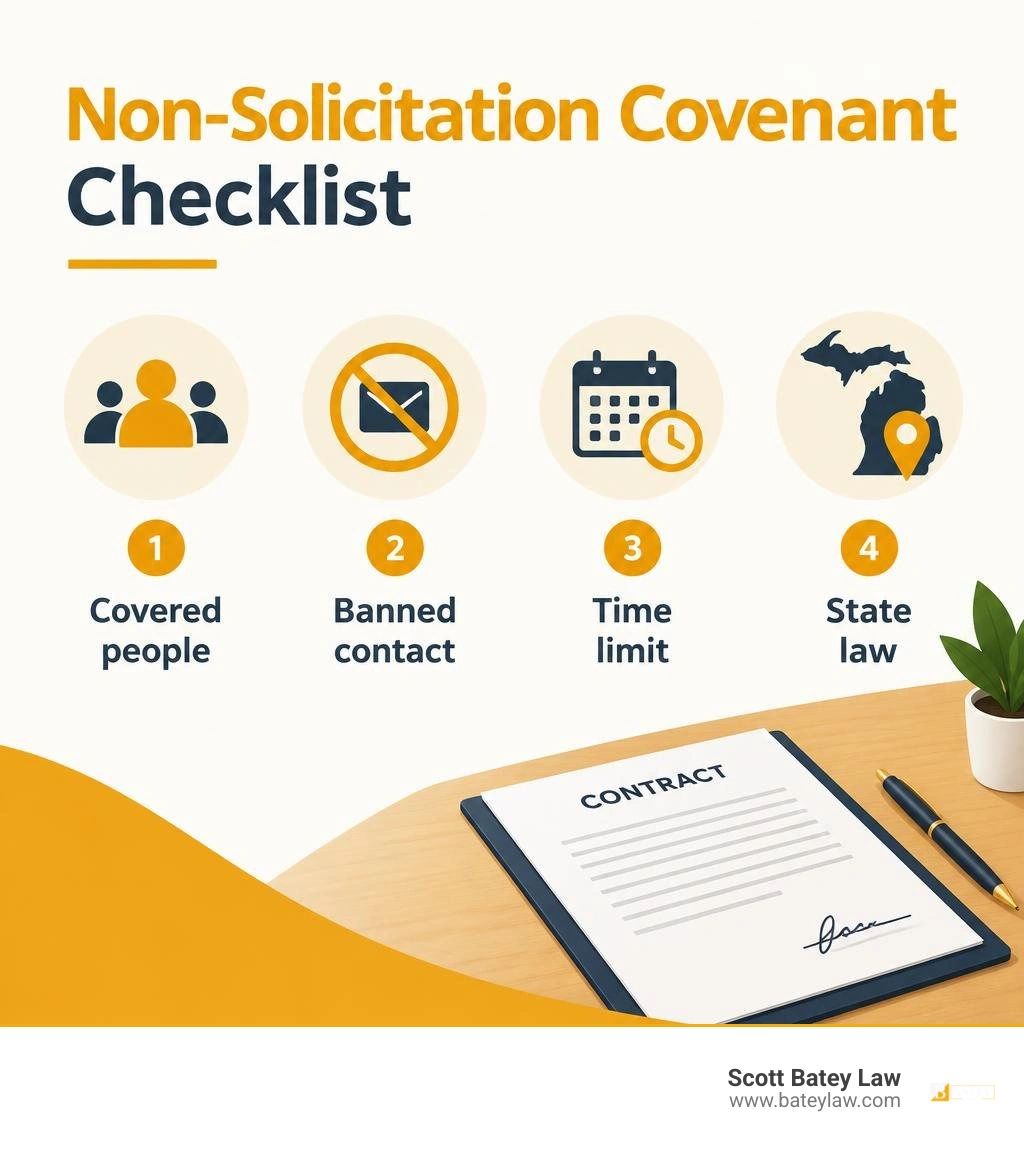
Simple non solicitation covenant glossary:
Understanding Restrictive Covenants: Non-Solicitation vs. Non-Compete
When navigating post-employment transitions, workers often encounter a web of restrictive agreements. While both non-compete and non-solicitation provisions aim to protect an employer’s competitive edge, they achieve this goal through fundamentally different mechanisms. Understanding noncompete vs nonsolicitation in Michigan is critical for assessing how freely you can advance your career.
A non-compete agreement functions as a broad barrier: it restricts an individual from working in a specific industry, role, or geographic area for a competing enterprise. Because non-competes restrict an individual’s general livelihood, courts scrutinize them heavily. In contrast, a non-solicitation covenant does not ban you from working for a competitor or launching your own venture. Instead, it prevents targeted outreach toward specific protected assets, namely the former employer's clients, prospective customers, and internal workforce.
| Restriction Feature | Non-Compete Agreement | Non-Solicitation Covenant |
|---|---|---|
| Primary Scope | Prohibits working for or operating a competing business | Prohibits soliciting clients, customers, or employees |
| Impact on Mobility | High: May prevent employment in your specialized field | Moderate: Allows working for competitors; restricts outreach |
| Judicial Enforceability | Strictly scrutinized; heavily restricted or banned in many jurisdictions | Generally easier to enforce if narrowly tailored |
| Standard Duration | Commonly 6 months to 1 year | Typically 6 months to 2 years (sweet spot: 6–12 months) |
| Geographic Focus | Defined geographic territory (e.g., radius, counties) | Account-level or specific client relationship scope |
What Is a Non Solicitation Covenant and How Does It Work?
At its core, a non-solicitation covenant is a contractual agreement where an employee agrees not to entice away the employer's accounts or talent after parting ways. These covenants generally divide into two categories:
- Customer and Client Non-Solicitation: Prohibits a former employee from asking established clients (and sometimes actively pursued prospective clients) to transfer their business to a new employer.
- Employee Non-Solicitation (No-Poach / Anti-Raiding): Prevents a departing worker from recruiting, enticing, or hiring former coworkers to join a competing enterprise.
Understanding how nonsolicits limit your next job helps clarify your professional boundaries. While you can typically step directly into a competing role across Oakland County or Metro Detroit, you cannot utilize your previous employer's proprietary rolodex to destabilize their client base or strip away their operational team.
Direct Solicitation vs. Passive Conduct
The line between actionable solicitation and permissible passive interaction often dictates the outcome of post-employment disputes. Solicitation requires proactive conduct aimed at diverting business or inducing an employee to quit.
- Prohibited Direct Solicitation: Sending targeted emails, making phone calls, or scheduling meetings with former clients to pitch your new services; directly approaching former coworkers with compensation packages to lure them away.
- Permissible Passive Conduct: Updating your LinkedIn profile, publishing a general public announcement regarding your new employment, or responding to inbound inquiries initiated entirely by a client without prior encouragement.
Courts consistently recognize client autonomy. If a client discovers your new venture independently through general advertising and requests your services, accepting their business does not automatically constitute solicitation, provided the agreement does not explicitly contain a broader (and often legally questionable) "non-acceptance of business" restriction.
Key Elements That Make a Non Solicitation Covenant Enforceable
Courts do not enforce restrictive covenants simply because an employer drafted them. To survive judicial review, a non-solicitation provision must be reasonable in scope, protect a recognized interest, and be supported by lawful consideration. Legal resources detailing standard drafting terms for restrictive covenants emphasize precision over blanket prohibitions.

Legitimate Business Interests and Consideration Requirements
An employer must demonstrate that the restriction protects a legitimate business interest rather than merely stifles open market competition. Recognized business interests include:
- Trade secrets and proprietary methodologies.
- Confidential business data, pricing structures, and pipeline metrics.
- Customer goodwill generated through substantial investment by the company.
- Specialized training provided to staff.
Additionally, a valid contract requires adequate consideration. When signing an agreement upon starting a job, the offer of employment serves as consideration. However, imposing a mid-stream restrictive covenant on an existing employee requires careful evaluation. Reviewing adequate consideration for restrictive covenants shows that some jurisdictions demand fresh consideration—such as a promotion, cash bonus, or specialized equity grant—to validate new restrictions. Moreover, pairing these covenants with reasonable confidentiality agreement standards ensures legitimate trade secrets remain safeguarded without imposing unlawful restraints on trade.
Reasonable Duration, Geographic Reach, and Account-Level Scope
Reasonableness governs restrictive covenant litigation:
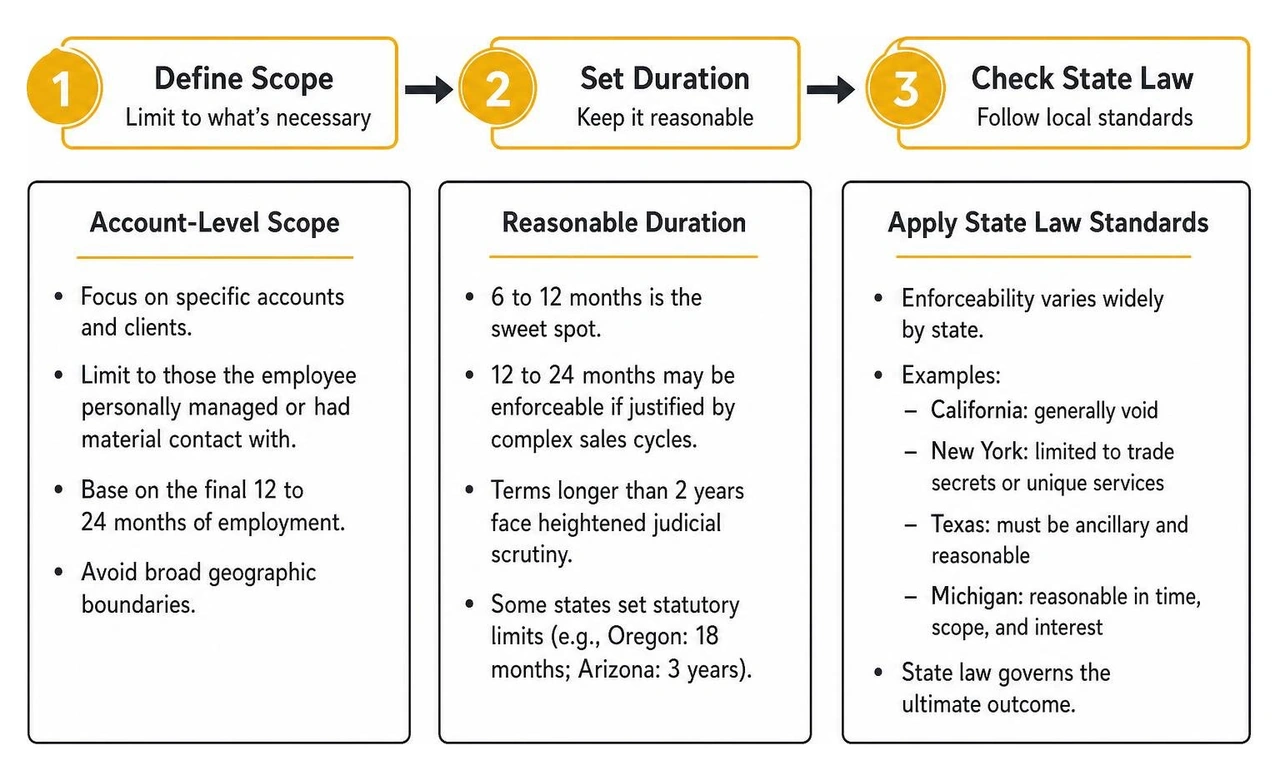
- Duration: Most courts consider 6 to 12 months as the sweet spot for enforceable client non-solicitation clauses. While restrictions ranging from 12 to 24 months may survive if justified by complex sales cycles, any restraint exceeding two years faces heightened judicial scrutiny. Certain states enact statutory outer limits; for example, Oregon caps terms at 18 months, whereas Arizona permits up to three years under strict reasonableness tests.
- Geographic vs. Account Scope: In modern commerce, broad geographic boundaries (such as a 50-mile radius) are increasingly obsolete. Enforceable covenants focus on account-level scopes, limiting restrictions strictly to the specific accounts and clients the departing employee personally managed or had material contact with during the final 12 to 24 months of employment.
State-by-State Enforceability and Federal Regulatory Landscape
Restrictive covenant enforceability varies dramatically across the country. Employers and departing executives frequently reference public corporate restrictive covenant filings when benchmarking contract terms, but local state laws always govern the ultimate outcome.
| Jurisdiction | Client Non-Solicitation Enforceability | Employee Non-Solicitation Enforceability | Notable Statutory Framework / Case Law |
|---|---|---|---|
| Michigan | Enforceable if reasonable in time, scope, and interest | Enforceable to prevent unfair raiding of personnel | MCL § 445.774a; evaluated under rule of reasonableness |
| California | Generally void as unlawful restraint on trade | Unenforceable under modern interpretations | Cal. Bus. & Prof. Code § 16600; narrow trade secret carve-outs |
| Texas | Enforceable if ancillary to an otherwise valid agreement | Enforceable if reasonable in duration and scope | Tex. Bus. & Com. Code § 15.50; requires adequate consideration |
| New York | Enforceable only to protect trade secrets or unique services | Enforceable if reasonably limited to protect stable workforce | Common law reasonableness standard; disfavors broad restrictions |
California, New York, Texas, and Michigan Enforcement Standards
California maintains the strictest posture in the nation. Under California Business and Professions Code § 16600, non-solicitation covenants targeting customers or employees are generally void as unlawful restraints on trade, preserving exceptions almost exclusively for the sale of a business or narrow trade secret protections.
In Texas, covenants must be ancillary to or part of an otherwise enforceable agreement at the time made, requiring clear consideration such as specialized trade secret disclosure. New York enforces non-solicitation agreements only to the extent necessary to protect proprietary customer lists, trade secrets, or instances where the employee's services are truly unique.
In Michigan, the enforceability of nonsolicitation agreements is governed by the Michigan Antitrust Reform Act (MCL § 445.774a). Michigan courts uphold covenants that protect reasonable competitive interests, provided they do not unduly restrict an individual's right to work. For workers across Birmingham, Troy, Royal Oak, and Southfield, understanding what employees should watch before resigning ensures proactive compliance and avoids costly emergency injunctions.
The FTC Rule Status and Nationwide Regulatory Outlook
Federal oversight of restrictive covenants underwent substantial turbulence between 2024 and 2026. While the Federal Trade Commission (FTC) issued a comprehensive nationwide ban targeting non-compete clauses in 2024, the rule faced extensive legal challenges in federal court and was formally set aside. In September 2025, the FTC officially withdrew its appeal, leaving restrictive covenant governance squarely in the hands of individual state legislatures and state courts.
Crucially, the FTC's regulatory initiatives targeted broad non-compete agreements rather than standard non-solicitation provisions. Because non-solicitation clauses allow workers to remain active within their industry, they remain a durable tool for businesses nationwide.
Best Practices for Drafting and Enforcing Protective Agreements
Well-structured employment agreements establish clear boundaries that protect company assets without unlawfully entrapping personnel. When evaluating non-competes during business sales or executive onboarding, precision drafting prevents future litigation.

Structuring a Non Solicitation Covenant for Different Roles
A standard non-solicitation clause should not be distributed indiscriminately across an organization:
- Sales Representatives: Restrictions should be strictly account-level. The clause should restrict outreach only to clients the salesperson actively managed, pitched, or accessed proprietary data for during their final year of employment.
- Executive Leadership: Given their enterprise-wide exposure to operational data, strategic growth plans, and high-level client rosters, executives may be subject to broader non-solicitation parameters, provided the restricted duration remains tied to industry realities (typically 12 months).
- Technical and Engineering Personnel: Customer non-solicitation clauses are often irrelevant for purely technical roles; agreements here should prioritize confidentiality, intellectual property assignment, and reasonable anti-poaching provisions.
Remedies for Breach, Tolling Provisions, and Common Drafting Mistakes
When a breach occurs, employers frequently seek immediate injunctive relief to halt unauthorized client outreach, alongside claims for actual damages, lost profits, and disgorgement of fees.
Key pitfalls to avoid include:
- Overbroad Client Definitions: Attempting to bar contact with "any past, present, or potential customer of the company" routinely leads courts to invalidate or aggressively narrow the clause.
- Missing Blue-Pencil Provisions: Agreements should include severability and modification terms allowing courts to strike unreasonable terms while enforcing the remainder.
- Aggressive Tolling Clauses: While tolling provisions extend the non-solicitation window during active violations or litigation, uncapped tolling clauses can be deemed punitive and unenforceable.
Departing professionals facing aggressive enforcement letters can consult a dedicated firm for legal representation for covenant disputes.
Frequently Asked Questions About Non-Solicitation Agreements
Can an employer enforce a non-solicitation clause without a geographic boundary?
Yes. Unlike traditional non-compete agreements that rely on physical geographic boundaries (such as a county or radius), modern customer non-solicitation covenants are frequently defined by account lists. If an agreement restricts outreach specifically to accounts the employee serviced, courts generally uphold it regardless of where the client or former employee is physically located.
What happens if a client reaches out to a former employee independently?
In most jurisdictions, an inbound, unprompted inquiry from a former client does not constitute solicitation. The departing worker is generally permitted to accept the client's business, provided they did not initiate contact, encourage the departure, or utilize stolen proprietary lists to secure the account.
Is continued at-will employment sufficient consideration for an existing employee?
In Michigan, continued employment can serve as sufficient consideration to support a restrictive covenant for an at-will employee. However, other jurisdictions require independent, fresh consideration—such as a raise, bonus, or promotion—for any agreement signed after initial hiring.
Conclusion
A well-crafted non-solicitation covenant balances an employer's right to protect customer relationships with an individual's right to pursue their career. Overbroad agreements that prevent ordinary commerce or lock workers out of their industries face swift challenges in court.
If you are navigating separation terms, evaluating an employment contract, or facing allegations of covenant breach across Bingham Farms, Birmingham, Southfield, or anywhere in Michigan, our team at Scott Batey Law provides strategic, seasoned counsel backed by over 25 years of courtroom experience. Contact an experienced employment attorney to schedule a consultation and safeguard your career transitions.