
Detailed Guide to Overtime Exemption Criteria

How to Tell Whether You Are Exempt From Overtime
An overtime exemption depends on your pay and the work you actually do, not your job title. Under the federal Fair Labor Standards Act, most employees must receive overtime pay for hours worked over 40 in a workweek. The common executive, administrative, and professional exemptions generally require a salary of at least $684 per week, pay that meets the salary-basis rules, and qualifying job duties. Some exemptions have different pay rules, and state law may give you greater protection.
I’m Scott Batey, a Michigan employment lawyer who has represented workers for nearly three decades, including blue-collar employees, managers, and professionals. I bring that employee-side experience to this guide to overtime exemption so you can better assess your classification and the records that matter.
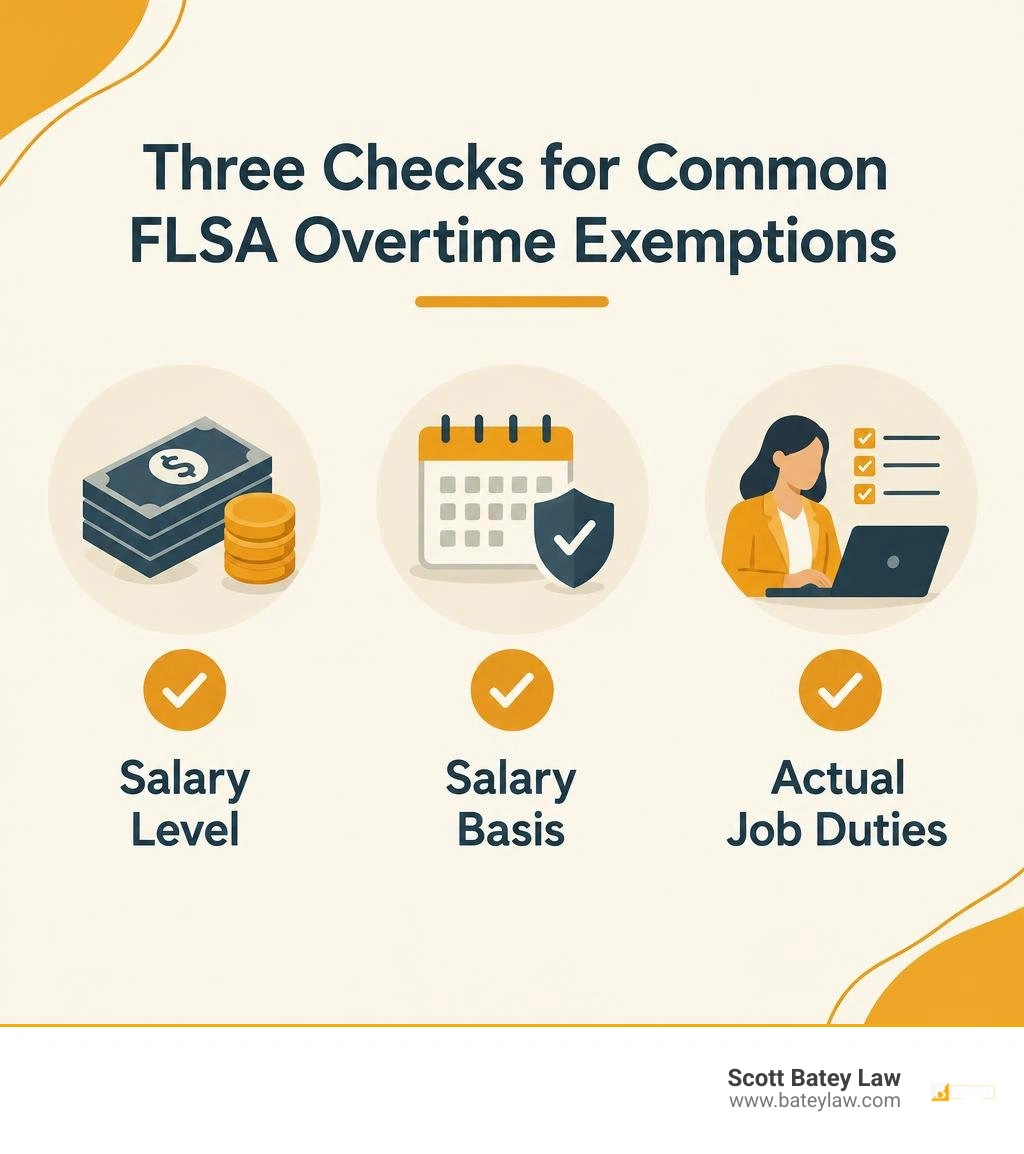
Understanding Exempt vs. Non-Exempt Status Under the FLSA
The Fair Labor Standards Act (FLSA) serves as the primary federal baseline protecting American workers from unfair pay practices. Under the FLSA, every covered employee is automatically presumed to be non-exempt unless the employer can prove that the worker meets specific, legally defined exemption criteria. Non-exempt employees are legally entitled to receive one-and-a-half times their regular rate of pay for all hours worked beyond 40 in a single workweek.
To maintain compliance, employers must keep accurate time and attendance records for all non-exempt staff. However, misclassifications occur frequently when businesses assume that putting a worker on a fixed salary automatically eliminates overtime obligations. In reality, hourly workers improperly treated as exempt face unlawful pay practices when their day-to-day duties do not meet statutory exemption standards.
Key Differences Between Exempt and Non-Exempt Employees
The fundamental distinction between exempt and non-exempt employees rests on how they are paid and their legal entitlement to overtime premiums.
- Non-Exempt Employees: Typically paid hourly (though they can be salaried non-exempt), these workers are fully protected by federal and state minimum wage laws and overtime rules. If a non-exempt worker logs 45 hours during a workweek, those extra 5 hours must be compensated at time-and-a-half.
- Exempt Employees: These workers receive a predetermined, fixed salary that does not fluctuate based on the quality or quantity of work performed in any given week. In exchange for meeting strict managerial, administrative, or professional standards, exempt employees are excluded from FLSA overtime protections, meaning they receive the same baseline pay whether they work 35 hours or 60 hours.
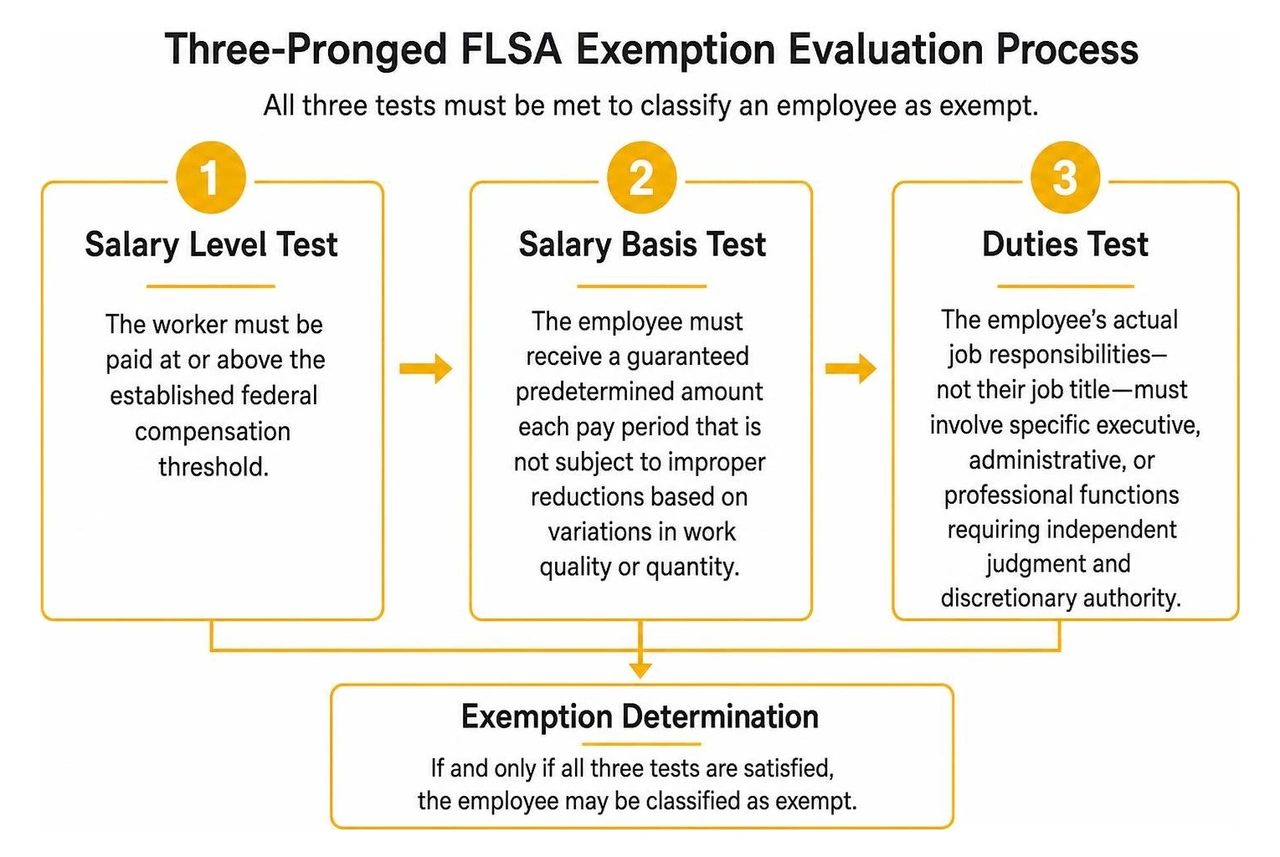
The Three-Pronged Exemption Standard
To legally classify an employee as exempt under the standard white-collar exemptions, an employer must satisfy all three prongs of the FLSA exemption test:
- Salary Level Test: The worker must be paid at or above the established federal compensation threshold.
- Salary Basis Test: The employee must receive a guaranteed predetermined amount each pay period that is not subject to improper reductions based on variations in work quality or quantity.
- Duties Test: The employee’s actual job responsibilities—not their written job title or contract description—must involve specific executive, administrative, or professional functions requiring independent judgment and discretionary authority.
Core FLSA Overtime Exemption Tests: Salary and Duties
To qualify for an overtime exemption under federal standards, the employee's compensation must meet minimum monetary amounts, and their primary daily tasks must align with statutory criteria.
| Exemption Category | Minimum Standard Salary / Pay Threshold | Primary Duty Requirements | Discretionary & Judgment Standards |
|---|---|---|---|
| Executive | $684 per week ($35,568 annually) | Managing an enterprise or recognized department; supervising 2+ full-time employees | Authority to hire/fire or substantial weight given to recommendations |
| Administrative | $684 per week ($35,568 annually) | Office or non-manual work directly related to management or general business operations | Customary exercise of discretion and independent judgment on significant matters |
| Learned Professional | $684 per week ($35,568 annually) | Performance of work requiring advanced knowledge in a specialized field of science or learning | Consistent exercise of discretion; knowledge customarily acquired by prolonged intellectual instruction |
| Creative Professional | $684 per week ($35,568 annually) | Work requiring invention, imagination, originality, or talent in a recognized artistic field | Independent creation rather than routine technical work |
| Computer Employee | $684 per week or $27.63 per hour | Systems analysis, software design, programming, or related complex software engineering | High-level technical expertise and independent problem-solving |
| Outside Sales | No minimum salary threshold | Making sales or obtaining orders/contracts away from the employer’s place of business | Regular engagement in sales activities outside the office |
| Highly Compensated | $107,432 annual compensation | Office or non-manual work; customarily performing at least one executive, administrative, or professional duty | High-level role with minimal duty test requirements |
Under federal guidelines, employers are permitted to use nondiscretionary bonuses and incentive payments (such as tied commissions) paid on an annual or more frequent basis to satisfy up to 10 percent of the standard salary level.
Federal White-Collar Overtime Exemption Categories
Federal law outlines specific requirements for each major white-collar classification:
- Executive Exemption: As outlined in DOL Fact Sheet #17A executive guidance, the employee’s primary duty must be managing the enterprise or a recognized subdivision. They must regularly direct the work of two or more full-time employees (or the equivalent in part-time workers) and possess the authority to hire or fire, or have significant input regarding promotions and terminations.
- Administrative Exemption: The primary duty must consist of office or non-manual work directly related to the management or general business operations of the employer or the employer's clients. A crucial element is that the role must include the exercise of discretion and independent judgment regarding matters of business significance.
- Professional Exemptions: Under DOL professional exemption criteria, the learned professional exemption requires work involving advanced knowledge in a field of science or learning acquired through specialized intellectual instruction (such as engineering, law, medicine, or accounting). Creative professionals must perform work requiring invention, imagination, originality, or talent in an artistic or creative endeavor. Notably, bona fide teachers and licensed practitioners of law or medicine are exempt from the standard salary level requirements.
- Computer Employee Exemption: Applies to computer systems analysts, computer programmers, software engineers, and similarly skilled workers. The employee can be paid on a salary basis of at least $684 per week or on an hourly basis of not less than $27.63 an hour.
- Outside Sales Exemption: Applies to workers whose primary duty is making sales or obtaining orders and contracts, and who regularly work away from the employer's physical place of business. This exemption contains no minimum salary requirement.
Highly Compensated and Equity-Based Executive Rules
Employees performing office or non-manual work who receive total annual compensation of at least $107,432 (which must include at least $684 per week paid on a salary or fee basis) are exempt under the highly compensated employee (HCE) standard if they customarily and regularly perform at least one of the exempt duties of an executive, administrative, or professional employee.
Additionally, under the elaws - FLSA Overtime Security Advisor executive rules, any employee who owns at least a bona fide 20 percent equity interest in the enterprise in which they are employed, and who is actively engaged in its day-to-day management, is exempt from overtime without needing to satisfy standard salary level thresholds.
Non-Exempt Classifications and Salary Deduction Rules

Protected Workers: Blue-Collar and First Responders
No matter how much they are paid or what title they hold, certain categories of workers are non-exempt under the FLSA. The white-collar exemptions apply strictly to office, non-manual, administrative, and intellectual roles.
- Blue-Collar Workers: Manual laborers, production line workers, construction tradespeople, mechanics, electricians, carpenters, and craftsmen are entitled to overtime pay regardless of earnings.
- First Responders: Police officers, state troopers, municipal firefighters, paramedics, EMTs, correctional officers, and park rangers are non-exempt workers entitled to full overtime protections.
Permissible vs. Impermissible Salary Deductions
Under the elaws - FLSA Overtime Security Advisor salary-basis guidelines, an exempt employee must receive their full predetermined salary for any workweek in which they perform any work. Pay cannot be docked for partial-day absences or business-related slowdowns.
Permissible Deductions Include:
- Full-day absences for personal reasons other than sickness or disability.
- Full-day absences due to sickness or disability if deducted in accordance with a bona fide sick leave plan, policy, or practice.
- Offsets against salary for jury duty fees, witness fees, or military temporary duty pay.
- Penalties imposed in good faith for infractions of major safety rules.
- Unpaid disciplinary suspensions of one or more full days imposed in good faith for workplace conduct infractions.
- Pro-rated pay adjustments for the initial or terminal week of employment.
- Unpaid leave taken under the Family and Medical Leave Act (FMLA).
Impermissible Deductions Include:
- Docking pay for partial-day absences (such as leaving two hours early for a personal appointment).
- Reductions due to operating closures caused by inclement weather or low business volume when the worker is ready, willing, and able to work.
- Deductions for minor disciplinary issues not involving major safety violations or formal written conduct policies.
If an employer engages in an isolated or inadvertent deduction, they can maintain the exemption by reimbursing the employee. However, an actual practice of making improper deductions strips the salary-basis status, causing the employer to lose the overtime exemption for all employees in that job classification during the violation period.
State Differences and the 2025–2028 Overtime Tax Deduction Rules

State-Specific Overtime Exemption Variations: California and Maryland
While the FLSA sets the federal baseline, individual states maintain their own distinct wage and hour standards.
Under California Code, Labor Code - LAB § 515, California enforces a strict salary test requiring exempt employees to earn a monthly salary equivalent to at least twice the state minimum wage for full-time employment (40 hours per week). For 2025, this sets the minimum annual exempt salary at $68,640. California also mandates daily overtime (pay after 8 hours in a single day) and enforces strict quantitative duty tests requiring exempt personnel to spend more than 50 percent of their working time engaged in exempt tasks. While agricultural workers in California historically followed phased overtime schedules, as of January 1, 2025, all agricultural workers are subject to standard overtime rules.
In contrast, other jurisdictions establish unique industry carve-outs. Under the Overtime Only Exemptions - The Maryland Guide to Wage Payment and Employment Standards - Employment Standards Service-Wage and Hour Information, Maryland exempts specific occupations from state overtime requirements—such as taxicab drivers, certain automobile and farm equipment sales/service staff, and non-profit concert promoters—provided those employees earn at least the state minimum wage.
Federal 'No Tax on Overtime' Deduction Guidelines
For tax years beginning January 1, 2025, and running through December 31, 2028, eligible employees can take advantage of the federal "No Tax on Overtime" deduction. This provision allows qualified taxpayers to deduct overtime pay from their federal adjusted gross income:
- Maximum Annual Deduction: Up to $12,500 for single filers and up to $25,000 for married couples filing jointly.
- Income Phase-Outs: The deduction begins phasing out for modified adjusted gross income (MAGI) over $150,000 for single filers and $300,000 for joint filers.
- Reporting Requirements: The deduction is claimed on federal Schedule 1-A. Starting in tax year 2026, employers are required to report qualified overtime compensation in Box 12 of Form W-2 using code TT.
- Scope: The deduction applies to federal income tax liability. Standard FICA payroll taxes (Social Security and Medicare) still apply to all overtime compensation.
Consequences of Misclassification and Legal Recourse for Workers
Misclassifying workers as exempt denies them legally earned compensation. Whether an employer improperly assigns an exempt title to a salaried staff member or attempts evaluating 1099 contractor versus W-2 status incorrectly, the legal consequences are substantial.
Employer Penalties for Misclassification
Employers that misclassify non-exempt workers face serious financial liabilities under federal and state enforcement frameworks:
- Back Wages: Full payment of all unpaid overtime hours worked over a two-year recovery period, or a three-year recovery period if the violation was willful.
- Liquidated Damages: An additional mandatory statutory penalty equal to 100 percent of the back wages owed (double damages).
- Attorney’s Fees and Costs: Employers found liable must pay the employee’s reasonable legal costs and attorney fees.
- Civil Penalties: Government regulatory bodies may levy civil money penalties for repeat or willful violations.
Pursuing Unpaid Overtime and Wage Theft Claims
Workers experiencing misclassification have practical avenues to recover their earned wages. Legal remedies for recovering unpaid wages from overtime violations allow employees to challenge unlawful payroll practices. If you need to initiate formal action, filing a formal wage and hour claim preserves your rights and stops the statute of limitations clock.
Federal and state laws strictly prohibit retaliation against workers who inquire about their pay or file wage complaints. Employees facing termination, demotion, or disciplinary threats can pursue legal remedies for wage and hour retaliation. If you work in Oakland County or surrounding areas, retaining experienced workplace retaliation legal support ensures your career is protected while recovering your compensation. Our team provides dedicated Metro Detroit overtime attorney representation to hold non-compliant employers accountable.
Frequently Asked Questions About Overtime Rules
Does having a managerial job title make an employee automatically exempt?
No. Job titles have zero legal weight in determining overtime exemption under the FLSA. A worker titled "Assistant Store Manager" or "Team Lead" who spends the majority of their shift performing routine cashiering, stocking, or food preparation—without meaningful authority over hiring, firing, and scheduling—is legally non-exempt and owed full overtime compensation.
Can an employer reduce an exempt employee's salary for slow business days?
No. Under the federal salary-basis rule, an exempt employee must receive their full weekly salary regardless of business volume. If an office closes early due to snow or lacks client work on a Friday, the employer cannot deduct those lost hours from the employee's fixed salary. Doing so jeopardizes the exemption across the entire job classification.
How does the federal overtime tax deduction affect state income taxes?
The temporary 2025–2028 "No Tax on Overtime" deduction applies specifically to federal income taxes via Schedule 1-A. Whether those deductions reduce state tax liabilities depends on whether the worker's home state conforms to federal adjusted gross income definitions. Social Security and Medicare taxes continue to apply at the standard rates.
Conclusion
Understanding your overtime rights requires examining how you are paid, how much you earn, and the actual tasks you carry out each day. Misclassification remains one of the most common forms of workplace wage violations, costing workers thousands of dollars each year in unpaid premiums.
At Scott Batey Law in Bingham Farms, MI, we have spent over 25 years helping workers across Metro Detroit, Birmingham, Southfield, Royal Oak, Beverly Hills, Farmington Hills, Oak Park, Troy, Ferndale, Berkley, Madison Heights, and throughout Oakland County assert their rights. If you have questions regarding your pay structure or want to understand 2026 Michigan overtime and exempt reclassification rules, reaching out for a professional review ensures your compensation reflects the full protection of the law.