.png)
How to Get Paid While Taking a Break at Work

What the Law Actually Says About Paid Breaks for Hourly Employees
Paid breaks for hourly employees are governed by a mix of federal and state rules that many workers — and even some employers — get wrong.
Here is the short answer:
| Break Type | Duration | Paid? |
|---|---|---|
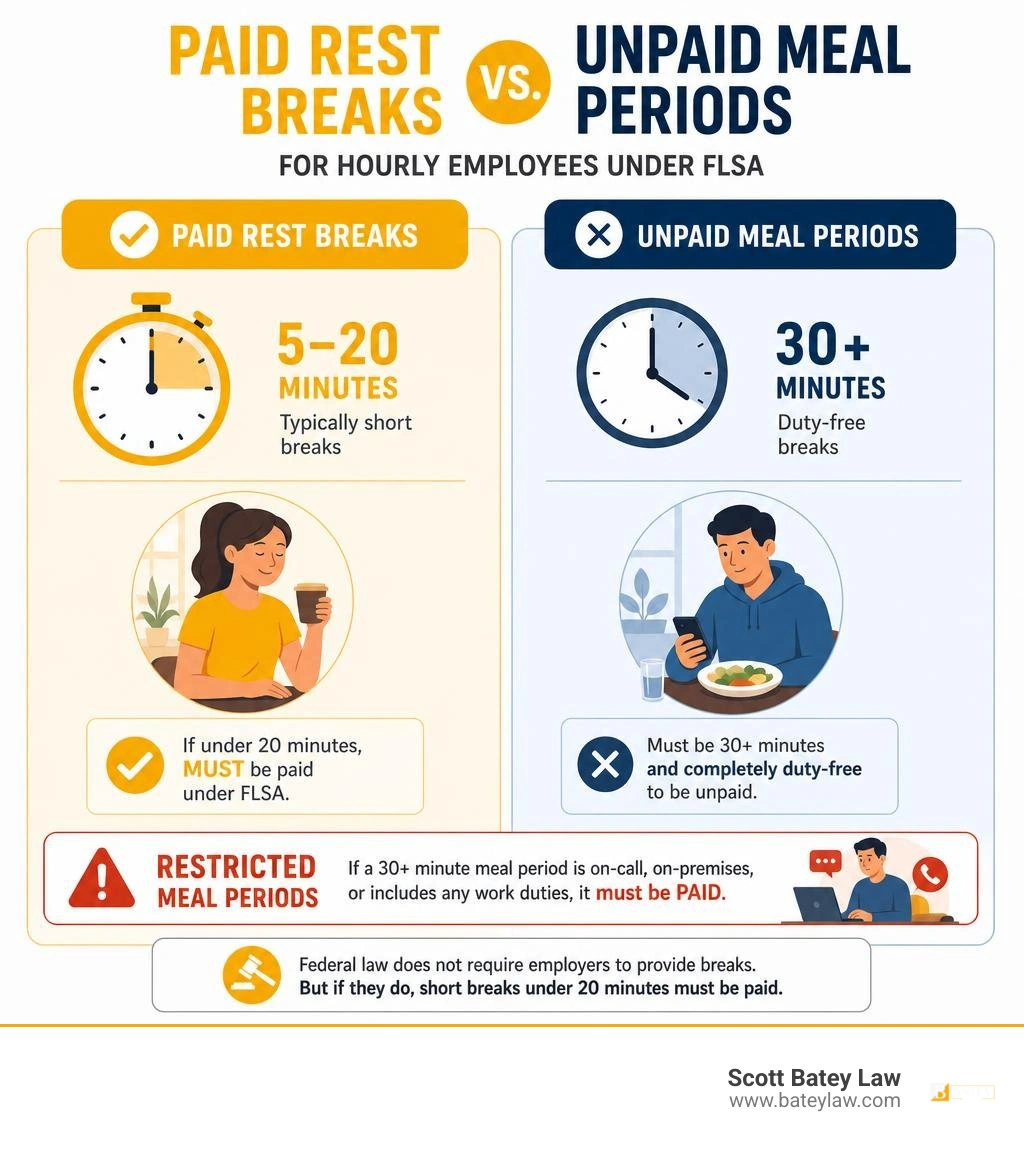
| Short rest break | 5 to 20 minutes | Yes — always |
| Meal period | 30+ minutes, duty-free | No |
| Meal period (restricted) | 30+ minutes, on-call or on-premises with duties | Yes |
| Nursing/lactation break | Varies | Depends on state and timing |
Federal law does not require employers to give you any break at all. But if they do give you a short break under 20 minutes, they must pay you for it. That rule comes from the Fair Labor Standards Act (FLSA) and has been upheld in federal court.
Many Michigan workers are surprised to learn that taking a working lunch — answering emails, staying at your desk, covering the phones — can legally convert an "unpaid" meal break into paid time.
I'm Scott Batey, a Michigan employment lawyer with nearly three decades of experience representing hourly and salaried workers whose employers have violated their rights — including cases involving unpaid paid breaks for hourly employees and other wage theft claims. If you think your employer is shorting your pay, this guide will help you understand exactly what you are owed.
Federal FLSA Rules on Paid Breaks for Hourly Employees
At the federal level, the Fair Labor Standards Act (FLSA) is the primary law governing wages and hours worked. However, a common point of confusion is whether the FLSA actually forces employers to provide rest periods or lunch breaks.
The short answer is no. Federal law does not mandate that employers provide lunch or coffee breaks. If an employer wants to run a continuous operation without scheduled pauses, the FLSA does not stop them. However, when employers do choose to offer breaks, federal regulations strictly dictate whether that time must be paid.

These regulations are divided into two main categories:
- Short rest breaks (29 CFR 785.18): Rest periods of short duration, typically running from 5 minutes to about 20 minutes, are common in the workplace. The law views these short pauses as highly beneficial to employee efficiency, focus, and productivity. Because these breaks ultimately benefit the employer's operations, they are legally considered compensable hours worked. This means your employer cannot dock your pay or require you to clock out for a quick 10- or 15-minute coffee break.
- Bona fide meal periods (29 CFR 785.19): For a break to be considered a non-compensable (unpaid) meal period, it must typically last at least 30 minutes. More importantly, the employee must be completely relieved from duty for the purpose of eating regular meals. If you are required to perform any active or inactive duties while eating, your meal period is not "bona fide," and you must be paid for that time.
Rest Breaks vs. Meal Breaks: The 20-Minute Rule
The "20-minute rule" serves as a bright-line boundary under federal law. Any rest period lasting 20 minutes or less must be paid. It must also be factored into your total hours worked for the week, which directly impacts your overtime calculations.
If you work 40 hours of regular labor and take two paid 15-minute breaks each day, those break hours count toward your weekly total. If your employer attempts to subtract those short breaks to keep you under the 40-hour overtime threshold, they are violating federal law. If you suspect your hours are being manipulated to avoid paying you overtime, consulting a Wage & Overtime Lawyer - Metro Detroit can help you assess your situation.
For a meal break to cross the threshold into unpaid territory, it must meet three strict criteria:
- It must be at least 30 minutes long (though shorter periods may be allowed under rare, specific industry conditions).
- The employee must be completely free from work responsibilities.
- The employee must be free to use the time for their own purposes.
What Happens When You Work Through a Break?
A major source of wage theft involves "off-the-clock" work during supposedly unpaid meal breaks. Employers frequently expect workers to remain at their desks, monitor assembly lines, or keep their walkie-talkies on during lunch.
If you are an hourly receptionist and your boss tells you that you can eat at your desk but asks you to "just answer the phone if it rings," that is not an unpaid break. Because you are not completely relieved of your duties, the law requires that you be compensated for the entire period.
The landmark federal court ruling in Secretary of Labor v. American Future Systems, Inc. addressed this dynamic directly. In that case, the employer implemented a "flexible" timekeeping system where employees were only paid when actively logged into their computers. If an employee logged off for more than 90 seconds — even just to use the restroom or stretch — their pay was deducted.
The court soundly rejected this practice. The Third Circuit Court of Appeals held that the FLSA requires employers to compensate employees for all rest breaks of twenty minutes or less, regardless of how the employer labels the policy. You can read the detailed legal reasoning in the official court opinion. The court even noted that unless an employee possessed a fictional "Portkey" from Harry Potter, it was physically impossible to complete a basic bathroom break in under 90 seconds.
Common break violations we regularly see in Michigan include:
- Automatic meal break deductions: Payroll software automatically subtracting 30 minutes from your daily total, even on days you worked straight through lunch.
- On-call lunches: Requiring you to stay on the premises with your radio on, ready to jump back to work at a moment's notice, without pay.
- Restroom penalization: Deducting pay for short trips to the bathroom or water fountain by claiming they are "unauthorized" personal breaks.
If your employer is engaging in these practices, they may be committing wage theft. To learn more about your rights and how to protect your hard-earned income, review our guide on Wage Theft in Michigan: Overtime, Off-the-Clock Work & Retaliation.
State-by-State Differences in Break Laws
Because federal law does not mandate breaks, the legal landscape is a patchwork of state-level statutes. Some states have passed incredibly strict, employee-friendly break laws, while others default entirely to the bare minimum federal standards.
The table below outlines how break requirements differ across several key states compared to our home state of Michigan:
| Jurisdiction | Mandatory Rest Breaks (Adults) | Mandatory Meal Breaks (Adults) | Special Penalties for Violations? |
|---|---|---|---|
| Federal (FLSA) | No | No | No (standard back-pay/damages) |
| California | Yes (10 mins per 4 hours) | Yes (30 mins for shifts > 5 hours) | Yes (1 hour of regular pay per missed break) |
| Minnesota | Yes (15 mins per 4 hours, effective 2026) | Yes (30 mins for shifts > 6 hours) | Yes (liquidated damages equal to break value) |
| Texas | No | No | No |
| Michigan | No | No | No (except for minors under 18) |
California and Minnesota: Stricter Rules for Paid Breaks for Hourly Employees
States like California and Minnesota have built highly structured systems to guarantee that hourly workers receive physical rest during the workday.
In California, the Division of Labor Standards Enforcement (DLSE) strictly enforces rest and meal periods. Non-exempt workers are entitled to a net 10-minute paid rest break for every four hours worked (or major fraction thereof). This 10-minute duration is "net," meaning the countdown only begins once the employee reaches a suitable rest area away from their workstation.
Furthermore, California employers must provide a 30-minute uninterrupted, unpaid meal break if an employee works more than five hours. If an employer fails to provide either of these breaks, they must pay the employee one additional hour of regular pay for each day a violation occurs. For more details on these strict requirements, you can review the California DLSE rest period FAQ or check the broader DIVISION OF LABOR STANDARDS ENFORCEMENT guidelines.
Minnesota is also leading the charge in progressive break legislation. Effective January 1, 2026, Minnesota law mandates that rest breaks must be at least 15 minutes long and must occur within each four consecutive hours of work. Additionally, employers must provide a 30-minute meal break for shifts of six or more consecutive hours.
Under these updated guidelines, if an employee's walk to the nearest restroom takes several minutes, the rest break must be extended to ensure they get a full 15 minutes of actual rest. You can read more about these 2026 updates directly on the Minnesota Department of Labor and Industry website.
Texas and Michigan: Defaulting to Federal Standards
On the other end of the spectrum, states like Texas and Michigan do not mandate rest or meal breaks for adult employees.
In Texas, adult workers are not legally entitled to any breaks under state law, meaning employers default entirely to federal FLSA standards. If a Texas employer chooses to offer breaks, they must pay for short ones (under 20 minutes) but do not have to provide them in the first place.
Michigan operates very similarly for adult employees. There is no Michigan statute requiring employers to provide rest periods or lunch breaks to workers aged 18 and older. However, Michigan does maintain strict protections for minor employees. Under the Youth Employment Standards Act, minors under the age of 18 must be given a documented, uninterrupted 30-minute meal or rest break if they are scheduled to work for more than five continuous hours.
To keep up with changing wage regulations in our state, including minimum wage hikes and overtime threshold adjustments, read our analysis of the 2026 Pay Changes: Overtime, Bonuses, and Exempt Reclassification – What's Legal in Michigan. For a broader look at local compliance, you can also review the Michigan Labor Laws for Meals and Breaks | MI Break Laws.
Special Break Rights and Proposed Federal Changes
While general break laws are highly dependent on your state, federal law does carve out specific, mandatory break rights for certain groups of workers, including pregnant employees and nursing mothers.
Lactation and Medical Accommodations under Federal Law
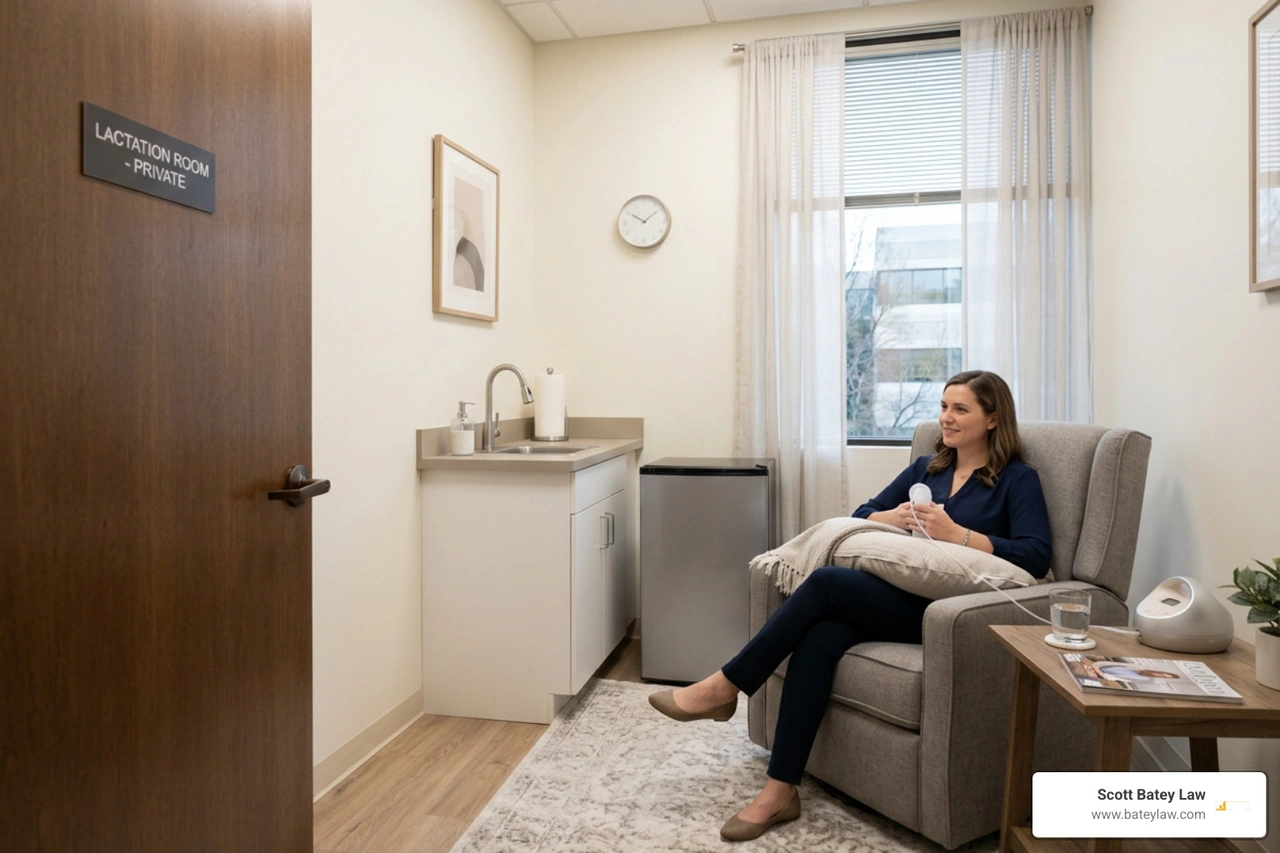
Under the Providing Urgent Maternal Protections for Nursing Mothers Act (PUMP Act), which expanded FLSA protections, most hourly and salaried employees have a federal right to reasonable break times to express breast milk. This right extends for up to one year after the child's birth.
Key requirements under the PUMP Act include:
- Reasonable frequency and duration: Employers must allow nursing mothers to take breaks as frequently and for as long as needed to express milk.
- A private space: Employers must provide a private space, other than a bathroom, that is shielded from view and free from intrusion by coworkers and the public.
- Compensation rules: If an hourly employee is expressing milk during an already authorized paid rest break, they must be compensated. Additionally, if the employee is not completely relieved of all work duties during the lactation break, the time must be paid.
Furthermore, under the Pregnant Workers Fairness Act (PWFA) and the Americans with Disabilities Act (ADA), employees with pregnancy-related limitations or chronic medical conditions (such as diabetes) may be entitled to additional, modified, or longer breaks as a reasonable accommodation. Employers must engage in an interactive process to accommodate these needs unless doing so would cause undue operational hardship.
If you are facing health challenges, you may also have rights under Michigan's paid sick time regulations. To understand how to utilize these protections safely, check our resources on the Earned Sick Time Act (ESTA) Lawyer - Michigan, Using Michigan Earned Sick Time During Flu Season: Notice, Documentation, Retaliation, and Using Michigan ESTA Without Risk.
The Worker Rights and Support Act: Future of Paid Breaks for Hourly Employees
There is also movement on Capitol Hill to establish a unified federal standard for workplace breaks. The proposed Worker Rights and Support Act (H.R. 9008) aims to amend the FLSA to mandate rest and meal periods for hourly workers nationwide, eliminating the current state-by-state confusion.
If passed, H.R. 9008 would introduce several major changes:
- Mandatory meal breaks: Requiring a 30-minute meal break for every 6-hour work period.
- Mandatory rest breaks: Requiring a paid rest break of at least 10 minutes for every 4-hour work period.
- Premium pay for restricted breaks: If an employer restricts an employee's ability to leave the premises during a meal break, or fails to fully relieve them of duty, the employer must compensate them for the entire break at 1.5 times their regular hourly rate.
- Statutory medical breaks: Codifying the right to paid medical breaks of up to 20 minutes when supported by documentation from a healthcare provider.
You can read the full, proposed legislative text of this groundbreaking bill by accessing the H. R. 9008 PDF.
Frequently Asked Questions about Employee Break Laws
Navigating wage and hour laws can be incredibly confusing. Below are answers to some of the most common questions we hear from workers in the Detroit metro area.
Can my employer require me to stay on the premises during an unpaid break?
Yes. Under federal law, an employer is legally allowed to require you to remain on the work premises during your lunch break. As long as you are completely relieved of all work duties, the break can remain unpaid, even if you are restricted to the breakroom or building.
However, if you are required to remain on-site and perform passive work duties (like waiting for a delivery or monitoring an assembly line), the break must be fully compensated.
Can I voluntarily waive my rest or meal breaks?
In Michigan, because there is no state law mandating breaks for adults, you and your employer can agree to work without them. However, in states with strict break mandates (like California), waiving breaks is highly regulated.
Even in Michigan, if your employer has an internal policy establishing scheduled breaks, they have the right to discipline or terminate you for insubordination if you refuse to take them. If you do choose to waive a break, it is best practice for your employer to document this voluntary waiver in writing to prevent future wage disputes.
What are the penalties if an employer violates break laws?
If an employer is caught illegally deducting pay for short rest breaks, or forcing employees to work off-the-clock during unpaid lunches, they can face severe legal consequences. Under the FLSA, employees can recover:
- Back wages: The unpaid wages they are owed for the uncompensated break times.
- Liquidated damages: An additional, equal amount of back wages as a penalty (effectively doubling your recovery).
- Attorney’s fees: The employer may be forced to cover your legal costs.
Additionally, if you complain to your employer about unpaid breaks and they fire, demote, or cut your hours in response, that is illegal retaliation. We represent workers facing these exact issues. Learn more about your rights on our page regarding Retaliation for Wage Complaint Oakland County MI and our guide on Wage & Hour Retaliation: Building Leverage After a WHD Complaint.
Conclusion
Understanding your rights regarding paid breaks for hourly employees is critical to ensuring you are fully compensated for every minute you work. While Michigan does not mandate lunch or rest periods for adults, the federal and state rules that do apply are strict. If your boss is docking your pay for 15-minute breaks, forcing you to answer phones during your unpaid lunch, or auto-deducting time from your paycheck, you may have a strong legal claim for wage theft.
At Scott Batey Law, we have spent over 25 years providing award-winning, personalized representation to workers throughout Metro Detroit, including Bingham Farms, Royal Oak, Southfield, and Oakland County. We understand the tactics employers use to shave time off your paycheck, and we know how to hold them accountable.
Don't let your employer pocket your hard-earned wages. If you believe your rights have been violated, contact our experienced Employment Law Attorney Metro Detroit or consult with a dedicated Michigan Employment Lawyer for Employees today.
Ready to take action? Reach out to a skilled Wage & Overtime Lawyer - Metro Detroit at Scott Batey Law in Bingham Farms, MI, and let us help you secure the compensation you deserve.