.png)
Navigating Short-Term Disability After Your FMLA Clock Stops Ticking

When Your FMLA Clock Stops: What Happens to Your Income and Your Job?
Short-term disability after FMLA runs out is one of the most stressful situations a working person can face. Your 12 weeks of job-protected leave are gone. You still can't return to work. And now you're left wondering: Will I still get paid? Can my employer fire me? What happens next?
Here's the quick answer:
| Question | Answer |
|---|---|
| Does short-term disability continue after FMLA ends? | Yes, if your policy allows it — benefits can continue for up to 3-6 months total |
| Does your job stay protected after FMLA expires? | No — federal FMLA job protection ends at 12 weeks |
| Can your employer fire you while you're on short-term disability? | Legally yes, but ADA protections may still apply |
| Should you file FMLA and short-term disability at the same time? | Yes — always file both concurrently for maximum protection |
| What protections remain after FMLA runs out? | ADA accommodations, state leave laws, and employer-specific policies |
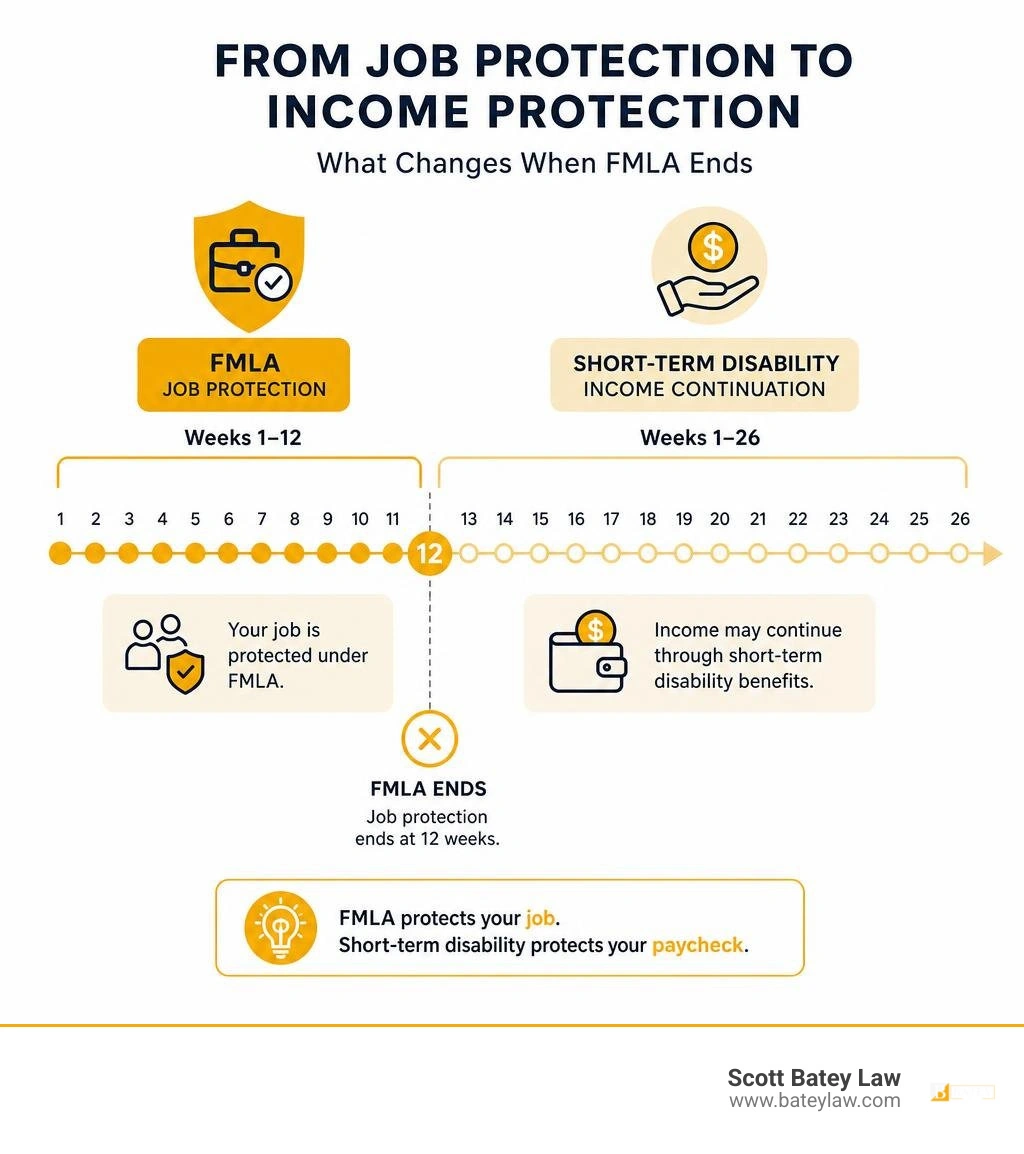
Think of it this way: FMLA protects your job. Short-term disability protects your paycheck. They serve completely different purposes — and when FMLA expires, one of those protections disappears while the other may continue.
This distinction matters enormously, and most employees don't realize it until it's too late.
I'm Scott Batey, a Michigan employment lawyer with nearly three decades of experience representing employees in FMLA disputes, disability accommodation issues, and wrongful termination claims — including cases where employers terminate workers mid-disability leave after short-term disability after FMLA runs out. If you're navigating this situation right now, this guide will walk you through exactly what your rights are and what steps to take.
FMLA vs. Short-Term Disability: Understanding the Core Differences
To understand what happens when your job-protected leave runs out, you first have to understand the core differences between the Family and Medical Leave Act (FMLA) and short-term disability (STD).
FMLA is a federal law. It applies to employers with 50 or more employees within a 75-mile radius. If you qualify, FMLA guarantees up to 12 weeks of unpaid, job-protected leave per year for a serious health condition. Your employer is legally required to maintain your group health benefits under the same conditions as if you were working, and they must return you to your same or an equivalent position when your leave ends.
Short-term disability, on the other hand, is not a law. It is an insurance policy—either purchased privately or, more commonly, offered as an optional benefit by your employer (historically, about 40% of private-sector workers have access to these benefits). Short-term disability does not protect your job. It does not force your employer to keep your health insurance active. What it does do is replace a portion of your income—typically 40% to 70% of your pre-disability base salary—for a set period, usually between 13 to 26 weeks.
Because they are entirely separate, they must be managed differently. For a detailed breakdown of how these two programs diverge, you can explore this comprehensive comparison of Short-Term Disability vs. FMLA: What's the Difference and Why It Matters | LeaveRights.
| Feature | Family and Medical Leave Act (FMLA) | Short-Term Disability (STD) |
|---|---|---|
| Type of Benefit | Federal law (statutory right) | Insurance policy (financial benefit) |
| Job Protection | Yes (guaranteed return to same/equivalent job) | No (does not prevent termination on its own) |
| Income Replacement | No (unpaid leave) | Yes (typically 40% to 70% of regular pay) |
| Duration | Up to 12 weeks per 12-month period | Typically 13 to 26 weeks (3 to 6 months) |
| Health Benefits | Mandated continuation of group health plan | Dependent on employer policy or COBRA |
As we enter July 2026, the legal landscape surrounding these benefits continues to evolve, making it more critical than ever to understand how they work together to shield you from financial ruin and job loss.
What Happens to Your Job Protection When FMLA Runs Out?

When FMLA expires, your federal right to job protection under that specific statute ends. On week 13, day one, your employer is no longer federally mandated by the FMLA to hold your position open or return you to an equivalent job.
If you remain unable to return to work due to your medical condition, your employer can legally fill your position or terminate your employment for legitimate business reasons. Many employees are shocked to discover that even if their doctor certifies they need just two or three more weeks to recover, the FMLA clock has stopped.
However, this does not mean your employer can automatically fire you without risk. If you are terminated immediately after your leave expires without any discussion, it can be a massive legal red flag. Employers often make critical errors during this transition period, such as failing to engage in an interactive process or retaliating against you for taking leave in the first place.
If you suspect your employer is preparing to let you go, or if they already have, it is vital to learn about Fired After Medical Leave FMLA ADA Red Flags Employees Should Know to protect your rights.
Managing Your Short-Term Disability After FMLA Runs Out
If you are still disabled when your 12 weeks of FMLA leave end, your short-term disability insurance payments do not automatically stop. Because short-term disability is an insurance contract, your eligibility for payments is governed by the terms of your policy, not the FMLA.
If your medical provider continues to document your functional limitations and certifies that you cannot perform the duties of your job, your disability benefits can continue for the remainder of the policy’s maximum benefit period (usually up to 26 weeks total). To better understand your financial safety net during this period, review the details on Short Term Disability Rights After FMLA Expiration.
However, you must be careful. If your employment is terminated because your FMLA job protection ran out, your insurance company may try to stop your disability payments. Under ERISA (the federal law governing most employer-sponsored benefit plans), if your disability began while you were still actively employed and covered under the plan, your benefits should generally continue even if your employment is subsequently terminated. Navigating this tricky intersection is highly complex, but understanding these federal protections is critical to ensuring your benefits are not wrongfully cut off.
Transitioning to Short-Term Disability After FMLA Runs Out
The most effective way to protect both your job and your income is to run your FMLA and short-term disability concurrently from day one.
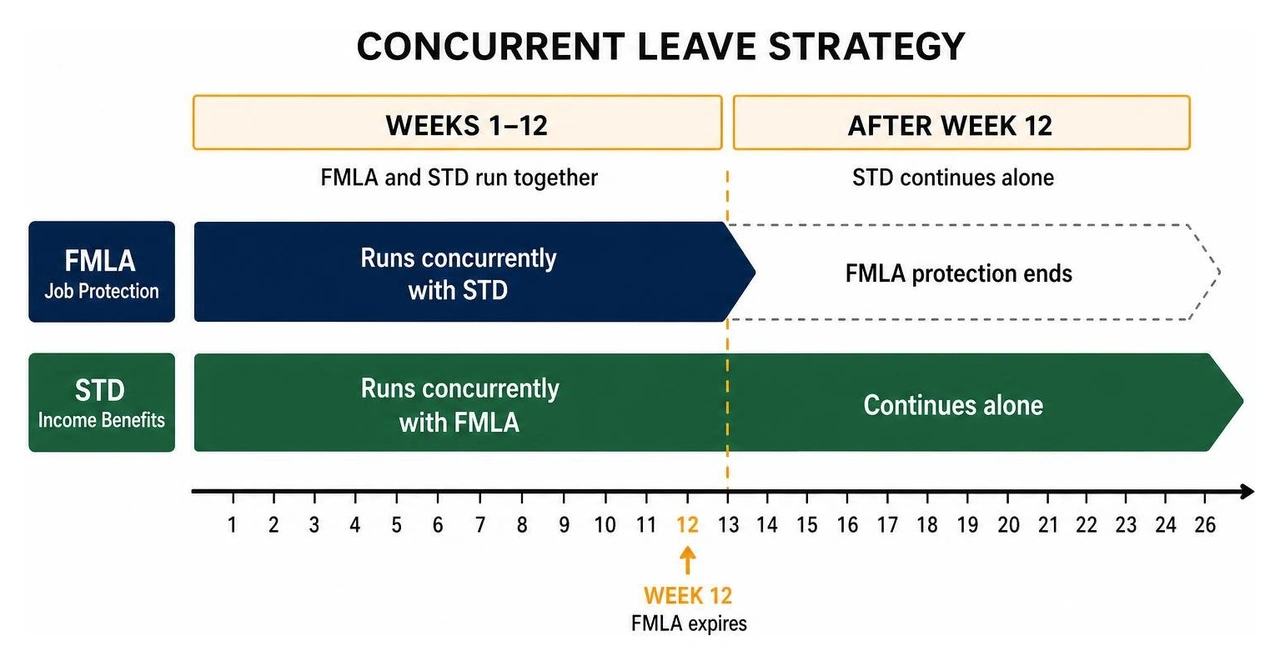
If you wait until your FMLA expires to apply for short-term disability, you may face severe delays due to policy elimination periods (waiting periods of 7 to 14 days where no benefits are paid). Furthermore, your employer may argue that because you did not file for disability initially, your continued absence is unexcused.
To ensure your paperwork is airtight and your medical certifications are properly submitted, we recommend reviewing our guide on FMLA Paperwork Tactics Certifications Recertifications Cures.
Applying for Short-Term Disability After FMLA Runs Out
To qualify for continued short-term disability benefits after FMLA ends, your medical documentation must be flawless. Insurance adjusters are not looking at your diagnosis; they are looking at your functional impairment. They want to know exactly what physical or cognitive limitations prevent you from performing your job duties.
This documentation gap is particularly challenging for mental health conditions (such as severe depression, anxiety, or PTSD) and substance use disorders. Many general practitioners are hesitant to fill out detailed disability forms because they lack the specific tools to quantify cognitive limitations.
If you are seeking leave for psychological reasons, it is often necessary to obtain an evaluation from a specialist who understands how to document these barriers. You can read more about choosing the correct path for psychological leave in FMLA vs. Short-Term Disability: Which Benefit Is Right for You? | Licensed Psychologist.
Can Your Employer Fire You While You Are on Short-Term Disability?

This is the number one question we hear: Can my employer legally fire me while I am actively receiving short-term disability benefits?
The short answer is yes.
Because short-term disability is an insurance product and not a job-protection law, receiving benefits does not immunize you from termination. If your 12 weeks of FMLA have been exhausted, and no other legal protections apply, your employer can terminate your employment.
However, they cannot terminate you because of your disability or because you filed a disability claim. Doing so violates federal and state civil rights laws. In Michigan, these cases often involve a complex overlap of FMLA, ADA, and state-level protections. If you have been let go while on leave, you should immediately read about Fired After Medical Leave in Michigan Where FMLA and ADA Claims Overlap.
Furthermore, employers often try to offer severance packages upon termination. Be incredibly careful here. Accepting a severance agreement usually requires you to sign a general release of all claims, which can inadvertently release your rights to continue receiving your short-term or long-term disability benefits.
Always consult an experienced employment attorney before signing anything. To understand how these return-to-work laws interact, take a look at Short-Term Disability Return to Work Laws: FMLA & ADA - LegalClarity.
Beyond FMLA: Your Rights Under the ADA and PWFA
When FMLA ends, your job protections do not necessarily evaporate. The Americans with Disabilities Act (ADA) and the Pregnant Workers Fairness Act (PWFA) can step in to provide a legal bridge.
Under the ADA (which applies to employers with 15 or more employees), a physical or mental impairment that substantially limits one or more major life activities qualifies as a disability. If you have an ADA-qualifying disability, your employer is legally required to engage in an "interactive process" to find a reasonable accommodation that allows you to perform the essential functions of your job.
Crucially, additional unpaid leave can be a reasonable accommodation under the ADA.
If you need an extra four weeks of leave to recover from surgery, your employer cannot simply fire you on week 13 because your FMLA ran out. They must evaluate whether granting that extra leave poses an "undue hardship" to their business operations. While courts are split on how many months of additional leave is considered reasonable, an employer who terminates you the day your FMLA expires without engaging in this interactive process is likely violating the law.
If you are a pregnant worker, the PWFA provides even stronger protections. Effective recently, the PWFA does not have a hard 12-week cap and includes a 40-week presumption for pregnancy-related conditions, allowing for the temporary suspension of essential job functions if necessary.
If you live in Oakland County, Detroit, or the surrounding Michigan areas, you can consult an FMLA Lawyer Oakland County MI to evaluate your case. To learn more about how the ADA protects you after FMLA, read FMLA Ran Out? Your Rights Aren't Over | LeaveRights.
Frequently Asked Questions About Post-FMLA Leave
Can I file multiple short-term disability claims in a single year?
Yes, but how your second claim is handled depends on whether it is for the same condition or a completely new one. Most short-term disability policies contain a recurrent disability provision.
If you return to work after a disability leave but must go out again for the same condition within a specific window (commonly 90 to 180 days), the second absence is treated as a continuation of your first claim. This means you do not have to serve a new elimination period, but it also means you are bound by the remaining weeks of your original benefit period.
If you go out for a completely new, unrelated medical condition, or if you return to work past the recurrent window, it is treated as a new claim with a new elimination period. For more details on managing multiple claims, read Can You File Multiple Short-Term Disability Claims in a Year?.
Does short-term disability provide job protection on its own?
No. Short-term disability is strictly an income-replacement insurance policy. It does not provide any job security or job restoration rights. Only federal laws like the FMLA, accommodation requirements under the ADA, or specific state-level leave laws can protect your job while you are unable to work.
What happens to my health insurance when FMLA ends but disability continues?
Under the FMLA, your employer must maintain your group health coverage. However, once FMLA expires, your employer is no longer legally required to keep you on the active employee health plan if you remain unable to return to work.
At this point, your active coverage will typically end, and you will receive a COBRA notice. COBRA allows you to continue your health insurance coverage, but you will be responsible for paying the entire premium yourself (including the portion your employer used to pay), which can be incredibly expensive.
Conclusion
Navigating the transition when your FMLA clock stops ticking is incredibly complex. If you find yourself facing termination, a denied disability claim, or an employer who refuses to accommodate your medical restrictions, you do not have to fight this battle alone.
At Scott Batey Law, we have spent over 25 years representing Michigan workers in wrongful termination, medical leave retaliation, and disability discrimination cases. From our office in Bingham Farms, MI, we proudly serve clients across Birmingham, Southfield, Royal Oak, Beverly Hills, Farmington Hills, Oak Park, Troy, Ferndale, Berkley, Madison Heights, Oakland County, and Detroit.
We provide award-winning, highly personalized representation to ensure your rights are protected and your employer is held accountable. If you have been terminated or retaliated against after your medical leave, contact us today to discuss your case at Fired After Medical Leave in Bingham Farms, MI.