
When Your Body Attacks Itself: A Worker's Guide to Navigating Disability Claims

Understanding Short Term Disability for Autoimmune Disease vs. LTD and FMLA
When an autoimmune flare strikes, figuring out which workplace protections and financial safety nets apply can feel overwhelming. Many workers assume that taking time off automatically pays their bills, or that receiving wage replacement guarantees their job is protected. In reality, wage replacement and job protection are managed under distinct programs that must be coordinated carefully.
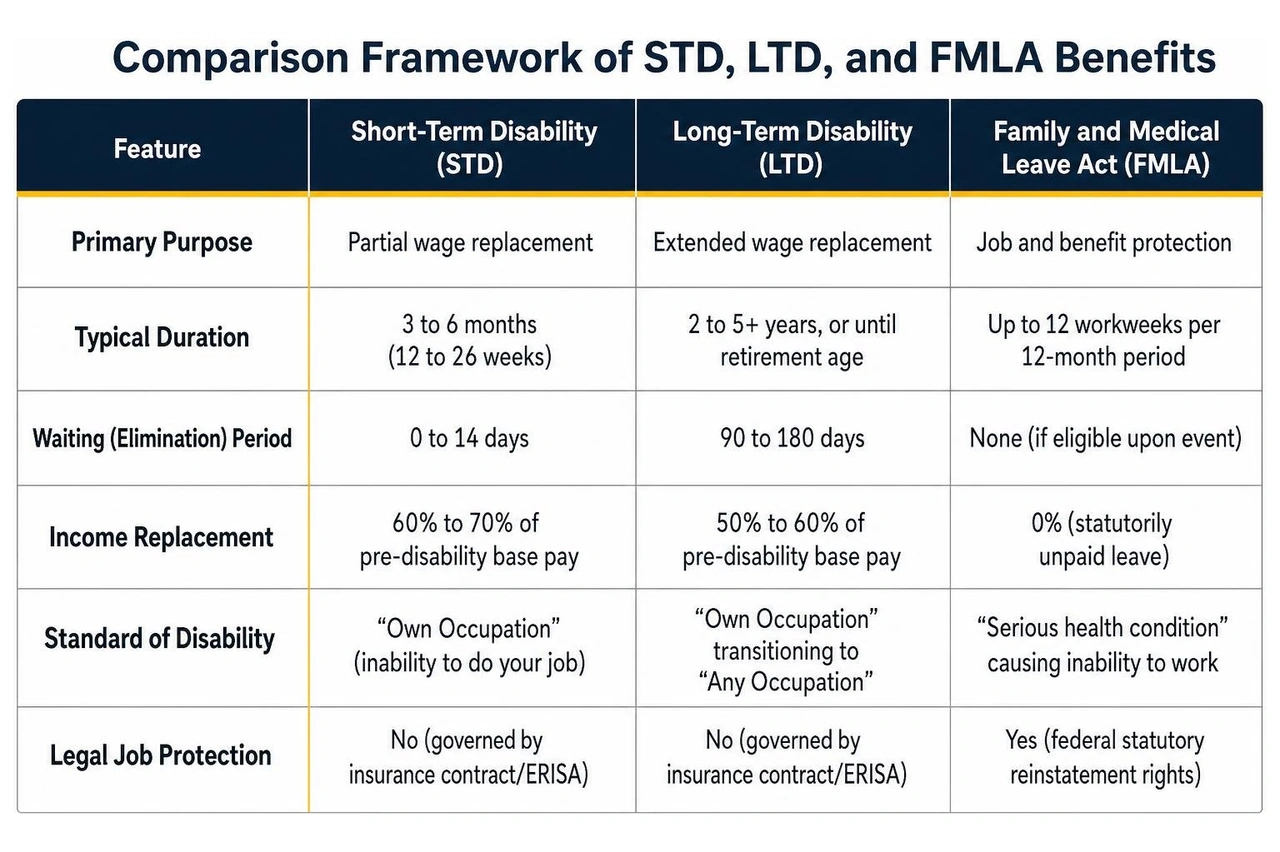
| Feature | Short-Term Disability (STD) | Long-Term Disability (LTD) | Family and Medical Leave Act (FMLA) |
|---|---|---|---|
| Primary Purpose | Partial wage replacement | Extended wage replacement | Job and benefit protection |
| Typical Duration | 3 to 6 months (12 to 26 weeks) | 2 to 5+ years, or until retirement age | Up to 12 workweeks per 12-month period |
| Waiting (Elimination) Period | 0 to 14 days | 90 to 180 days | None (if eligible upon event) |
| Income Replacement | 60% to 70% of pre-disability base pay | 50% to 60% of pre-disability base pay | 0% (statutorily unpaid leave) |
| Standard of Disability | "Own Occupation" (inability to do your job) | "Own Occupation" transitioning to "Any Occupation" | "Serious health condition" causing inability to work |
| Legal Job Protection | No (governed by insurance contract/ERISA) | No (governed by insurance contract/ERISA) | Yes (federal statutory reinstatement rights) |
Under most private and employer-sponsored STD policies, the standard applied is the "own occupation" definition of disability. This means you qualify if your medical symptoms prevent you from performing the material duties of your specific, current position.
However, because STD policies only replace income and do not legally prevent your company from replacing you, consulting an experienced FMLA attorney in Michigan to protect your job and family ensures your leave is simultaneously shielded by statutory job protections.
The Difference Between STD and Long-Term Disability
Short-term disability is designed as a temporary financial bridge. If an acute autoimmune flare incapacitates you, STD generally replaces 60% to 70% of your weekly earnings for up to six months. In contrast, long-term disability is built for catastrophic or protracted illnesses that extend past the 180-day elimination period.
A unique challenge in autoimmune claims is polyautoimmunity—where a person develops multiple overlapping conditions (such as rheumatoid arthritis combined with Hashimoto's thyroiditis or Sjögren's syndrome). When transitioning from STD to LTD, polyautoimmunity often triggers heightened scrutiny from insurers.
While STD claims look at your ability to perform your specific job today, LTD policies frequently change definitions after 24 months, requiring you to prove you cannot perform any occupation suited to your education and background.
Medical Leave vs. Income Replacement: Coordinating FMLA and STD
It is critical to distinguish between statutory medical leave and private wage-replacement plans. The federal Family and Medical Leave Act provides up to 12 weeks of unpaid, job-protected leave for qualifying employees at covered employers (those with 50 or more workers within a 75-mile radius, provided the employee has logged at least 1,250 hours in the previous 12 months).
Because FMLA provides zero dollars on its own, employees often use STD benefits concurrently to replace lost income. You can learn more about how federal rules accommodate unpredictable episodes by reviewing FMLA for autoimmune disease and recurring flare-ups. Coordinating these benefits from day one ensures that while your insurance provider processes your weekly benefit check, your employer cannot legally treat your medical absence as an unexcused attendance violation.
Autoimmune Conditions That Commonly Qualify for Wage-Loss Benefits
Autoimmune diseases occur when the body's immune defenses mistakenly target healthy tissues, causing chronic, systemic inflammation and potential organ failure. While over 100 distinct autoimmune conditions exist, qualifying for disability benefits requires concrete proof of functional loss. Many evaluators cross-reference the SSA 14.00 Immune System Disorders Adult Listing to assess whether symptoms such as severe fatigue, fever, malaise, or involuntary weight loss substantially restrict physical or cognitive tasks.
Connective Tissue and Joint Disorders
- Systemic Lupus Erythematosus (SLE): Lupus can cause profound joint inflammation, pleurisy, photosensitivity, kidney complications (nephritis), and severe constitutional fatigue. Flares can make sitting, typing, or concentrating impossible.
- Rheumatoid Arthritis (RA): Characterized by bilateral joint swelling, stiffness, and severe pain, RA often limits manual dexterity, pinching, gripping, and prolonged standing or walking.
- Systemic Sclerosis (Scleroderma): Causes hardening of the skin and connective tissues, restricting joint mobility, digital blood flow (Raynaud's phenomenon), and respiratory stamina.
- Sjögren’s Syndrome: Primarily targets moisture-producing glands, leading to debilitating dry eyes, severe dry mouth, joint aches, and chronic, systemic exhaustion.
Neurological and Gastrointestinal Conditions
- Multiple Sclerosis (MS): This condition attacks the protective myelin sheath of nerve fibers, causing vision disturbances, severe coordination loss, limb spasticity, and acute cognitive slowing.
- Crohn’s Disease and Ulcerative Colitis (IBD): Severe gastrointestinal inflammation causes persistent abdominal pain, internal bleeding, malnutrition, and unpredictable, urgent bowel movements requiring immediate and frequent restroom access.
How to Build an Unshakeable Disability Claim for Chronic Illness

To win a short-term disability claim, you must translate clinical diagnoses into functional workplace restrictions. Insurance adjusters evaluate claims on what you can and cannot do across an eight-hour workday.
Under both federal law and Michigan's Persons with Disabilities Civil Rights Act (PWDCRA), employers must also consider reasonable adjustments. Reviewing reasonable accommodation rules in Michigan under the ADA and PWDCRA can help clarify your options if a modified schedule or physical adjustment could allow you to work between disability leaves.
Proving Disability with Invisible Symptoms
Insurance companies frequently target subjective, invisible symptoms like chronic fatigue, widespread myalgia, and brain fog, using them as pretexts for claim denials. To substantiate these limitations:
- Maintain a Daily Symptom Journal: Log the time, intensity, and duration of symptoms, noting exact physical limitations (e.g., "Could only sit upright for 20 minutes before lumbar spasms forced me to recline").
- Gather Third-Party Witness Statements: Obtain short, factual statements from coworkers, supervisors, or family members describing visible signs of your impairment (such as observable balance issues, cognitive lapses during conversations, or hand swelling).
- Document Medication Side Effects: Many immunosuppressants, biologics, and high-dose corticosteroids cause severe nausea, insomnia, tremors, or increased infection risk. Make sure your medical records clearly note these adverse effects.
How to Apply for Short-Term Disability Step-by-Step
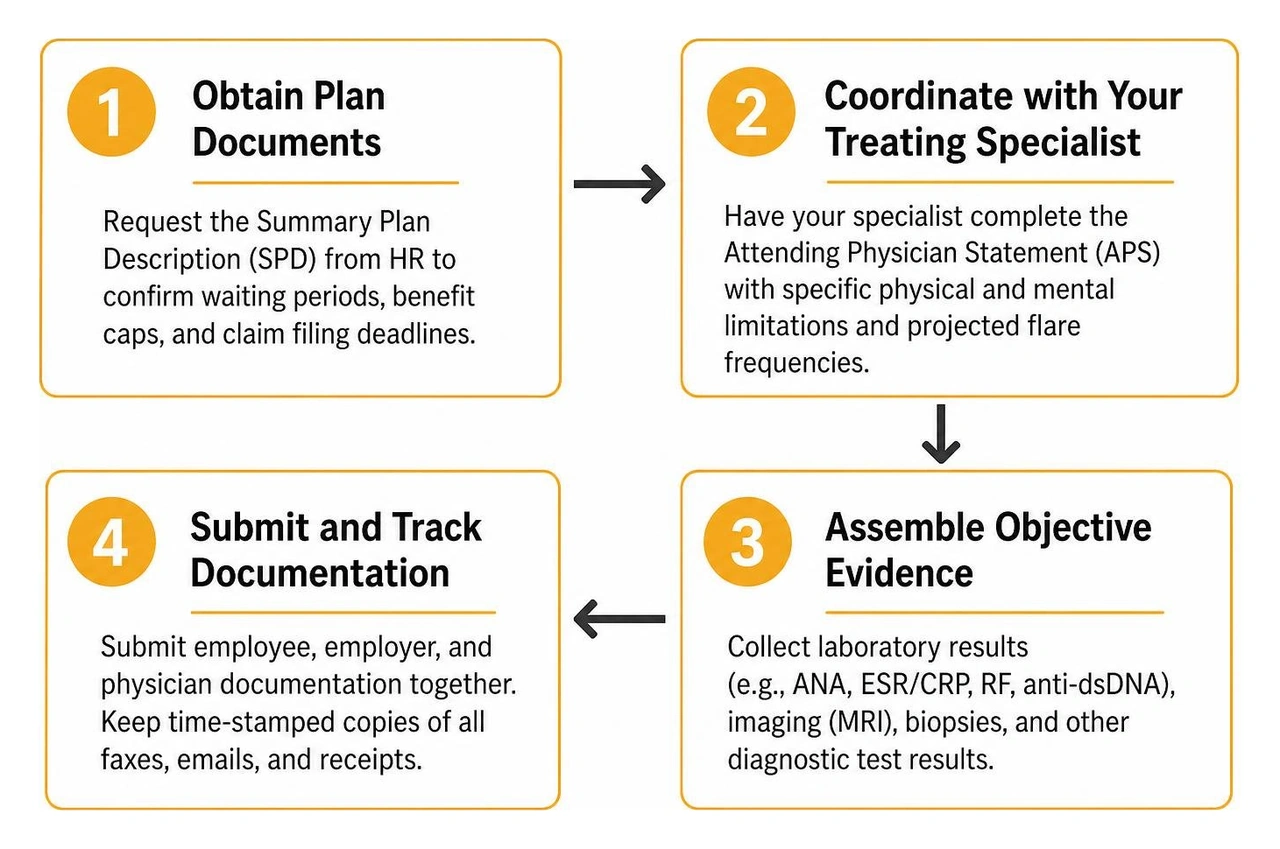
- Obtain Plan Documents: Request the complete Summary Plan Description (SPD) from your HR department to confirm waiting periods, maximum benefit caps, and specific claim filing deadlines.
- Coordinate with Your Treating Specialist: Schedule a dedicated appointment with your rheumatologist, neurologist, or gastroenterologist to complete the Attending Physician Statement (APS). Ensure your doctor details explicit physical and mental limitations (e.g., maximum sitting/standing tolerance, lifting restrictions, and projected flare frequencies).
- Assemble Objective Laboratory and Imaging Evidence: Compile blood panels (e.g., positive ANA, elevated ESR/CRP, rheumatoid factor, anti-dsDNA), MRI scans, colonoscopy biopsies, and electromyography tests.
- Submit and Track Documentation: File the employee statement, employer statement, and physician records simultaneously. Keep time-stamped copies of all faxes, emails, and postal receipts.
Why Insurers Deny Autoimmune Claims and How to Fight Back
Disability claims for autoimmune diseases are frequently denied on the initial application. Insurance companies are profit-driven entities that exploit the intermittent, fluctuating nature of autoimmune disorders to claim you are fully functional based on a single "good day."
Common denial tactics include:
- "Lack of Objective Medical Evidence": Denying claims because blood markers do not cleanly correlate with day-to-day pain or fatigue levels.
- Independent Medical Examinations (IMEs) & Paper Reviews: Hiring third-party physicians who perform a brief, 15-minute physical exam or simply review select records to declare you capable of work.
- Video and Social Media Surveillance: Deploying investigators to film you running a short errand or posting online during a brief period of low symptoms, using it to claim your functional limits are fabricated.
If you suspect your employer or insurer is treating your medical condition unfairly, consult an experienced disability discrimination attorney in Michigan to protect your career and your legal rights.
Navigating Denial Appeals and ERISA Regulations
Most employer-sponsored short-term disability plans are governed by the federal Employee Retirement Income Security Act (ERISA). Under ERISA, you generally have 180 days from the receipt of an adverse benefit determination to file a formal administrative appeal.
The administrative appeal is often your only opportunity to build the evidentiary record. If your appeal is denied and you file a lawsuit in federal court, the judge is generally restricted to reviewing only the documents submitted during the administrative process. Submitting an exhaustive, well-documented appeal package is essential.
What to Do if You Face Employer Retaliation or Termination
Some employers respond to extended or intermittent medical absences with hostility, manufacturing pretextual performance issues to justify termination. Both federal laws (such as the ADA and FMLA) and Michigan's PWDCRA strictly prohibit terminating or penalizing workers for exercising their medical leave rights.
If your employment is suddenly terminated while you are attempting to manage an autoimmune condition, review these critical first steps to take if you are fired after medical leave to safeguard your legal claims and preserve vital evidence.
Frequently Asked Questions About Autoimmune Disability Claims
Can I receive short-term disability and apply for SSDI simultaneously?
Yes. You can apply for Social Security Disability Insurance (SSDI) while receiving short-term disability benefits. Because SSDI has a statutory five-month waiting period and initial processing typically takes three to six months, applying early can help prevent income gaps if your condition becomes permanent.
However, review your STD plan's offset provisions. Most policies contain clauses that reduce your private benefit by any SSDI payments received, and they may require repayment of retroactive SSDI lump-sum awards.
Can my employer fire me while I am receiving short-term disability benefits?
Yes, in certain circumstances. Receiving short-term disability wage replacement does not provide independent job protection. If you work in Michigan under an at-will arrangement and your statutory 12 weeks of FMLA leave have expired, an employer may legally terminate your employment unless you are protected by reasonable accommodation rules under the ADA or PWDCRA.
To understand your legal options if your position is eliminated, explore your rights regarding termination after medical leave in Michigan.
Do I have to be 100% healed before returning to work from disability leave?
No. Employer policies requiring employees to be "100% healed" or "fully recovered without restrictions" before returning to work violate the Americans with Disabilities Act.
When your acute flare improves, your employer must engage in a good-faith interactive process to explore reasonable accommodations—such as modified workstations, ergonomic tools, intermittent rest breaks, or adjusted shift schedules. Learn more about your rights by reading about the myth of being 100% healed when returning to work after leave.
Conclusion
Securing short-term disability benefits for an autoimmune disease requires thorough documentation, detailed medical records, and a clear understanding of your legal rights. Insurance carriers frequently underestimate invisible illnesses, but an organized claim supported by clear functional assessments, detailed symptom logs, and consistent medical care can successfully protect your income.
At Scott Batey Law, we have spent over 25 years advocating for workers across Bingham Farms, Birmingham, Southfield, Troy, Detroit, and throughout Oakland County and Michigan. Whether you are confronting an unjustified disability claim denial, facing workplace retaliation for requesting medical leave, or exploring your options when short-term disability ends after FMLA leave runs out, our firm provides the focused, award-winning representation you need. Contact us today to evaluate your case and protect your workplace rights.