
The Complete Guide to Medical Leave Eligibility
Medical Leave: Who Qualifies and What It Protects
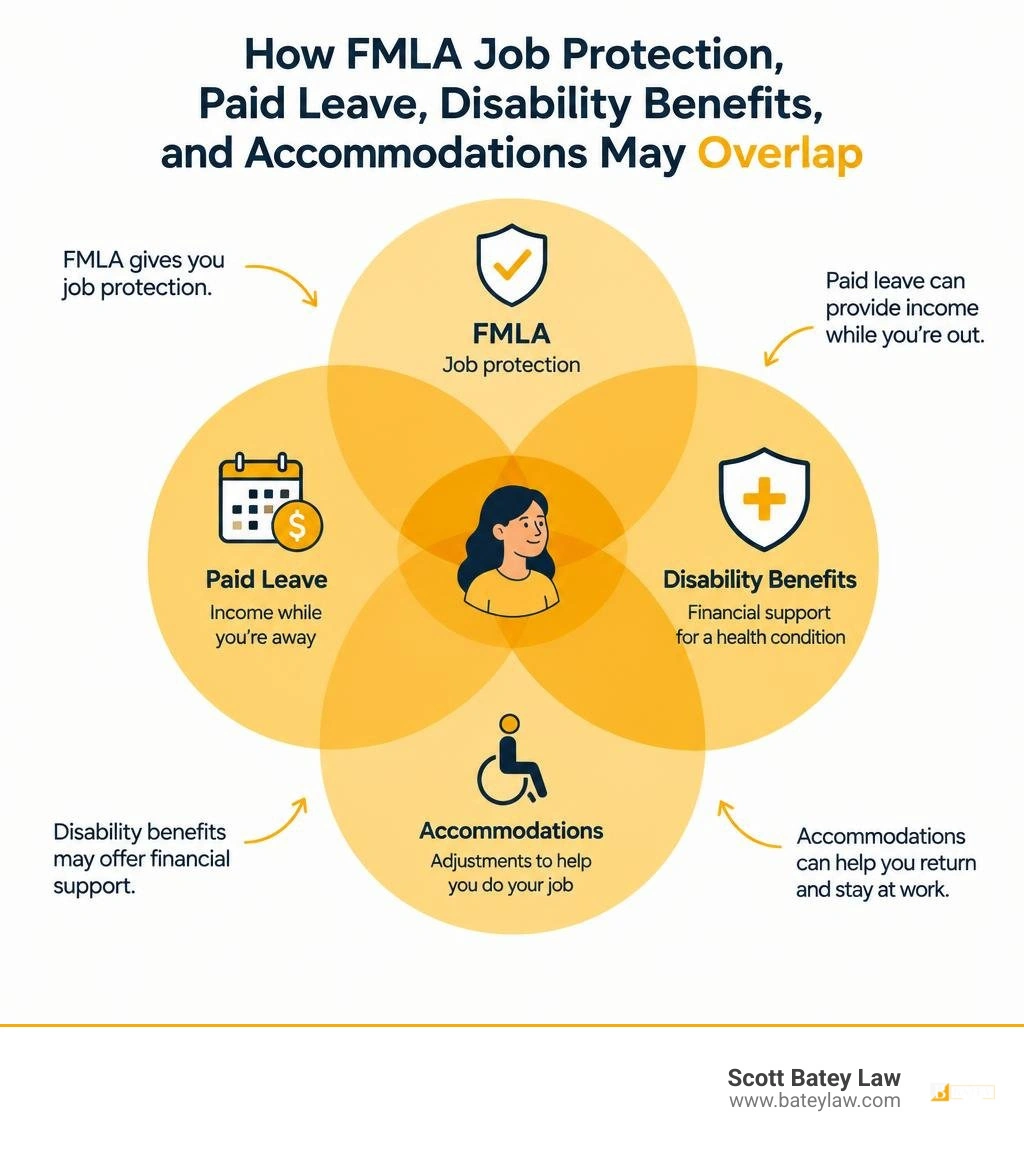
Medical leave is time away from work for an illness, injury, or other health condition. If you qualify for the federal Family and Medical Leave Act (FMLA), you may take up to 12 workweeks of unpaid, job-protected leave in a 12-month period. FMLA does not provide a paycheck, but paid sick time, disability benefits, or an employer policy may provide income while you are away.
Your rights depend on your employer, how long you have worked there, and the reason you need leave. In Michigan, state sick-time rules and disability accommodation laws may also matter. Before requesting leave, check your employer's policy, give notice as soon as you can, and keep copies of your request and any response.
I'm Scott Batey, a Michigan employment lawyer who has represented workers in medical leave and disability accommodation disputes since 1996. I help employees understand their options when leave is denied or their job is at risk.
What Medical Leave Means and How It Differs From Other Leave
Medical leave is a broad term for time off related to an employee's health. It may be governed by federal or state law, an employer policy, an insurance plan, or more than one of these at the same time. It can be a continuous absence, separate blocks of time for treatment, or a reduced work schedule.

| Type of leave or benefit | What it generally provides | Pay and job protection |
|---|---|---|
| Medical leave | A general term for time away for a health-related reason | Depends on the law, policy, or benefit plan that applies |
| Sick leave | Time off for covered health needs, often for shorter absences | May be paid; Michigan's Earned Sick Time Act provides protected sick time to covered employees |
| FMLA leave | Leave for qualifying family and medical reasons | Unpaid, job-protected leave for eligible employees |
| Disability benefits | Wage replacement when a covered condition prevents an employee from working | May replace part of wages; does not by itself guarantee job protection |
| Workers' compensation | Benefits for a work-related injury or illness | May provide wage and medical benefits; separate job protections may apply |
What counts as a medical leave of absence?
A medical leave of absence may be needed for surgery and recovery, a serious illness or injury, ongoing treatment, or a chronic condition that causes flare-ups. Mental health conditions can also require time away for inpatient care, therapy, medication management, or other treatment. Pregnancy-related incapacity and prenatal care may qualify for FMLA leave.
Whether an absence is legally protected depends on the applicable law and the facts. An employer may also offer leave under its own policy even when a particular absence does not qualify for FMLA protection.
How medical leave differs from sick leave, FMLA, and disability leave
Sick leave often covers shorter absences and may be paid from an accrued balance. FMLA is a federal law, not a type of paycheck: it can protect eligible employees' jobs while they take qualifying unpaid leave. Disability benefits are typically wage-replacement benefits under an insurance policy or state program; they do not automatically protect a job.
Workers' compensation is generally relevant when an injury or illness is work-related. These options can overlap. For example, an employee may receive workers' compensation benefits while qualifying time away is also counted as FMLA leave.
Who Qualifies for FMLA Medical Leave?
FMLA eligibility depends on both the employer and the employee. The U.S. Department of Labor's FMLA overview explains the basic eligibility and job-protection rules.

Which employees and employers meet FMLA eligibility requirements?
FMLA generally covers private-sector employers that have at least 50 employees for 20 or more workweeks in the current or previous calendar year. Public agencies and local educational agencies, including public schools, are covered regardless of their number of employees.
To be eligible, an employee generally must:
- Have worked for the employer for at least 12 months. Those months do not always need to be consecutive.
- Have worked at least 1,250 hours for the employer during the 12 months before leave begins.
- Work at a location where the employer has at least 50 employees within 75 miles.
Special rules apply to some workers, including airline flight crew and certain instructional employees. USERRA also requires employers to credit qualifying service time that an employee would have worked but for military service when determining FMLA eligibility.
What qualifies as a serious health condition under the FMLA?
A serious health condition generally involves inpatient care or continuing treatment by a health care provider. Inpatient care usually means an overnight stay in a hospital, hospice, or residential medical care facility. Continuing treatment can include a period of incapacity lasting more than three consecutive full calendar days, with qualifying treatment, or a chronic condition requiring periodic care.
Other qualifying situations can include pregnancy-related incapacity, long-term conditions under a provider's supervision, and conditions that require multiple treatments. Mental and physical health conditions can both qualify. The Department of Labor's serious health condition criteria explain the categories and examples.
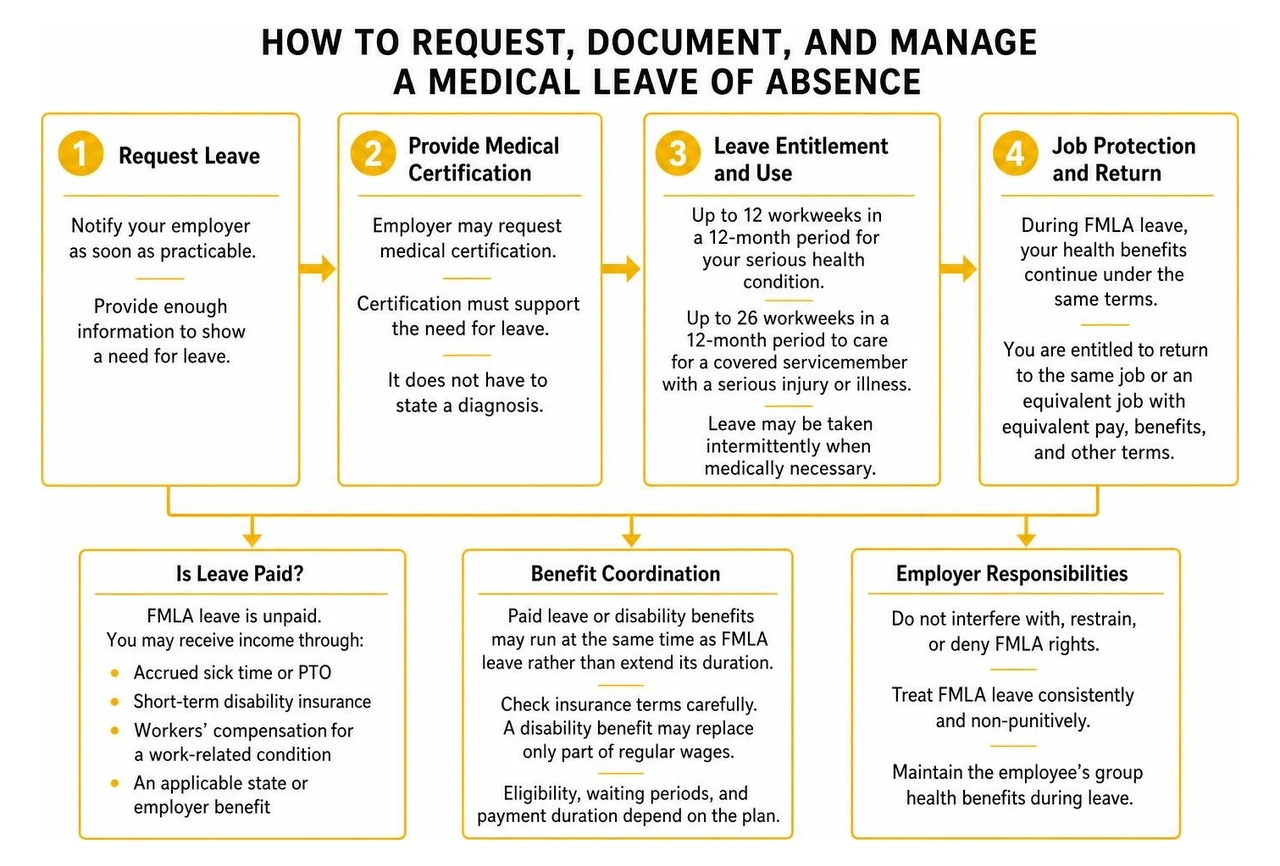
An employer may request medical certification from a health care provider. The certification generally needs to support the need for leave, but it does not have to state a medical diagnosis.
How long can medical leave last, and can it be intermittent?
Eligible employees can generally take up to 12 workweeks of FMLA leave during the employer's chosen 12-month period for their own serious health condition or certain family and parental reasons. Eligible employees may also take up to 26 workweeks in a single 12-month period to care for a covered servicemember with a serious injury or illness. Qualifying military exigencies may also be covered.
When medically necessary, FMLA leave may be taken intermittently, such as for recurring appointments or flare-ups, or as a reduced schedule. Only the time actually taken counts against the employee's entitlement. Intermittent leave for birth or placement of a child generally requires the employer's agreement.
Pay, Medical Leave Requests, and Employer Responsibilities
Is medical leave paid, and what income options may be available?
FMLA leave is unpaid. However, an employee may receive income through accrued sick time or PTO, short-term disability insurance, workers' compensation for a work-related condition, or an applicable state or employer benefit. Depending on the circumstances and governing rules, paid leave or disability benefits may run at the same time as FMLA leave rather than extending its duration.
Check the terms of any insurance plan carefully. A disability benefit may replace only part of regular wages, and eligibility, waiting periods, and payment duration depend on the plan. Receiving benefits does not necessarily mean the job is protected.
How to request medical leave from an employer
If leave is foreseeable, such as for planned surgery, give at least 30 days' notice when practical. If that is not possible, notify your employer as soon as you can. For an unexpected emergency, follow the employer's usual call-in procedures as soon as circumstances allow.
A written request to HR or the designated leave administrator can help create a clear record. Include the expected start date, whether you anticipate continuous or intermittent leave, and an estimated return date if known. You do not need to use the words “FMLA,” but you should share enough information for the employer to understand that the absence may qualify.
If the employer requests medical certification, employees generally have at least 15 calendar days to provide it, unless it is not practicable despite diligent, good-faith efforts. Follow up promptly if your provider needs more time. Our guide to FMLA paperwork and certification requirements covers common documentation issues.
What employees and employers must do during leave
Employees should keep following applicable call-in rules, provide required certification, and update the employer if the expected leave dates change. If an employer requests recertification where permitted, respond by the stated deadline.
Employers must provide required FMLA eligibility and rights notices, designate qualifying leave, track time accurately, and maintain required health coverage during FMLA leave. Medical records and certifications must be kept confidential and separate from ordinary personnel files, with access limited as appropriate.
During FMLA leave, employees generally remain responsible for their share of health-plan premiums. Employers should explain how and when those payments are due, especially when payroll deductions stop. Employers also may not obstruct an employee's FMLA rights or punish the employee for using protected leave. Learn about the distinction between FMLA interference and retaliation.
Job Protection, Return to Work, and State Leave Laws
Can an employee be terminated while on medical leave?
FMLA generally protects an eligible employee's right to return to the same job or an equivalent one, with equivalent pay, benefits, and working conditions. It also prohibits employers from interfering with FMLA rights or retaliating against an employee for exercising them.
That protection is not absolute immunity from every employment decision. An employer may still take action for a legitimate reason unrelated to the leave, such as a position elimination that would have occurred regardless. But an employer cannot use leave as a reason to penalize an employee or disguise discrimination or retaliation. Our overview of medical-leave termination rights in Michigan explains warning signs to consider.
What happens when an employee is ready to return?
Tell the employer your expected return date and ask whether it requires a fitness-for-duty certification. An employer may require one under a uniformly applied policy, subject to FMLA rules. If the employee can return with restrictions, provide accurate information about those restrictions and discuss whether they affect essential job duties.
The Americans with Disabilities Act may require an employer to consider a reasonable accommodation for a qualified employee with a disability, unless doing so would create an undue hardship. An accommodation might include a schedule adjustment or another change that enables the employee to perform essential functions. FMLA itself does not require an employee to be completely symptom-free before returning. Read more about returning to work without being “100% healed”.
How state laws and company policies affect medical leave
Michigan's Earned Sick Time Act (ESTA) provides paid sick time to covered employees for specified reasons, with accrual and use rules that depend in part on employer size and the law's requirements. ESTA is separate from FMLA: it does not turn every medical absence into a 12-week FMLA leave, and FMLA does not provide paid time by itself. See our guide to Michigan earned sick time rights.
Company handbooks, collective bargaining agreements, and benefit plans may provide additional leave or pay. Review their terms and ask HR how they interact with legal protections. The following comparison includes New York programs for contrast; those programs do not create benefits for Michigan employees.
| Program | Main purpose | Pay and job protection |
|---|---|---|
| FMLA | Qualifying family and medical reasons | Up to 12 weeks of unpaid, job-protected leave for eligible employees |
| Michigan ESTA | Specified health, safety, and family needs | Paid sick time under Michigan's accrual, use, and coverage rules; retaliation is prohibited |
| New York Paid Family Leave | Care for a family member, bonding, or certain military-family needs | Partially paid leave for eligible New York workers; generally does not cover the employee's own medical condition |
| New York Disability Benefits | An employee's own qualifying non-work-related illness or injury | Partial wage replacement under New York rules; distinct from job-protection laws |
Conclusion
Before taking leave, check whether your employer is covered by FMLA, whether you meet the service and hours requirements, and whether your condition or caregiving need qualifies. Review your employer's leave and benefits policies, provide notice as soon as practical, and save copies of requests, certifications, notices, and responses.
If your leave is denied, you are disciplined for using protected leave, or your employer refuses to consider a return-to-work accommodation, the details matter. At Scott Batey Law, we represent workers in Bingham Farms, Birmingham, Southfield, and nearby Michigan communities in employment matters involving wrongful termination, discrimination, and retaliation. Our firm offers award-winning, personalized representation backed by more than 25 years of experience. These red flags after medical leave can help you identify when to take a closer look at what happened.